
IT WAS BITTERLY COLD AND WINDY IN WASHINGTON, D.C., ON MONDAY, JAN. 20, the day of President Donald J. Trump’s second inauguration. The new administration blamed the weather for moving the ceremony inside the Capitol Rotunda, where a few hundred people gathered to watch Trump take the oath of office. Included among the attendees were the four living former presidents and former vice president Kamala Harris, who lost to Trump, as has been the tradition throughout U.S. history.
Also in attendance were some of the titans of the tech world and industry. Photographers snapped photos of four of the wealthiest CEOs standing in a line under the rotunda: Mark Zuckerberg of Facebook, Jeff Bezos of Amazon, Google CEO Sundar Pichai and Tesla’s Elon Musk. Also in attendance were TikTok CEO Shou Zi Chew, Apple’s CEO Tim Cook and several others.
The sight of these wealthy men at the inauguration was a turning point for Pacific Grove resident Betsy Buchalter Adler. The retired philanthropy attorney made a conscious decision to change how she spends her money as a way to send a message to the corporations owned by some of the richest people in the world who don’t represent her values.
“What really provoked me to look at my spending – beyond my belief that local spending is the right thing to do – was seeing the CEOs all bending the knee,” Adler says, referring to the symbol of pledging allegiance to a leader. “And I thought, why am I giving them my money?”
Adler decided to not renew her subscription to the Washington Post, owned by Bezos, and stopped buying books from Audible, another Bezos company.
“I’m basically trying to put my money where my mouth is and stop buying from anything owned by Jeff Bezos,” she says. “I don’t want to give him my money. It’s not a hell of a lot of money, but I don’t want to give him my money.”
This is not virtue signaling, she says: “I just want to live up to my values. I have choices.”
Adler’s not the only one who feels that way. A Harris poll released in February showed that 4 out of 10 Americans said they are shifting their spending habits to align with their political and moral views. Of those polled, 31 percent said they had no interest in supporting the economy in 2025. A quarter of respondents said they had stopped shopping at their favorite stores due to their beliefs.
On Feb. 28, the People’s Union USA organized a 24-hour economic blackout, followed by a schedule of boycotts of different companies through the spring, including Amazon, Target, Walmart, Nestle and others. Another 24-hour blackout took place Easter weekend, April 18-20, and more are scheduled.
The impact on companies thus far has been mixed, although a boycott of Target led by U.S. Black churches, prompted by the company’s announcement it was eliminating diversity, equity and inclusion policies after Trump was elected, has apparently made a serious dent in Target’s business.
The chilly Inauguration Day has transformed into a chill on spending for many who feel like controlling their spending is the only power they have to protest what they see as unfair and even immoral policies and actions.
Adler and others in Monterey County are joining millions across the country in this charge. For Adler, that means shopping at local businesses as much as possible, but she also added a new mega-chain to the rotation to replace Amazon.
“I joined Costco,” she says, noting the company announced it would not back down on its DEI policies. “Costco didn’t bend the knee.”

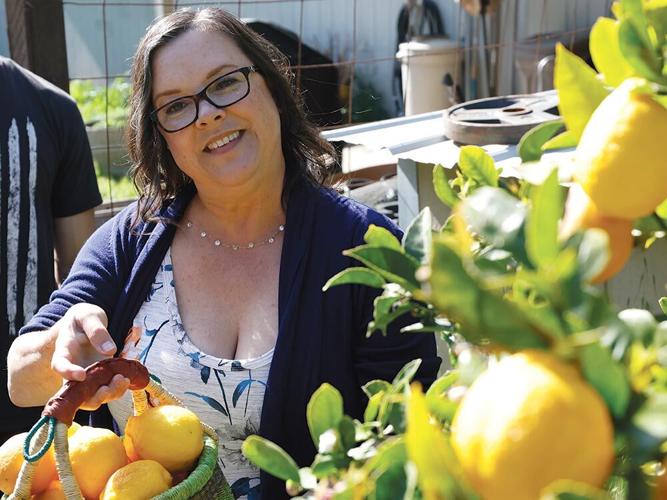
Monica Glatzel Williams shows off lemons from her tree in Prunedale. She and her family have changed their spending habits to avoid supporting corporations and prioritize local businesses. She often offers and finds items on the Prunedale Facebook Buy Nothing group.
MONICA GLATZEL WILLIAMS of Prunedale was never a big Amazon shopper, but her teenage children were regular customers.
“I put the kibosh on that,” Williams says. She told them they would have to shop elsewhere, in hopes it would be a lesson about spending money with morals in mind they will carry throughout their lives. Her husband canceled their automatic annual renewal of Amazon Prime.
“One of the most powerful things is voting with our dollars,” she says. “It seems like the only thing people pay attention to.”
Williams’ feelings about her family’s spending habits began to change right around the time Trump was elected to a second term in November, when she also read the book The Year of Less by Cait Flanders and she watched the Netflix documentary Buy Now: The Shopping Conspiracy.
The book and the documentary caused her to rethink how they spend their money, and how they can do with less, or find alternative ways to acquire the things they need. One way they’re doing this is by using the Prunedale Buy Nothing Facebook group, where people can post items they are giving away for free. Williams recently found a rice cooker through the group – which she acknowledges is an imperfect platform given that it is owned by Meta, the company Zuckerberg leads.
Choosing where to spend her money is not new for Williams. She’s proud to say she’s never shopped at businesses like Hobby Lobby and Chick-Fil-A, both owned by companies with leaders who espouse right-wing values, and only once bought something from Walmart when she couldn’t find what she was looking for anywhere else.
“If I know a company’s stance on pushing their religious views on employees, I will avoid them. If I know they underpay or don’t offer benefits to full-time employees but they make millions, I will avoid them,” Williams says.
“Likewise, if they promote equality and fair wages and offer employees flexibility and healthcare I will shop there more often,” she says.
In recent weeks, as Trump’s back-and-forth announcements on tariffs have been a blow to the economy, she says she’s nervous for what’s ahead, which makes saving money all the more important. Williams, a massage therapist, knows that if people have less disposable income, that will mean fewer clients and less income for her and her family.
“We’re definitely not spending the amount of money that we would have without thinking about it,” she says.
“I don’t mind spending on services that impact people more than corporations, and trying to find small businesses, rather than the bigger, more convenient big box [stores],” she adds. “It makes me feel better, supporting my community.”
Like Adler, Cheryl “Rebelle” Robinson says Costco is one chain store she and her family can support. Beyond that, they are buckling down, saving as much money as they can by spending less, including eating out.

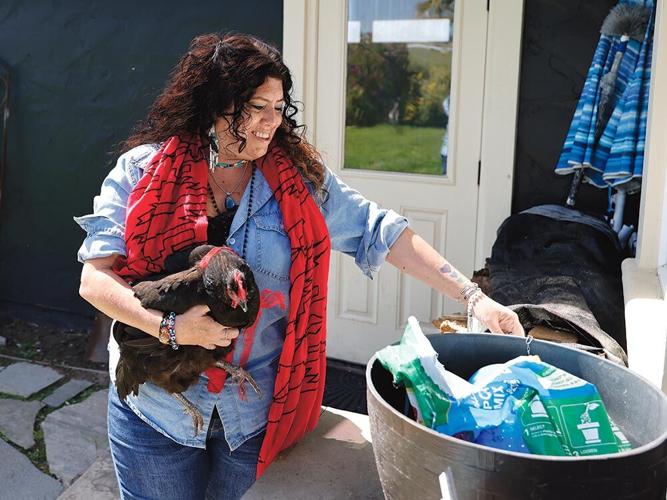
Above: Cheryl “Rebelle” Robinson, who lives near Elkhorn Slough, carries one of her chickens as she retrieves some chicken feed. She and her family have cut back on spending and are relying on using what they have. It’s one way she feels less powerless: “The corporations have gotten so big it’s not fair anymore.”
“It’s not like I can’t afford to spend the money, but based on principle alone, I won’t do it,” she says.
Robinson, a native Californian and third-generation descendant of an immigrant family, says she’s always lived by the motto of being prepared in case of an earthquake or other calamity. Living near Elkhorn Slough, her family has the ability to raise their own chickens for eggs. She shops at farmers markets for vegetables. She has a lot of flour in her pantry so for now, she can make her own bread.
Cutting back on spending at big corporations, are important ways all people can make their views known, especially those who can’t make it out to a protest, she believes.
“It’s a creative way to give everybody a chance to feel like they’re doing their part,” Robinson says.
ERIM FOSTER IS STANDING IN FRONT OF THE TESLA DEALERSHIP in Seaside on March 29, taking stock of the long lines of protesters on either side of the street, as they wave signs and shout: “Hey, hey, ho, ho, Elon Musk has got to go!” Numerous car and truck drivers honk their horns in support, as passing drivers and passengers gave a thumbs up.
This was the fifth Tesla protest Foster organized – he has been leading the protests weekly since March 1. The first protest brought around 25 participants. The event on March 29 was the largest group yet, in part thanks to it being part of a global day of protest organized by a group called Tesla Takedown. Over 250 protests took place across the globe, with untold thousands of people participating.
In Seaside, more than 200 people were gathered a little after 1pm, the midpoint of the day’s event. Tesla salespeople peered from out the dealership windows, watching the two-hour spectacle. Foster says there hadn’t been any issues between the workers and protesters up to that point. (Tesla officials did not respond to a request for comment.)
Another 20 counterprotesters had placed themselves right in front of the dealership. They carried a large “Trump 2024” flag, U.S. flags and signs. One read, “We love Elon.” A couple of the counterprotesters attempted to rile anti-Trump/Musk protesters with shouts in favor of Trump’s policies and the actions of Musk’s Department of Government Efficiency, or DOGE.
For the most part the Tesla Takedown participants ignored them, especially with a crowd that outnumbered the Trump/Musk supporters 10-to-1.
“Bad Dogey,” read one protester’s sign. Other signs said “Musk & DOGE must go!” and “Stop the Coup!”
One man made a cut-out of a Tesla Cybertruck, covered it in aluminum foil, and decorated it with a red downward line, representing Tesla’s stock value, which declined by 45 percent between the beginning of the year and the end of March.
The man’s creative poster got to the heart of what Tesla Takedown is all about.
“It’s not about Tesla. It’s about Elon Musk and trying to hit the share price,” Foster says of the protests.
He’s attended protests in the past, but this is the first time he has organized one. Foster says he’ll be returning every Saturday from noon to 2pm, week after week, for as long as it takes to diminish Musk’s wealth and power.
“This is go time for democracy,” he told the Weekly in early March. “Considering the fecklessness of the Democratic Party, it’s up to us. The grown-ups aren’t coming to save us.”
As of April 21, Tesla stock was down over 40 percent since the start of the year. Tesla’s sales fell by 13 percent in the first three months of the year, 15 percent in California. Other carmakers saw increases in the sales of electric vehicles in the same period.
Statistician Nate Silver, writing in his newsletter Silver Bullet, reported on April 11 that Musk’s favorability rating in a new poll had fallen even further than in earlier polls. The new numbers showed 53 percent of Americans had an unfavorable opinion of Musk, with 40 percent having a favorable opinion. In October 2024 his numbers, unfavorable versus favorable, were nearly even, at just over 40 percent each. They took a sharp turn immediately after the presidential inauguration.
A little over a week before the new poll numbers, Politico reported that Trump told his inner circle that Musk would be leaving DOGE “soon.” (By law, he has to leave by the end of May or early June as a “special government employee.”)
It was apparent that Musk had become a political liability to Trump.
THE “BLACK WALL STREET TICKER” is the first thing one notices about the homepage of targetfast.org. The black scrolling banner lists companies under boycott – denoted by a red dot by each company’s name – as well as those groups are “buycotting,” the companies to support, marked with a green dot.

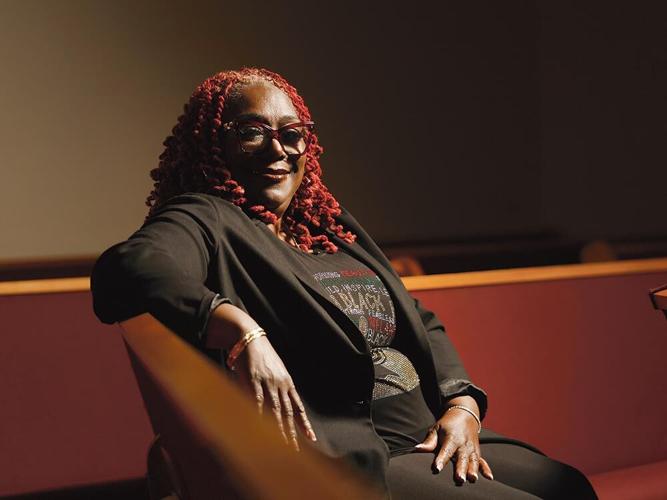
Rosalyn Green is a founder of Monterey County Black Caucus, which is promoting the Target Fast, a 40-day boycott of the company after it announced it was eliminating its DEI programs and ending investments in Black-owned businesses. It extends to other companies. “Target is just the start,” Green says.
“Vote with your wallet,” the ticker states.
Top of the boycott list is Target, which four days after Trump’s inauguration announced it was ending its DEI programs, reportedly due to pressure from conservative groups and Trump’s threats of investigations into supposedly “illegal” DEI programs. In addition, Target announced it was ending its Racial Equity Action and Change program that promised to invest $2 billion in Black-owned businesses in 2025.
The response from Black organizations was swift, urging the public to boycott Target. Pastor Jamal Bryant, senior pastor of New Birth Missionary Baptist Church in Stonecrest, Georgia, called for a Target fast over the 40 days of Lent, March 5-April 17, leveraging the practice of fasting that some Christians follow during Lent. Bryant called it a “spiritual act of resistance.”
The fast took hold at churches across the country, with organizers announcing that over 150,000 people had pledged their support.
In interviews, Bryant said he called for the fast for several reasons: Target is headquartered in Minneapolis where George Floyd was killed; Black consumers spend $12 million a day at Target; the company is on 20,000 college campuses but not one HBCU (historically black colleges and universities); Target is the largest employer of Black people, outside of the federal government.
Members of the Monterey County Black Caucus and several Black churches in the county are participating in the fast, says Rosalyn Green, one of the founders of the caucus.
“This is a Target fast, it’s not a forever boycott. It is a spiritual fast, but it is a strategic fast,” Green says. “It’s not that we don’t love Target, it’s that Target needs to love us back.”
Black people’s spending power is around $1.6 trillion – “That’s trillion with a T,” Green says for emphasis – and corporations should be mindful of their contribution.
“We’re cultural and economic drivers. Why are we pouring dollars into systems that don’t pour back into us?” she says. (Target officials did not respond to requests for comment.)
The Caucus has pushed out information to all of its members, local Black churches and other nonprofit partners about the Target fast. They are also encouraging people to shop at Black-owned businesses, as well as other local businesses.
“We spend with intention and not convenience, even if it’s not necessarily Black owned. We are definitely leaning into our ma-and-pop shops, the local places,” Green says.
On April 11, Target’s stock price hit its lowest point in four years – $88.76 a share on April 6, compared to a high of $266.38 a share in 2021 – and its weekly foot traffic numbers had also continued to decline.
“It’s not just resistance. It’s redirection, it’s restoration, it’s economic restoration – and it’s long overdue,” Green says.
On Easter Sunday, April 20, Bryant told his church that the fast was now a boycott. He said he met with Target CEO Brian Cornell during the fast, resulting in Cornell pledging to invest $2 billion in Black-owned businesses by July 31. But other demands remain unmet.
“We gave you 40 days to answer four [demands], not one,” Bryant said. “We ain’t going back in there.”
THE TARGET BOYCOTT officially ended April 17, but the People’s Union USA extended its own economic blackout through Easter weekend.
“It is a holiday weekend and that’s the moment we strike, not with violence, not with chaos, but with silence, with resistance and with our power,” John Schwartz, the group’s leader, said on social media on April 4. He said it was a message to “every corporation engaged in price gouging” and profiting “while families suffer.”
“We are done, no shopping, no fast food orders, no unnecessary spending,” he said.
The group’s first blackout on Feb. 28 “grabbed the attention of the entire world,” Schwartz said. “Millions stood in solidarity. People came together, and for the first time in a long time they realized that we are the economy.”
It’s unclear exactly how much these boycotts organized by the People’s Union are impacting sales at the companies in question. Forbes reported that Amazon’s sales actually increased by 6 percent during a weeklong boycott that took place March 7-14. The boycotts of Target and Tesla by other groups appear to have had more impact.
Robinson, from her home in Elkhorn Slough, shares Schwartz’s sentiment, that corporations have forgotten the people, and that people have the power to speak, if only through money.
“I think a lot of people feel this way, as though our voices are not important,” Robinson says. It’s made people seek other ways to protest, “to say yes we do have some kind of power… Is it working? I don’t know, but it makes you feel less helpless,” she says.
In Pacific Grove, Adler says it’s the legacy of her Jewish grandparents who fled antisemitism in Europe before World War I that has her committed to her decision to boycott Amazon.
“I come from people who did their best to do right, and I owe it to them to think carefully and thoughtfully about the consequences of what I do and how I spend my money,” Adler says.
“I’m 76 years old; there’s a limit to what I can personally do in terms of physically standing up,” she says. “I am not a person of power, but at least I can do what’s in front of me.”
(0) comments
Welcome to the discussion.
Log In
Keep it Clean. Please avoid obscene, vulgar, lewd, racist or sexually-oriented language.
PLEASE TURN OFF YOUR CAPS LOCK.
Don't Threaten. Threats of harming another person will not be tolerated.
Be Truthful. Don't knowingly lie about anyone or anything.
Be Nice. No racism, sexism or any sort of -ism that is degrading to another person.
Be Proactive. Use the 'Report' link on each comment to let us know of abusive posts.
Share with Us. We'd love to hear eyewitness accounts, the history behind an article.