



AMY ALLEN HAS SEEN THE EDUCATIONAL FILMS THAT ARE MEANT TO HELP GIVE YOUNG PEOPLE A SCRIPT TO FOLLOW IN DIFFICULT SITUATIONS. Even so, real life is more complicated. It was during her sophomore year at Carmel High School, and she was casually dating a freshman boy. They were hanging out at his house one night in the spring of 2022 when he asked her if he could record a video of her performing oral sex on him.
“I knew it was wrong,” Allen says. “When you read books and watch movies they say, ‘Say no, when they ask.’ It’s different to be in the situation – I trust this person – it’s exactly like the videos say, but you don’t realize until it’s too late.”
The next day, she asked him to delete the video, she says. He told her he would. But it quickly became evident to Allen that not only did he not delete it, he shared it around. Other students copied the video. People jeered at her. After they broke up, the boy taunted her with sexual comments and threw objects at her, like fruit from the cafeteria. Allen, now a senior nearing graduation, endured his behavior for roughly 10 months, from the end of her sophomore year through the first half of her junior year.
The administration at Carmel High School knew what was happening to Allen. And over those 10 months, the boy’s behavior would grow more aggressive. He continued to leverage the video. In January of 2023, for example, he made slut-shaming, sexual comments to Allen on the school bus home to Carmel Valley, and threatened to release the video again.

Carmel High School senior Amy Allen (pictured in shadow, below) suffered emotionally and academically after a sextape was released against her will her sophomore year. “It’s been long enough that I am not so weighed down by it anymore,” she says.
By then, he had also victimized at least one other girl. In this case, it was not a consensual video – he allegedly held a knife to her neck trying to force her to kiss him.
Not only did administrators not intervene when the unwelcome sex tape first emerged – they instructed Allen and her family to keep it quiet, so they did, Allen and her family say.
Finally, when Allen couldn’t bear the harassment, she reported it. This time, action was swift. Not only was the aggressor removed from shared spaces in the school, he faced felony charges in juvenile court. (Although the boy’s name is public in related court records, the Weekly is not publishing his name because juvenile court proceedings are confidential.)
It was not the first time that a story like this would play out at Carmel High School – that consensually obtained videos or photos of girls nude or performing sexual acts would be shared without their permission. It was not the first time girls whose images were shared would say they were treated by school administrators not as victims but as perpetrators. But it was the first time the Carmel Unified School District superintendent made big public proclamations about misconduct. Those proclamations are what led the board of education to force the superintendent out, and the fallout has continued to shake CUSD.
Since the 2022-23 school year, two principals, two assistant principals and a superintendent are gone; a former school board president resigned; and now a former assistant principal faces misdemeanor charges for failure to report suspected child abuse.
“This is a very rare charge that we don’t frequently file,” Assistant District Attorney Lana Nassoura says. “This is an unusual circumstance where we felt that the failure was so egregious that it necessitated a filing.”
It is unusual for the Monterey County District Attorney, but for many members of the Carmel Unified School District community, it is business as usual. Students, parents and former administrators interviewed for this story describe a culture of silence at the expense of student safety. And when top staff, including former superintendent Ted Knight, tried to change that culture, they ran into barriers.
“Carmel Unified has, unfortunately, been plagued with a longstanding systemic issue of failure in both the reporting and investigation of employee, student and community complaints involving sexual harassment,” Knight wrote in a letter to the CUSD community on Feb. 7, 2023, amid the investigation at CHS. “When I was interviewing for this position two years ago, one of the concerns raised was the culture of silence and lack of seriousness and follow through, in reference to district staff and student concerns.”
A month-and-a-half later, on March 31, the board placed Knight on leave. He would never return to the district.
KNIGHT WAS NOT THE FIRST CUSD SUPERINTENDENT to be released before his contract ended. In the nine years since Marvin Biasotti retired in 2015, following a 15-year tenure as superintendent, there have been six other leaders.
Scott Laurence was recruited from Palo Alto in a national search and began the job in July 2015. He went on medical leave just five months later, and was paid $100,000 when he resigned in June 2016. Karen Hendricks served as interim superintendent until June 2017, when Barb Dill-Varga was recruited from the Chicago area (and received over $21,000 in moving expenses from CUSD). She agreed to resign in 2020, two years before her contract ended. In exchange, she was paid a year’s salary ($262,500) plus health insurance, and agreed to drop any claims against CUSD. (She is now the superintendent of Aromas-San Juan Unified School District in San Benito County.)
Some former board members who’d helped hire Dill-Varga advocated in 2020 that the board rethink forcing her out, especially in a pandemic. “What the district needs most right now is continuity of strong leadership,” Mark Stilwell, Rita Patel and John Ellison wrote.
“In hindsight, Barb’s most significant ‘weakness,’ which some, ourselves included, would not consider a real weakness, is that she’s not a great ‘politician.’ She’s always been far too honest and direct to play games or make decisions based on political favor. Maybe that’s what has led the district to this point.”
Trish Dellis served as interim superintendent after Dill-Varga’s resignation, then Ted Knight was recruited from Colorado to start in 2021. He held the role until he was placed on leave on April 3, 2023, and he resigned four months later, on Aug. 11, a little over a year before his contract was set to end.
Former deputy superintendent Sharon Ofek, whom Knight had hired, became interim superintendent after his departure, and on Jan. 24, 2024 the board voted 4-1 to appoint her as superintendent – the district’s seventh since 2015.
Knight received a separation payment of $770,000 – equivalent to two years’ worth of salary and benefits – and agreed to drop all claims against the district. Those included complaints lodged with the California Civil Rights Department and Equal Employment Opportunity Commission against the district, as well as a civil lawsuit seeking public records in Monterey County Superior Court.
That has not stopped other parties from filing claims. Christine Davi, a parent of a CHS student (who also works as city attorney for the City of Monterey) raised questions about the legality of Knight’s separation package. On Sept. 28, 2023 she sued CUSD, seeking to invalidate the board’s approval of the resignation agreement. Davi claims that the $770,000 payment exceeds by $500,000 the amount allowed under California government code, which caps payments upon contract termination for a school superintendent at a year’s worth of pay. CUSD is asking a judge to dismiss the suit.

The CUSD board of education usually meets in the Carmel Middle School library. From left to right: Karl Pallastrini, Anne-Marie Rosen, Sara Hinds, Seaberry Nachbar, Jason Remynse and Superintendent Sharon Ofek.
AFTER KNIGHT’S RESIGNATION ON AUG. 11, the board was eager to move on. They said as much when they met the next week for the first board meeting of the 2023-24 school year.
“Let’s right the ship, correct our problems and move on,” said Jason Remynse.
“I acknowledge there is more healing to be done and trust to be earned,” said Seaberry Nachbar. “Today I look towards the future and I ask my community that you do the same.”
But members of the community were not ready to do the same. Instead, many of them wanted an explanation.
Some were happy to see Knight go – he’d been a polarizing figure during the pandemic, generating many enemies who opposed mask mandates and the like – and some were not. But both fans and foes were confused.
“I feel like Erin Brokovich trying to figure out what’s going on with this school district,” said Bobby Pfeiffer, a Carmel Valley mom of two students. “Nobody can tell me a straight answer.”
For months, it was hard to get a straight answer, or any answer at all.
Along with Knight’s departure, CUSD’s communications officer resigned in April 2023. Although details about matters of personnel and student discipline are confidential, little context was offered.
When former CHS principal Jon Lyons was placed on leave in December of 2022, the CUSD administration began to go silent. Interviews with the local press stopped, replaced by written statements only. Students at Carmel High School’s newspaper, The Sandpiper, could not get responses from administrators or the board for over a year, until board members agreed to be interviewed in spring 2024. The Weekly repeatedly requested interviews with members of the board and administration, but none were granted until March 2024. Sara Hinds, the board president for much of 2023, said board communications were to go through her, and that she would speak only about “positive things.” That policy has changed since Jason Remynse became president in December. (This story is based on interviews with current and former students, parents, employees and board members, as well as documents gathered over a one-year period.)
During the long silence, many questions and sometimes conspiracy theories emerged. Members of the community appeared again and again at board meetings to air grievances during the public comment period.
“There is still stuff going on that needs to be addressed, and we aren’t addressing it,” said Ann Berry, the former CHS attendance secretary who retired in 2023 after 44 years with CUSD, during a Sept. 13 board meeting. “I want to know why Ted Knight was released. Why Ted Knight isn’t here, why he was paid off $770,000 in taxpayers’ money, I want an explanation.”
A PARTIAL EXPLANATION WAS PROVIDED ON APRIL 18, 2023 a couple of weeks after Knight was placed on leave, by Gregory Rolen, an attorney who was representing Knight. In a letter to members of the CUSD board, Rolen wrote: “The Carmel Unified School District has long had a reputation of as a den of sexual harassment and misconduct… The board and public were acutely aware that Superintendent Knight was investigating a historic pattern and practice of sexual harassment within the district.”
While Knight has not been reachable for an interview since he was placed on leave in 2023, his lawyer has suggested that Knight sought to root out a history of sexual misconduct and mishandling of complaints, then faced retaliation for those actions.
Some of the issues were related to students, some to staff. There are three pending lawsuits filed in 2023 by three different Jane Does who are current or former employees. In two cases filed by custodians, the women allege lead custodian Roel Martinez verbally and physically harassed them. After one of the women, a longtime employee, reported the misconduct in 2022, Martinez was reassigned from CHS to Carmel River Elementary School, where he worked until he retired in June 2023 – and received a $100,000 payment from CUSD.
River School Principal Jay Marden and Knight locked horns over whether Knight had advised Marden about Martinez’s past conduct. Meanwhile, CHS Principal Lyons was marched out of the high school in December (“he got basically perp-walked out,” Ellison says) and, until he was formally removed from the job in February, Lyons continued to publicly plea for his job back. (He is now working as a high school principal in Oregon.)
The board hired the firm School and College Legal Services of California to investigate Knight’s handling of Marden and Lyons, at a cost of $35,640. A June 30, 2023 letter to Knight summarizes the findings of that review. There are six issues reviewed, some of which Knight was dinged for mishandling.
For example, they found that Knight should have notified Marden of why Martinez was moved to River School.
On other items, the firm exonerated Knight. As to Audit/Issue #5 – “Did Dr. Knight act in the best interests of the district when he placed Jon Lyons on administrative leave without the benefit of an investigation?” – the determined the answer was yes.

CUSD Superintendent Sharon Ofek shown listening to a student presentation on March 13. She says the path forward is getting back to basics at each school: “Consistency builds reliability, and it rebuilds trust.”
THAT CARMEL UNIFIED HAD CHALLENGES WITH ADDRESSING SEXUAL MISCONDUCT IS NOT NEW. Just as the MeToo movement was gaining widespread attention in 2017, the U.S. Department of Education Office for Civil Rights was completing an investigation into a complaint against CUSD made by a 2017 CHS graduate claiming she was subject to a hostile environment, on the basis of sex, in 2015.
Legally speaking, the investigation – like many of CUSD’s own investigations – was bureaucratic in nature. The Office of Civil Rights was specifically looking at Title IX, a federal statute enacted in 1972 that guarantees all people in the U.S. have participation in educational activities that receive federal funding. That applies to the presence of sexual harassment and sexual violence in schools and school-related activities.
“Under the Title IX and the regulations, once a school district has notice of possible sexual harassment between students, it is responsible for determining what occurred and responding appropriately,” according to OCR’s determination letter. “The district is not responsible for the actions of a harassing student, but rather for its own discrimination in failing to respond adequately.”
A series of redacted Title IX reports viewed by the Weekly lay out a similar pattern. In 2017, a student wrote to then-superintendent Dill-Varga with a complaint. “I am writing about an ongoing issue that has greatly affected my ability to feel safe at Carmel High School.”
Details are redacted, but the student’s frustration comes through. “I have been into ___ office approximately __ times until this case was handed to ___… I have been told to __ and __ by the CHS administration… I do not feel safe at school.”
A Sept. 4, 2020 letter from Paul Behan, the former CUSD chief technology officer and Title IX compliance officer (who has since retired) describes the findings of an investigation into four students. “The district has reached the conclusion that sexual harassment occurred,” Behan wrote. “The conduct had the effect of creating an intimidating, hostile or offensive educational environment. The district has taken steps to prevent this type of incident from occurring in the future and to protect your [redacted] and other students at Carmel High School.”
He sent a letter with some of the identical Title IX language eight months later, on May 14, 2021, regarding a different investigation into Students A and B. The allegations were substantiated.
In its 2017 investigation, OCR looked into a student whose ex-boyfriend was arrested for drug activity on campus. Rumors began to spread that the ex-girlfriend had cooperated with police, and she saw signs of the rumor everywhere – her name in bathroom graffiti, and in derogatory comments in classrooms and hallways. “The name calling lasted one to five minutes each time, it occurred more than three times a day, and the name calling consisted of the following four names in a rotated fashion: slut, whore, bitch, and narc,” OCR reported. Her grades dropped; she sometimes felt ill and missed school.
OCR determined that CUSD violated Title IX requirements; the district agreed to pay for counseling for the student.
It wasn’t until four years later, in 2021, that a 2020 graduate, Itzél Rios-Ellis, posted on Instagram about her own experience of sexual assault while she was a sophomore at CHS.
She woke up the next day to more than 1,000 messages in support.
“All I really wanted was closure,” says Rios-Ellis, now an artist who lives in San Francisco. “I didn’t mean for this to turn into anything so big. I just decided I had had enough, because I had been carrying this weight for so many years.”
Dozens of students and former students posted their own stories, Carmel’s own MeToo. “A movement was sparked,” according to a 2021 Sandpiper story.
At the time, Eva West was a sophomore at CHS. She had also been sexually assaulted, and posted about it on Instagram. “I felt like it was my responsibility to come forward so other girls felt willing to come forward,” says West, now a freshman studying kinesiology at the University of Hawaii. She says after she went public, at least a dozen girls shared stories with her.
“Kids call it the ‘Carmel Bubble,’” West says. “Horrible things happen at the school and the community never hears about it.”
West didn’t log a formal complaint – “It wasn’t a matter of, ‘I need help,’” she says. “It was, ‘I don’t want this to happen to anyone else.’”
So she became an advocate. That included educating her fellow students – and administrators.
“I was trying to get them to start some sort of education and also change the culture at the school,” West says. “There was so much victim-blaming.”
Those efforts included, with other students, visiting classrooms to present on consent. She helped create a task force on sexual harassment and assault. The Monterey County Rape Crisis Center started staffing an Our Voices Club on campus in 2021. (For the 2023-24 school year, the nonprofit has a $29,250 contract with CUSD, which includes staffing and snacks for the Our Voices Club, as well as presentations to student groups.)
West says assistant principals Debbi Puente and Craig Tuana were at first defiant in acknowledging there was a problem. But she ended her senior year in 2023 on a positive note with the administration. Before she graduated, she says they called her in just to say thank you for the work she’d put in educating the campus community.
“Some people are so stuck in their ways. That wasn’t them,” West says. “They were genuinely wanting to hear what we had to say and genuinely wanting to make change, they just didn’t know how.”
CHANGE SOMETIMES COMES IN WAVES. Former CHS students describe a group chat from around 2018 that included roughly 10-20 boys. The group was called “Respecting Women,” but its content was anything but. Boys would obtain sexually explicit photos or videos of girls, then share them in the group chat. When girls learned about this, they were under the impression it was best to do nothing – they believed they could be punished in relation to child pornography, even though they were victims.
Amy Allen and her grandmother, Diane Allen, tell a similar story about what happened to them in 2023. (Allen and her brother live with their grandparents in Carmel Valley.)
Amy Allen says right after the taunts began, Puente called her into the office. Puente then called home to tell the grandparents what happened and, Diane Allen says, to encourage them not to talk about it, claiming that Amy could be criminally charged for manufacturing child pornography. “That kept my mouth shut for a while,” Diane Allen says. “It scared the hell out of me.”
Amy was ashamed, and started keeping to herself. She was anxious and her grades fell. Eventually, by her junior year, the harassment was so persistent she says she went to talk to Tuana about it. It felt like suddenly, the gears started moving. The offender was removed from school. Allen received counseling. Although she just wanted the harassment to stop – she didn’t care about a police investigation – she cooperated with law enforcement. It was only then, interviewing with a detective, that she saw herself as a victim.
As her case was finally getting traction, high-level personnel changes unfolded around her.
On Dec. 16, 2022, “District administration received notice of various allegations against [John Doe] spanning multiple months,” then-deputy superintendent Ofek later wrote in a letter.
That same day, Lyons was walked out of the school and placed on leave.
In March, Ofek wrote to the Allens: “The allegations meet the definition of sexual harassment and bullying… the allegations are substantiated.”
At the end of the 2022-23 school year, Tuana moved back into the classroom as a special education teacher. Puente resigned.
The District Attorney charged Puente on Jan. 29, 2024 with failure of a mandated reporter to report child abuse or neglect.
Puente entered a plea of not guilty on March 7. (Because she is charged with misdemeanor counts only, she was not required to appear in court, and she did not.)
Puente’s defense attorney, Larry Biegel, believes she will be exonerated. “As soon as my client found out about these allegations, the first thing she did was call the mother of one of the girls involved and in the other case, the grandmother,” he says. “Why would an educator like Debbi Puente ever have buried this?” He calls it scapegoating, noting the district overall has long been under fire for failure to properly handle claims of sexual misconduct. (Puente is now principal of Branciforte Middle School in Santa Cruz.)
Now a senior, Allen is doing well, and CUSD has agreed to pay for up to $12,500 of counseling. “When I look at things now, I am somehow more appreciative of my life,” Allen says. “When you shift your mindset, the world just looks a lot better. It takes a lot to take a bad situation and get more out of it than the negative parts.”
She plans to attend Gavilan College next year to study cosmetology, and then to pursue a degree in forensics. She’s now talking about her experience publicly, she says, for the same reason other students have before her.
“My grandma said, ‘This is how these things keep happening, nobody talks about them.’
“I said, ‘You’re right.’ Bringing it to light is super important.”

CHS senior Marcus Michie is the Associated Student Body president, meaning he also serves as a non-voting student rep on the CUSD board. An amendment to the constitution means that in the 2024-25 school year, those will be two separate elected student roles, one more focused on school spirit and one on policy. “There’s a lot to this role,” Michie says.
AT THE START OF THE 2023-24 SCHOOL YEAR, CUSD began contracting services for a Title IX officer with third-party firm Grand River Solutions that now receives and handles complaints.
Jackie Moran of Grand River presented to the board on March 14 to report that this school year, she had received 13 total reports (which could be multiple parties reporting the same issue) and zero formal complaints.
Board President Jason Remynse asked if that was a typical number. “That’s not something I can answer with certainty. I might be able to answer that better in a couple of years once we have specific data for Carmel,” Moran said. “I can say I would be more concerned if there were zero reports. The fact that people are reporting is good.”
Senior Maggie Short is president of the Our Voices Club this year, and she says the new CHS administration – Principal Libby Duethman, plus assistant principals Ernesto Pacleb and Laurel Gast, a team that came over to Carmel together from Salinas High – is committed to upholding the letter of the law.
“I am so grateful the administration takes things seriously, because the old administration didn’t,” Short says. “That was really discouraging. Kids are coming in more to talk to the admin, because things are going to happen. They know action will be taken.”
Many actions are unrelated to Title IX – students say things like enforcement of tardies and the number of hall passes are being implemented in the high school in a serious, consistent fashion they’ve never seen before. “Some kids might not be happy about it, but upholding all of the rules and not just some of the rules is good for the campus,” Short says.
THE HIGH SCHOOL MAY HAVE NEW RULES IN PLACE, but board meetings and adjacent politics can be a mean-spirited free-for-all. The board sometimes bickers publicly. Members of the public – parents, teachers, retired staff – voice impassioned grievances.
Most board votes are unanimous, but members have clashed on the process of appointing a superintendent. When board members first began talking about appointing Ofek, some stakeholders urged them to slow down. The board heard from teacher and staff union representatives, residents and student board representative Marcus Michie, who as Associated Student Body president gets a non-voting seat on the board.
“I am disappointed in the board professing transparency and the importance of community input and now moving into closed session to appoint a superintendent, without hearing from the community,” Michie said in November.
After the board voted 4-1 (Anne-Marie Rosen dissenting) to appoint Ofek, a group of constituents launched a recall attempt against the four members who voted yes, although they failed to file their petition correctly.
“We have not done a good job communicating, period,” CUSD board member Karl Pallastrini says. “You have to be able to say, ‘We blew it. We didn’t get this right, blame me.’ Of all the people on the board, it’s me.”
That’s because Pallastrini is the longest-serving board member. He was first elected in 2011 as a write-in candidate, and that came after a career working in the district. Pallastrini attended Carmel High, but graduated from Juvenile Hall in Salinas. He went on to Chico State, then came home to teach history, drama and English in Pacific Grove. He became an assistant principal, then principal at Carmel Middle School for 14 years, followed by eight years as principal at Carmel High School.
As allegations of sexual misconduct have surfaced in the past year, some people have accused Pallastrini of being complicit. A former administrator spoke during a March 2023 board meeting about when she raised concerns about her nephew being harassed in the middle school locker room. “When I went to you, Karl, your solution was, ‘boys will be boys.’ You brushed off the bullying behavior and did nothing.” Later in the meeting, when it came time to nominate a new board president, Pallastrini spoke about his longtime relationship with Sara Hinds, his former middle school student, and made a cringe-worthy joke: “I didn’t abuse her, I want you to know that.”
Pallastrini understands the frustration expressed by the public. “The biggest thing in Carmel is trust, and getting to know people,” he says.
Pallastrini believes that’s what doomed Dill-Varga and Knight, who both came from out of town. “The way it works in Carmel is it’s all about trust – that’s the keyword. If they trust you, they’ll let you take a flyer and try something. If they don’t, you’re done,” he says.
In some ways, Pallastrini’s explanation about relying on trust and relationships is exactly what some people say is wrong with the institutional failures at CUSD – that issues related to behavior and even sexual misconduct are left for families to sort issues among themselves, informally.
“There isn’t an organized conspiracy,” says Bobby Pfeiffer, a parent who has spoken up at board meetings seeking answers. “There is, however, a culture of elitism and reputation that has to be upheld. It’s a parochial, insular community in many ways. It comes from wealth and privilege, and also fear of losing that status.”
As for the school board’s status, Pallastrini acknowledges that whatever trust the community did have in them “quit when we went to the string of superintendents. Even then, it did nothing to get in the way of high performance.”
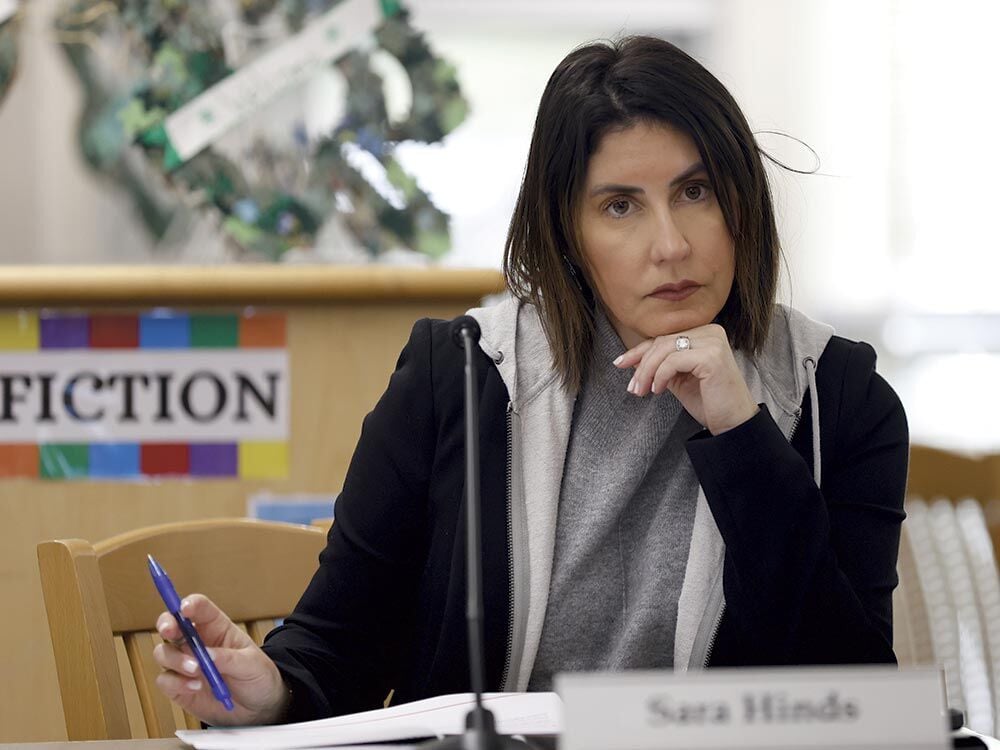
Sara Hinds served as CUSD board president starting in February 2023, when the former president abruptly resigned, until December. “Simply acknowledging that our district has work to do does not mean in any we are sweeping the problems of this district under the rug,” she said during a September 2023 board meeting.
BY EDUCATION METRICS, Carmel Unified School District teachers and students are doing well, despite whatever drama or superintendent churn is happening around them. “The thing that has been our saving grace is that we do have so many high-quality faculty and staff that they are able to insulate the classrooms from whatever chaos and disarray is outside of it,” says CHS teacher Bill Schrier, who until 2023 was the teachers union president. “A good teacher can seal off the classroom. But at some point there’s got to be a limit to that.”
Schrier says things are already calmer since Ofek has been appointed, that she’s been a steady leader in unsteady times, and having a known person in that role was a good choice by the board.
Meanwhile, Carmel remains a high-performing district. It has roughly 2,400 students spread out over 464 square miles, from the Peninsula down the coast to Big Sur and east through Cachagua. According to data from the California Department of Education, English scores are 53 points above standard, math is 20 points above standard and 76 percent of students are college – or career-ready. (Compare that to neighboring Monterey Peninsula Unified School District, with a student body that is four times bigger and has more socioeconomically disadvantaged students and English language learners. There, English scores are 34 points below standard, math is 80 points below standard, and 54 percent of students are college – or career-ready.)
Because property taxes within its boundaries are uniquely high, CUSD is funded primarily through property taxes, rather than per-pupil payments from the state, a formula that backfills revenue in other districts. This school year, CUSD is projected to receive $80.6 million in revenue. That is about $33,583 per pupil, more than double MPUSD.
Still, CUSD is looking at needed facilities upgrades, and leaders are beginning to consider floating a bond. When the issue came up at a board meeting on March 14, Pallastrini acknowledged it would be a tough ask this November.
“The climate needs to be right, both politically and financially,” he said. “Something like that requires a great deal of trust. I think we’re not there yet.”
Wherever they land with a bond measure, there will be new board members after the November elections. CUSD is transitioning from at-large to district-based elections for the first time. In November, areas 1, 3 and 5 will be up for election, plus a two-year, at-large seat that Remynse was appointed to mid-term. That means four seats on the ballot Nov. 5, one of them at-large. Unless they move, Karl Pallastrini and Seaberry Nachbar cannot run again – they, along with Sara Hinds, live in Area 2 in Carmel. (Hinds is midterm, and Area 2 won’t be up for election until 2026.) Rosen’s Area 4 won’t be up for election until 2026.
“We are spending too much time on things that are not student-centric,” says Remynse, who was appointed as Knight was on the way out. “We need to be spending 85-90 percent of our time on student programs – not talking about the [stadium] lights anymore, or recalls, or politics, but talking about the students.
“Now is the time to make progress, move forward, instead of relitigating the release of superintendents. What’s done is done.”
CUSD hired the firm Hazard, Young, Attea & Associates to conduct stakeholder outreach before hiring a new superintendent. The top of the list for expectations was “fostering (ie: rebuilding) a positive, professional climate of mutual trust among all stakeholders.”
According to HYA’s stakeholder survey, only 7 percent of respondents agreed or strongly agreed that the district is heading in the right direction.
Michie, the student board rep, understands why the public is skeptical – he regularly meets with his constituents (students) as well as teachers to hear their concerns.
He says a lack of knowledge about what happened to the former CHS principal and the former superintendent contributed to confusion, and to a lack of trust. “I just want students to be informed, to know what is happening,” he says. “And why we can’t know what we can’t know.”
Michie is sensitive to the challenges the board faces, especially with matters that are confidential, such as personnel and student discipline.
Transparency, he believes, will go a long way toward improving things. “It’s the board’s responsibility to convey to the community why their decisions are correct,” he says. “It shouldn’t be the public’s responsibility.”
(0) comments
Welcome to the discussion.
Log In
Keep it Clean. Please avoid obscene, vulgar, lewd, racist or sexually-oriented language.
PLEASE TURN OFF YOUR CAPS LOCK.
Don't Threaten. Threats of harming another person will not be tolerated.
Be Truthful. Don't knowingly lie about anyone or anything.
Be Nice. No racism, sexism or any sort of -ism that is degrading to another person.
Be Proactive. Use the 'Report' link on each comment to let us know of abusive posts.
Share with Us. We'd love to hear eyewitness accounts, the history behind an article.