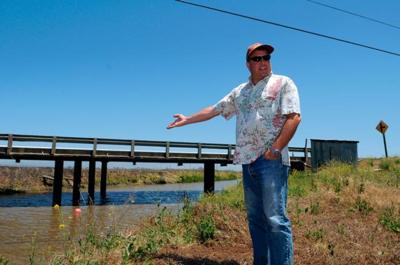
Step too far out onto the banks of Tembladero Slough at low tide, and you’ll find yourself knee-deep in brown muck.
Most visitors to this experimental site – which is designed to filter problematic pollutants from agricultural runoff before it reaches the ocean – wear clunky waders to stay dry. Ross Clark, the Moss Landing Marine Laboratories biologist managing this wetlands project, wears only flip flops. Nevertheless, he navigates deftly through the maze of rushes and thorny weeds.
Local water politics can be just as mucky. The sticky issue Clark hopes to address with this slough west of Castroville: nitrates.
For anyone who eats vegetables or drinks water, nitrates can be both a blessing and a curse.
Nitrogen is central to a plant’s cell growth. Without enough of it, plants suffer from stunted growth. So farmers apply it to soils as water-soluble nitrates to help crops thrive. Commercial growers swear by them.
But as nitrates move past the root zone, all sorts of nasty things happen to the environment. They contaminate the groundwater we drink, and have been linked to a number of diseases. And they flow into the ocean, feeding algaes that choke out other sea life. Environmentalists often swear at them.
The California Environmental Protection Agency’s 2010 list of impaired waterways includes a dozen in Monterey County, including the lower and middle Salinas River, Alisal Slough and Tembladero, giving the Central Coast the highest share of toxic surface waters in the state. While it takes a 10-page appendix to list all the pollutants regularly detected in the region – from fecal coliform to 2,4-dichlorophenoxyacetic acid, an ingredient in the notorious chemical defoliant Agent Orange – the most culpable pollutants are nitrates and pesticides associated with agriculture.
New regulation is intended to improve water quality on the Central Coast by getting farmers to use fertilizers and pesticides more judiciously. The rule – inelegantly called the “conditional waiver of waste discharge requirements for discharges from irrigated lands,” or the ag waiver, for short – aims to heal those water ills.
The first five-year ag waiver took effect in 2004 and mandated water-quality monitoring and farmer education. The new waiver swaps nonspecific large-scale monitoring for farm-by-farm checks, and holds the biggest farms and the worst polluters to tougher standards.
While most everyone agrees local water is below par, that’s about as far as consensus goes. Farmers say the ag waiver sets an impossible standard, fails to account for uncertainties like weather and crop failure, and exposes them to litigation. Environmentalists say it doesn’t go far enough, making nitrate reduction rules too vague and allowing pesticides (chlorpyrifos and diazinon) earlier drafts prohibited entirely.
Another wrinkle: Some farmers feel nitrates and other pollutants should be measured in collective spots downstream instead of on individual properties. That could mean less liability and less accountability, and more places like the mucky marsh at the end of Tembladero Slough.
The 100-year-old reclamation ditch starts near Salinas’ Carr Lake and wends its way across farmland to the end of the Gabilan watershed, where it meets the Pacific Ocean at Moss Landing Harbor. Along the way it gathers pesticides, fertilizer and sediment. Clark plopped his 3-acre wetlands project at its foot because he could use the county land for free, and because the spot is positioned between the farms and the ocean.
Clark pulled weeds and diverted water to support marsh flora he planted to attract beneficial bacteria like the loveable Paracoccus denitrificans, which metabolizes nitrates into pure nitrogen gas in the atmosphere (and not in groundwater). Clark envisions similar plots dotting the Central Coast, letting more moisture-loving microbes in wet soils process what’s fouling the waters.
“This expanse out here is where I think the magic happens,” he says.
Only now, scientists like Clark, accustomed to working quietly in the background, have found themselves in a different kind of bog, and one that doesn’t feel too magical: a politically charged battle that’s drawn the attention of state lawmakers and U.S. Rep. Sam Farr. (He prefers to let growers self-regulate.)
Four ag-waiver appeals to the State Water Resources Control Board are pending, and lawsuits will likely follow.
Roger Briggs, executive director of the Central Coast Regional Water Quality Control Board, says it’s unprecedented for legislators to get so vocal about water rules. “It’s been pretty amazing in terms of the political pressure,” he says.
Clark’s description of Tembladero slough is just as applicable to the policy battle. “It gets really soupy out here,” he says.
~ ~ ~
For a guy married to an ag spokeswoman (California Strawberry Commission’s communications director Carolyn O’Donnell), Steve Shimek has a lot of people believing he exists just to make the industry mad.
Shimek manages Monterey Coastkeeper and runs the nonprofit Otter Project out of an office in downtown Monterey. He insists the regional water board must meet its state-mandated obligation to improve Central Coast water quality. He’s watched each draft ag waiver over the past three years (see sidebar, p. 23, or visit mcweekly.com/agwaiver), and he views each one as environmentally weaker than its predecessor. Along with Santa Barbara Channelkeeper and San Luis Obispo Coastkeeper, Shimek appealed the final ag waiver on the grounds that without a limit on nitrates, the board is merely suggesting improvements rather than mandating them.
“On the one hand, they acknowledge that nitrate is one of the biggest problems of the Central Coast,” he says. “On the other hand, they say, ‘We’ll remove the rules on what these guys have to do about it.’ They replaced a ‘must’ with a ‘we sorta kinda hope.’”
He’s referring to changes from early drafts that set hard nitrate limits for the biggest polluters to softer “milestones,” a concession to ag interests.
Ag also got more leeway in data collection with a few paragraphs allowing neighboring farms to monitor their water quality through small cooperatives at drainage sites like Clark’s wetlands project. By lifting that burden from individuals, the new language reduces the potential liability for growers who detect high nitrate levels.
Even though the paragraphs give ag advocates more of what they want – freedom – they’re taking issue with who wrote it.
The timing also raised eyebrows. Three long, bureaucratic years of discussion and drafts, thousands of pages of public comment and two full days of final hearings had failed to yield consensus on cooperative monitoring. As the board prepared to finally vote, board member Michael Johnston offered the three-paragraph amendment. It was like adding a sticky note to the U.S. Constitution right before the delegates signed it.
Ag interests immediately recognized the language from a memo circulated by their arch nemesis, Shimek. The Grower-Shipper Association and Western Growers say that undermines the entire process. In their appeal, filed by the Sacramento lobbying firm Somach Simmons & Dunn, the industry lobbyists argue Shimek’s influence violates their due process rights.
Johnston thinks he behaved within bounds. He says he asked Briggs to help craft language that would get at these key points, and Briggs obliged.
Briggs acknowledges he met with Shimek and other stakeholders, including CSU Monterey Bay Professor Marc Los Huertos, whom ag groups hired to advocate for their own proposal to the regional water board. Briggs says the cumulative input led to the addition Johnston read.
“It’s OK for us to meet with people and get their ideas,” Briggs says.
For water board staff, that’s true. But it’s not legal for board members to do so. The appellants contend Johnston’s last-minute amendments, which they call “the Shimek proposal,” shows Shimek exerted undue influence.
“Whether or not Johnston was aware of the origins of the language provided to him by Briggs,” the appeal states, “the fact is that the prohibited ex parte communication occurred, at minimum due to the actions of Briggs. Such communications – direct or indirect – are expressly prohibited under the law.”
Shimek acknowledges circulating an amendment strikingly similar to Johnston’s. Records obtained by the Grower-Shipper Association imply buy-in from even higher authority: Briggs’ phone notes on the amendment say, “Steve took draft to Sacto.” A governor’s spokesperson and state water board members declined to comment.
Asked whether he would’ve felt differently knowing much of what Briggs offered up had also been circulated by Shimek, Johnston takes a deep breath and pauses. “I’m not sure of the answer to that,” he says. “I certainly would have thought about it.”
THE LAST DROP
Real-world outcomes of the ag waiver.
It took three years, but the final ag waiver sailed through the Central Coast Regional Water Quality Control Board with a 6-0 vote March 15, sealing the 94-page document as policy. Here’s some of what’s in store for every farmer who turns on a sprinkler in the next five years:
• Growers enroll and pay fees based on the size of their farms. They also submit specs on crops, irrigation method and chemical use.
• Farms are classified based on size and water quality today, with the strictest requirements imposed on the largest farms.
• By Sept. 15, all growers must monitor the creeks and estuaries immediately downstream of their farms.
• By Oct. 1, farmers must turn in their plans for improving water quality. These include irrigation, fertilizer and pesticide use plans, and will be updated annually. Larger farms also have to calculate how much nitrate might run off their properties and document the condition of adjacent waterways with photos and sampling.
• By March 15, 2013, all growers must sample and monitor water from an irrigation well.
• By Oct. 1, 2013, the largest farms and worst nitrate offenders are required to determine the typical nitrogen uptake for each crop type. They must also develop a plan designed to apply only as much fertilizer as the plants can use.
• By Oct. 1, 2015, those growers are required to report progress toward meeting those fertilizer plans.
• By Oct. 1, 2016, those growers will have to show their fertilizer plans are working, and report nitrate reductions.
• Growers can propose water-quality improvement projects (such as wetlands), which regional water board staff can choose to accept for cooperative monitoring rather than individual farm-by-farm monitoring.
~ ~ ~
The well at Rio Farms in King City pumps groundwater from hundreds of feet below to ponds on the surface, and from there through PVC pipes to hundreds of acres of crops. That’s a lot of ground to cover, but it’s what happens between the top 18 inches of soil and the subsurface depths that has drawn the most intense attention.
Roots take up all the nutrients – including nitrates – they can. But over-irrigation and rainfall often percolate nutrients below the root zone. Eventually they wind up in groundwater, which accounts for 90 percent of the drinking water supply on the Central Coast through more than 700 municipal and roughly 40,000 private wells.
Nitrates don’t stick to soil particles, preferring the more welcoming chemistry of water, and it’s easy for them to persist below the surface for decades. Nitrate-spiked water poses a number of health issues for the people who drink it. Most notorious is “blue-baby syndrome”: Nitrates can kill infants by preventing oxygen from traveling through the bloodstream. Research also suggests nitrate exposure might be linked to Parkinson’s disease, Alzheimer’s and other illnesses. A UC Davis study published in April shows one in 10 people living in the Salinas Valley are at risk of exposure to nitrate contamination in drinking water.
Nitrate also nourishes unwanted plants, like algae that form thick barriers on the surface of oceans and lakes, creating “dead zones” void of aquatic life. Toxic algae from Watsonville-area lakes have been found in the livers of dead otters in Monterey Bay.
Those health and environmental impacts explain the regional water board’s tough stance on nitrates. The ag waiver sets a goal of applying only as much nitrate as a plant can take up through its roots, leaving none to seep into the groundwater.
Richard Smith, a vegetable crop farm adviser with UC Cooperative Extension in Salinas, is ambivalent about classifying farmers as polluters at all. “As long as nitrate’s in the root zone, it’s a beneficial thing,” he says. “The problem farmers run into is that once it gets away from them, out of the root zone, it becomes a pollutant.”
Rio Farms Manager Bob Martin, who also serves on the boards of the Grower-Shipper Association and Monterey County Farm Bureau – both anti-ag waiver – is ahead of the curve on his nitrate controls. He’s spent $11,000 on soil-moisture sensors that hook up to his computer, producing what look like EKGs monitoring irrigation and soil wetness. This lets him shut off irrigation pumps as soon as the soil is saturated.
But Martin’s investment doesn’t mean his property produces crystal-clear water samples. A number of other factors come into play. Once gravity gets ahold of nitrates and takes them down deep, they can remain in groundwater for decades. Martin and other growers worry that despite their efforts to clean up, they might still be in violation of the ag waiver targets.
Monterey County Water Resources Agency board member Mike Scattini grows vegetables next to Clark’s pilot wetlands. He and Clark worry that efforts like wetlands – which are expected, but not guaranteed, to improve water quality – won’t necessarily get them credit for complying with the ag waiver.
Clark also doesn’t want to be held responsible for factors beyond his control. Water samples, collected on a given time on a given day, might not show water-quality improvements, he says; a plume could be traveling 200 feet below the surface carrying nitrates from a century-old dairy. The impairments on the Central Coast will take decades to reverse, and critics like Clark say monitoring under the ag waiver is capable of producing only snapshot data.
“The objective of our group is not to have clean water in ditches,” Clark says. “It’s to re-create a healthy aquatic ecosystem where we have clean water.”
~ ~ ~
Marc Los Huertos has all the hallmarks of an absent-minded professor. From his CSUMB office to the lab across the parking lot, he misplaces his key fob, then his car keys, which sends him scouring the hallways until they’re finally recovered from a jacket pocket.
He says he can’t remember exactly how much ag groups paid him to draft a farm-friendly waiver – was it $10,000?
Los Huertos reaches for a pen or a dry erase marker each time he wants to illustrate a thought. Between spooning potassium nitrate from a jug into a beaker for a potential class demo on fertilizer proportions, he draws plants and roots and raindrops. He’s trying to show a net-zero nitrate system, in which a crop takes up all of the applied nitrate and leaves none to run off.
“This is exactly what the regional water board wants. This is nirvana,” Los Huertos says. “But you can be doing everything right, and then you can have a sprinkler leak, or disk your entire crop under, and release nitrogen.”
Los Huertos was commissioned to prepare what became known as “the Los Huertos report,” pushing the regional water board to adopt a system that would let farms report collectively rather than as individuals.
Los Huertos says farm-by-farm data is excessive, and could expose growers to liability. “I call it monitoring pornography,” he says.
Although the final ag waiver incorporated many of Los Huertos’ ideas about collective monitoring, he takes issue with the entire process, dismissing the water board’s approach as “very 1970s.”
Water board staffers started out with specific nitrate standards, then softened them to allow for measurable reductions. But growers still face lots of paperwork requirements to explain exactly what they’re doing, and staffers at the regional water board will get to choose which on-farm management practices count toward ag waiver compliance.
The ag waiver has been divisive since long before Los Huertos was hired as a peacemaker. Eight representatives from farming and environmental interests sat down last year with retired Monterey County Superior Court Judge Richard Silver in an attempt to resolve their differences, and failed – because even farmers disagreed about how much monitoring is manageable.
Johnston’s contentious addition aimed to tackle that same question, without the public wrangling that’s bogged down every revision.
The ag waiver debate raises fundamental questions about the purposes and limitations of ag regulation. Growers say they’re being unfairly treated like factories, where sampling water from an outfall pipe tells you everything that’s been added within four walls. When it comes to water moving through soil, they say, it’s both unfair and unscientific to blame a single grower for pesticides or nitrates.
Ag leaders have made the case that they’re willing to innovate, but they prefer calculated business risks to regulatory compliance. Rep. Farr is in their corner, insisting growers will make progress if only the regulatory system lightens up.
But Shimek and his allies argue that if ag gets to move at its own pace and report its own plans for nitrate reductions, improvements will be too slow, voluntary and incidental.
There’s even friction within the ag community. Some growers, including Martin, see the waiver as reasonable after specific nitrate targets and pesticide prohibitions were dialed back.
Others, like Mike Scattini, say it could ironically undermine projects like Clark’s pilot wetlands project. Scattini worries the ag waiver doesn’t include an incentive for trying new things – and that ventures to improve water quality could actually tighten regulations. Wetlands could become habitat for protected species or draw critters that pose food-safety risks, he says.
“Would I love to be able to have drinking-water quality water running through ranches in the Salinas Valley?” Scattini asks. “I’d also like world peace. Unfortunately, practicality doesn’t always come into play with regulators.”
Los Huertos also sees the ag waiver as heavy-handed, and predicts it will have the unintended effect of driving so-called bad actors even further underground. “These are the guys saying, ‘F*** the water board, they’ll never get me.’ They’re moving from ranch to ranch.”
The regional water board estimates that of about 3,000 farms on the Central Coast, only 100-300 will have a tough time complying with the ag waiver. But that doesn’t account for the farmers who never even register (see sidebar, p. 22).
WATERED DOWN
A brief history of Central Coast ag runoff regulations.
1967 The State Water Resources Control Board is created.
1969 The California Legislature passes the Porter-Cologne Water Act, charging the state and nine regional water boards with the preservation and improvement of water bodies.
1972 The Federal Clean Water Act, modeled partly on Porter-Cologne, is passed.
July 9, 2004 The Central Coast Regional Water Quality Control Board adopts the 2004 agricultural waiver.
July 9, 2009 The 2004 ag waiver expires; the regional water board renews it for one additional year.
July 8, 2010 The regional water board again renews the 2004 ag waiver, two days before its expiration, for eight additional months.
Sept. 18, 2010 Two regional water board members’ terms expire, leaving only five serving members. One of those works professionally in irrigated agriculture, and therefore must recuse himself from voting on the ag waiver.
March 29, 2011 Two days before the 2004 ag waiver expires again, regional water board director Roger Briggs signs an executive order extending it for six more months. The regional water board now lacks a quorum to vote on another renewal.
April 28, 2011 Monterey Coastkeeper, Santa Barbara Channelkeeper and San Luis Obispo Coastkeeper file an administrative appeal alleging Briggs does not have legal authority to extend the ag waiver.
Sept. 30, 2011 Briggs signs another executive order extending the 2004 waiver for another year.
Nov. 10, 2011 Gov. Jerry Brown appoints three new regional water board members: Marina Mayor Bruce Delgado, Teamsters consultant Michael Johnston of Watsonville and Santa Barbara insurance executive Michael Jordan. The board now has a voting quorum.
Jan. 9, 2012 Regional water board Chair Jeffrey Young issues an order sealing the public record from new information.
Feb. 1, 2012 The regional water board hosts a final public workshop in Salinas. CSU Monterey Bay Professor Marc Los Huertos delivers a presentation commissioned by an industry group, Farmers for Water Quality. Young sticks with his January order and rejects Los Huertos’ presentation as part of the official record.
Feb. 23, 2012 Assemblyman Luis Alejo, D-Watsonville, introduces a bill that would change the rules on how the public can communicate with regional water board members, allowing for private stakeholder meetings instead of exclusively public presentations. The bill passed the Assembly in May and is now on its way to state Senate committee hearings.
March 15, 2012 The regional water board votes 6-0 to adopt the ag waiver.
April 16, 2012 Monterey Coastkeeper (along with other environmental groups), a coalition of farming groups (including the Grower-Shipper Association), the Farm Bureau, Ocean Mist Farms and RC Farms file administrative appeals of the ag waiver. A state opinion is pending.
~ ~ ~
Fluffy, black-and-white killdeer chicks teeter on spindly legs that look disproportionately long for their bodies. They’re in an irrigation ditch that runs between an artichoke field and a lush wetlands draped with willow trees and loud with birdsong.
To approach the water in the ditch, the chicks walk over a crumbly turquoise edge that resembles dried toothpaste, then approach a film that fades from dark to lime green – none of them natural shades. The biofilm is thick enough to support the chicks as they scurry over the surface of the water.
There’s something beautiful about the scene of natural habitat abutting a farming operation, but it’s also unnerving to watch the little birds try out their legs on a toxic soup of runoff.
That ambivalence is at the heart of the ag waiver debate, which will probably head to court after the State Water Resources Control Board makes a determination on the four appeals.
Central Coast board director Briggs might be the only person who’s pleased with the final ag waiver. He says it’s not too much of a compromise with ag, and was happy to see the board vote unanimously even after state and federal officials urged them to lean more in ag’s favor.
Most importantly, Briggs believes the ag waiver – even if it morphs through litigation – will eventually give these killdeer chicks a cleaner habitat.
“We stuck with our core values,” he says. “I think there will be nitrate reductions.”
(0) comments
Welcome to the discussion.
Log In
Keep it Clean. Please avoid obscene, vulgar, lewd, racist or sexually-oriented language.
PLEASE TURN OFF YOUR CAPS LOCK.
Don't Threaten. Threats of harming another person will not be tolerated.
Be Truthful. Don't knowingly lie about anyone or anything.
Be Nice. No racism, sexism or any sort of -ism that is degrading to another person.
Be Proactive. Use the 'Report' link on each comment to let us know of abusive posts.
Share with Us. We'd love to hear eyewitness accounts, the history behind an article.