


MANY PARENTS MIGHT NOMINATE THEIR KID AS AN EXEMPLARY CHILD in early childhood education programs, but if one now-11-year-old from Salinas is the poster child for Head Start, Adrina Carmona is the poster mom. Carmona had never thought much about the program until she tried to enroll her daughter in kindergarten, but her birthday meant she was too young. School officials suggested she consider Head Start in the interim. She got a spot for her daughter and quickly learned that part of the early childhood education program is not just about kids, but entire families.
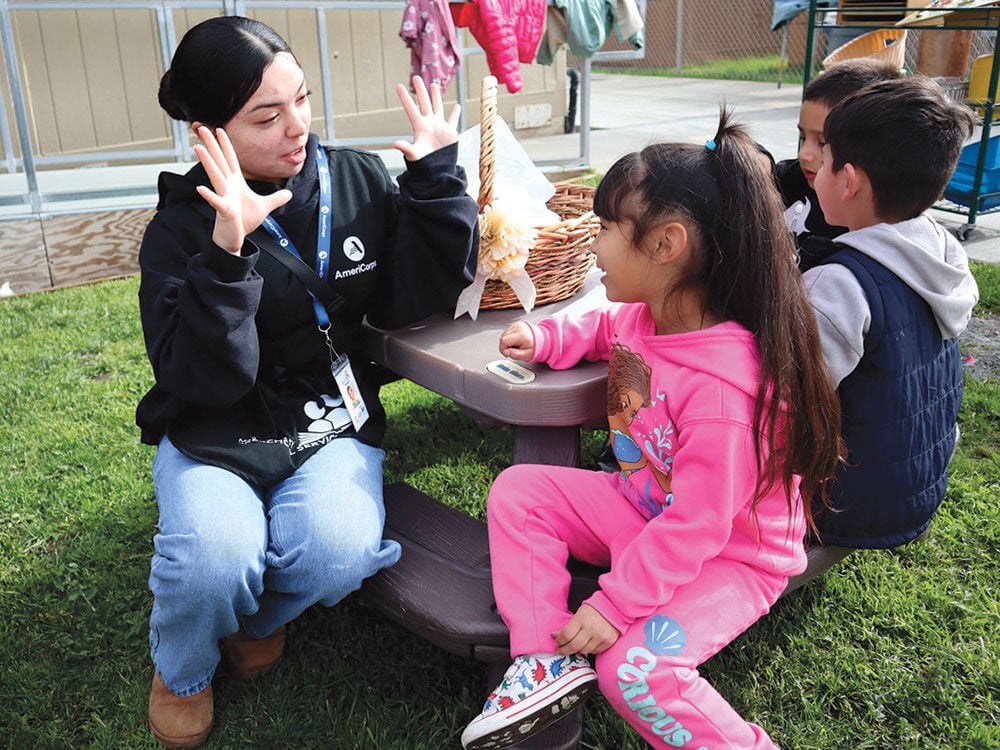
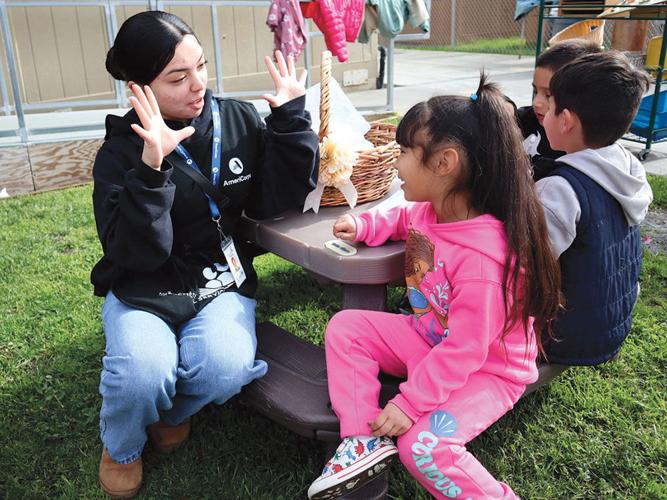
Members of the Monterey County Preschool Service Corps work with Head Start students outdoors. The Preschool Service Corps program, designed to help get new early childhood educators into the workforce, lost its federal funding when the Trump administration took aim at AmeriCorps programs in April.
“They had mandatory meetings for parents,” Carmona says. “They meet with every parent and talk about your dreams, aspirations, goals: What do you want to do this year, and in the next five years? And how can we help you?”
There was accountability built in, with a follow-up meeting midway through the school year to ask: Did you achieve your goals? Carmona’s might seem modest – she hoped to take a family vacation – but she was proud to report she’d fulfilled it, with a trip to San Diego.
To Carmona, everything about Head Start, from intake to the followup, felt different than other government programs she had utilized, such as enrolling in Medi-Cal. “It was just such a different experience to feel like a whole human, instead of someone who struggles,” Carmona says.
When Head Start, a federal early childhood education program for families who otherwise could not afford it, launched in 1965 as part of Lyndon B. Johnson’s War on Poverty, the “whole child, whole family” approach was innovative. “The idea of providing comprehensive health, nutrition and education services to children in poverty was revolutionary, if not radical,” according to the National Head Start Association.
In the 60 years since then, Head Start has served more than 40 million children and their families, according to the U.S. Department of Health and Human Services.
The mission is to help qualifying children – based on factors like family income, homelessness, foster care – get a leg up in their earliest years, before kindergarten, so they start school ready to learn alongside their peers from other backgrounds. For Carmona’s daughter, it did all that and more; Carmona says it helped shape her into a thoughtful and caring child who, as a kindergartner during the pandemic, decided to donate her toys to others. “Head Start has given her such a good foundation of self,” Carmona says.
Carmona volunteered to serve on the county’s Early Learning Program Policy Council, composed mostly of parents serving alongside Monterey County Office of Education officials, with governance responsibilities for the local program. She was encouraged by Isabel Valtierra, then managing family engagement and special needs students for the county’s program, to be a leader. Carmona became Council chairperson, and served for five years, the maximum. “If it wasn’t for Isabel, I probably would have left after the second year,” she says.
Valtierra was a Head Start parent herself before becoming an early childhood teacher, launching a 24-year career in the program. Like Carmona, Valtierra also lived and breathed it. Last year, she was promoted to assistant director.
Two months later, she was placed on leave while a third-party investigator looked into allegations of mismanagement by Valtierra and the long-time program director, Sonia Jaramillo.
“The following are major themes of the concerns: nepotism, favoritism, retaliation and bullying,” according to the report, commissioned by the Monterey County Office of Education last year. After 34 witnesses were interviewed and reams of paperwork were reviewed, three damning reports were produced.
Jaramillo and Valtierra resigned in January.
CONCERNS ABOUT LEADERSHIP at Monterey County’s Early Learning Program (ELP) – which combines Head Start and a smaller number of state-funded preschool spots – started to emerge in summer 2024. Emails show that in July, MCOE Assistant Superintendent Ernesto Vela shared concerns from ELP staff with Chief Human Resources Officer Leigh Butler. After receiving “myriad” complaints, they discussed a requirement for all ELP managers to receive sensitivity training. A few weeks later, Butler wrote to follow up: “We have received additional complaints and feel that we need to look into the program further.”
Things escalated quickly. MCOE hired San Diego-based Christy White, Inc. to investigate.
White’s firm produced three extensive reports, one on contracting procedures and bid awards in November, one on stipends and summer camp hours completed in January, plus a 107-page summary report that notes in the introduction, “This is a confidential investigative report.”
In February, the Monterey County Weekly submitted a request under the California Public Records Act seeking the reports and associated records from MCOE. In April, Deputy Superintendent Ralph Porras wrote to say MCOE would need additional time, pending possible legal action by Jaramillo and Valtierra. “The former employees have retained legal counsel to evaluate whether to seek a court-issued protective order prohibiting disclosure of certain records responsive to your request,” Porras wrote.
No such court filing ever came, and in June, MCOE provided a redacted copy of the report, along with hundreds of pages of emails.
For allegation after allegation, White details her findings, but for 22 of 25 allegations, the top line is the same: “Finding: Sustained.”
BETWEEN AUG. 30 AND NOV. 21, 2024, 34 WITNESSES – NAMES REDACTED – PLUS JARAMILLO AND VALTIERRA WERE INTERVIEWED.
White’s report opens with an assessment of the credibility of each witness. For example, Witness #8: “Overall, her testimony is a valuable and reliable source of information for the investigation.” On Jaramillo, whose testimony is deemed partially credible: “Her responses were often inconsistent, vague or deflective when addressing key concerns such as favoritism, nepotism, policy violations and financial mismanagement.”
White looked into six major areas of allegations. One of them – lack of confidence in leadership, evidenced by 39 involuntary transfers and 11 demotions – might have been addressed by sensitivity training. The rest revealed bigger cracks in the system.
In the category of misappropriation of funds, investigators examined alleged mismanagement of overtime, specifically that Jaramillo’s associates were improperly paid overtime. For example, the report describes “a close family friend of Sonia Jaramillo, the [redacted] of Sonia’s [redacted]” who provided custodial and maintenance services. In 2023-24, according to the report, he received $16,512 in overtime, compared to other employees who averaged $1,000.
Another example is an employee who recorded 48 days of overtime work in a three-month period in 2024, but GPS data from a district vehicle showed that the person did not do overtime work on 11 of those days.
“Witness #29 reported that individuals with close connections to management, including [redacted] received preferential treatment in accessing overtime and other benefits,” according to the investigation.
The audit found that overtime pay was used to compensate certain employees as a retention tool. Jaramillo’s intentions might have been good – as she wrote in an email about a plan to pay $5,000 stipends to summer camp employees, “As you can see our new staff is really making very little (I am sad to see that) and I am processing how to make sure they get the pay they should get.”
Given ongoing challenges to recruit and retain early childhood educators, it may be no surprise that ELP leaders would look for creative options. But as White’s report notes, this creates a vulnerability for the program. “Given that the ELP is funded by federal and state grants, this practice constitutes not only a misuse of overtime but also a potential violation of grant requirements regarding the appropriate and lawful use of public funds,” she wrote.
Investigators also looked at whether a child associated with Jaramillo was improperly enrolled in the program in 2022. “It is alleged that [redacted], the [redacted] Sonia Jaramillo, was inappropriately enrolled in the Early Learning Program despite being ineligible for services,” the report reads. “This alleged improper enrollment could be a misallocation of state and federal funds, which are strictly designated for eligible students.”
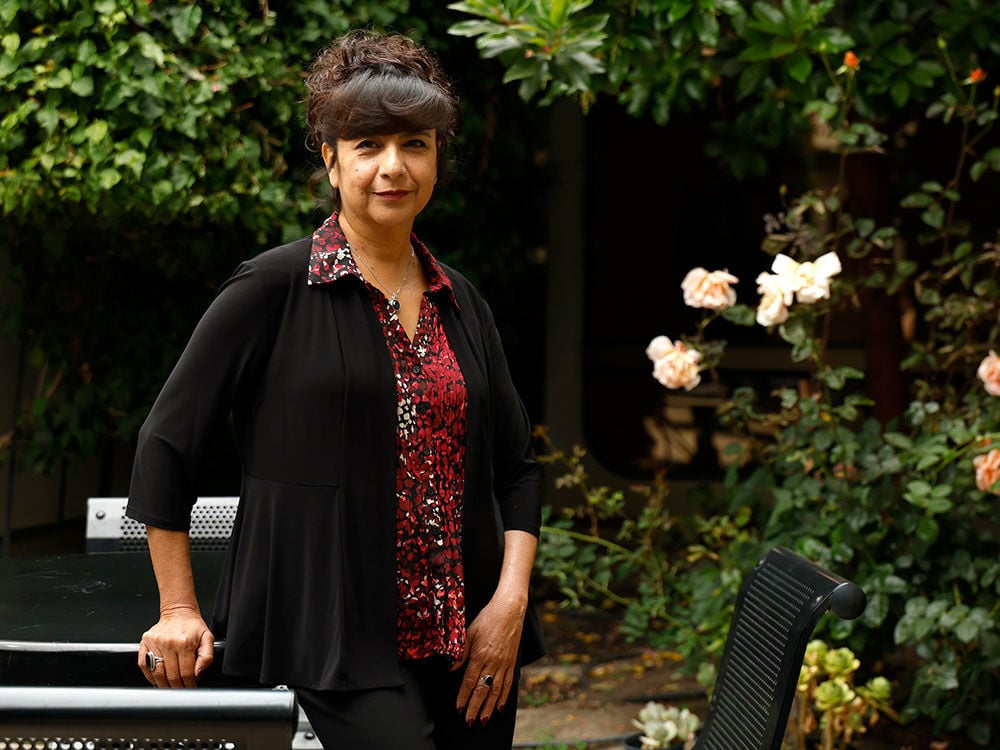
“I want to focus on promoting lifelong learning for the students,” says Anabel Garcia, who became Monterey County’s Early Learning Program director on July 1. “The children come happy and ready to learn.”
White also examined conflict of interest in vendor selection for services such as asphalt and flooring. Over a four-year period, $31 million in construction work had been done at ELP sites, and White documented multiple contracts that had been awarded in violation of protocol. In multiple instances, contracts that should have gone out to bid were instead awarded without one. A year of playground repairs from 2022-23 totaled $251,035 – which would have required a formal bidding process – but were instead awarded to one contractor as eight smaller projects, a practice known as bid-splitting.
White determined that Jaramillo awarded bids to friends and/or family members, directly or through subcontractors.
“Sonia Jaramillo acts as the ELP construction manager by preparing the scope of work, securing the quotes, determining whether bids are required, executing the contract, managing the project and approving payment for services,” investigators found. “To our knowledge, she is not qualified for that role.” They recommended that MCOE make a facilities expert responsible.
WHITE’S REPORT CAME WITH A LONG LIST OF RECOMMENDATIONS, and MCOE Superintendent Deneen Guss says many have been implemented. They’ve hired a purchasing manager, and that person is currently developing a manual; they are in progress of implementing new software for bidding; custodial work has moved to MCOE’s general services department; an updated overtime authorization form has been developed to accurately track hours worked; an audit of payroll records was completed; a new policy prohibits the ELP director from authorizing placement in the program of their own relatives; managers have been retrained on conflict-of-interest policies; and more.
“We want to have super strong systems of checks and balances,” Guss says. “Even though humans do human behavior, we have enough internal controls in place that folks cannot work around the system.
“I think most people understand when you run a large organization some things will happen. When you don’t follow policies and you don’t follow the rules, we are going to find it and deal with it. We are not going to turn a blind eye to anything.”
One of White’s recommendations is to audit the past three fiscal years. MCOE already does annual audits and going forward, they’ve hired White’s firm to conduct those audits.
ON TUESDAY, JUNE 17, the last meeting of the Early Learning Program Policy Council for the 2024-25 school year convenes at 5:38pm after parents and MCOE staff have time to mingle and to grab dinner from a spread of taquitos with heaping sides of rice, beans and guacamole. Almost right away, as Assistant Superintendent Vela hands over the microphone to Maria Zarate, a Head Start parent and council member to run the meeting, he says, “Vamos a continuar en español.” We are going to continue in Spanish.
Although she is no longer on the Policy Council, Carmona still attends meetings, listening through a headset for English interpretation. When she was selected as chair, she says that was a priority: “Eighty-five percent of those parents could not speak English,” she says. “I felt like I had to represent them the best I could. I made sure all of our meetings were in Spanish, because usually it’s the other way around.”
Like Head Start, there is cultural sensitivity around this advisory body, from the language of the meetings to the dinner menu. (One feature of ELP is that parents do not need to send their children with food – breakfast, lunch and snacks are provided. The August menu includes bean and cheese burritos, carne asada tacos as well as chicken alfredo pasta.)
The only controversial topic of the evening is a request by parents for promotion ceremonies; many are disappointed that parents and grandparents are not invited to end-of-year celebrations. “It is a big deal, they want to feel special,” parent Virginia Batrez said.
The limitation, Vela says, is licensing requirements: They don’t want to end up over capacity. “In the last two weeks alone, we’ve had three licensing visits. They’re random, they’re unannounced, and we don’t want to run the risk that on that day we allow 60 people, but it says 50.”
It’s a reminder that dotting the i’s and crossing the t’s matters when implementing a federal/state program. Vela adds that the ELP program lost a grant it was seeking because of past licensing findings. “It is a real thing and it is a real consequence if we don’t comply,” he tells the Policy Council.
It’s Vela’s last meeting as the head administrator – he stepped in to manage meetings when Valtierra and Jaramillo were placed on leave. He announces Anabel Garcia will become the new ELP director on July 1.
“Since November, when I started attending these meetings, I have kept you informed of a situation we had in the program,” Vela says. “I can’t give you the details but I can report the investigation was done…
“We know there are challenging times in our program. We cannot thank enough our staff, and especially you, our parents, for your patience.”
NOT EVERYONE WAS PATIENT DURING THE INVESTIGATION.
While her career spanned 24 years, Valtierra had been in the assistant director role for just a couple of months when she was placed on leave for the investigation. During that time, she sent multiple emails to MCOE HR Director Leigh Butler, asking for an update. “I have been as patient and respectful as possible throughout this five-month investigation, which seems to have brought up additional concerns beyond the initial issues,” she wrote. “I have remained confident because I have always maintained the greatest integrity, following procedures while maintaining a strong work ethic.”
Valtierra says she remains proud of the work she did for ELP. “My legacy to the program is all the systems, policies, procedures – all I’ve done, I left it there,” she says. “Anyone that comes in can continue to implement it. They will need that passion and honesty, the heart, to really use federal and state funds to serve the neediest families.”
Valtierra was once a Head Start mom herself. She immigrated from Mexico, where she had been attending law school, and raised her three children in the U.S. Her middle child is autistic, and she scrambled to understand her options. “There were no resources then,” she says. She connected informally with other special needs parents, and began a journey into a career that would define her.
Valtierra is reluctant to speak about the specifics of White’s report, in large part because most of the findings focus not on her, but on the former director.
Jaramillo served for 11 years as ELP director. She declines to comment on specifics in the report, but says she is proud of the program. “I want to make sure the services for our kids are not jeopardized,” she says. “Our kids need to be prioritized and I am happy with what I accomplished.”
Jaramillo and Valtierra did not receive copies of the investigation from MCOE until the Weekly requested it, and both suggest it was incomplete. (After it was produced, MCOE in February notified the California Commission on Teacher Credentialing of the allegations.)
The Policy Council likewise did not receive the report, and Carmona says they should have – and that they should have been looped in all along to what was happening to their former leaders.
“They felt the weight of not just a classroom or a job – they felt the weight of an entire community,” Carmona says.

Members of the Monterey County Preschool Service Corps work with Head Start students outdoors. The Preschool Service Corps program, designed to help get new early childhood educators into the workforce, lost its federal funding when the Trump administration took aim at AmeriCorps programs in April.
IN MANY WAYS, EARLY CHILDHOOD EDUCATORS DO CARRY THE WEIGHT OF AN ENTIRE COMMUNITY. The premise behind Head Start and the California State Preschool Program is to give children in low-income families a chance to be prepared for kindergarten so that they can learn, play and thrive alongside their peers.
“One of my goals is school readiness,” says Garcia, the new ELP director. “I want to make sure we strengthen and improve student achievement. Then my belief is these children will be able to make a smooth transition into kindergarten, and as they move through different grade levels.”
Garcia immigrated to the U.S. at age 12, and says she already knew at that time she wanted to be a teacher. Her career took her into early childhood – over the years, she worked with Jaramillo and Valtierra – then community schools, before returning in this director role. “So far it has been very, very welcoming,” she says.
Before the school year begins on Aug. 4, Garcia is working to hire teachers, fighting a longstanding shortage. Ironically, an expanding awareness about the value of early childhood education might be working against her; as more (and often better-paying) school districts adopt California’s transitional kindergarten program, both 4-year-old students and teachers are going there.
That situation led Monterey County’s ELP team to seek less funding for Head Start in the 2025-26 school year. They’ve been approved for 20 centers serving up to 320 students, down from 514 students last year. That’s despite a current wait list of 356. Each classroom requires two teachers, plus assistant teachers (who sometimes serve two classrooms). They plan to have 120 staff members this year, down from 132 last year. They are also eliminating the position of assistant director, formerly held by Valtierra.
“We don’t have the staff to serve [more] students,” Vela told the Policy Council in June. “This plan is a sacrifice right now, but hopefully it is going to set us up for the long term… Some of what we are doing is a gamble because we’ve never been in this territory before.”
As more 4-year-olds enroll in transitional kindergarten, Head Start enrollment may shift to younger kids; but more 3-year-olds changes the formula, requiring more teachers. Two additional Early Head Start classrooms will serve infants and toddlers this year, and those classes are capped at eight students, unlike the 20-person classes of 3- and 4-year-olds. (An additional 96 students can enroll in state preschool slots in ELP this year.)
As the program locally has faced challenges from within, Head Start is also in the crosshairs of the Trump administration. “We are still very worried that the program may be eliminated,” Vela said in June. “Every day we’re staying up on what is happening. Now more than ever, we need to demonstrate that our program is strong, that we do change lives.”
Earlier this year, regional Head Start offices were abruptly eliminated; the person who used to answer questions and provide technical guidance to Monterey County’s ELP simply vanished overnight. On July 10, the U.S. Department of Health and Human Services announced that Head Start would no longer enroll students who do not have legal immigration status. (Valtierra says that should impact only about 1 percent of enrollment.)
Despite the challenges, Garcia keeps bringing the focus back to the reason Head Start exists at all. “I cannot change the past; I want to move forward,” she says. “The staff deserves that, and the parents and the children. I want to focus on the future, and the future is our children.”
(0) comments
Welcome to the discussion.
Log In
Keep it Clean. Please avoid obscene, vulgar, lewd, racist or sexually-oriented language.
PLEASE TURN OFF YOUR CAPS LOCK.
Don't Threaten. Threats of harming another person will not be tolerated.
Be Truthful. Don't knowingly lie about anyone or anything.
Be Nice. No racism, sexism or any sort of -ism that is degrading to another person.
Be Proactive. Use the 'Report' link on each comment to let us know of abusive posts.
Share with Us. We'd love to hear eyewitness accounts, the history behind an article.