




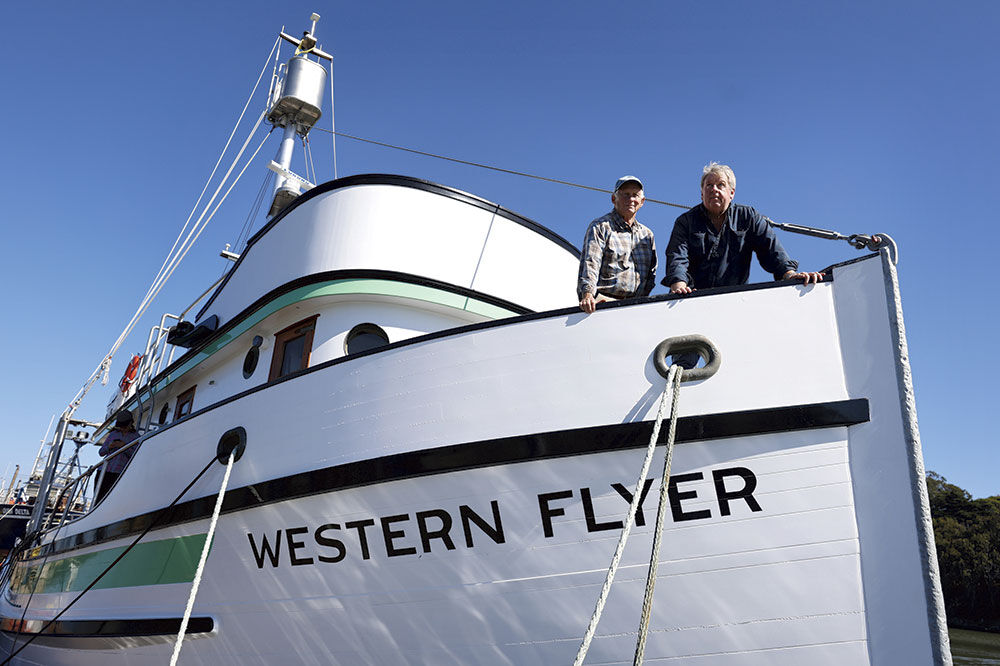
Western Flyer Captain Paul Tate (left) and Western Flyer Foundation president John Gregg on the bow of the boat, re-creating a 1940 shot of Western Flyer’s original captain, Tony Berr), and writer-turned-explorer John Steinbeck in a similar position.
ED RICKETTS AND JOHN STEINBECK WERE, IN STEINBECK’S OWN WORDS, “OBVIOUSLY RIDICULOUS” WITH THEIR 1940 IDEA OF A SIX-WEEK-LONG EXPEDITION TO THE GULF OF CALIFORNIA. No wonder that when they spread the word, in early 1940, that they wanted to charter a purse-seiner – sardine season was nearly over and roughly a hundred purse-seiners were anchored in Monterey – “no boat was offered,” Steinbeck wrote.
Nobody knows what would have happened if captain Tony Berry didn’t sail into Monterey Bay on the Western Flyer, a 77-foot purse-seiner that Ricketts and Steinbeck eventually chartered. This tolerant man of Croatian origins agreed to go, and his decision secured the Western Flyer a place in history; the boat is the main character in this story. It was one of two times that Berry changed the fate of a humble sardine purse-seiner that was sold, lost, sunken, found and bought back and is now, after 70 years, coming home to Monterey.
While planning the trip, Steinbeck and Ricketts considered themselves broke without feeling poor, but both already had certain achievements. In 1939, Ricketts published Between Pacific Tides (along with Jack Calvin) that became one of the most popular Stanford University textbooks for marine biology courses, while Steinbeck, the same year, released one of his best novels, The Grapes of Wrath, which won the National Book Award and the Pulitzer Prize. By then, the Western Flyer was already built, in 1937 in Tacoma, Washington, along with three other sister boats designed specifically for the Monterey sardine fishery.
Ricketts arrived in Monterey in 1923, from Chicago. Steinbeck arrived in 1929 and before they met – at the dentist’s office (according to Steinbeck) or at a friend’s place (according to everybody else) – they’d already heard about one another and were mutually intrigued.
In Steinbeck’s account – one that is colorful and unreliable – they immediately went for a drink, one of many they were to have, typically at Ricketts’ quirky marine biology lab at 800 Cannery Row, where parties could last for days, if the spirit was right.
The plan for their voyage was to “collect marine animals on certain days and at certain hours indicated on the tide charts,” as reported by Steinbeck in The Log from the Sea of Cortez (1951). The book was his second take on the trip after 1941’s less famous Sea of Cortez: A Leisurely Journal of Travel and Research, by Steinbeck and Ricketts. Their mission was “to observe the distribution of invertebrates, to see and record their kinds and numbers, how they lived together, what they ate, and how they reproduced.”
And Steinbeck and Ricketts executed the plan. They traveled over 4,000 miles, around the southern tip of Baja California, Mexico, and into the sea that separates Baja from mainland Mexico. They captured 560 species of marine invertebrates, among other specimens in the Gulf of California, “a long, narrow, highly dangerous body of water,” and “subject to sudden and vicious storms of great intensity,” as Steinbeck wrote. They preferred to call it the Sea of Cortez.
While such commitment seems about right in the case of Ricketts, a marine biologist, it strikes as unusual in Steinbeck, a rising literary sensation. The bridge between them turned out to be philosophy, particularly the philosophy of science. The voyage of the Western Flyer was, as reading of The Log proves, a profoundly philosophical quest.
During the trip, Ricketts and Steinbeck spoke about George Darwin (Charles’ son) and Vincent van Gogh, and made social and political comments in two respective journals that Steinbeck then reworked into one piece. The Log moves from discussing the behavior of the amoeba under the microscope to “spiritual teleology,” or “the tidal theory of cosmogony” – all that on board the Western Flyer, in between staring at turtles, red rock lobsters and schools of jumping tuna.
“We knew that what we would see and record and construct would be warped,” Steinbeck wrote, sounding like a postmodernist, “as all knowledge patterns are warped, first by the collective pressure and stream of our time and race, second by the thrust of our individual personalities.”
Perhaps Ricketts needed someone like Steinbeck to cross the limits of his discipline and land on the frontiers of ecology and environmentalism, awakening our common consciousness that, as Steinbeck wrote, “going into the Sea of Cortez means becoming forever a part of it”; “that our rubber boots slogging through a flat of eel-grass, that the rocks we turn over in a tide pool make us truly and permanently a factor in the ecology of the region.”
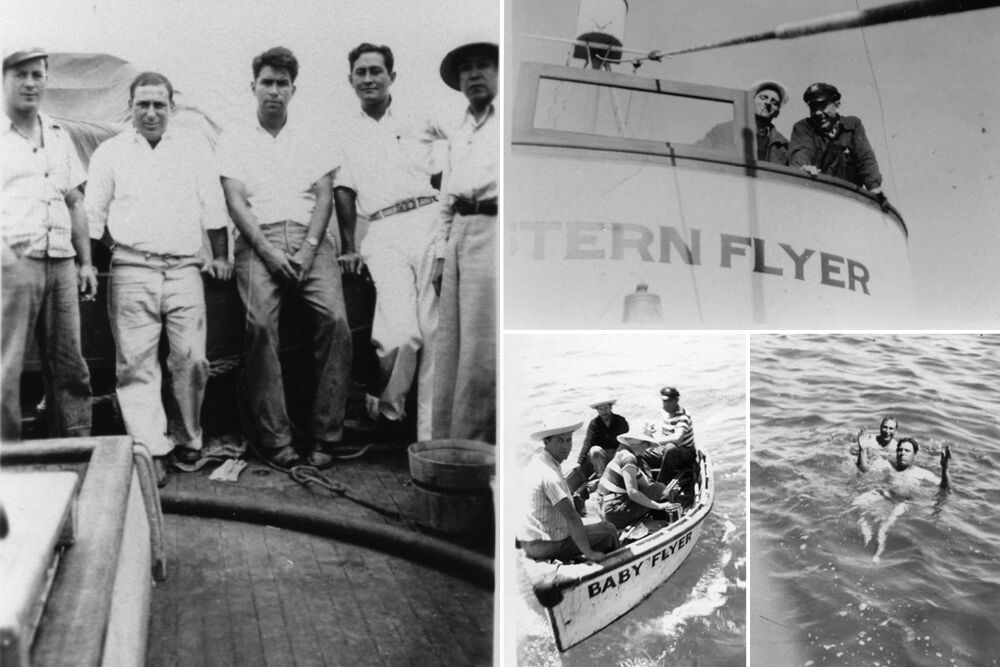
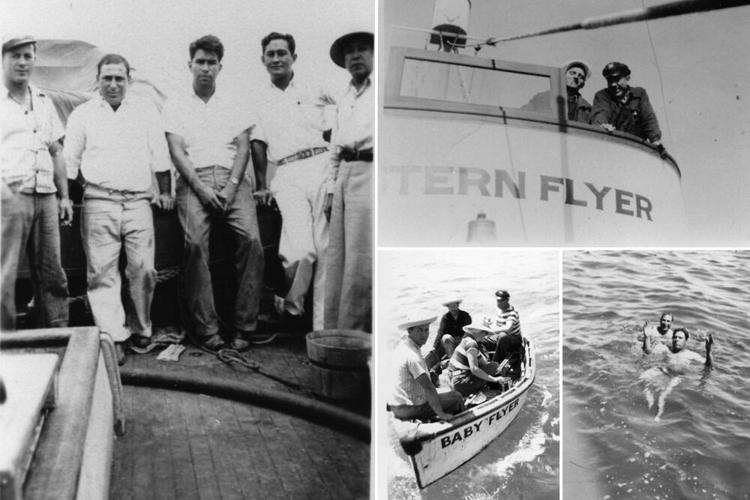
Photos from the original voyage of the Western Flyer - (top) Western Flyer’s original captain, Tony Berry (right), and writer-turned-explorer John Steinbeck. (bottom right) Sparky Enea and Travis “Tex” Hall swimming during the Sea of Cortez expedition. (bottom left) Aboard the Baby Flyer: Ed Ricketts, John Steinbeck, Carol Steinbeck and Ritzi “Tiny” Colletto during the Sea of Cortez expedition. It is one of only two known photos of Steinbeck and Ricketts together. (left) Travis “Tex” Hall (left) and Horace “Sparky” Enea (second from left) aboard Western Flyer with three unknown men.
THERE IT IS – a boat taken straight from literature – slightly swaying in the morning sun in Moss Landing Harbor where it has been docked since the first week of October 2023, to the delight of the Elkhorn Yacht Club, whose members will escort the Western Flyer toward Monterey on its big homecoming day, Saturday, Nov. 4.
The description is still accurate: “She was seventy-six feet long with a twenty-five-foot beam,” Steinbeck wrote. “Her deckhouse had a wheel forward, then combination master’s room and radio room, then bunkroom, very comfortable. After the galley, a large hatch gave into the fish-hold, and after the hatch were the big turn-table and roller of the purse-seiner.”
Before the Western Flyer was found in 1986, it was lost for 70 years, becoming a local legend.
Shortly after the trip to the Sea of Cortez and the publication of Steinbeck’s first book about it, the Western Flyer returned to fishing along the Pacific North. But then life happened – Steinbeck divorced (1943) and moved away, Ricketts died (1948), much too early, at the age of 51, after his car was hit by a train. Soon after that, the sardine boom in Monterey was over. Nobody had time to think about the Western Flyer.
Fortunately, the 1945 novella Cannery Row, in which Steinbeck immortalized Ricketts as the fictional character Doc, and The Log (published in 1951) inspired generations of upcoming marine biologists. One of them was John Gregg, the founder of the Western Flyer Foundation, who picked up The Log as a child, expecting something of a Jules Verne story. It was quite different but perhaps even more exciting – it was of this world. He always kept the lost boat in mind.
“I was a big fan from a very young age of Steinbeck and since I read the story, I got interested in what happened with the boat,” Gregg says, standing on board the Western Flyer, beautifully restored with as many original elements as possible, but also modernized and equipped as a fully-functioning oceanographic research vessel.
The boat feels new and clean, but also like something from the old movies – with its elegant woodwork and round windows that makes one think of both submarines and the Orient Express at once. It is freshly swabbed, with plenty of space to sleep and a surprisingly spacious galley for dining. It’s probably much cleaner and much more luxurious (especially technologically) than in 1940, when Steinbeck and Ricketts saw it for the first time.
Gregg, who has a geotechnical and environmental sampling business, kept asking about the boat when traveling up and down the coast. “Ports attract old guys with stories,” he says. “I always asked them about the Western Flyer. They always had some theory.”
He was one of a few who kept searching. Another man was Bob Enea, a teacher from Monterey, and the nephew of two crewmembers of the 1940 voyage of the Western Flyer.
When the boat was finally located, under a different name, in 1986, Enea struggled to raise the funds to buy it. Meanwhile, Salinas developer Gerry Kehoe swooped in and bought it.
Kehoe planned to disassemble it and move at least part of it to Salinas to display in the Bruhn Building, which he owned at the time. But the boat languished, in a state of disrepair.
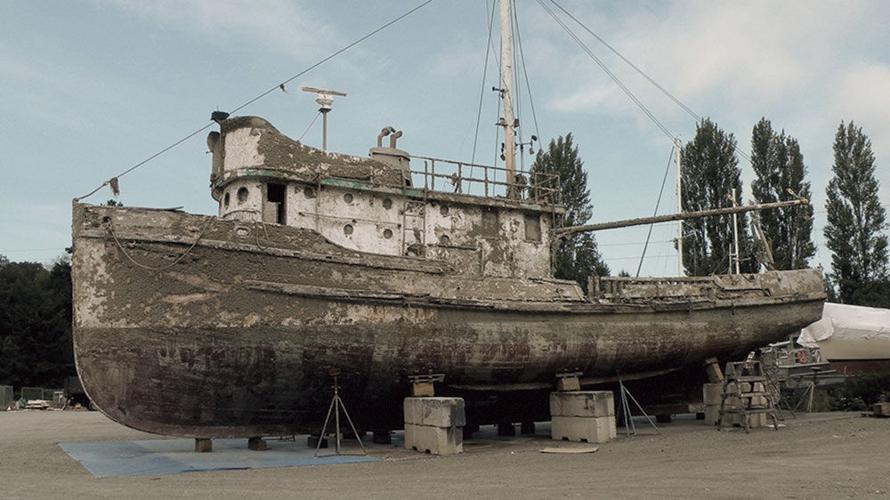
Then finally, with mud and barnacles all over, rotten and twice-sunk, this one-time Monterey Bay darling was purchased in 2015 by John Gregg for $1 million.

The Western Flyer at its worst in 2015, before its recent restoration.
IT TOOK $6 MILLION MORE TO BRING THE VESSEL BACK TO LIFE. “We had to do 70 years of maintenance at once,” Gregg says – replacing rotten wood, getting a new (but historic) 19th-century steering wheel.
The biggest difference is a cutting-edge hybrid electric diesel engine, Paul Tate, the Western Flyer’s captain since April 2023, proudly explains. He is responsible for maintenance, operations and people’s safety on board, including yours on Nov. 4 – if you care to tour the historic boat.
“Everything white is diesel,” Tate says, presenting a clean and ultra-modern-looking engine, contrasting with the old-fashioned feel of the boat. “The black equipment came from Italy. It’s a high-tech electric drive unit that can push a boat for five hours. And when you are running on diesel, it charges batteries up.”
It was Tate who sailed the boat down to Moss Landing from Seattle over a week in the beginning of October, after spending several days in Newport, Oregon, due to the bad weather and a large science community that was interested in seeing the boat. But while everybody wants to see it and many have something to say, the most important question is: What would Steinbeck and Ricketts think and say if they saw the Western Flyer 2.0, several decades and several millions of dollars later, with a modern silent engine, a lab in the fish-hold, a generator for power and 3,000 gallons of fuel stored on board?
“They would be wowed,” says Sherry Flumerfelt, executive director of the Western Flyer Foundation. “They were talking about how great it would be to have a lab here.”
“I think they would be just astounded,” Tate echoes, looking around the fish-hold, spacious and orderly – no sign of sardines. “They were visionaries and it would be very gratifying for them to see it all. I’m sure they would be happy with the hybrid engine.”

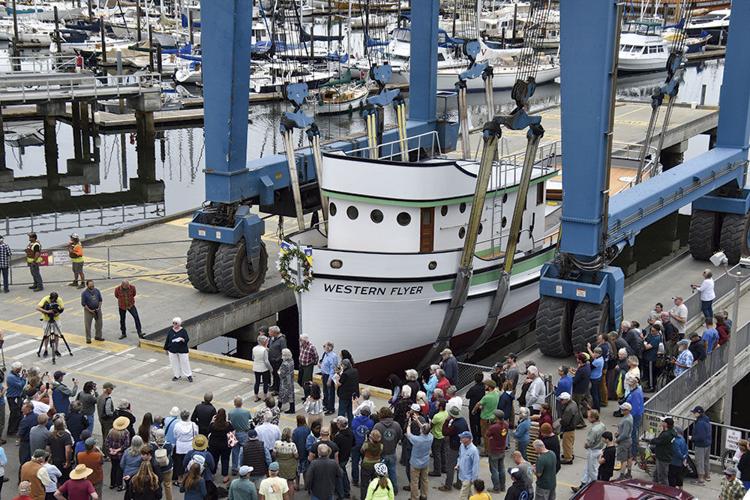
A crowd gathers at Port Townsend Shipwrights Coop in Washington to bid farewell to the Western Flyer before its October 2023 voyage back to Monterey Bay.
BOB ENEA FOUND THE BOAT, under a different name, not far from Seattle, in 1986. But he quickly learned that locating it was one thing – being able to buy it back required a second miracle. The owner was a reluctant seller, and eventually requested $100,000. Then Kehoe offered more and acquired it – but never proceeded in retrieving it.
In 2015, a new chapter began when Gregg acquired the boat with a mission to get it back on the water.
He recruited Steinbeck scholar Susan Shillinglaw, her husband and marine biologist William Gilly, and others (Jack Barth, Enrique Umberto, Linda Powell-McMillan, Bob Lesko and Tom Keffer) to his board, and in 2017 the Western Flyer Foundation was approved by the IRS as a 501(c)(3).
The story itself was gaining traction; in 2015, Kevin Bailey published a book titled The Western Flyer: Steinbeck’s Boat, the Sea of Cortez, and the Saga of Pacific Fisheries.
It was also a story 75 years earlier. “The moment of hour of leave-taking is one of the pleasantest times in human experience,” Steinbeck wrote. “People who don’t ordinarily like you very well are overcome with affection.”
Before leaving, in 1940, the boat took part in a fiesta and a boat parade. By the time of leave-taking so many people came to see the crew off that they departed much delayed.
It’s interesting to think about whether Steinbeck would agree that the same applies to homecoming.
Like many Monterey residents, Enea, the man who first found the boat in 1986, will be on Fisherman’s Wharf to greet the boat upon its return.
Just like when the boat took off in 1940 – when “the whole town of Monterey became fevered and festive” for the end of the sardine season celebration, as Steinbeck wrote – the homecoming of the Western Flyer will be accompanied by festivities with a decorated boat parade, led by a Monterey fire boat.
A retired teacher and now a part-time swim coach, Enea is a nephew of both captain Tony Berry and seaman Sparky Enea, who was part of the crew, along with his inseparable friend, seaman Tiny Colletto. These men were known trouble-makers and were closely supervised by the Monterey police, Steinbeck reported with affection.
“We’re not fishing,” Sparky would announce to each passing boat, when the Western Flyer finally took leave on March 11, 1940, full of shovels, nets, fish kits, flashlights, as well as cases of spaghetti, peaches, pineapple tomatoes and whole Romano cheeses.
“Why not?”
“Aw, we’re going down in the Gulf to collect starfish and bugs and stuff like that,” Sparky Enea would respond casually, making the fishermen’s jaws drop, according to The Log.
It was March 1940; “Hitler marched into Denmark and into Norway, France had fallen, the Maginot Line was lost,” Steinbeck wrote.
The voyagers on the Western Flyer, at sea for six weeks, didn’t know any of that at the time, but they knew the daily catch of every fish boat within 400 miles.

This is not the original steering wheel, it’s older than that. This historic wheel was part of a 19th-century boat.
ENEA DIDN’T GET REALLY INTERESTED in the family story until his Uncle Sparky wrote down his own memories and shared a copy.
Sparky Enea was Bob’s uncle; Tony’s Berry’s wife, Rose “Tootsie” Berry, was Sparky’s sister. As a child, Bob didn’t know much about the voyage of the Western Flyer even though names and places were mentioned, typically during Sunday spaghetti dinners that could gather 20-30 people. Sparky and Tiny Colletto grew up together.
The Enea and Colletto families’ houses were back to back, Bob explains, both Sicilian families. Tony (Anton, really) came from the other side of the Italian peninsula, on the Adriatic coast. He was a quiet person, an engineer by education and later in life a carpenter.
“Sparky, on the other hand, would always tell a lot of stories,” Bob says. “One thousand wacky stories, he called them.”
What was the wacky story from the trip to the Sea of Cortez?
“That was a crazy trip,” Bob says. For example, Carol Steinbeck was also on the boat, but she didn’t share a bed with her husband, nor was she mentioned in The Log. “Carol was enamored with Tiny during that trip, and later,” Bob says, relating what he heard from Sparky. “The Steinbecks were fighting throughout the trip, and didn’t even sleep in the same room. Sparky said the whole crew thought it was pretty odd.”
But there were wonderful memories too: Sparky’s favorite was the day when Tiny, a lightweight Navy champion, fought with a regional lightweight champion they encountered in the Sea of Cortez and was beaten. “Probably because they had a gallon of rum before the fight,” Enea says, passing on what he heard from his uncles.
That led to his first reading of The Log, a pivotal moment that resulted with Enea starting his own search for the Western Flyer, in the 1980s, when the first local foundation with aspirations to get the boat back was started.
But, despite years of trying, the Western Flyer would never be found without a final consultation that took place between Bob Enea and then-still-living Captain Tony Berry, who figured out how to confirm a suspect boat’s real identity. “Check the call sign for the radio,” Berry advised his nephew. WB4044; it worked.
“I’m a little sad Uncle Tony will not see it,” Bob says. “But I think he knows somehow that the boat is back.”
While the late Berry cannot attend, his daughter, Geraldine “Gerry” Schwarz, will be in attendance on Nov. 4 with her family, and she will be a judge in the “best dressed boat” contest.
There will also be a lot of Rickettses – and they are coming with their own approach to the story, a bit frustrated that Steinbeck’s version of Ed Ricketts as Doc is the only version posterity pays attention to.

The boat sleeps up to 11 people, and the Western Flyer Foundation will be chartering it to individual scientists who can do research and spend their nights aboard.
ONE OF THE THINGS THAT WE DON’T LEARN ABOUT RICKETTS from Steinbeck, says granddaughter Chris Ricketts, was that he was “a wonderful father and a big family man.” Readers of The Log find out that Ricketts was a womanizer, but the families (of Ricketts, and Steinbeck) are not mentioned.
Chris never met her grandfather, inheriting most of the stories from her mother, Nancy, Ricketts’ second daughter with Anna Makar, now age 99, a 50-year resident of Sitka, Alaska.
“Collecting was a family endeavor,” Chris says about Ricketts’ passion, adding he shared it not just with Steinbeck, but also with his family. The family would spend summers on collecting trips, practicing Latin names of marine invertebrates.
Dominated by Steinbeck’s voice – even though Ricketts was a skilled writer and liked writing – the story of the Western Flyer doesn’t do justice to Ricketts, not as a family man and perhaps not even as an original thinker.
His idea that “wave intensity was a critical factor in determining both the types of organisms present in a community, and how these organisms were arranged within a stretch of shoreline became the basis of the seminal ideas that emerged from coastal ecology in the decade to follow,” wrote C. Melissa Miner, David P. Lohse, Peter T. Raimondi and John S. Pearse in their 2020 essay The Legacy of a Naturalist from the book Ed Ricketts: From Cannery Row to Sitka, Alaska.
It is not a coincidence that the Monterey Bay National Marine Sanctuary’s award to honor scientists who have exhibited exemplary work and advanced the status of knowledge in the field of marine science bears the name of Ed Ricketts. Or that the Monterey Bay Aquarium Research Institute has an unmanned submersible research platform named ROV Doc Ricketts.
Ricketts’ scientific legacy, in many ways, has lived on, even before the Western Flyer was located and restored.

The Western Flyer feels new and antique at the same time. Here, it offers a view of Moss Landing Harbor.
STEINBECK AND RICKETTS hated museum pieces and had no patience for artifacts, according to Gregg.
“They would want it to earn its own keep,” he says about the Western Flyer and its future. “As cool as this boat is because of its place in history, it’s sort of meaningless if it can’t go and do good work in the future.”
It was Steinbeck and Ricketts who came up with the idea of a lab in the fish-hold, but feared dampness there would have rusted their instruments overnight. They had no darkroom, no permanent aquarium, no tank for keeping animals alive, and no pumps for delivering seawater – and they were painfully aware of it.
“We have concluded that all collecting trips to fairly unknown regions should be made twice, once to make a mistake and once to correct them,” Steinbeck announced, adding that next time they would take along a cameraman, who would do nothing but take pictures.
Now, the Western Flyer has access to all these technologies – high-tech scientific equipment, meteorological instrumentation – so the lab will be constructed and named after another influential local scientist, Chuck Baxter, a longtime instructor at Hopkins Marine Station and a co-founder of the Monterey Bay Aquarium, who died in 2022.
The plan for the foundation is to keep the Western Flyer in Monterey Bay nine months of the year, doing research trips with local colleges and universities. Each year, it will travel for a few months – one year to the Sea of Cortez, another to the Pacific Northwest. “The boat will be going on trips all the time,” Flumerfelt says.
This year, the foundation has been shifting from the restoration effort to stewardship, research, education and outreach. In addition to a captain, it hired a full-time science manager, Katie Thomas, who is busy developing details of the research program. There’s also a new education manager, Rebecca Mostow, and the plan is for all education programs to be free. They are scheduled to start in the spring or summer 2024. (For now, the boat will remain mostly in Moss Landing; Fisherman’s Wharf in Monterey is its intended final home.) Students will not only use the boat, but also a 1947 bus that the foundation bought from an old Hollywood set, which will transport Monterey County students to the ocean to do on-land or on-boat work.
The foundation plans to rely on a mix of government and private funding, maintaining partnerships with institutions such as Stanford University that are also interested in using the boat. Additionally, they will be chartering the Western Flyer to scientists, who can do work and spend nights on board. Because the Flyer is so quiet now, thanks to the new engine, the foundation expects to see demand.
“We are not theory-driven,” Gregg says. “We want to go to places on a regular basis over a long period of time to record minor changes [in the environment]. That’s really important to science.
“When I look around, it’s hard to take a victory lap,” he adds, taking a sweeping look at the reborn Western Flyer. “There’s so much work to do.”
The idea is to try as many different programs as necessary, from scientific monitoring to boat building, to see what works – while always trying to combine art and science, Steinbeck and Ricketts.
The Western Flyer and boat parade arrive in Monterey Harbor on Saturday, Nov. 4. Boat parade starts 11:30am; welcoming ceremony at California Dock (end of Fisherman’s Wharf) 12:30 pm; tours of the Western Flyer 1:15pm-4pm. Free. 220-8047, westernflyer.orgThe Western Flyer: A Timeline of the Famous Fishing Vessel
1937 The boat is built in Tacoma, Washington.
1940 Sails to the Sea of Cortez with Ed Ricketts, John Steinbeck, his wife Carol Steinbeck and four crew members on board.
1941-45 It is a working sardine boat in Monterey Bay.
1948 Captain Tony Berry said he sold the boat to Western Boat Building.
1951-52 The boat is registered to Armstrong Fisheries, out of Ketchikan, Alaska as the owner.
1952 Seattle fisherman Dan Luketa buys the Flyer and converts it to a trawler to fish for petrale sole, black cod and ocean perch. He eventually converts it for crab fishing and changes its name to the Gemini. He sells the boat in 1970.
1971-86 Various fishing interests own the boat.
1986 Ole Knudson buys the boat at auction.
1986 Bob Enea of Monterey locates the boat in Anacortes, Washington. He offers to buy it from Knudson and is repeatedly rebuffed.
2011 Salinas developer Gerry Kehoe buys the boat before Enea is able to raise the funds needed. He plans to transport it to Salinas, then display it in the Bruhn Building.
2012-13 The boat, in terrible condition, sinks – twice. The second time, it is underwater for six months.
2015 It is purchased by John Gregg, who founds the nonprofit Western Flyer Foundation.
2020-22 The Western Flyer remains docked in Port Townsend, Washington, for refurbishment.
October 2023 The Western Flyer sails to Moss Landing. Efforts continue to create long-term docking at Fisherman’s Wharf.
(0) comments
Welcome to the discussion.
Log In
Keep it Clean. Please avoid obscene, vulgar, lewd, racist or sexually-oriented language.
PLEASE TURN OFF YOUR CAPS LOCK.
Don't Threaten. Threats of harming another person will not be tolerated.
Be Truthful. Don't knowingly lie about anyone or anything.
Be Nice. No racism, sexism or any sort of -ism that is degrading to another person.
Be Proactive. Use the 'Report' link on each comment to let us know of abusive posts.
Share with Us. We'd love to hear eyewitness accounts, the history behind an article.