
HE’S THE SON OF ITALIAN IMMIGRANTS WHO RAN A MONTEREY RESTAURANT AND THEN OPERATED A WALNUT RANCH IN CARMEL VALLEY. He attended Catholic grammar school, then graduated from Monterey High in 1956. He and his brother were the first in their family to attend college, and Leon Panetta graduated magna cum laude from Santa Clara University in 1960, then its law school in 1963. He made captain in the U.S. Army by the time of his discharge in 1967. Initially a Republican, he served for Richard Nixon’s administration as a special assistant on civil rights (although he was forced to resign in 1970). He became a Democrat and in 1976 was elected congressman for Monterey Bay area, serving for 16 years in the House and becoming the chair of the powerful Budget Committee in 1989. He left Congress to serve as director of the Office of Management and Budget under President Bill Clinton, before Clinton named him as chief of staff, a position he held from 1994-1997.
Upon leaving the White House, Panetta returned home and co-founded the Panetta Institute for Public Policy at CSU Monterey Bay, until President Barack Obama appointed him to be CIA director in 2009 and he went back to Washington. Two years later he was appointed to serve as the Secretary of Defense, until his retirement in 2013, again returning and chairing the Panetta Institute.
He currently serves on the board of directors of Oracle, Blue Shield of California, and co-chairs the Bipartisan Policy Center’s Defense Personnel Task Force and the Center for Strategic and International Studies Commission on Countering Violent Extremism. Panetta previously co-chaired the Joint Ocean Commission Initiative, working to reform ocean policy.
He published a memoir, Worthy Fights: A Memoir of Leadership in War and Peace, in 2014, and more recently planted wine grapes on his Carmel Valley property, where he keeps a few walnut trees in remembrance of his father. The next generation, Jimmy Panetta, Leon’s son, was elected in 2018 to his second term in Congress.
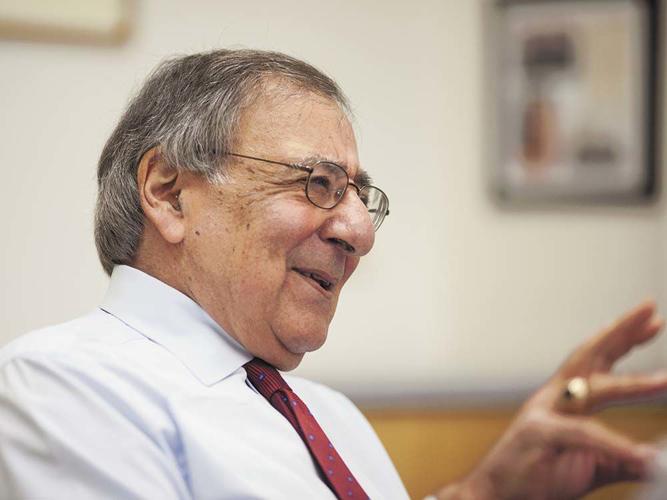
The Weekly caught up with Panetta and his golden retriever, Bubba, at the Panetta Institute, which sports a wall of photos showcasing his life in public service and a brick from the compound that had concealed Osama bin Laden. It was a gift from Seal Team 6, the Special Forces that captured bin Laden while Panetta led the CIA.

This year’s Leon Panetta lecture series focuses on the theme, “Checks and Balances – Will Our Democracy Survive?” The short answer, he says in an interview, is that it’s being tested.
Weekly: You write in Worthy Fights that some see the purpose of governing as to secure political advantage rather than to benefit the public. You reference Newt Gingrich’s contract with America as one of the shifts in Congress. More recently, Senate Majority Leader Mitch McConnell said that the single most important thing he could do was to make Obama a one-time president and he didn’t even give Obama’s Supreme Court nominee Merrick Garland a Senate hearing. That strategy was wildly effective for the Republicans, and they’re getting more conservative judges placed on the courts today than ever before. It seems like that partisan play is serving their constituents.
Panetta: I see it now obviously because my son is in Congress and I’ve often said this: I’ve seen Washington at its best and Washington at its worst. I can honestly say when I was there, Washington worked and Republicans and Democrats worked together to pass legislation. That was important to the country.
The difference is this: When I was in Congress, governing was good politics. If you governed, if you dealt with the problems in the country, it was good politics, whether you were a Republican or Democrat.
I think over the last 20 years, there has been a view that governing is not necessarily good politics, that beating up the other side is much better and that’s created a lot of dysfunction. That’s why McConnell largely took the kind of partisan positions he took. Regardless of whether it was good or bad for the country, he felt it was good for the Republican Party. The Democrats are generally in my mind still a governing party, but they’re tempted to go after the politics of the moment as well. We pay a price for that.
The really fundamental question – because I really do think that in many ways our democracy itself is being tested, not only because of Trump, but also because of the dysfunction in Washington – I think there’s a real challenge about whether or not we can get back to the business of governing our country.
Are you hopeful?
I would like to believe that we have a lot of checks and balances. But the most important check and balance is the ability of the public to vote, and we saw that happen in the last midterms. What I’m sensing is that because I don’t think this dysfunction in Washington is gonna change from the top down, if anything it’s gonna change from the bottom up, which means the election of new members who feel committed to the idea that they’ve got to govern this country. I see that in a lot of the newer members.
A lot of the younger members are veterans who basically put their lives on the line on the battlefield and go back to Washington. They’re not about to just pound their shoe on the table. They want to get things done.
I guess I remain hopeful that maybe with newer members being elected and with the hope that a new president will be elected as well, there’s a chance we can get back to governing.
The youngest member of Congress, 29-year-old Alexandria Ocasio-Cortez from the Bronx, is a self-proclaimed Democratic Socialist. She recently said that the country cannot have billionaires while a homeless person cannot afford a burger – that it’s absurd. She’s proposing a 70-percent tax on high-income folks. Here in Monterey County, we have had a single-family home sell for over $31 million, while farmworkers and others struggle to make a livable wage. We have thousands of homeless people in the county right now. The polarity in our community is stark. Is she right?
Well, I approach this on the same basis as what [Alexis de] Tocqueville found to be the primary strength of America. De Tocqueville came here in the 1800s to try to look at what is this new country all about, this America, and traveled throughout the West and visited communities in the frontier. In his book, there’s a conclusion that is very important: The one thing he found that was very different from Europe was that in these communities, as far-reaching as they were, there was a sense of community and a sense that people work together in order to make sure they took care of their neighbor.
I believe that is really at the heart and soul of the strength of America. That it is people working together, whether they’re wealthy or whether they’re poor or whether they’re middle class, but working as a community to try to make sure that we take care of the problems in our society. I think it gets dangerous when you try to attack one group or the other. I think we do much better if we recognize that we need to sit down at a table and work together to resolve these issues.
There’s no question that equality is a real concern in our society, that the rich are getting richer and the poor are getting poorer and the division between the two is growing worse. But I think we have to be careful that we don’t wind up creating a war between the poor and wealthy but try to see if we can build bridges.
In your book, as often in life, you tell your story of growing up in a family of Italian immigrants. You and your brother worked at your father’s restaurant on Alvarado Street, you were the first generation to go to college and law school. Are the immigrants who arrived legally at Ellis Island then different than those crossing the border illegally today?
I really don’t think so. They seek the same dream that my parents sought. I used to ask my father, “Why did you travel all of that distance to come to a strange land?” Even though they came from a poor area of Italy, in Calabria, they had the comfort of family. I’ve been there; I’ve seen what it was like. Why would you just pick up and travel with no language ability, no skills, no money, and go all of that distance? My father kept saying, “The reason we did it is because your mother and I believed we could give our children a better life in this country.” Which is the American dream.
I think that’s what you’re seeing today. I think our country is a better country because we opened our doors to people from across the world.
How should Monterey County leaders respond to President Trump’s immigration policies, if at all?
There is no question that what is needed is comprehensive immigration reform. I had the opportunity when I was in Congress, during the Reagan administration, to work on the last comprehensive immigration bill to pass the Congress. And it was not easy. It went through a lot of debate, a lot of discussion. I can remember as a member sitting down with my Republican counterparts and other Democrats to try to work through the issues related to farmworkers, and how we would deal with the whole issue of being able to allow them to come in and work and what obligations we would put on employers. It took us about two or three weeks to work through it, every night, negotiations.
What’s needed today is the same kind of comprehensive effort. We’ve known that for a while. There have been some efforts to try to deal with that. [Sen. John] McCain tried to do it, [President] George Bush tried to do it, but they’ve all failed.
Last July, President Trump said that he believes Russia over the U.S. intelligence community when it comes to the Kremlin’s meddling in the 2016 election. What is your reaction?
I am very concerned about the fate of our country when the president of the United States criticizes the information that our intelligence community provides him. You cannot defend the national security of this country unless you have good intelligence that you rely on. To have a president who basically makes up his own intelligence puts us on a very dangerous position.
You still have a lot of friends in the intelligence community, no doubt. It’s a shocking statement from the president of the United States.
There is no question that it impacts the morale of the intelligence community because the only way you get intelligence is to put people’s lives on the line in order to gather that intelligence. If they are concerned that in the end, the primary beneficiary of that intelligence, the president of the United States, rejects that information, then it makes it much tougher to get good people to be willing to do that.
You know Bob Mueller personally.
I do. He was FBI director when I was CIA director and we developed a very strong relationship. We worked together in a number of areas, particularly on counterterrorism. The two of us worked together on something called the Russian illegals when they made an effort to locate 10 spies in our country. As a result of that, we developed a very close personal relationship. We used to go out and play golf together and enjoy each other’s company, so I know Bob Mueller pretty well. There is nobody I trust more in Washington to determine the truth in all of these allegations than Bob Mueller. He’s a professional. He really is nonpartisan.
Should his report be made public?
Absolutely. For all of the talk, there is no way in hell that anybody is going to prevent this report from becoming public.
The U.S. will spend $638 billion on defense this year, 54 percent of the budget. China spends one-third that much and has the second-largest military budget in the world. Russia spends 10 percent of that. What percent should the U.S. devote to the Department of Defense?
No area of the federal government ought to get a free ride when it comes to our budget. That it is critical that whatever money we spend is truly targeted at protecting our national security. When I was Secretary of Defense, the Congress had voted on a Budget Control Act that cut close to $500 billion from the defense budget. My approach to that at the time was to use it as an opportunity to look at what strategies we need for the future, what is it we need to invest in, but also where are the areas where we can save money in defense? There are areas where we can save money. Too often, procurement results in a doubling and tripling of the cost of whatever weapons system we’re investing in; there’s no question we can improve in the procurement process.

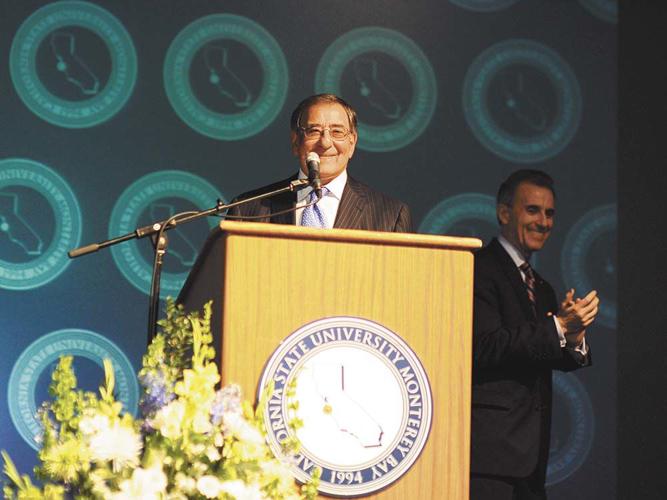
“Every time I retire, we have a hell of a party,” Leon Panetta told a crowd of about 500 people at his 2013 retirement party at CSU Monterey Bay.
What percentage should the defense budget get of the U.S. budget? We hear it’s out of whack because college students carry this ridiculous amount of debt, there’s not enough money for infrastructure, while the military is overfunded. Would you agree with that?
This country has lost sight of fiscal discipline altogether. In the ’80s and ’90s, when I was on the budget committee, recognizing that we were running heavy debts, Congress came together to develop budget agreements that put us on a path to reducing the deficit and the debt. But in order to get there, we had to put everything on the table. We had to put entitlements, which are two-thirds of federal spending, you have to put defense spending, you have to put discretionary spending, and you have to put taxes. All of those have to be on the table. For too long now, the Congress has failed to address all of those areas, and so what’s happened is that they focus on cutting domestic discretionary spending, and it has hurt a lot of programs that are important to people.
While in Congress, you played a significant role in negotiating Fort Ord's closure and its transition. What's gone well and what has not?
Fort Ord represented 25 percent of our local economy. It was a challenge to try to determine how we could try to develop a reuse plan that really would not only restore our economy but also fit with what the Central Coast is all about. I think the decision to make a campus was a very wise decision. Having CSU Monterey Bay continue to develop as a large campus in the CSU system has been one more rewarding aspects of what happened, because we really did in many ways convert swords into plowshares by virtue of developing this campus.
The difficult thing was to try to make sure that the communities that had an interest in the property here would be able to work together in terms of planning the future of what would happen with the 25,000 acres. There's no question that some of the important things have been protecting some of the open space and making the shoreline a state park.
Some communities, working through the Fort Ord Reuse Authority, provided some development as well for the area. In a place where housing is so expensive, it's nice to have at least one area where we can develop new housing.
I really do think that it's really important for the communities that have a vested interest in this area to continue to work together. I guess if there's any disappointment, it's that FORA has, too often, not been able to provide that forum.
Many in the community feel that FORA is painfully ineffective, clumsy bureaucracy, politics is winning out over effective policy in the public's interest. Is it time for FORA to sunset as originally envisioned?
There's no question in my mind that FORA is not performing the role that was envisioned when it was created, which was really to have a forum for the communities to work together in order to make sure we took the right steps in terms of land use for the area. Unfortunately, now there have been too many obstacles that have interfered with what I think was envisioned as the purpose for FORA. What I would say is that it's probably time to create a forum for the communities to be able to work together. That means changing FORA from what it is and what it used to be.
Do I take that as a yes, it should sunset and then create something new?
Before it sunsets, I would rather have something in place. I just think it's really important for community leaders to figure out what we would use to replace FORA before just allowing it to end.
Any suggestions?
I guess the best thing would be to have our state representatives and our federal representative sit down and determine what do we do to make sure we have a much more effective process.
Another round of Base Realignment and Closure may happen in Congress in 2020. Both the Defense Language Institute and Naval Postgraduate School have been considered for the BRAC list. What strategies should the community employ to keep them open, or should we prepare for their closure?
It's important to try to do everything possible to maintain those institutions. I say that not so much as a resident of Monterey County so much as a former Secretary of Defense because the missions of DLI in teaching foreign languages has become even more important in the world of today.
What the Navy school does in providing education on some of the most intricate technologies we now have in our defense systems, the ability to educate officers of the future so that they really understand not only the technical but also what is important in terms of the policies, I think that's critical. I think we have two institutions that have a very critical mission in terms of our national security.
I don't think anybody is suggesting to shut down the functionality of the institutions, but Arizona and Maryland look pretty affordable.
I guess in that sense, I can't get away from putting on my old hat and saying Monterey has done a great job in developing those institutions and we're the ones that frankly ought to continue to host those important facilities.
There have been 239 school shootings since the shooting at Sandy Hook Elementary School in Connecticut. What can be done to curb gun violence in this country?
It relates to the dysfunction that I talked about. Because of the political dysfunction in our country, we’ve been unable to deal with a number of issues, whether it’s the issue of funding infrastructure, dealing with the budget, dealing with education, dealing with gun violence. I remember one of the great things about when I worked with Bill Clinton was that he was willing to take that issue on. We took steps, we developed the assault weapons ban, we developed a pretty strong gun control bill at the time, we had to fight to get it through the Congress, it was not easy. And it was risky, it was tough, but we did it.
As I often say, in our democracy we govern either by leadership or crisis. If leadership is there and we are willing to take the risks associated with leadership, then we can deal with crisis. But if leadership is not there, then we govern by crisis.
Too often now, we govern by crisis. That’s true for what’s happened with gun violence. We all come together, we say how terrible it is, but we never have gotten together to confront this issue. If we continue to elect new people to office, at some point there will be a willingness to take this issue on.
You've written that faith and duty go hand in hand, and your Catholic faith has been central to your family life and your work. You've even met the Pope personally. Meanwhile, the Catholic Church continues to be embroiled in sexual abuse cases concerning many of its priests, including a few years back here in the Diocese of Monterey. Is the Church being accountable in doing what it must do to protect the innocent? Where does faith and duty apply here?
One of the most shameful things that's happened in the church is this whole situation with priests and abuse of children. That's just totally, not only unacceptable, but an embarrassment for all of us who believe deeply in our faith.
I was on a commission to review this issue a number of years ago and we made a number of suggestions (to the U.S. Bishops) about steps that needed to be taken in order to ensure that this should not happen. Unfortunately, the church leaders did not really act as they should have acted to protect the church from those that would abuse our faith. I think that's still the case today. I don't think that the leaders in the church have taken the necessary steps that are required in order to ensure that this doesn't happen. The result is that there is increasing distrust in the church among Catholics, and I think somehow that trust has to be restored.
Does it challenge your own faith?
I'm a believer that as a Catholic, I believe in the message that really established the church from our founder, which is a message of love, not only love of god but love of your neighbor. That's what is at the foundation of my faith. It isn't whoever is Pope or whoever happens to be the priest that guide our faith. My faith is based more on the fundamental belief that created my faith to begin with.
The U.S. Bishops asked us for that report. We did it, we went around the country. We spoke to different bishops, different cardinals. It was obvious that it was a deep wound that had to be dealt with. Unfortunately, what we've seen is that too many have tried to shove it under the rug and not deal with it.
When you were CIA director, Cannery Row Company CEO and Sardine Factory founder Ted Balestreri, your long-time friend, offered to put up his most prized bottle of wine, the 1870 Chateau Lafite, worth more than 10 grand, if you caught Osama bin Laden. The story, as I’ve heard it, is that your wife, Sylvia, called Ted and said, “Get the wine opener ready.” He said, “That son of a bitch set me up.” Did you have some inside knowledge you forgot to share with him?
It was at a New Year’s Eve party and we were in the (Sardine Factory) wine cellar and everybody was having a good time. Ted got up and was, you know, typical Ted talking about the restaurant and things he was proud of and then he began to talk about the wines in the wine cellar. He talked about how he had this Lafite Rothschild, 1897 or something like that, and that it was the most expensive bottle of wine he had. Then he kind of paused and said, “You know, and I’ll tell you what… ” Because I think somebody said, “When are you gonna open that thing?”
He thought about it and he said, “When Leon gets bin Laden, I’ll open that bottle of wine.” As Sylvia described it, my eyes got tight. I looked at him and I said, “You’re on.” They all commented that I did not hesitate to do that.
The truth was, although I couldn’t have told him because it was classified at that point, for the first time, we thought we had some pretty good evidence about the location of bin Laden. When we finally did the operation, I think the first thing I told Sylvia was, “Call Ted and tell him to watch the president tonight.”
What do you remember about the wine?
We then had the wine opening at the Carmel Beach Club. He ordered little shot glasses from the CIA. The sommelier opened the bottle and poured it, and everybody had a chance to drink the Lafite Rothschild out of a CIA shot glass. I remember saying something like, “You know Ted, you’re obviously very generous to do this but I have to tell you, I’m not sure that bottle was worth $10,000.”
Has he opened a second bottle, just for the two of you?
I don’t know when the hell he’s gonna open that. We’ll see.
Is there a challenge on the table?
Not at this point.
Is there one you want to put out there now? I’m happy to be the messenger on this one.
When we get a new president. (Laughs.)
What’s on your bucket list?
I really like being 3,000 miles from Washington. Probably what (Sylvia and I are) doing now with our place in Carmel Valley, planning a vineyard. On my bucket list is the opportunity to taste a Panetta Reserve when it comes out of that vineyard.
Speed round. What’s your favorite Italian main course?
Gnocchi.
What movie have you seen more than any other?
Casablanca. I used to watch it on long plane rides, whether it was the CIA or Defense. That andHidalgo.
Who’s the one person, living or dead, you would pick to have dinner with?
Winston Churchill. Having read books on Churchill and knowing the kinds of things he went through, he had this kind of incredible mind and ability to be able to look at what was happening in our world and really determine what we had to do in order to protect ourselves.
[Sylvia Panetta enters the room with a time check to end the interview.]
What’s your favorite swear word?
Sylvia: Gosh. Gosh.
Leon: I don’t say gosh.
Sylvia: Oh my gosh.
Leon: I’ll tell you a story. (James) Gandolfini, who played me in the story of the bin Laden raid, wrote to me and said, “I’m playing you in this movie, Zero Dark Thirty. You probably don’t like the way I played it, but you’re Italian and I really appreciate your leadership.” I called him up and I told him, I said, “Look, thank you for your note. You did a great job in the movie. I’m glad they picked an Italian to play me, but it’s a movie. It’s a good movie.”
He said, “Thank you for that. There’s one thing that really bothered me is that they kept making me use four-letter words.”
I said, “You know, that’s the one thing you got right.”
(2) comments
Leon Panetta you are a war criminal and should be sent to the Hague to stand trial. Our country would gain a lot of credibility and respect around the world if we turned you over to face justice. You're typical of what is wrong in our government - too many sheep with no integrity.
Mr. Panetta, your opinion is your own. In my opinion, Our hope and fear was real during 2008-2017. The Obama administration that you were part of did not protect the Americans that fought to live in Benghazi for 13 hours. Unfortunately, Ambassador Stephens did not make it because there was no help in site. Where was their hope for 13 hours in 2012?
Welcome to the discussion.
Log In
Keep it Clean. Please avoid obscene, vulgar, lewd, racist or sexually-oriented language.
PLEASE TURN OFF YOUR CAPS LOCK.
Don't Threaten. Threats of harming another person will not be tolerated.
Be Truthful. Don't knowingly lie about anyone or anything.
Be Nice. No racism, sexism or any sort of -ism that is degrading to another person.
Be Proactive. Use the 'Report' link on each comment to let us know of abusive posts.
Share with Us. We'd love to hear eyewitness accounts, the history behind an article.