

Vista de la terraza is Spanish for “balcony view” and each of 40 apartments here comes with a balcony facing a surprisingly impressive landscape for low-rent housing. The Vista de la Terraza complex sits at the dead end of Carr Avenue in East Salinas, perched on an embankment overlooking grassy fields and a playground at Cesar Chavez Community Park. Beyond that, emerald squares of farm fields, then North Salinas, rise up in the distance.
But many of the backyard balconies, built of wood, have rotted over the past 30 years, leaving some unusable. It’s the kind of irony that permeates recent dealings at Vista, an affordable housing complex where 33 families, most of them working poor, live.

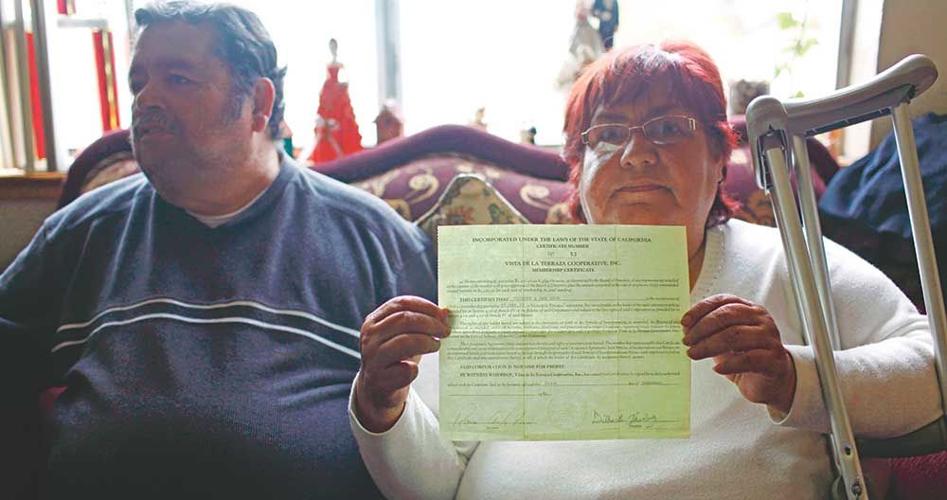
Ana and Vicente Leon, with their certificate showing cooperative membership.
Ironic because the tenants can afford to live here thanks to a number of entities that are keeping this housing affordable – yet doing just that meant relinquishing the promise of homeownership that helped bring many of them there in the first place.
Another irony: Salinas nonprofit housing developer Community Housing Improvement Systems and Planning Association, Inc. (CHISPA) has been the property manager here since Vista was built. CHISPA positions itself as a defender of impoverished tenants, but for years has deferred building maintenance and alienated many of the Vista tenants it is charged to assist. Now that they’ve purchased the property, residents are even more up in arms.
The 30-year state subsidy agreement that made Vista units affordable expired last fall. Without that, any private developer could have bought this place and razed the buildings, built something new and raised the rents to market rate – far out of the financial reach of the working-class families who live here now.
Residents gathered in the first-floor apartment of Ana and Vicente Leon on July 1, after an evening meeting with officials from the city of Salinas.
A city staffer delivered the news: A deal CHISPA struck, which includes an extension on the state subsidy that’s kept the rents low, is expected to close any day. To the city, that’s good news; it means these 40 apartments will stay at affordable rents, a big deal for a city facing a constant housing crunch and rising rents.
But not all Vista residents see it as a positive. A half-dozen are in the Leons’ living room poring over documents, trying to establish a paper trail proving that they – not CHISPA – should be the ones to buy and own the place. The news that escrow is closing means their odds are close to nil.
It’s 10:45pm, too late for caffeine by most standards, but Ana Leon motions to her husband, Vicente, to make coffee. He retreats to their small kitchen, but continues looking on over the counter. (The conversations among residents are entirely in Spanish; quotations are translated into English, with help from the Leons’ son, Jesus.)
This living room has become the de facto meeting place for some Vista residents. The tenants who gather here are members of the nonprofit Vista de la Terraza Cooperative, and Vicente is the treasurer of the group. They bought in at $1,200 to $1,600 apiece, with the expectation that money would eventually be used to buy the buildings when the subsidy lapsed after its 30 years.
It would have never been enough to buy the place outright, but it would give the co-op the option to buy – meaning they were first in line to negotiate. Unless they signed that option away, the dream of homeownership had at least a chance.
Vicente sets down a tray of steaming paper cups of coffee and a pile of sugar packets. He and Ana look on as Jesus, who grew up in this apartment 25 years ago and now lives nearby, rummages through a stack of papers in his backpack.
He finally finds the document, stamped with a state of California seal and dated Nov. 1, 1991, and hands it to his mother. It’s the proof of their family’s one share of the Vista de la Terraza cooperative, bought for $1,500.
“I always knew I was part of something bigger,” Ana says. “It was backed up by the state of California.”
CHISPA is preparing to dissolve the cooperative. That means the Leons’ share will effectively be worthless. They’ll get back the cash they put in, but what they wanted was different.
Instead of becoming owners, they’re renters under a different landlord, CHISPA. Some residents believe CHISPA’s claim on the option to buy is illegitimate and possibly illegal.
Some don’t trust that CHISPA will repair their decaying balconies. So instead of a view from the balconies, the situation presents a view of how challenging it is to keep housing affordable in working-class neighborhoods, and how for many of Salinas’ poor, owning a home is an unattainable goal.
~ ~ ~
At Las Palmas Ranch southeast of Salinas, homes have manicured yards and views of the Santa Lucia foothills, and the streets have names like Legends Court and Acclaim Drive. This 1,031-home community was built over 15 years starting in the 1980s. As a condition of county approval, the developers of Las Palmas were required to provide affordable units.
Some were designated within the development itself, but most were built off-site, including the 40 apartments at Vista and another 50 at Lakeview Towers near Natividad Medical Center.
Both of those multi-unit projects were created under a 30-year obligation, meaning after 2015, the developer could sell the properties at market rate. (The apartments at Lakeview are doing exactly that.) That’s not entirely uncommon for housing projects, unless they are designated as affordable in perpetuity.
Vista de la Terraza was owned by a group of Las Palmas developers, under a separate business entity called Carr Avenue Property, which was represented by Salinas accountant Pat Marchello. The project was originally subsidized by the state Department of Housing and Community Development (HCD) with the California Rental Housing Construction Program, which no longer exists. It meant the state helped CHISPA, the property manager, fund property maintenance and upkeep.
“The rents are set by income. It tempts some tenants to quit their job and walk in and say, ‘I want a lower rent.’ It’s hard to run a building that way.”
The state also set rents on the 40 Vista units based on tenants’ incomes, meaning higher earners pay higher rent. That’s instead of basing rents on averages, which is the practice in affordable housing today.
That means families at Vista pay rents not only way below market rate, but also way below newer affordable housing prices. Rents are as little as $316 a month for a four-bedroom and $230 for a three-bedroom. A quick Craigslist search shows the market rate for neighborhood apartments is easily five times that.
Vista tenants know their rents are about to go up under the new subsidy program, but that’s not why they’re upset. It’s because they paid into the co-op, and a 1982 lease agreement lays out the terms and conditions for 2014, when the state subsidy expired: The co-op would have 60 days to exercise its option to buy, and the purchase price would be $3.2 million. (That would include paying off the remaining $2.1 million on a state loan HCD made to the Las Palmas investors, plus paying another $1.1 million outright to Las Palmas, totaling $3.2 million.)
The litany of complex documents and state subsidy programs is difficult to wade through, and co-op members have faced an uphill battle seeking supporters who can ably interpret the deeds, leases and tax filings of who gets to buy Vista.
The turning point was in 2008, when Vista co-op members reportedly voted to hand over their option to buy to CHISPA. Ever since, CHISPA negotiators have been talking with the city, the state and Las Palmas rep Marchello to come up with a plan to pay off the $3.2 million.
Meanwhile, Vista tenants have been to City Hall and Sacramento to plead their case with nonprofit leaders who represent cooperatives, and they’re not backing down.
Co-op President Maria Santos Santibánez, a friend and ally of the Leons, is quietly fierce. She is poised when others get emotional about their stake in these homes. This group tends to refer to each other by first name, but everyone calls her Señora Santos.
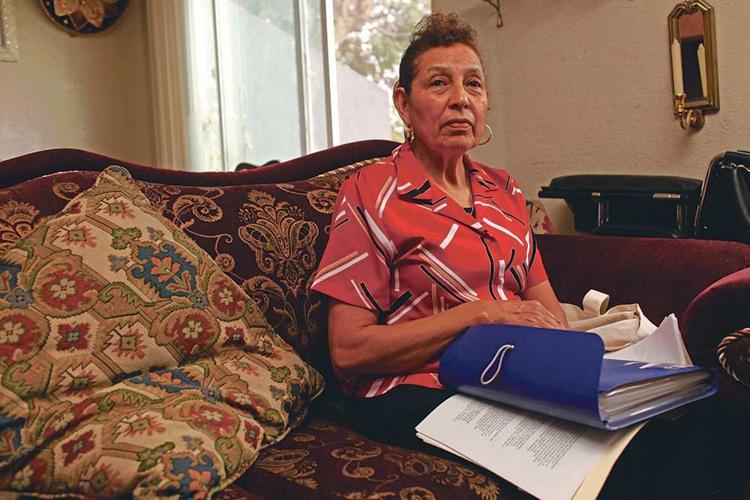
She’s also effectively the group’s secretary, and carries a Trader Joe’s tote bag of important documents. The pile includes photocopies of her handwritten co-op meeting minutes in spiral-bound notebooks.
Santos worked for years as a farmworker, and is now a housekeeper at Carmel Valley Ranch. She’d been living with her two children in a one-room apartment in Salinas in the ’80s, when she heard from a friend in 1991 about a chance to qualify for a better spot.
She put together all of the documents she needed, including her immigration paperwork, applied for a unit and qualified for a three-bedroom Vista apartment that costs just $625 a month.
“The units were very nice, and had a lot of space,” Santos remembers. “They had everything I wanted.”
Twenty-five years later, she lives here with her granddaughter. Santos lists problems with the Vista buildings: leaking ceilings, faulty refrigerators and stoves, kitchen flooring that curls up.
As it turns out, peeling back the linoleum to reveal rotting flooring in the Leons’ kitchen is a lot easier than peeling back the history of how the co-op came to see CHISPA, an advocate, as an adversary.
~ ~ ~
CHISPA President and CEO Alfred Diaz-Infante is the son of farmworkers, and was raised in Salinas. He remembers well the first house his parents bought, in 1971 for $12,500, because they held onto it, and Diaz-Infante and his wife lived there as renters when they were first married.

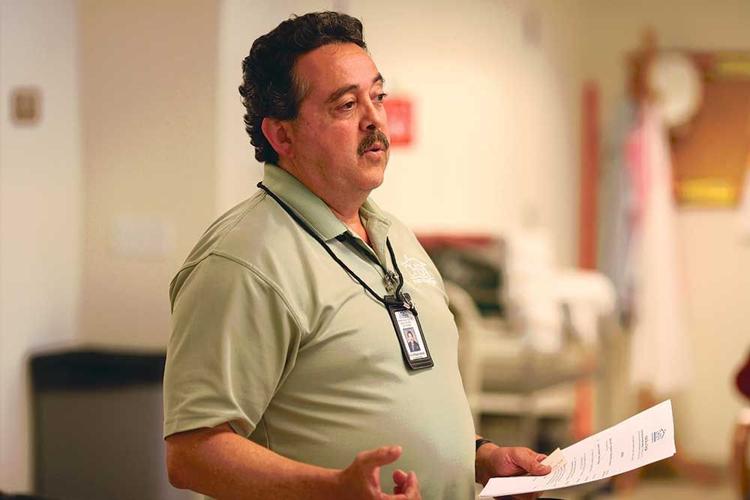
CHISPA CEO Alfred Diaz-Infante views the nonprofit’s successful effort to purchase Vista de la Terraza as the only viable way to keep it affordable. “The worst case is we do nothing, and the property goes to market.”
“Shortly after they bought, we had the first wave of huge price increases. Those times are gone,” Diaz-Infante says. “I don’t think we’re ever going to get back to the time when working families are able to buy homes.
“They were able to build equity. My sister is a doctor, and I got a master’s in business administration. I see what equity does. It helps create more opportunities.”
Since launching in 1980, CHISPA has built or renovated 2,268 homes and apartments for moderate – and low-income people in the Monterey Bay area. Today, Diaz-Infante heads the nonprofit, which reported $6 million in revenue in 2012, the most recent year for which financial information was available.
When Diaz-Infante talks about Vista de la Terraza, he talks about CHISPA as a hero willing to step in for families.
It’s not a property in the kind of condition most investors would eagerly take on; the group of Las Palmas developers who owned the place stuck with years of tedious negotiations to offload the place. (Though one individual from that group still holds a 32-percent ownership stake.) The CHISPA board itself was divided by a 5-4 vote on whether to go for it.
CHISPA has for years been the property manager for Vista, and blames deferred maintenance on the low rents and low subsidy payments from HCD. Seven units are vacant, and CHISPA officials say they haven’t filled them because they need to do major structural repairs to fix a cracking foundation.
Diaz-Infante says the negotiations between CHISPA, the accountant repping the original developers (Marchello) and state HCD officials were complicated. “There were times we were ready to walk away,” Diaz-Infante says.
CHISPA had to persuade HCD to extend its 30-year loan for another decade, and to convert it to another housing program, since the Rental Housing Construction Program no longer exists. HCD is effectively the bank in this deal.
CHISPA agreed to take over the Las Palmas developers’ remaining $2.1 million state loan. CHISPA also negotiated directly with Marchello on the investors’ remaining $1.1 million asking price, and cut that in half. They had some $380,000 from the co-op’s account – including a $50,000 grant from the United States Catholic Conference, which CHISPA had helped them to win years earlier – to help pay the investors.
The result is that CHISPA, through Carr Avenue Partners L.P., now owns the place and intends to begin renovations within a few months. Rents will go up, but will still be based on income.
In Diaz-Infante’s view, this is the best outcome for residents who still struggle to make ends meet. Cooperative memberships didn’t accrue value over time, he points out, leaving tenants without nearly enough capital to buy the place.
“This co-op is the illusion of homeownership,” Diaz-Infante says. “If you’re not building equity, not building wealth, it’s a disservice. We have as a goal at CHISPA to graduate our tenants to homeownership – true homeownership.”
Members bought in decades ago, but all they have now is what they originally put in, plus minimal interest.
What they did have, though, was the first option to buy. For that reason, to Santos and the Leons, there’s reason to question why CHISPA was involved.
A critical document residents point to is a two-page resolution signed on June 3, 2008 by four co-op board members. (Three other board members were absent from that meeting.) The resolution confirms the co-op is handing over its option to buy to CHISPA. It’s in English, even though the four signatories speak only Spanish.
One of them, Ana Gonzalez, claims she never signed it. She, along with a vocal group at Vista – and San Jose attorney Herbert Patty – is calling the integrity of that document into question.
“There are questions that haven’t been answered,” Patty says. He’s meeting wih CHISPA officials on Aug. 11.
The resolution codified a vote of co-op members, cast on secret paper ballots a month earlier. There were three choices on that ballot: For the co-op itself to raise enough money to purchase and rehab the property; to assign the option to buy to CHISPA; or to become a partner with CHISPA in buying and managing Vista.
Diaz-Infante doesn’t know the exact vote count, but he says it wasn’t close. But the co-op members who are speaking up now dispute some key facts about the vote and the subsequent resolution approving it: Chiefly, they say they relied on bad legal advice.
When these critical decisions were coming to a head in 2008, co-op board members asked Salinas city officials to help them pay for a lawyer. They agreed, and the city paid Blanca Zarazua $15,000 for legal counsel she provided to the Vista cooperative.
Zarazua has an impressive resume. She’s bilingual, the honorary consul for Mexico in Salinas, and a champion of immigrants’ rights. She has warned Mexicans against scammers who are looking to rip them off instead of handling their immigration paperwork, and she’s an attorney representing King City residents in a federal class-action lawsuit against police officers who allegedly targeted them and impounded their cars for profit.
She also has ties to CHISPA. Zarazua’s law office was a sponsor at CHISPA’s 2015 annual celebration and fundraiser, and she served on the CHISPA board in 1995, before Diaz-Infante joined CHISPA 18 years ago.
It’s not clear what advice Zarazua gave to co-op members and why, because she declined interview requests.
Current co-op board members say Zarazua led them to believe they had no choice but to hand over their option to CHISPA.
“CHISPA gave us the runaround,” Santos says. “Blanca Zarazua said, ‘If it’s difficult for CHISPA, imagine how hard it would be for you, as a co-op, to purchase this.’”
That’s true; it would’ve been difficult. After CHISPA withdrew $380,000 to pay off the Las Palmas investor group, the co-op has $169,000 left in the bank. Taking on a 10-year $2.1 million loan from the state would’ve been no easy feat – figure $6,000 a family per year, with interest, compared to lower rents.
Santos says the co-op’s relationship with Zarazua began deteriorating when they started asking questions. “I said, ‘I want everything on paper.’ And she said, ‘What, you don’t trust me anymore?’ I said, ‘Well, yes, but here in the United States, everything is done in writing.’”
Whatever happened between parties, Zarazua made her side clear in a July 13 letter, written in Spanish, to Santos. “During recent months, communication between Vista and yours truly has been terrible,” she wrote.
“Your unmistakable show of lack of confidence has caused me serious humiliation as a lawyer… I do not currently consider myself a professional representative of Vista de la Terraza Cooperative, Inc.”
Dubious of CHISPA as an ally, co-op members started seeking help elsewhere. They met this spring with all the Spanish speakers on Salinas City Council: Tony Barrera, Jose Castañeda and Gloria De La Rosa, whose district includes Vista. They traveled to Sacramento May 18 for an annual event hosted by the California Center for Cooperative Development, a nonprofit that supports housing and agricultural co-ops and credit unions.
“This is a community that is governed by residents. This is the basic level of empowerment for groups of people who are disempowered.”
Cooperative Development Executive Director Kim Coontz has taken an interest in the Vista co-op’s cause, and has assigned an intern to read through the extensive paperwork that explains exactly how the co-op was formed and why it got cut out of the acquisition.
“This is a community that is governed by residents,” Coontz says. “This is the basic level of empowerment for groups of people who are disempowered. I worry that we criticize lower-income people’s ability to make decisions, and I am worried that part of what’s happening is they’re saying, ‘Oh these people can’t govern, so we need to have another way of having decisions made.’”
That’s the trouble with affordable housing, and any program designed to help the poor: How do you help without disempowering them? To keep Vista affordable, CHISPA had to leverage its own hard-earned power.
Negotiations with HCD and the Las Palmas group weren’t easy, Diaz-Infante says. When it came down to the wire negotiating for an extension from HCD, Diaz-Infante played a trump card: He’s a long-time ally of Juan Uranga, the director of the nonprofit Center for Community Advocacy. Uranga has helped train former Vista board members in community leadership. He’s also married to Anna Caballero, former Salinas mayor and currently a member of Gov. Jerry Brown’s administration as the secretary of the California Business, Consumer Services and Housing Agency.
When Diaz-Infante got frustrated negotiating the loan extension with HCD officials, he says he brought it up: “I said, ‘Look: We have a very good friend who is everybody’s boss. She’s got a powerful position.’ And I told Anna, ‘I know you’re very busy, but the residents are very anxious.’”
~ ~ ~
Diaz-Infante doubts the co-op could’ve been successful at negotiating the maze of state subsidy programs, much less getting the capital together to buy.
“I’m not sure whether or not they could’ve been successful,” he says. “The city, I suspect, would’ve asked, ‘Co-op, if you want to buy this, you need to demonstrate that you have the capacity to go through the acquisition.’”
He adds, “Because of our knowledge and experience, we were able to get the city to invest $2 million for improvements.”
Alan Stumpf, the city’s community development director, agrees. He also says it’s unlikely HCD would have been willing to loan $2.1 million to a group of low-income tenants, or that co-op members would have had the wherewithal to see it through.
“Even if the city had wanted to, I very much doubt the state would’ve said, ‘Let’s give this over to a co-op board that has no experience with ownership or development of affordable housing.

Vista co-op President Maria Santos Santibánez found a San Jose attorney to represent the co-op, but still hopes for pro bono legal counsel.
“Would they have the wherewithal to hire contractors [for needed repairs], then ensure that those contractors follow all the prevailing wage rules embedded in state and federal laws? It’s just an extremely complicated financing mechanism that was needed.”
To Stumpf, CHISPA buying Vista was the best case. “Hats off to CHISPA for hanging in there all these years to see this project through,” Stumpf says. “On the other hand, there was no choice; there was no opportunity for them to do this themselves. There wasn’t anybody else out there that was coming to the rescue.”
Co-op residents went to City Council on May 26, when council was set to consider contributing $95,000 to CHISPA for an operating reserve; CHISPA was in 11th-hour talks with the state HCD for the loan extension, and needed a bigger reserve to seal the deal.
Council agreed, by a 6-1 vote, Councilman Jose Castañeda dissenting. That pledge came after the city had already agreed to give a total of $2 million to CHISPA toward renovations at Vista. (The money from the city is expected to cover just about half of the costs, but the city may give more in the future, mostly from designated housing-related funds.)
But they didn’t agree until after Castañeda asked some hard questions about how the co-op had lost out on its shot at buying the place. He took to heart the co-op’s pleas for help, and he’s joined in some of their late-night meetings over coffee in the Leons’ living room. What the resident don’t seem to realize is that Castañeda isn’t necessarily a credible ally these days; he’s at war with his own City Council, as his fellow councilmembers are considering whether to publicly censure him for a variety of misdeeds, including failing to pay a court-ordered fine and not filing his required economic interest disclosure forms.
Gloria De La Rosa, another councilmember with whom they met, delivered a bold reprimand to Vista residents in Spanish, from the dais. “We are going to help you,” she said sternly. “CHISPA is trying to help. You think CHISPA is wasting the money? I don’t think so.”
Dana Cleary, director of real estate development at CHISPA, also chimed in to clarify some facts. She wanted City Council to know that co-op members had voted in 2008 to transfer their option to buy over to CHISPA – it wasn’t just four signatures responsible for that decision.
“There was a vote by the co-op,” she said. “I don’t have the records of it. I assume they keep records.”
If she sounds frustrated, that’s because she is – at the tenants.
“The residents of the building have enjoyed very low rents for 30 years,” Cleary said. “It’s been a pretty good deal.
“The rents are set by income. It tempts some tenants to quit their job and walk in and talk to us and say, ‘I want a lower rent.’ It’s hard to run a building that way.”
Cleary won’t name names, but says that has happened several times. The tenants, she adds, are constantly squabbling over who pays how much rent – more proof they would’ve been ill-equipped to pool their resources and exercise their option to buy Vista.
According to CHISPA’s form 990s, which a nonprofit is required to file with the IRS in lieu of tax forms, Cleary earns $103,000 a year; Diaz-Infante, $143,000.
Questions about money and management between CHISPA and the Vista co-op have been around for at least 15 years. The Monterey County Civil Grand Jury investigates complaints, then issues an annual report with recommendations to Monterey County Superior Court. In 2000, the grand jury looked into CHISPA’s relationship to the Vista co-op.
It’s unusual for the grand jury to take on an investigation into a privately owned housing complex, which the grand jury acknowledged in its own report: “While CHISPA is an independent, nonprofit entity, the grand jury felt this issue warranted an inquiry because almost $2 million in state and local loans and grants were given in support of Vista. The grand jury felt it was appropriate to track the use of those public funds.”
What the grand jury found 15 years ago was a complicated mess of documents and poor record-keeping, by both CHISPA and the co-op, that only grew worse with time.
“As the years pass, the goal of purchasing Vista is becoming less attainable for the tenants,” the grand jury reported in 2000. “Under the terms of the Housing and Community Development loan, the purchase price of the property increases by $36,000 every year.”
Now it’s too late. CHISPA acquired the property July 8.
On a Friday night around 5, neighbors start congregating at the Leons’ house as they get home from work. Kids are playing soccer in the parking lot out front, and grown-ups go inside for living room chairs, then carry them out to a small concrete entranceway. There’s a small garden, with chili peppers, a rosebush and nopales.
It’s July 17, barely a week after the deal closed. But residents, hanging onto broken hope, still think they have a shot at buying Vista. Ezequiel Hinojosa pulls up a chair. The 64-year-old’s face is lined deeply after three decades of working in the fields, first in Michoacán, Mexico, then Salinas. Hinojosa, who now works in a packing plant, carries a stack of important documents in a plastic bag.
“We’ve been deceived,” he says. “Where did the money from the co-op go?”
What’s left is what co-op members originally put in, plus interest. They’ll have to sign a new lease with CHISPA, their landlord, and put down a security deposit. That will leave a little something for CHISPA to disburse to each family, maybe $2,000 each.
Diaz-Infante penned a letter inviting residents to an informational meeting July 30 at the nearby Los Abuelitos senior living apartments.
“CHISPA has acquired an ownership interest in the Vista de la Terraza apartment buildings,” he wrote.
His letter goes on to explain that they can keep their co-op if they want to, but it would be a co-op in name only, without any future ownership option. It would also entail continued IRS filings, which CHISPA has done in the past, but will not continue to do: “You may prefer to continue your activities as acomité, where you don’t need to spend money filing papers with the state of California and the federal government.”
The letter ends by telling residents they can expect a check for their share of the co-op membership.
As dusk approaches, the group on the Leons’ patio disperses. Señora Santos and Ana Leon are left sitting side by side, contemplating what remedies are left.
“What are we going to do? There’s no money to hire a lawyer,” Leon says. She looks up and says, “We’ll pray to God. That’s all we can do.”
Vicente Leon has been hovering in the back of the group all night, offering up chairs and water bottles. He finally approaches his wife and sits down in empty chair next to her. Wordlessly, he leans back against the cracked stucco wall and weeps.
“Don’t worry,” she tells him, then closes her eyes and turns her head skyward. “We’ll ask God.”
Then Señora Santos, the one who always keeps her compsure, starts crying too.
Ana Leon reaches out and touches her hand: “Don’t worry.”
(0) comments
Welcome to the discussion.
Log In
Keep it Clean. Please avoid obscene, vulgar, lewd, racist or sexually-oriented language.
PLEASE TURN OFF YOUR CAPS LOCK.
Don't Threaten. Threats of harming another person will not be tolerated.
Be Truthful. Don't knowingly lie about anyone or anything.
Be Nice. No racism, sexism or any sort of -ism that is degrading to another person.
Be Proactive. Use the 'Report' link on each comment to let us know of abusive posts.
Share with Us. We'd love to hear eyewitness accounts, the history behind an article.