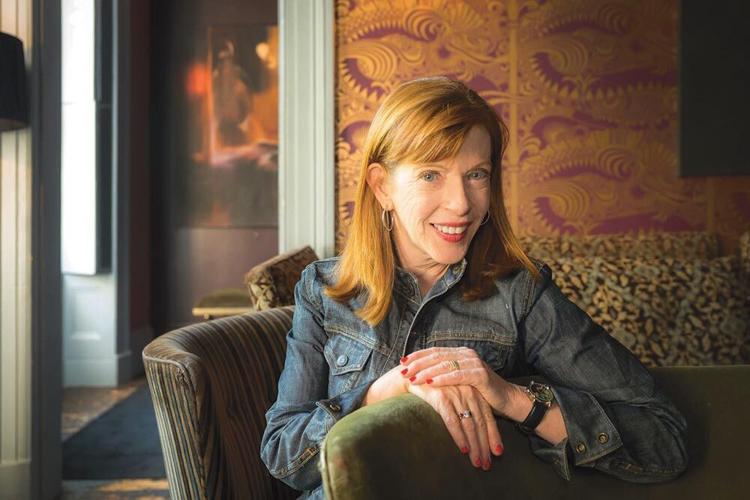


Susan Orlean has been writing since the 1980s. Two of her books have been adapted into movies.
THE WORLD WITHOUT SUSAN ORLEAN AND HER CURIOSITY WOULD BE LESS INTERESTING.
Even if you are not a reader of her regular contributions to The New Yorker or her books – eight to date, two of which became bestsellers, The Orchid Thief and The Library Book – you have likely encountered Orlean’s work in some form. It could have been a 2002 movie, Adaptation with Nicholas Cage playing the orchid thief and Meryl Streep as Orlean, or perhaps Blue Crash, based on her 1998 article about surfer girls in Maui, titled “Life’s Swell.” There’s also television; Orlean did some writing for the HBO comedy docuseries How To With John Wilson.
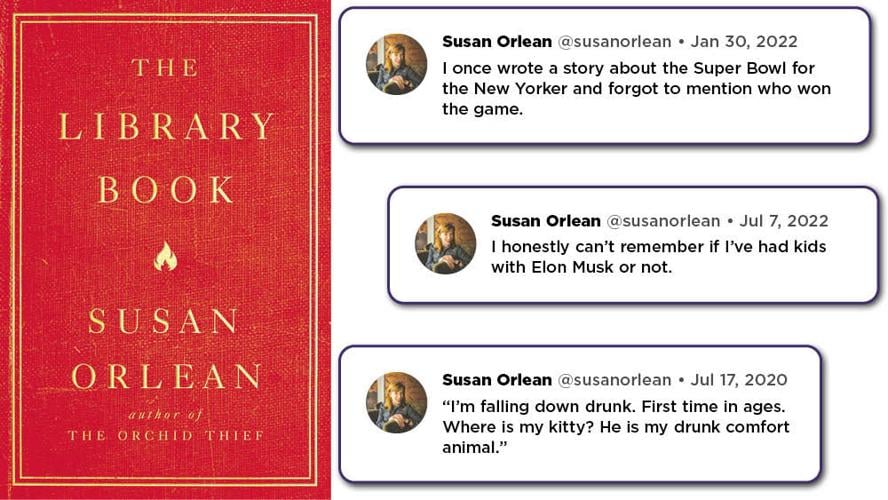
She is also omnipresent in the cultural scene more broadly, with a hilarious presence on social media; she stopped posting on Twitter when it became X, but she is growing strong on Instagram, documenting her trips and everyday thoughts. (A selection of her posts runs throughout this story.) When it comes to longer entries, in 2024 she migrated from Medium to Substack, where you can find her as Wordy Bird. And now this fantastic writer is coming to Carmel to meet her local audience.
The Library Book, the above-mentioned story of a mysterious fire that in 1986 destroyed 400,000 volumes (20 percent) of the Los Angeles Central Library’s collection, is another piece of Orlean’s that will soon be adapted into a film; Paramount TV purchased the rights. Therefore it’s not exactly surprising that the Carmel Public Library Foundation created by the Harrison Memorial Library invited Orlean to the Sunset Cultural Center as a highlight of this year’s programing. There will be a lot of talk about libraries on Tuesday night, April 22, as well as an update on a memoir Orlean is finishing, set to be published on Oct. 14.
“Susan Orlean was selected as our 2025 annual fundraiser speaker because of her unique gift for storytelling, her passion and love of libraries and her far-reaching diverse readership,” noted Alexandra Fallon, executive director of Carmel Public Library Foundation.
What is Susan Orlean uninterested in? Nothing, really. She is into architecture, animals, coffee, gospel, origami, taxidermy and umbrellas. Many of these topics became the subjects of her New Yorker articles. Her neighbor once told her about his revolutionary umbrella invention, hence the 2008 story about an enlarged canopy with a sort of tail on a tuxedo. Intrigued by the niche world of taxidermy, the art of preserving an animal’s body by mounting or stuffing, Orlean wrote about the 2003 World Taxidermy Championships and its fanatics.
Born in Cleveland, Ohio, Orlean studied at the University of Michigan and then moved to Portland, Oregon, where she started working as a journalist for the alternative weekly newspaper Willamette Week. Freelancing for Rolling Stone, Esquire and Vogue, she became a staff writer for the Boston Phoenix and later a regular contributor to the Boston Globe.
As a staff writer for The New Yorker, she moved to New York City in 1986 and later purchased a farm in upstate New York; she relocated to Los Angeles in 2011, where she now lives in the Kallis House, designed in 1946 by the modernist architect Rudolph Schindler with sweeping views of the San Fernando Valley and bobcats walking around.
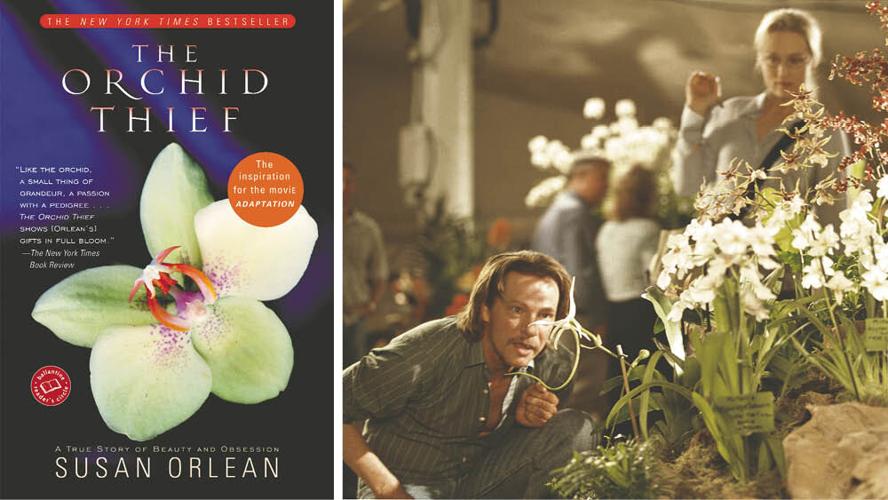
The Orchid Thief is a book about obsession as much as it is about orchids. Its main character is flower aficionado John Laroche from Florida, who is not above theft trying to obtain a certain type of orchid. Orlean followed him on his wild escapades through the swamps and the Seminole Tribe’s land.
A moving character study, the book also portrays the niche but obsessive flower-selling subculture. Why does Laroche do what he does?
“I think the real reason is that life has no meaning,” Orlean quotes him as saying in the book. “You wake up, you go to work, you do stuff. I think everybody’s always looking for something a little unusual that can preoccupy them and help pass the time.” Sounds innocent enough, but Orlean concludes that “orchid hunting is a mortal occupation.”
Orlean, as worldly as she is domestic, is always surrounded by animals, horses and chickens on her former farm, or cats and dogs in a more urban setting.
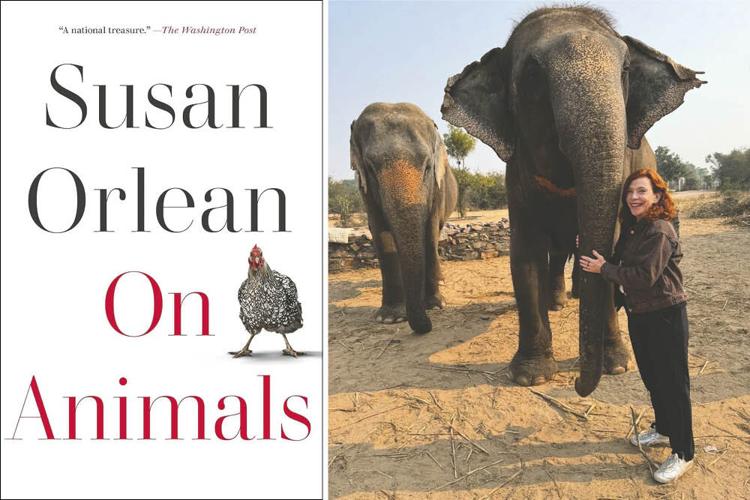
She loves all the animals and has written quite a bit about them. In 2012 she published Rin Tin Tin: The Life and the Legend, a book on the dog who started as an orphan and became a movie star; in 2001 she published On Animals, a book of essays about chickens, pigeons, tigers, panda bears and more. “If I were a bitch, I’d be in love with Biff Truesdale,” she wrote to open her 1995 article about a show dog, a boxer named Biff Truesdale.
Libraries are Orlean’s favorite places to visit. As a child, she used to go there regularly with her mother, who was a big reader. In The Library Book, Orlean talks about her disbelief that, as opposed to a candy shop or a toy store, a young reader discovers that she can browse for hours – and take back home as many books as she wishes.
“The library is a whispering post,” she wrote. “You don’t need to take a book off a shelf to know there is a voice inside that is waiting to speak to you, and behind that was someone who truly believed that if he or she spoke, someone would listen.”
Naturally, Orlean is neither the first nor last writer fascinated by libraries. That’s how many readers become writers – and why libraries are burnt by enemies of a given culture, from the burning of the Great Library of Alexandria by Julius Caesar in 48 BCE to Hitler’s onslaught that destroyed over 20 libraries in Italy alone. Libraries are full of secrets, hence the Index of Forbidden Books (1550-1966) and contemporary attempts to ban books on gender and sexuality.
One of the reasons you haven’t heard about the big and destructive fire in the Los Angeles Central Library is that the same day, on April 29, 1986, the Chernobyl disaster was announced, filling people with terror; each European child and adult was given a dose of potassium iodide to prevent radiation poisoning.
Arson was suspected from the very beginning. The suspect was, and still is, Harry Peak (arrested but not tried), a handsome young man who sought fame and celebrity status. Orlean never had a chance to speak with him because he died before she started the book.

The Library Book, a 2018 bestseller by Susan Orlean, is an homage to the wonder of libraries, spaces that are entrances to thousands and thousands of worlds (through books). The book also reopens a mysterious and still-unsolved event of 1986, when a suspected arsonist set fire to the Los Angeles Central Library, leading to 400,000 volumes burning.
The Library Book is a love letter to all libraries and why they are being burnt. It’s not so much a mystery or a dry historic assessment of libraries and this library in particular, but rather a book of reflections, even if the reader can find many fun facts about libraries and the Los Angeles Central Library itself, as well as the signature Orlean humor. Once a reader called to find out “which is more evil, grasshoppers or crickets?,” Orlean reports.
The below conversation is devoted to the art of writing that Orlean has been developing since the 1980s, starting her career at an alt weekly and eventually becoming not only a staff writer at The New Yorker, but also a bestselling author whose work has been shared widely thanks to Hollywood’s attention.
Weekly: Which early piece of yours was the first that went “viral” and made you famous?
Orlean: A story that really took off for me was the story that evolved into The Orchid Thief [the book that was adapted into the movie Adaptation]. I had gone to Florida originally just to report a New Yorker piece about the theft of orchids. I didn’t have any idea if people would be interested in this subject or not, because it was certainly an odd subject. But it got a huge response, a great deal of interest, as well as a movie option.
You started to write for The New Yorker in 1987 and became a staff writer in 1992. How did you feel when you got promoted to be a staff writer, which is a writer’s dream? Tell us a bit about this transition.
Well, I agree that it’s every writer’s dream to write for such a significant publication, but more than that, to have freedom to write. Not that many magazines have that kind of openness to the writer’s ideas.
Since 1987, I have been contributing to the magazine regularly, but I really yearned to have the acknowledgment of being a staff writer and everything that that implies. It was almost hard to believe. It was something that I could never have dreamed would have happened for me. It really was just as thrilling as you might imagine from afar. You know, it really made me feel like I had achieved something that was almost unimaginable.
How is your writing voice different from your inner voice? Is there a huge difference there?
No, I think, in fact, that what you try to achieve as a writer is to write as authentically as you can, and that means you write to accurately reflect your inner voice. The moment where you’ve achieved the most authentic version of your writing voice is when it truly is a reflection of your way in the world.
Obviously, you write in a more deliberate, careful way on the page than when you speak off the cuff. But what you’re really hoping is to reflect your personality, your perspective, something that is a really genuine reflection of who you are.
You’ve been asked several “desert island” questions in the past. I have a couple, too. What animal – not a pet – would you take with you?
My automatic thought would be to take a dog for company and protection, but if we’re not going to include pets, I would take a useful animal. I think I would take a cow, so I can have milk and cheese.
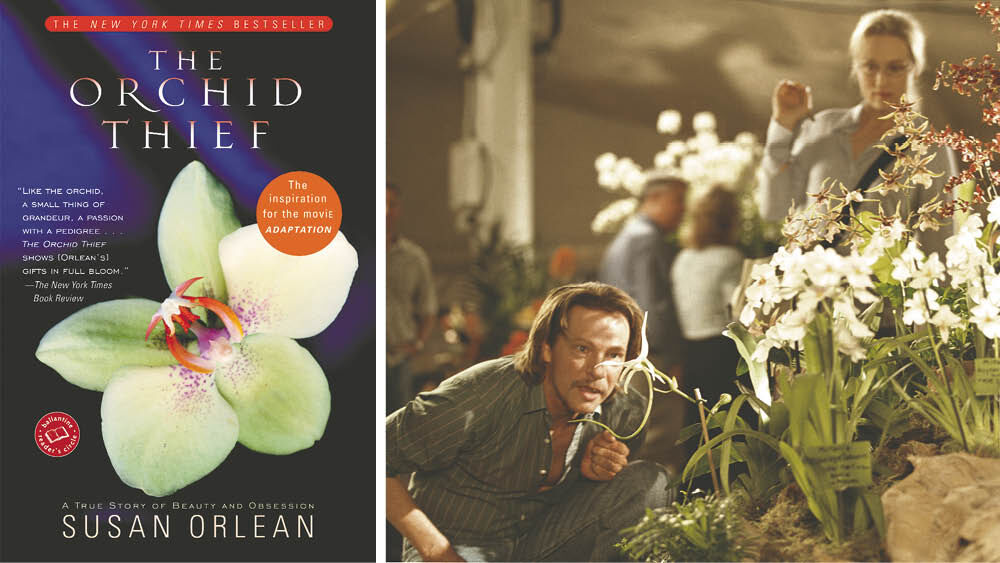
(right)This still from Adaptation shows Meryl Streep as Susan Orlean, observing her subject, John Laroche (played by Chris Cooper). Her interest in orchids grows as she covers his obsession.
Would you continue to write on the desert island, with no readers around?
I guess the big question of writing is: What if the reader is not there?
I think that I would. I would hope someday to be rescued from the desert island, and then I would have all the writing that I had done while I was there, but writing is also a natural way for me to sort out how I feel about life in general. I think I would automatically turn to writing as a way of recording the experience.
How early did you discover that writing leads, potentially, to a sort of secular immortality?
I didn’t express it this way as a kid. But I instinctively knew early there’s something about the permanence of writing. As an avid reader, I was reading books by authors that were no longer alive, and their books lived on. The characters they created are timeless and permanent. I was conscious of the way writing can endure well beyond the lifespan of the writer.
How have things changed for female writers since you started to publish?
There were accomplished women writers in the past, especially in New York. They were trailblazers; their writing was being published. Nellie Bly [1864-1922, a journalist known for her trip around the world in 72 days] comes to mind. For centuries, female fiction writers have been around. Journalists, not so much; when I was a kid, 90 percent of newspaper bylines were men.
The New Yorker is a place that has always had a lot of women in prominent positions, both as writers and editors. I think that, with time, journalism has become a much more evenly distributed kind of landscape, and nobody blinks anymore when seeing a female name on top of a story.
You are working on a memoir. Would you mind sharing a bit?
It’s called Joyride. I would say it’s both a very personal story, but it’s also tracking pretty closely my writing life. It’s very much about my life as a writer, but it’s also pretty intimate.
How do you take your coffee?
So funny. As you were saying that, I was actually lifting my cup of coffee and taking a swig. Nonfat cappuccino. When I’m home I make it for myself. I do have a little espresso machine and a milk frother, and I’m a pretty good barista.
In 2022, you tweeted: “I honestly can’t remember if I’ve had kids with Elon Musk or not.” Do you remember writing that?
Oh, I do. I don’t remember the context that triggered that comment, and of course we have Musk playing even a bigger role in our lives right now. At that time, I believe that the announcement of the birth of another child with another woman was an often thing. It started to seem like he was impregnating just about every woman he encountered. I was just joking around saying that at this point, if you’re female, you have to stop and think for a minute to remember if you’ve had a child with him or not because he’s spreading his genetic pool wider and wider. And since then, he found even more women to carry his children.
Oh, those were more innocent times when Elon Musk just was a wealthy, prominent, innovative business person, but he wasn’t running the country.

Orlean loves animals of all kinds. She not only writes about animals in books (left) and essays, but also documents her animal encounters on social media; the post and photo above originally appeared on Instagram.
At some point you said you are not interested in writing news and prefer deeper and more timeless subjects. But I am wondering if you are a consumer of the news, and what do you think about the future of journalism?
I’m definitely a consumer of news and I’m really happy that there are smart, capable people doing that. I just have never felt that I had the right frame of mind, or motivation, to do a good job being a newshound. I read a lot of news from a number of different sources – The New York Times, The Los Angeles Times and The Guardian. I try to read a lot of news every day and I listen to the news twice a day.
My sense of the future of journalism… I just do not know where we’re headed. We clearly have gone through a huge transformative change in the news business in the last two decades, and my guess is that we haven’t seen the end of it. I will be very surprised if physical newspapers are readily available 10 years from now. There’s every reason to expect that it’s all going to migrate to being digital.
Now we are able to get the news updated constantly and I think the appetite for news has remained constant or even increased, but the system of delivering it is going to keep evolving. The real question is, how will those platforms support themselves and what is the financial model?
It’s not just newspapers – things changed for book readers too in the era of e-books and audiobooks. What is your experience with these formats?
I consume a lot of my books as audiobooks and e-books, and honestly I don’t know if there’s a different neurological function to listening versus reading. The point of storytelling is the same, no matter what way or what manner you consume it. I just like the idea that people continue to consume stories and I’m delighted when anyone engages with what I’ve written.
I guess certain books are enhanced by being audiobooks, actually. I think there’s an imaginative quality that I’m experiencing myself. I am more engaged with it visually. Storytelling since ancient history was oral, and an audiobook, in a way, is as ancient a format as we could possibly imagine.
Then, there’s the environment where it’s not possible to read. New formats don’t demand physical space in your house, you can carry them easily with you, and there is something incredibly liberating about having a book as an e-book. Especially when you’re at the doctor’s office waiting for your appointment and you can read a few pages.
What about libraries, do you think they will be with us forever?
Again, kind of like news, libraries’ collections will likely migrate to audiobooks and to e-books. But I hope the libraries will be around.
You live in and write about California. Do you have any memories associated with this particular part of the Central Coast?
I remember coming to Carmel the first time when I was probably about 5 years old. For a Midwesterner, seeing the ocean and seeing the coast was really magical and unforgettable, and it almost seemed like I was on another planet. It was so different from the landscape that I lived in.
It’s a very early memory because my family had come to California when I was really young. I remember Carmel in particular; that coastline was something that I never forgot.
(0) comments
Welcome to the discussion.
Log In
Keep it Clean. Please avoid obscene, vulgar, lewd, racist or sexually-oriented language.
PLEASE TURN OFF YOUR CAPS LOCK.
Don't Threaten. Threats of harming another person will not be tolerated.
Be Truthful. Don't knowingly lie about anyone or anything.
Be Nice. No racism, sexism or any sort of -ism that is degrading to another person.
Be Proactive. Use the 'Report' link on each comment to let us know of abusive posts.
Share with Us. We'd love to hear eyewitness accounts, the history behind an article.