



In a fluorescent-lit room, Frank Maconachy, CEO of Ramsey Highlander, walks between rows of shelves filled with nuts, bolts, screws and other pieces that keep his business running, literally. The company is an equipment manufacturer, specifically for agriculture.
“We cover the simplest tractors to the most complex harvesters,” he says.
Maconachy stands in front of a demo lettuce packager, which can seal 1,100 heads of lettuce an hour with just one person at the helm. The entire machine, from nuts and bolts up, was built at Gonzales-based Ramsey Highlander, which Maconachy bought from his father-in-law in 1996.
The business is still fundamentally about mechanical components, but Maconachy says the level of innovation happening today wouldn’t be possible without highly skilled workers – and high-speed internet. He notes that at least 15 employees are online at any given time, and everything from billing to purchasing parts is done through the web. “We do everything with the internet,” he says.
Maconachy is not alone. As the agricultural technology sector in the Salinas Valley grows, there’s a need not only for skilled workers, but also for high-speed broadband.
The problem is that when shopping for broadband service, there historically has not been much to choose from – anywhere in Monterey County.
In Gonzales, top download speeds (which are calculated in megabytes per second, or Mbps) for businesses range from 10 Mbps to 20 Mpbs, meaning that when Maconachy has to send large files back and forth to clients on the East Coast or in Mexico, download times can take up to 30 minutes. And those speeds aren’t cheap, with connections costing upward of $199.99 monthly for top speeds of 15 Mbps.
“It’s slower than we want, but we make do,” he says.
Ramsey Highlander’s problem is representative of something more widespread. Until the county invests in proper broadband infrastructure that can support the growth for all its residents and businesses, the digital divide grows wider.
THE “DIGITAL DIVIDE” IS A TERM AS OLD as Apple’s first iPod. Coined by American psychologist Lloyd Markle in 2001, it was meant to describe a disparity between people who had access to devices and the internet and those who did not. Today, the term has come to encompass much more. Because of the ubiquity of the internet and devices in day-to-day life, the conversation about digital access has become a conversation about necessity.
“A 21st-century economy relies on high-speed broadband,” says Steve Blum, president of Tellus Venture Associates, which helps develop community-based broadband policies and networks.
Monterey County’s internet market is dominated by two internet service providers, or ISPs (see glossary, p. 22): AT&T and Comcast. That means no major competition – and therefore fewer incentives to modernize infrastructure or provide competitive pricing, Blum says.
What Monterey County lacks, he adds, is an open-access first-mile broadband infrastructure – essentially the core pipeline that various ISPs – big, small, local or multinational – can lease from and hook into and run their services. Without that critical piece of infrastructure, ISPs are left to create their own – which can cost upward of $250,000 per mile – or to lease off of the few existing pipelines.
Yet, just a few miles past the county line, things look different. The giants of internet in Santa Cruz County include Comcast and AT&T, but they face a formidable competitor: Cruzio.
The independent ISP serves over 9,000 homes and businesses with big clients like the city of Santa Cruz, Santa Cruz County and Watsonville-based A&A Organic Farms. And according to the site broadbandnow.com, Cruzio’s coverage area is at 100 percent in Santa Cruz County. Meanwhile, AT&T and Comcast provide 86.7 – and 63.9-percent area coverage, respectively. Cruzio’s latest project includes providing high-speed fiber internet to the entirety of downtown Santa Cruz – “and we’re only growing,” CEO Peggy Dolgenos says.
Keeping up with the goliaths of the internet industry didn’t come easily. Dolgenos says in the early days, telecom companies like AT&T had major advantages with government subsidies throughout the ’90s to lay the groundwork for high-speed internet.
Yet Cruzio gained an upper hand by getting in the game early and building up a loyal client base. They became the first ISP in Santa Cruz County in 1989. Now, almost 30 years later, Cruzio has made multi-million dollar infrastructure investments, and serves customers from apartment buildings to whole neighborhoods. They provide month-to-month rates for high speeds, unlike many entry-level deals advertised by Comcast and AT&T, which can lock customers into one – or two-year contracts.
Dolgenos sees competition as good for business, driving down rates for customers. “All we’re asking for is a chance,” she says. “We can’t do what we do in a monopoly or duopoly.”
Monterey County, however, has few independent providers, and none with as long a tenure as Cruzio. Of the eight local and independent ISPs that emerged in the mid-’90s, Red Shift is the only locally owned ISP with considerable coverage, servicing 28.9 percent of Monterey County. (That’s in comparison to Comcast’s 69-percent area coverage and AT&T’s 91.3 percent.)
Monterey County is still waiting for an internet lifeline: a major network that can connect urban centers with rural pockets areas at high speeds.
There are solutions are on the way. Construction on a major pipeline called the Connected Central Coast project was completed in April 2017, built by telecom company Sunesys, a subsidiary of Houston-based giant Crown Castle. It has the potential to connect South and North Monterey County cities with the high-speed networks of Santa Cruz and Silicon Valley, covering a total of 430 square miles. The project is a “middle mile,” meaning it stems from a bigger network (in Silicon Valley) and provides a pipeline for local ISPs to connect into.
The Sunesys project has the potential to bring internet to customers in traditionally underserved parts of the county, with faster speeds at cheaper prices.
While better infrastructure is slowly coming along, educators are trying to get ahead and train a new generation in anticipation of that future. One key piece of bridging the digital divide is teaching people how to best use technology – even if that technology remains a thing of the future.
LATE IN THE AFTERNOON, A SCHOOL BELL RINGS OUT, echoing onto Williams Road in Salinas. Like a dam holding back a flood, a swarm of students breach the doors of Alisal High School. At least a dozen are making the two-block trek to Digital NEST.
Nestled in a back room of the Cesar Chavez Library, the nonprofit offers year-round programs in everything from coding to graphic design. It’s modeled after the most successful and – in founder Jacob Martinez’s eyes – most creative tech companies. Think Google and Facebook, complete with colorful modular furniture, co-working spaces and a 3-D printer.

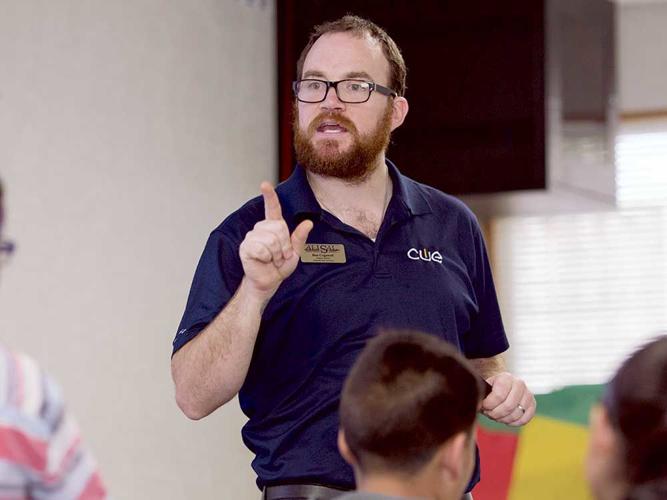
Teacher Ben Cogswell says the first hurdle in bridging the digital divide is giving kids devices like Chromebooks and tablets. “That’s the easy part,” he says. The second hurdle, he says, is harder: Using technology to integrate skills on a regular basis with his students.
It’s not just the space that makes it feel like a place for innovation. It’s also the students attending the program. They’re 17 – to 24-year-olds, mostly Latino from high-need socio-economic backgrounds, many of whom also come from families working manual labor jobs in ag or construction, according to Martinez.
This makes Salinas the perfect location to begin workforce development.
After years of research, Martinez’s formula is simple: Identify an under-resourced city, train high school and college-aged kids, and build their confidence so they can contribute to the local economy. Martinez hopes a few will eventually run big Silicon Valley tech companies themselves – meaning careers for them, and a more diverse tech workforce.
During their tenure at the Digital NEST, students are continually exposed to leaders in tech, plus community partnerships with local businesses looking to recruit students for projects like website design and video production.
“Once these kids have a safe space to be creative, they become problem solvers,” Martinez says.
The proof is on the walls of Digital NEST. Prototype posters promote a reinvention of Chinatown. It’s a local project done on a contract with the Asian Culture Experience, a Salinas nonprofit.
“It’s partnerships like these that allow them to affect the communities they’re in,” Martinez says. “They can be the brains behind the machines.”
He’s thinking about the growing emphasis on ag tech, where the future is often envisioned with robots and drones doing jobs currently held by humans. Martinez hopes to train future employees who can be the inventors and operators of that high-tech gear.
The curriculum and the excitement are in place to create a new generation of tech-savvy local workers. What’s still missing is the infrastructure to support them. But some Monterey County school districts are getting ahead even when it comes to infrastructure.
WHEN SAN ANTONIO UNION SCHOOL DISTRICT SUPERINTENDENT Pam Gildersleeve-Hernandez first took a hard look at internet speed for her one-schoolhouse district in July 2015, it was abysmal.
“You could barely run two Chromebooks,” she says.
Gildersleeve-Hernandez wanted to change that. She received financial help from a Broadband Infrastructure Improvement Grant. Also known as BIIG, the grant was a statewide effort to improve internet access in public schools. Many recipients, like SAUSD – along with Big Sur’s Pacific Valley School and San Lucas Elementary School – are miles away from major cities.
With BIIG, SAUSD partnered with the Monterey County Office of Education to update satellite infrastructure. Broadband speed shot up from 5 Mbps to 100 Mbps. The Monterey County Office of Education stepped in where private industry didn’t, and became SAUSD’s ISP, and the district went from walking to riding a Japanese bullet train.
Then came the devices. Gildersleeve-Hernandez equipped all second – through eighth-graders with Chromebooks. Her students are currently engaged in a project gathering well water samples from local ranches and vintners, and also collecting data through game cameras installed at Lake San Antonio, which play real-time videos of passing wildlife.
Despite embracing technology in the classroom, Gildersleeve-Hernandez is reluctant to send teachers to out-of-area trainings due to the cost. “That’s $4,500 a year, just to send one of our teachers to a ‘free’ training out-of-district,” she says.
Similarly, Alisal Union School District equips second – through eighth-graders with Chromebooks or tablets. They are facing another teacher-training dilemma: Some long-time teachers are reticent to implement technologies in classes outside of science and math.

Teacher Ben Cogswell says the first hurdle in bridging the digital divide is giving kids devices like Chromebooks and tablets. “That’s the easy part,” he says. The second hurdle, he says, is harder: Using technology to integrate skills on a regular basis with his students.“That’s what separates schools from having a middle-class or upper-class education,” Cogswell says.
It’s a pattern that AUSD’s Ben Cogswell is familiar with. Cogswell is a teacher on special assignment, working with district teachers to increase the implementation of technology in the classroom.
“What people forget is that when kids have a screen in front of them it’s not just for entertainment,” he says. “They have access to a wealth of knowledge from around the world.”
As Cogswell sees it, even subjects that are text-heavy, like English, can make use of technology. For example, he says, students can watch a five-minute video demonstrating literary terminology.
“You’re not replacing the book, but you’re getting them to practice looking for patterns before they dive in the book,” he says. “It no longer about whether or not we have these devices – it’s about what we do with them.”
IT WAS AN EXCITING DAY FOR PACIFIC GROVE on April 16, 2014. The city approved a contract with SiFi Networks, a fiber-to-home network developer, to run high-speed fiber cables along the city’s sewer pipes. It would raise speeds from 50 Mbps to up to 1 Gbps – roughly the equivalent of taking the time required to download a high-definition movie down from 14 minutes to 41 seconds.
The deal was almost too good to be true. The city’s share of the $30 million project would be just around $3,000 for the time spent by city staff.
The idea was that existing ISPs – Comcast and AT&T – would foot the bill. London-based SiFi would pay up front, then lease the infrastructure to the ISPs, covering its costs.
Only problem: Comcast and AT&T didn’t buy in, and the project fell through in 2015.
Blum, the president of Tellus Venture Associates, sees the SiFi story as a cautionary tale: A private company comes along willing to front the cash to get a small city up to speed, but bets on telecom giants to pay for it – only to lose in the end. “It doesn’t make business sense,” Blum says.
The deal flopped, but Blum says the fight for local broadband hasn’t stopped. He cites Gonzales as a success story. In 2015, the city petitioned the California Public Utilities Commission to stop Charter Communications – a telecom company that had just acquired competitors Time Warner Cable and Bright House – from leaving out Gonzales from its service area for high-speed internet.
In seeking the CPUC’s blessing for the merger, Charter promised faster speeds in most – but not all – service areas.
“A small portion (less than 1 percent) of New Charter that is not interconnected to the New Charter network may be offered at lower speeds,” according to company filings. That 1 percent covered rural parts of Monterey County including Gonzales, where maximum speeds were just 5 Mbps for downloads and 1 Mbps for uploads.
That was, until Blum fought back.
The city and Charter cut a deal, and as of Dec. 20, speeds are up to 20 times faster in Gonzales: 100 Mbps for downloads and 60 Mbps for uploads, for $39.99 a month.
“Until [December], it was dire,” Blum says.
In the course of the negotiations with Charter, the communities of unincorporated Monterey County and the three other South County cities – Soledad, Greenfield and King City – solicited Charter for quicker speeds. (They’re set to get the faster offering by May of 2019.)
It’s slowly getting better, but there’s still a lot of ground to gain.
According to broadbandnow.com, 30 percent of Monterey County does not have broadband access (defined by the FCC as 25 Mbps or faster). That’s worse than Santa Cruz or San Benito county, where 7 and 17 percent, respectively, of the service areas don’t have broadband.
Blum believes that what Monterey County lacks in broadband, it makes up for in two major ways. It has an abundance of intellectual capital along with a number of post-secondary institutions like the Naval Postgraduate School and Middlebury Institute of International Studies, as well as CSU Monterey Bay. Plus, it has youthful potential, with the median age in the Salinas Valley cities running anywhere from 25 to 29 years old. Those are all assets that telecom company Sunesys cited in its 2014 proposal for its now-completed Connected Central Coast Project, a $13.3 million, 91-mile long middle-mile network that runs from Santa Cruz to Soledad.
Sunesys’ report echoes Blum’s sentiment: The county needs a regional network. “Without that backbone, the digital divide gets wider,” Blum says.
Alan Katz, a vice president of Crown Castle (Sunesys’ parent company), says the key to making Connected Central Coast work was public support. “Sometimes these things fall through, but in this case, it’s been very successful,” he says. “We’ve had community members and mayors make their case to the CPUC for this project.” That, he says, assured Sunesys there would be a return.
Only a handful of ISPs are leasing off the pipeline so far, but Katz says that’s pretty good in less than a year.
“Middle-mile projects are never going to be a perfect answer,” Katz adds. “But it’s a good start.”
(0) comments
Welcome to the discussion.
Log In
Keep it Clean. Please avoid obscene, vulgar, lewd, racist or sexually-oriented language.
PLEASE TURN OFF YOUR CAPS LOCK.
Don't Threaten. Threats of harming another person will not be tolerated.
Be Truthful. Don't knowingly lie about anyone or anything.
Be Nice. No racism, sexism or any sort of -ism that is degrading to another person.
Be Proactive. Use the 'Report' link on each comment to let us know of abusive posts.
Share with Us. We'd love to hear eyewitness accounts, the history behind an article.