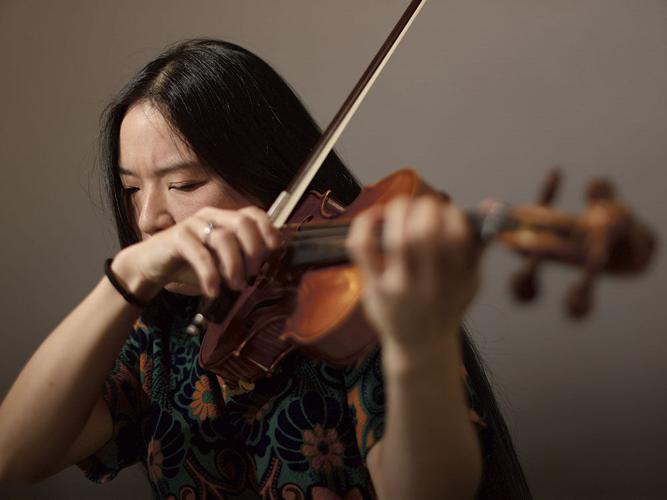


Tien-Hsin Cindy Wu practicing in the living room of her home in Corral de Tierra. She practices five hours daily, on average, and sometimes twice that much.
IMAGINE AN IVORY-YELLOW, SINGLE-FAMILY HOME AT THE TOP OF A HILL ON A SUNNY SUNDAY SPRING AFTERNOON. Even getting here – if you are lucky enough to get an invitation to attend a private concert – brings aesthetic pleasure. The neighborhood is Corral de Tierra, green and hilly, with the views of Santa Lucia Range to the south.
Clearly, there’s a garden party to be held in the house, sprawling and stately from the outside, built on a steep hill, with other equally impressive mansions to the right and left. The hill and the house are soaked in sunlight, with a few strategically placed trees and garden flowers offering dark green umbrellas of foliage.
Drivers, on their best behavior, are gently rolling up the hill to park in an orderly line. People – some dressed up, some carrying plates of food – approach the front door, which is ajar. They follow the directions of the man of the house, Ryan Goodfellow, who is slightly sweating in his blue Sunday shirt, while figuring out logistics and sending incoming food to the kitchen. No time for it now; food is only a dessert here, an afterthought.
The main meal is for the ears, and possibly other senses. It is a house concert for up to 50 listeners, all sitting in the same large living room area where on other days, the lady of the house, violinist Tien-Hsin Cindy Wu, practices for many consecutive hours. “Give me a good practice space,” she likes to say. “Everybody knows that about me. Even at festivals, you always find me at the practice room.”
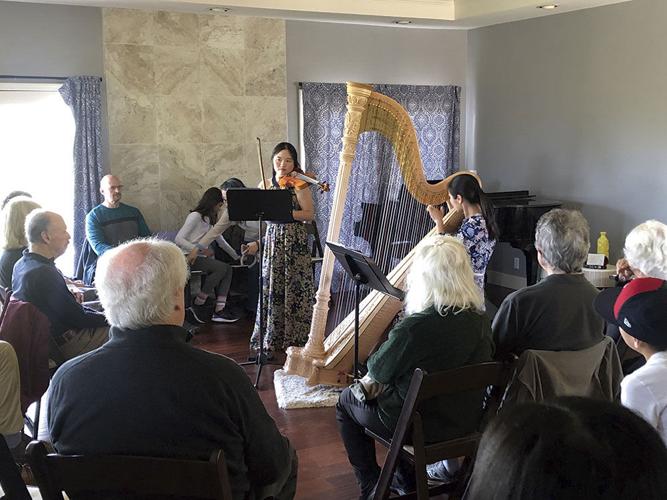
Today, instead of practice, it is a small, intimate performance. Chairs of various design, carried in from all over the house, fill the usually mostly-empty living room with high ceilings. Each seat is topped with a program, made available only at this moment; those who attend the house concerts do so without knowing in advance what will be performed.
This afternoon Wu is performing too, but mainly she is the director, the one who chooses the material, recruits the musicians, rehearses with them and makes sure they get paid – as well as providing them with a stage in her own living room.
At a previous house concert, Korean-American harpist Ko Ni Choi could be heard plucking all 47 strings of what Wu described to her audience as “the most difficult of instruments.” On this afternoon, the program is all about various fiddle traditions.
Wu wears an ethereal golden dress, and keeps her favorite yellow towel between her neck and her instrument, a 2021 Samuel Zygmuntowicz violin made just for her. Her face is expressive, matching the joy, the sadness, the drama of the music.
She is accompanied by violinist Sam Weiser, violinist Pei-Ling Lin and cellist Evan Kahn, and they appear to be having as much fun as the audience. There’s no conductor, so the playful communication between those four makes for a wonderful theater; Wu brings lightness and humor to everything she does.
The program varies, from works by French turn-of-the-20th-century harpist Henriette Renié to Pacific Grove-based composer Carleton Macy. It’s the audience that returns.
Wu describes the house concert audience members as ranging in age, from 6 to 90, and “sparkly-eyed, teary-eyed, taking everything in.” They are “professors, students, ministers, engineers, designers, realtors, landscapers, business owners, daughters, moms, husbands, grandfathers.” They may be seen in larger concert halls attending classical music concerts on more classic stages, or they may not.
It’s all part of Wu’s vision of democratizing the experience of hearing live chamber music. She’s thinking about shaking up the world of Monterey County music, and she already has, starting in her own home.

Wu’s living room during an April 8, 2023 house concert. The harpist is Ko Ni Choi. The program included works by French harpist Bernard Andrès and Russian composer Valeri Kikta.
AFTER THE CONCERT, THE DOUBLE DOORS TO THE GARDEN OPEN AND THE GARDEN PARTY STARTS. Now you can chat with the musicians and have a glass of wine, while looking toward the mountains, enjoying so much space open for the eye. Now it’s time for questions and answers, and the hostess – all smiles – moves from one group to another.
When Wu chose Corral de Tierra as her home, it was done with the understanding that the house must be suitable not only for violin practice, but also for private concerts.
“A lot of musicians can’t afford homes with beautiful rooms,” she says. “And there are so many stories of composers who have a home space where they shared music with the people they wanted to share it with. It’s a lost art.”
Since she moved to Monterey County in 2020, Wu has already organized three seasons of private concerts, inviting friends and new neighbors first. She calls the initiative Sunkiss’d Mozart.
“Our central value is investment in artists,” she says, speaking in the plural on account of her husband, Goodfellow, who is her volunteering right hand in the project, and also on behalf of the current nonprofit sponsor of those private events, New Asia Chamber Music Society.
Wu believes that providing the best working conditions for artists will result in the best performance and the most transformative audience experience, adding that over 90 percent of the donations that Sunkiss’d Mozart takes in go directly to performing artists.
That might not sound subversive, but at least as much as changing up programming and the venue for classic music, the premise of paying more to musicians is out of step with the status quo in the industry.
“Because musicians should also be people that deserve to join the human race of having children, owning a home, eating at restaurants, like normal people,” Wu says. “In all of my own projects, respectful musicians’ fees will be my top priority. I am a musician’s musician.”
Each concert Wu organizes has a central theme and a storyline. One of the concerts in the upcoming season (which starts Sunday, Sept. 17) is titled “Smile, Chuckle and Laugh.”
“It is a program with music that will evoke different humorous reactions from people,” Wu says. “And at the concert, I introduce each piece before performing. A combination of stories about the music, the composer, us musicians, and all human beings – with a heavy touch of comedy.”
It was Ludwig van Beethoven, Wu says, who was a tireless concert organizer determined to create opportunities for fellow-musicians. He had to be; in the early 19th century, musicians built a world for themselves by taking financial risks.
“He organized concerts regularly where every piece, every musician was his artistic curation,” Wu says. “And they were the most important concerts to see, because it was the vision of the greatest musician on the planet.”

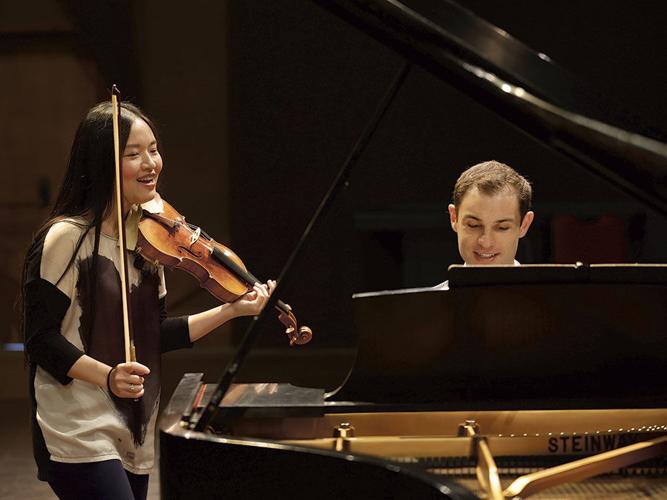
Wu and pianist Drew Petersen during the Emerging Composers Intensive. Petersen is the recipient of the 2018 Avery Fisher Career Grant and 2017 American Pianists Award, and is the Christel DeHaan Fellow of the American Pianists Association.
WHEN WE TALK ABOUT WORLD-CLASS MUSICIANS IN CLASSICAL MUSIC, WE’RE TALKING ABOUT A VERY SMALL GROUP OF PEOPLE. Only very few make it into top conservatories and even fewer can translate conservatory education into a performing career that will take them to stages such as Lincoln Center. Wu is one of them, which automatically means that she is also an educator, responsible for passing the craft to the next generation.
“Labels like excellent, master, and even world-class get thrown around quite a bit when it comes to music,” she says. She adds that labels typically relate to nothing more than whatever experience the listener had, “used so irresponsibly as if music and art is something anyone can randomly decide to claim.”
Being a world-class chamber musician is like being a top athlete and a lifelong researcher, Wu says.
“I think very few can imagine the discipline it takes to keep yourself at your best game whether it’s precision, speed, versatility, leadership, teamwork or whatever the repertoire calls for.”
In the summer, Wu spends almost every week performing in a different chamber music festival. Every single concert takes an average three days of rehearsals. Every festival comes with an artistic director and the musicians who are hired to fulfill his or her vision. Pieces get assigned from the existing, always expanding canon that opens with Beethoven, Mozart, Schubert, Schumann, Brahms, Mendelssohn and Dvorák. Wu ends up playing about 40-50 pieces each summer. There are lots of days when she plays as many as 10 hours per day.
With all of that comes travel and being away from home. Speaking from Chestnut Hill, Connecticut, before her final concert of the season in Portland, Maine, her husband, Goodfellow has joined her for nine days. “Otherwise,” Wu says, “we would have not seen each other since the second week of June.”
Since she departed from Monterey in June, Wu managed to drive to Menlo Park (Music@Menlo Chamber Music Festival), fly to the Hamptons, fly back to Menlo, then to leave for Connecticut. Not every musician can handle that much repertoire plus the traveling. Wu is not only capable of that but typically also brings loads of positive energy; her enthusiasm is constant and contagious.
There are so many things that can go wrong in a day. Musicians get sick and exhausted like everybody else, instruments get locked up in hotels, a mattress one night just feels wrong. “The bottom line is that your bottom line is always above a certain level,” Wu says.
And that’s what she tells her students because in her profession, each musician becomes both a student and teacher.
Not only does Wu have regular and less-regular violin students, but she also continues to mentor former students. “They text me all the time,” she says. “I was at the [most recent] concert of Youth Music Monterey County, and the whole front row was my students.”
After her move to Monterey County, Wu was quickly approached by Hidden Valley Music Seminars, as well as Chamber Music Monterey Bay, where she became artistic director in late 2022. She has since parted ways with the CMMB, but has been running the Emerging Composers Intensive program at Hidden Valley for two years now.
“Many elements of the complete skillset [of a young composer] are often overlooked in conservatory education,” Wu says, “like relationships, communication, public presentation, and even charm, which is unexpectedly but undoubtedly essential as a musician. The Emerging Composers Intensive focuses on completing the skill set for young composers to step into the professional world.”
Lasting nine days, the intensive is essentially a festival, where 10 young, promising chamber music composers have a chance to premiere their pieces and have them performed by musicians like Wu. Composition teachers are composer and piano prodigy Wang Jie and Nick DiBerardino, the dean of the Curtis Institute of Music. The performing faculty includes Eunice Kim (violin), Mihai Marica (cello), David Samuel (viola) and Drew Petersen (piano).
Actual final concerts of the Emerging Composers Intensive are preceded with open rehearsals that are in many ways even more interesting to watch than the final concerts.
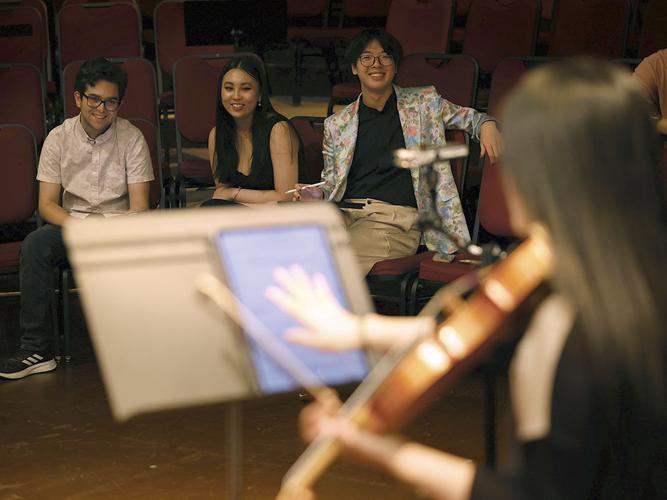
In the dark belly of the 300-seat theater at Hidden Valley, composers and musicians take the first and second row to themselves. In assigned time slots, Jie – in white T-shirt and a half-shaved hairstyle – is sitting at the front central spot with her laptop open. She looks like a casting director, with composers at her side changing every 20 minutes or so. The performing faculty (in addition to being a program director, Wu performs many pieces) go through each composition, starting and stopping several times, laughing, explaining and sometimes singing things to one another. If there’s an error in notation, now is the time to find it, as well as agree on the best tempo.
“I can play it like this,” says violinist Eunice Kim, who is wearing shorts and a tank top, demonstrating a few notes. “Or I can play it like this.” She starts again, her high ponytail moving with the instrument.
A very few laymen in the audience don’t hear the difference, but Jie and composer Jordan Hendrickson from Santa Rosa frown and think, intrigued by a possible modification to the piece, replaying the notes in their heads.
The atmosphere is relaxed and professional at the same time – flip-flops, laptops, bottles of water are scattered all over red, padded theater chairs.
“It’s really exciting to hear your piece for the first time,” says another young American composer of Iranian origins, Kian Ravaei. “But it’s also stressful. I’m usually shaking in my chair.”

The Emerging Composers Intensive festival at Hidden Valley in 2023. Across from Wu are “emerging” composers Kian Ravaei, Yurui “Rain” Hou and Jonathan Wu.
CHAMBER MUSIC DEPENDS ON SPACE. As opposed to the elaborate tradition of classical church music designed to move the masses, it was born to be performed in private homes; the number of musicians usually not more than nine.
The term was used for the first time at the court of Francis I of France (who reigned from 1515-1547), and a decade after his death the term musica da camera was used by Italian composer Nicola Vicentino is his 1555 book, L’antica musica ridotta alla moderna prattica.
A strict division between musica de chiesa (church music) and musica da camera (chamber music) lasted until the baroque period, when composers started to experiment with the fugue form. The golden age of cameral music was the late 18th and early 19th century, when chamber music moved from the houses of aristocracy to those of the bourgeoisie, where a piano and space for instruments was a must. The first public concerts organized in concert halls (new at the time) didn’t happen until the 19th century.
“Up to 200 people,” Wu decides, when pushed to answer the question how many listeners in the chamber music experience are too many. “Otherwise you lose the ability to be involved intimately and participate in the dynamics that are happening.” Or, if you need a more practical understanding of what she is getting at with this relationship between performers and listeners: “People at the back of the room would feel that the musicians are performing in a different space than they are in.”
While she understands the limitations, Wu still would like to try to open up her private home concerts project to a bigger audience. For the last year, she has been working on the project of a full festival that she would like to bring to Monterey County in early 2024. It will carry the same artistic values as Sunkiss’d Mozart, but will be more available to the community.
“Every once in a while, a new experience comes along that completely throws off the scales, setting a new standard for what labels like these mean,” Wu says about the experience she is looking to give, and believing that in classical music, delivering transformative experiences is a byproduct of a lifetime of disciplined practice, conservatory education and decades of experience gained through growing with peers and mentors.
Wu is still looking around for the right space, possibly the Monterey Museum of Art – public but intimate. Her ideal audience would sit all around the musicians, an arrangement she tried at home, but people are somehow afraid to sit in the area they consider to be behind the musicians.
Given her limitless energy and proven organizational skills, Wu is likely to succeed. She has been managing various groups since her time in college. When she started teaching at University of Southern California in Los Angeles, she had opportunities not only to organize reading parties – gatherings to read and play music for the first time, often with cocktails, a staple in musicians’ life – but also to curate her own programs.
There is one program she remembers particularly well, and she would like to repeat its success. It included her absolute favorites for a string sextet: “Verklärte Nacht” (“Transfigured Night”), Op. 4 by Arnold Schoenberg (1899), followed by Tchaikovsky’s “Souvenir de Florence” (1890). Wu had Jessica Lee (violin; now with the Cleveland Orchestra), Lily Francis (violin, viola), Nicholas Canellakis (cello) and Mark Holloway (viola) of the Pacifica Quartet, she reminisces.
Of course, the music is just one part of what makes it work. “I love organizing,” Wu says, “and taking musicians to eat and making everyone happy.
“I hope I don’t give the wrong impression by saying ‘festival,’” Wu adds, “because it is not going to be a carnival of wine and food tasting, or arts and crafts socials. While there are several organizations that present classical music in Monterey County, this is an artist-led project that invests everything it has back into those artists.”
The festival formula seems to be working for musicians and their audiences for many reasons, and Wu would like to explore it.
“Three concerts can paint the same storyline,” she says. “The festival really gives space for storytelling. If you have enough musicians, you can mix and match, from duos to sextets, playing with the sonic, making the experience bigger… I would love for this festival to become a deeply beloved gem in our community.
“I call our concerts’ programming omakase-style,” Wu adds.
Omakase means “chef’s choice” in Japanese. When you order omakase in a Japanese restaurant, the chef crafts each course at the very moment out of the best of his ingredients, knowledge and creativity, and presents it to you with a personal introduction.
Hopefully Wu will be able to translate from home concert to the festival formula the sense of her engagement and presence, because that’s what’s ultimately the most beloved element of Sunkiss’d Mozart project. She is really there with the audience, addressing members directly, sharing her knowledge about the pieces and musicians, always joking, teasing her audience, asking them to trust her, hoping they will hear something that will change their lives.
In the meantime, she is happy to open the fourth season of Sunkiss’d Mozart in mid-September. She is meanwhile experimenting with other ways to give more access to listeners who are curious about classical music, including by hosting a podcast about music that you can listen to on the Monterey County Weekly’s website; it’s called “Wu’s World: Intersections.”
When she is not traveling or teaching, she is likely practicing in her Corral de Tierra living room, thinking about future festivals and playing for her future audience.
“Sometimes, I play in the middle of the night,” she says about her need for constant practice that nowhere feels better than in this chamber of her own. “No one can hear me. Downtime? Downtime is the best time to practice and prevent bad days.”
MIC’D UP AT THE PRESS CLUB presents Tien-Hsin Cindy Wu speaking and playing violin at 12:30pm Thursday, Sept. 7. The Creperie Cafe @ The Press Club, 1123 Fremont Blvd., Seaside. Free. 394-5656, montereycountyweekly.com/pressclub
(0) comments
Welcome to the discussion.
Log In
Keep it Clean. Please avoid obscene, vulgar, lewd, racist or sexually-oriented language.
PLEASE TURN OFF YOUR CAPS LOCK.
Don't Threaten. Threats of harming another person will not be tolerated.
Be Truthful. Don't knowingly lie about anyone or anything.
Be Nice. No racism, sexism or any sort of -ism that is degrading to another person.
Be Proactive. Use the 'Report' link on each comment to let us know of abusive posts.
Share with Us. We'd love to hear eyewitness accounts, the history behind an article.