
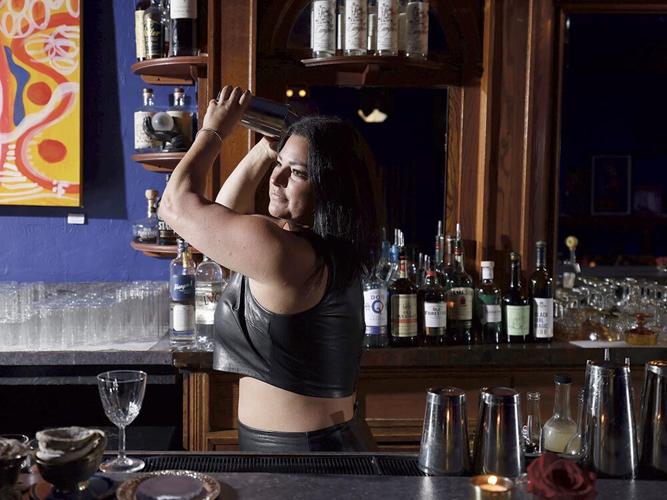


Anthony Vitacca showing some flair at Bar Napoli in Carmel. When he first ventured into mixology years ago at Montrio, the owner was hesitant. But the cocktails created such a stir the San Francisco Chronicle sent a reporter to see what was going on. “If I look back now, they were kind of pedestrian,” Vitacca says of his early drinks.
It’s just before 2:30 on a Thursday afternoon. The restaurant doesn’t open for a few hours, but Daniel Watson is already stationed behind the bar.
In front of him are five containers, and he carefully strains one to another and then repeats the process. As he does, the sullen, timberland aroma of bourbon swells over the counter.
“This is part of the daily routine,” he says.
This is the last step of Watson’s Brown Butter Bourbon cocktail, a staple on the menu at Montrio in downtown Monterey. Earlier he had caramelized butter in a pan and then used it to “wash” the spirit, giving it a cashmere warmth that drapes over the palate and lingers. Now he is in the process of removing any remaining solids left behind.
Is it necessary to blend the essence of butter with a perfectly fine whiskey? Perhaps not, but more than two decades after leather-smocked bartenders with waxed mustaches and muddlers at the ready brought mixology into fashion, expectations are changing.
“There’s a renaissance happening that hasn’t happened in a long time,” observes Ashley Havens at Carmel’s Chez Noir. “People are coming to restaurants also to try the cocktails.”
LEADING THAT RENAISSANCE ARE A GROUP OF MIXOLOGISTS WITH CREATIVE INTENT, and they have ignited a once slumbering craft cocktail scene on the Monterey Peninsula. Five years ago Anthony Vitacca, then at Montrio, was center stage, using smoked ice – a painstaking process involving a wood-fired grill – and other unique house-made ingredients to create memorable drinks. Vitacca now serves as director of wine and spirits for Little Napoli, Bar Napoli and Vesuvio in Carmel.
There were other standout bartenders pouring craft cocktails at the time. But there’s a do-it-yourself element implied in the word mixology that extends beyond making a great drink.
“That’s my apothecary,” says Katie Blandin, pointing to shelves behind the bar at Pearl Hour in Monterey that are stocked with herbs, teas, bitters, shrubs and syrups, all made from scratch. One of their permanent menu fixtures is a mezcal-based construction called Pearlescent, made with a yarrow tincture. Naturally Blandin grows her own yarrow.
“I’ve always taken pride in the ingredients I use,” she explains. “I like flavors, discovering new tastes.”
Matty Eggleston of Stokes Adobe frequents farmers markets. If he returns from a venture with fresh Thai basil, he will work it into a cocktail. Havens has access to the pantry and walk-in at Chez Noir, and all the foraged and daily harvested items that arrive for the restaurant.
“I love the process almost more than the finished product,” Walker admits. “You’re taking a product and elevating it, giving it a life it was never supposed to have.”
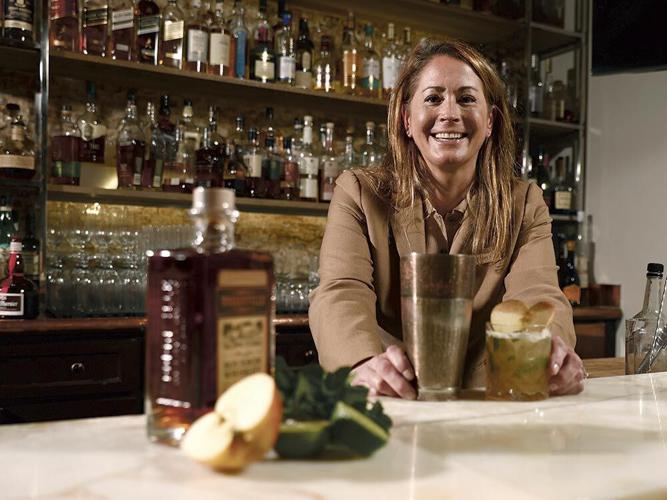
At Lucia Restaurant in Carmel Valley’s Bernardus Lodge & Spa, Colleen Kelly picks from gardens on the resort’s grounds, drying flowers, herbs and fruits. A slice of cured apple completes an herbal cocktail somewhat similar to a Mint Julep, but with a savor suited to fall. She tested four different bourbons before finding one that sneaks in under the apple then is drawn along with it. Recently she created a reverse Bloody Mary, freezing her house-made mix then shaving it on top of the drink.
“It was fun,” she says. “I should put that on the list.”
Kelly’s cocktail menu has been very well received. Bernardus Lodge has earned Wine Spectator’s Best of Excellence Award every year since 2015. The wine list at Lucia Restaurant & Bar is impressive and draws a sophisticated following. This year – for the first time since it opened in 1999 – sales of cocktails surpassed that of wine.
Interest in craft cocktails and premium spirits is on the rise nationwide. While beer tops the alcohol market in the U.S. at 42 percent of sales, its hold on the lead is tenuous. After 12 consecutive years of growth in market share, spirits now account 41 percent. And demand for craft alcoholic beverages in general is on the increase. The Congressional Research Service tallied 21,745 producers of small-batch spirits, liqueurs, ciders, beer and wine in 2020, pegging the market at $32 billion.
These represent new tools. The lead botanical note in Automatic Sea Gin, distilled in the Bay Area, is seaweed harvested off the Mendocino County coast. Black Cow is a milk-based vodka from England. Fog’s End Distillery in Gonzales produces a silver rum with a smoky haze that can at first be mistaken for tequila. There are whiskeys from heritage corns with colorful names such as Blue Hopi, Bloody Butcher or Orange Flint. Liqueurs and spirits little known in the past are now readily available.
“The consumer is educated,” Kelly says. “They know that spirit. They want to see your vision with it.”

According to Colleen Kelly, much of what goes into a cocktail at Lucia in Carmel Valley’s Bernardus Lodge happens behind the scenes, including reading and learning about different spirits. Pouring is the fun part. “There’s an active audience,” she says. “You need that interaction to get the reaction.”
THE MIXOLOGY REVOLUTION IS LARGELY RESPONSIBLE FIRST FOR THE REDISCOVERY OF CLASSIC COCKTAILS, some of which – like the Aviation and the Rob Roy – had been largely forgotten. Studying recipes dating back to the 1800s led them to shrubs, tinctures, a wider range of bitters and liqueurs that had fallen out of favor. As mixology gathered into a trend, these items returned to bar shelves.
“Back in the ’80s all you had to do was pour whiskey, Jack and Coke, it was so simple,” recalls Tuyet Vitacca, the veteran mixologist at Jacks in the Portola Hotel & Spa and also the wife of Anthony Vitacca, who adds that when he started, adventurous drinks were items like the raspberry Lemon Drop.
“Vermouth? Absolutely not,” Havens says, looking back. “It was a dusty bottle on the shelf. We didn’t know how to care for it.” Now the spiked and aromatized wine is one of her favorites, both to sip and to use. “I found, too, that we can find a space for Galliano and others that people turned their noses at. I love Benedictine. I love using Drambuie.”
The word mixologist began being applied to a craft style of bartending in the 1990s, increasingly so during the 2000s. Yet many people – on both sides of the bar – remain uncertain of its boundaries and wary of its airs.
“I remember when the term was first thrown around in the late ’90s-early 2000s, the old surly bartenders looked down on it,” says Andrew Boggan of Sea Root in Monterey’s Hyatt Regency.
Indeed, early mixologists were so taken by long-forgotten techniques and so fastidious in their presentation that dozens of ingredients were often muddled and shaken before a drink was completed and ready to serve.
The turn-of-the-last century attire and facial hair just fueled mockery.
“That word sounds like it came from an SNL skit – ‘Ooh, I’m a mixologist. A little goat cheese foam,’” says Anthony Vitacca, holding his nose in the air and pretending to swirl on the fancy topping. “But I get it, it’s given us legitimacy.”
“Mixologist” can seem precious. There are, however, fine distinctions. Many bartenders in Monterey County serve cocktails of note, recommended for the skill involved. Many bars and restaurants offer a list of specialty cocktails. But they are less likely to prepare their own gomme to replace simple syrup or create a line of homemade bitters.
Havens explains that mixologist does not indicate a status above other bartenders. Instead, it evokes a different approach. “At the base of it is bringing a culinary aspect, another step,” she says.
The recipe for one cocktail at Pearl Hour involves grated ginger, fresh lemon and a tincture from California poppies grown in the bar’s back patio garden space. Another is prepared with a shrub made from pears picked at Birdsong Orchard in Watsonville and lemon verbena grown by Blandin. Mugwort, Maldon sea salt, chamomile and other ingredients appear on cocktail listings.
“We’ve become more accustomed to culinary philosophy and techniques,” Blandin observes. Herbs and garnishes are arranged behind the bar like mise en place, a kitchen tradition of assembling ingredients ahead of time. Blandin refers to Pearl Hour bartender Mel Williams as a sous chef. At Montrio, Watson is refining a cocktail he calls Open Sesame that he believes could be served at the table as an amuse bouche.
The culinary approach can cause some chafing from old-school types. Like a chef, Watson introduces nuances – silent ingredients that would only be noticed if he left them out. “When I designed a drink, bar managers would say ‘if you’re putting something in a drink, you have to be able to taste it,’” he says, referring to some employers in his past. “I heard that time and time again. It’s so annoying. They are building blocks, the foundation.”
Essentially, a mixologist tends toward fresh ingredients, often crafting from farm to highball glass. And while they may retain a core menu, they change some offerings frequently. At Stokes Adobe, for example, Eggleston brings in new cocktails every two weeks.
Yet this is not always the case. Bars tied to hotels, for example, generally try to keep a relatively stable focus. While Havens at Chez Noir changes her menu whenever she gets the urge (she admits to being easily bored, ready for something different), Boggan follows a seasonal schedule.
Both the Hyatt Regency and Portola Hotel host strong craft cocktail programs, but hotels often tread in that narrow space between bartending and mixology. Tuyet Vitacca at Jacks in the Portola acknowledges the gap is dwindling.
“There’s not that much of a difference,” she says. “A lot of bartenders are becoming more and more creative.”
While pouring a concoction of Japanese whiskey, a particularly spicy red vermouth and miso – yes, fermented soybean paste – that has been treated to a sous vide process, frozen and eventually strained, Walker (of Montrio) addresses the differing approaches.
Montrio is part of Coastal Roots Hospitality, along with Tarpy’s and Rio Grill. All three locations need their own identities, whether as elevated cocktail bars or mixology-driven destinations. “It would be inappropriate for them,” Watson says of the drink he calls Miso Harmony. “People going to Tarpy’s don’t want a miso-washed Japanese whiskey. It goes against the ethos of the place.”
Still, he remains unconvinced that “bartender” needs subdivisions.
“I don’t have anything against the term mixologist, I’m just uncomfortable when it’s applied to me. I’m a proud bartender.” Walker does, however, allow a concession: “If you’re making fancy cocktails there’s a part of you that’s pretentious. I’m OK with this.”

“The only thing I did that was different was opening a bar that is exclusively for craft cocktails,” observes Katie Blandin at Pearl Hour in Monterey. “The cocktail scene in Monterey has definitely elevated.”
AT ONE POINT IN TIME, MIXOLOGY WAS ACTUALLY INTENDED TO DISTINGUISH SKILLED COCKTAIL ARTISANS FROM WHISKEY-SLINGING SALOON KEEPERS. The word can be traced back to the mid-1800s, suggesting that it might have been in use earlier. There’s an account from an 1856 edition of The Knickerbocker of a tipsy gentleman entering the wrong hotel room blaming the mistake on the “mixologist of tipulars” behind the bar downstairs. A decade later, a dispatch about the city of Blackfoot in the Montana Post bragged of the Headquarters Saloon, where a gentleman could imbibe on “drinks of all kinds, from ‘whiskey straight’ to the most intricate ‘stonefence,’ put up at all hours by the most scientific mixologists of fluid excitements.”
Historians often single out Jerry Thomas – famed as “The Professor” – as the founder of mixology. In 1862 Thomas, who was already a celebrity bartender thanks to showy contrivances like the flaming Blue Blazer, published America’s first cocktail guide, and it was comprehensive. Bar-Tenders Guide, which was also labeled The Bon Vivant’s Companion, established a level of craft and professionalism that had not existed widely, and it helped to develop the nation’s first cocktail culture.
“The white coats, the bow ties – those were the OG,” Kelly says.
The forefathers of mixology came up with drinks that became staples. Martini, Old Fashioned, Manhattan, Sazerac, Gimlet, Daiquiri and other names date from this late-19th-century cocktail golden age launched by Thomas’ book. According to the media analytics firm Nielsen, some of these remain popular among American drinkers.
Ironically, classics create the foundation for modern mixologists.
“You can do all kinds of variations,” Anthony Vitacca explains. “Manhattans were always my base. Three ingredients.” Bitters can be substituted, a liqueur swapped in for vermouth, maybe a barrel-aged gin to replace the bourbon. “You can build on that,” he continues. “Maybe it needs sage, maybe it needs egg white.”
Vitacca likes to place bottles used in a classic cocktail on the bar, let his thoughts swirl and begin changing them for others. Kelly finds inspiration at random moments.
“It will start with the weirdest thing,” she says. “I was eating Brach’s caramel and there was an apple on the table.” She ended up dissolving caramels in vodka – a 72-hour investment before the sugars completely broke down – and honing a drink for Halloween. “The whole thing is taking what was old and putting new, creative twists on them. It’s time to utilize fresh ingredients and elevate the cocktail.”
IF THE DISTINCTION BETWEEN MIXOLOGIST AND BARTENDER IS NARROWING DOWN TO APPLIED CULINARY LOGIC, the not-long-ago era of fussy concoctions, made to order with long wait times now seems like an anomaly. The current wave of mixologists understand that when guests order a drink, they want it sooner rather than later.
“People don’t want to wait 20 minutes for a cocktail,” Boggan notes. “We are a high-volume bar. I like simple and elegant.”
The trend now is to pre-mix – or batch, in bar parlance – what they can. If they want an herbaceous, strawberry note in a particular drink, they first create an infused gin rather than muddling strawberries in front of a patient guest. Functionality, and fewer ingredients, is the goal.
“I’ve worked in those scenarios where you have 15 ingredients,” Havens says. “Honestly, after ingredient four, you’re not going to taste anything else.” That doesn’t mean mixologists no longer push limits. It’s that the industry has backed away from the showmanship of the 2000s. “At the heart of it, I like to make a good drink. You don’t have to have a PhD to know what’s going on.”
WHEN JERRY THOMAS PUT OUT BAR-TENDERS GUIDE, he aimed to elevate the cocktail and the profession. An introduction to one volume contended that the desire for “social drinks” is universal, adding with some pride that the U.S. was home – in the mid-19th century – to a greater variety of such drinks.
Following the logic, it was imperative that cocktails be of the finest quality. Craft cocktails, the introduction asserted, were a public benefit.
Monterey County can now boast of more mixologists than in the past, as well as bartenders turning out worthy cocktails.
“Inspiration is contagious,” Blandin says.

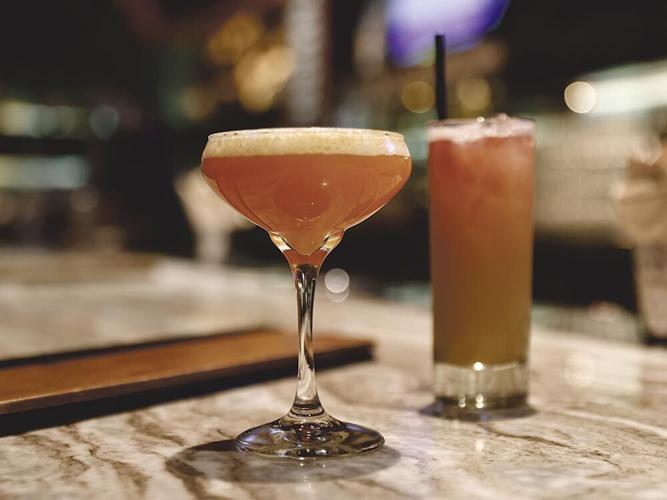
Tuyet’s Elixir, left, is a popular option at Jacks in the Portola Hotel. But Tuyet Vitacca’s Asian Persuasion, right, was named one of the top 10 cocktails at independent restaurants nationwide by Restaurant Hospitality. It involves turmeric and carrot juice.
Some of Monterey County’s top mixologists offer thoughts on cocktails well worth a try.
Josh Perry, Cella Restaurant & Bar, Monterey
Cocktail: 525 Solstice
What’s in it: Brown butter washed rye whiskey, cognac, Peychaud’s Bitters, caraway-infused absinthe
Why: “This one is a smooth, luxurious cocktail you just want to sip – more by the fireside than on a veranda.”
Katie Blandin, Pearl Hour, Monterey
Cocktail: Pearlescent
What’s in it: Mezcal, gin, Bordiga extra dry vermouth, Italicus rosolio, yarrow tincture
Why: “It’s a combination of bottles from producers who make spirits in small batches and care about using real ingredients and their craft.”
Colleen Kelly, Lucia Restaurant, Carmel Valley
Cocktail: Gingerly Paired
What’s in it: Nolets gin, pear puree, spiced pear liqueur, lemon juice, honey, ginger bitters, ginger beer
Why: “Gin, spiced pear, and ginger are the fall flavors that get me excited and inspired to put fall cocktails together. Spiced pear is a very underrated flavor profile, it has such depth and warmth and can vary from spirit to spirit.”
Daniel Watson, Montrio, Monterey
Cocktail: Miso Harmony
What’s in it: White miso washed Japanese whiskey, red vermouth, spiced orange foam
Why: “This may well appear to be a drink for those bold cocktail aficionados, but it is strangely approachable and utterly delicious. The decadent umami, the spicy foam and the aromatic red vermouth all combine to create a drink that you won’t find anywhere else in the world.”
Ashley Havens, Chez Noir, Carmel
Cocktail: East of Eden
What’s in it: Other Brother olive oil washed gin, tarragon-infused white vermouth, fino sherry, orange expression
Why: “While martinis tend to be on the stiffer side, the introduction of tasty olive oil gives the drink a wonderful silky texture that makes it dangerously smooth. The fresh tarragon along with all the aromatics of the gin and vermouth keep things light and bright. Finally a skosh of fino sherry balances everything with the right amount of salinity and bite.”
Tuyet Vitacca, Jacks Restaurant, Monterey
Cocktail: Asian Persuasion
What’s in it: Turmeric-infused Ketel One vodka, carrot juice, honey, lemon, bitters
Why: Earlier this year Restaurant Hospitality magazine named it one of the 10 best cocktails at independent restaurants – nationwide.
Matt Eggleston, Stokes Adobe, Monterey
Cocktail: Fun Vodka Drink
What’s in it: Crop Meyer lemon vodka, guava ponche, pineapple syrup, lemon juice
Why: The cocktail menu at Stokes Adobe changes frequently. But this cocktail was on the list when the restaurant opened and has remained there. It’s that good.
(0) comments
Welcome to the discussion.
Log In
Keep it Clean. Please avoid obscene, vulgar, lewd, racist or sexually-oriented language.
PLEASE TURN OFF YOUR CAPS LOCK.
Don't Threaten. Threats of harming another person will not be tolerated.
Be Truthful. Don't knowingly lie about anyone or anything.
Be Nice. No racism, sexism or any sort of -ism that is degrading to another person.
Be Proactive. Use the 'Report' link on each comment to let us know of abusive posts.
Share with Us. We'd love to hear eyewitness accounts, the history behind an article.