


The bigger problems started with a small clerical mixup.
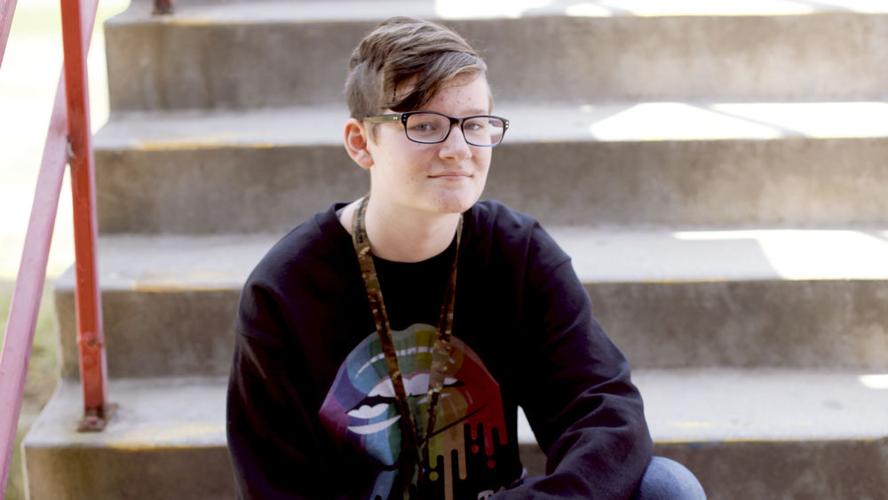
The previous summer, a now-14-year-old high-school sophomore started going by Thomas Bunten as he began high school. He came out as transgender in seventh grade and shaved his head the summer before freshman year, dressing more like a typical boy.
“It felt inherently right,” Bunten says. “I felt more like myself.”
Teachers accepted Bunten, and in keeping with California Assembly Bill 1266, which passed in 2013, administrators allowed him to use his new name on unofficial school records, including attendance rolls. But during his freshman year at Seaside High School, substitute teachers would call Bunten by his birth name, which continued to appear on the attendance sheets.
Each time a substitute teacher was in class – about 15 times his freshman year – Bunten would have to explain that he was trans and had changed his name.
“I felt really anxious about it, because I had to give individual notes each time. Sometimes I just went with it,” he says. “If the teacher told me we were going to have a sub, I’d ask them the day before to make a note and sometimes I made my friends go up to the sub before class and tell them.”
Bunten also encountered other challenges.
“It mostly went well, except the physical education teacher who was really weird about it,” he says. “She kept putting me on the girls’ teams. It felt weird.” His solution was not to participate at all.
On occasion, he was bullied by other students after class. “I was outside one day and this guy started harassing me by asking to see my birth certificate,” Bunten says. “He called me a ‘tranny’ and ‘it.’”
His mom, FeLecia Bunten, didn’t know there was a problem until her son’s grades started to suffer. He went from getting mostly As and Bs to failing some classes.
“I wouldn’t do assignments for the classes where they used my birth name,” he says.
FeLecia started to investigate, and learned her son had stopped participating in some of his classes.
“Thomas isn’t one to come to me and say he’s having a problem,” she says. “It wasn’t until he mentioned how he wasn’t do any of his schoolwork, because it was an experience every time to explain his name.”
FeLecia, a veteran teacher in the Monterey Peninsula Unified School District who currently teaches at Ord Terrace Elementary in Seaside, says the experience with her own son has helped her understand new needs facing LGBTQ students.
“Sometimes we’ll see a student who needs a different kind of support,” she says. “We’re always looking at how we can support those kids who don’t fit into the boy line or the girl line.”
Her son found that support from a theater teacher.
Seaside High School and MPUSD officials has been making efforts to better reach and support LGBTQ students. As administrators work away at creating a more welcoming atmosphere in the ways that they can, queer students have found their own de facto support group – not in a club designed as a group for queer students, but in a theater program.
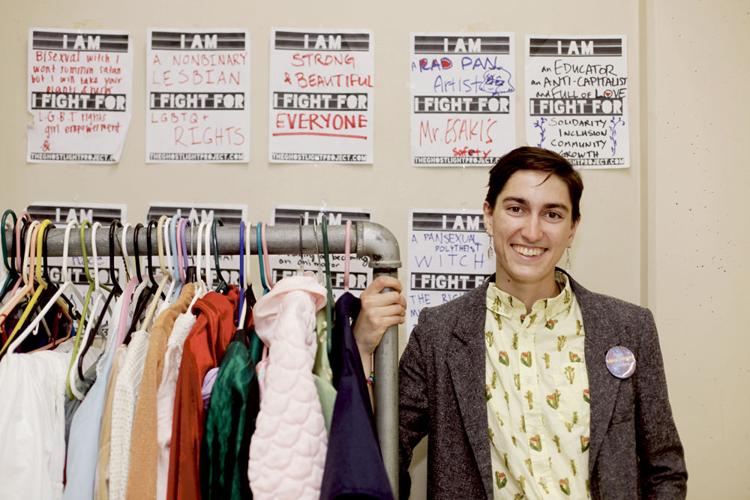
Theater teacher River Navaille, who themself identifies as as queer, transgender and non-binary (meaning neither male or female) doesn’t think that’s so surprising: “Theater art teaches so much about personal growth and working together, as well as literally stepping into someone else’s shoes.”
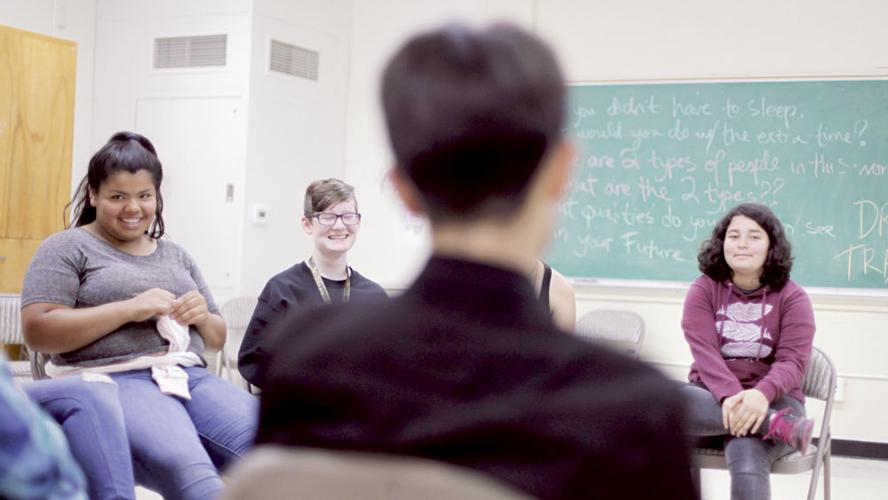
On a recent Friday afternoon, nine high school kids gather in the theater classroom after school. Starting slowly and then getting faster and faster, they recite the words “red leather, yellow leather.” It’s a warm-up exercise to prepare them to enunciate and clearly differentiate between consonants, especially important as they prepare for their first rehearsal of Shakespeare’s poetic lines of Romeo and Juliet.
The “red leather yellow leather” activity is one that Bunten, normally shy, chimed in to recommend. (In the play, he plays Tybalt, Juliet’s cousin who dies in a sword fight in Act three of five.)
The lead parts in this traditional heterosexual romance, star-crossed Romeo and Juliet, have been cast as a boy and girl, respectively, but other roles break the gender norms.
Vanessa Valenzuela, a sophomore who identifies as asexual, is playing the male role of Mercutio, Romeo’s best friend and adviser. “He seems a bit feminine and I want to play him like that,” Valenzuela says.
In this group of nine students rehearing at Seaside High, five say they identify on the LGBTQ spectrum, or not straight.
Gay teens coming together in theater is a story that’s repeated itself many times over. On the LGBTQ news site The Advocate, stand-up comic Jim David wrote, “Every profession has an ‘old boys network,’ but Broadway is one of the only professions in America where most of the ‘old boys’ are gay… Gay writers and performers have dominated theater since the Greeks – the opening night party of Sophocles’ Oedipus allegedly featured Dionysian go-go boys and an open bar.”
To Navaille, the graviational pull of theater makes sense for teens who might be struggling otherwise to feel comfortable with their identity, even though dressing in a costume, wearing makeup and getting onstage might seem like a counterintuitive path to feeling accepted.
“Theater makes us take on roles we may not otherwise take on in society,” Navaille says. “It starts to free you from the societal roles we’re pressured to take on.”
Navaille participated in theater as a student at Monterey High School and performed with Western Stage in Salinas and Pacific Repertory in Carmel after graduating from UC Santa Cruz. They – the pronoun Navaille uses, rather than he or she – were planning to move away from the area when a teaching opportunity opened up at Seaside High in 2016 – and a chance to help resurrect a defunct theater program. The Arts Council for Monterey County awarded a $5,000 grant, enough to hire Navaille for four hours a week. Seaside High School supplemented that budget to fund supplies for an after-school drama club, which put on two performances per school year.
This year, Navaille’s teaching about 20 hours a week, offering two sections of Introduction to Theater each day, plus an after-school program for Seaside High.
Navaille says one goal is creating a safe place for students like Bunten to feel more comfortable as themselves: “I worked with them through a major election they were watching without being able to do anything about it; I just felt like they really needed a sense of community on their campus,” Navaille says. “There are many students who don’t find community in sports.”
Outside the theater classroom at Seaside High, costumed students work in small groups in a grass courtyard. They’re working on character placement, moving around to stand in different positions in relation to each other and the audience.
“It will be strongest if you can find conflict,” Navaille says while directing the students. “That’s the drama, right?”
Back inside the square theater room, faded green chalkboards filled with acting notes and stage directions line the walls. Navaille continues the lesson.
“Think about where the audience is,” Navaille says, encouraging them to make sure they’re relating to the people watching. “You need to ask, ‘What just happened and what is about to happen?’”
Connecting the audience to the characters, and the characters to each other, is advice students say they are taking off-stage, too. Jenaye Brelland, a sophomore, was a member of the after-school theater club last year, and she says it helped her better understand her relationship to others in real life.
“I learned what kind of image I give off and how to interact with others,” she says.
For Brelland, who is straight, drama club became an escape: “Usually after hard days freshman year, I was very much looking forward to drama,” she says. “The space is free and it’s comforting.”
Valenzuela, who identifies on the LGBTQ spectrum and is practicing her Mercutio, agrees.
“I was struggling with depression and wasn’t enjoying school,” she says. “Drama made me a happier person. My confidence improved and I’m able to communicate better with others.”
Valenzuela says the Seaside High drama club allows her to be free to explore what it means to identify on the LGBTQ spectrum.
Valenzuela expands in an email on that it means to conform in most realms of her life: “At home and at school I am expected to act feminine and wear fem clothing. I am expected to date boys or go to dances because that’s what people assumed a typical 15-year-old girl does. In reality, that’s not what I’m interested in.”
Drama, she adds, gives her something different: “We can yell out, ‘I’m gay!’ and there is no fear there,” she says. “I can be an asexual human being without being asked: ‘Are you sure you’re not broken?’”
Outside of the theater group, Valenzuela says it’s harder to find acceptance.
“It’s really difficult to be yourself, because if you act differently compared to what most people think is normal, they call you weird,” she says. “It is a really understanding group and makes me realize I can be both masculine and feminine – I can be whatever I want without judgement.”
For Bunten, drama club was his first time performing in front of others. The support comes not just from theater itself, but from seeing an older role model in Navaille, who is 25.
“[Navaille] introduced me to their trans friends and said it would get better,” Bunten says. “It helped create a place I could talk about being queer. There is at least one person students can feel comfortable around if they need support.”
So-called “bathroom bills” across the country have become political flashpoints in recent years, and hate crimes motivated by a bias around sexual orientation accounted for 22 percent of hate crimes in California last year, according to a state Department of Justice report. Navaille is trying to create a safe space for queer kids against a national backdrop of controversy and isolation.
Seaside High and MPUSD are also doing their share. Last year, MPUSD spent $3,000 to match a grant from the California Teachers Association to the Monterey Bay Teachers Association that went toward purchasing gender-diverse literature for all the libraries at their elementary and secondary schools, with books like Two Boys Kissing and Beyond Magenta: Transgender Teens Speak Out mixed in.
“If a student is struggling with their identity, it’s nice to see, ‘Hey, there are books in my library that are open to me,’” MBTA President Tom Grych says.
MBTA teamed up again with CTA and MPUSD to provide diversity training for teachers and staff in June of 2017, as they prepared to go back to school.
“Our goal is to make the students feel comfortable and accepted for who they are and how they identify,” MPUSD Superintendent PK Diffenbaugh says. “Because there can be gender fluidity, it’s important for schools to allow an open dialogue.
“Rather than forcing the student to enter the box we’ve created, we need to adjust ourselves to where our students are.”
Starting this school year, MPUSD introduced World Ethnic and Cultural Studies, a class required for incoming freshmen at its four high schools (Marina, Seaside, Monterey and Central Coast High). Among other topics, the class looks at gender roles and LGBT rights and for one assignment students must write a “free response essay about how cultural attitudes affect the lives of LGBT individuals.”
Diffenbaugh says he sees lots of teachers across the district creating welcoming spaces for students who are questioning their gender identity, and a culture of learning that cuts both ways.
“It’s new to a lot of administrators,” he says. “It’s the type of thing where we are learning as we go and we are learning from our students.”
Seaside High School Principal Carlos Moran agrees that for teachers and staff at his school, adapting to the needs of trans and queer students is a learning curve.
“Our intentions are always positive to support all of our students, but how do we get the message out without singling out anyone?” Moran says. “I struggle with that. It’s one of those things we have to grow with and systematize.”
Those systems happen inside and outside the classroom. Seaside High has single-person restrooms, but, Moran notes, “the problem is, how do we tell the students without drawing attention to them?” (Besides, not all trans kids will choose designated gender-neutral bathrooms.)
Currently, Seaside High has four single-person bathrooms labeled gender-neutral, and a student needs to go to the school office and get a key to use one. Moran says school administrators are seeing if there is a better way for students to access the bathrooms.
They’ve also made strides when it comes to name changes.
“Everyone here understood the necessity of it, but we just didn’t know how to go about it,” Moran says. “After the first one, it was easy.”
The process is simple: A student wanting to use a different name tells administrators in the school office, who then notify the district office, and the student’s name is changed in an information system that generates attendance sheets and other documents.
There are also counseling services on campus, and a counselor who Moran says has become an advocate for students.
There are changes big and small at schools all across MPUSD, which Diffenbaugh sees as creating a culture that’s embracing all students.
But something unique has happened in Navaille’s classroom and club, he notes: “Clearly River has made a deep impact on a lot of students in a short amount of time, and that’s certainly positive.
“Our hope is someone within our school community has a positive relationship with them.”
For at least Bunten and Valenzuela, they have found that support on the stage.
And as for Bunten’s performance in the classroom, it’s on track to get back to what he achieved historically. So far this school year, he’s getting Bs and Cs.


Counseling and Therapy Services (CATS)
757-7915, chservices.org/mental-health/c-a-t-s
CSU Monterey Bay LGBTQQI Club
csumb.edu/safezone/campus-resources
Intimacy, Sexuality and Gender Center of Monterey
494 Alvarado St., Suite A, Monterey
375-7553, isgcmonterey.com
LGBTQ Monterey
spotlights upcoming community events and provides a list of other groups; lgbtqmonterey.com
Our Gente Program at The Epicenter
20 Maple St., Salinas
998-7291, epicentermonterey.org
Pride of Monterey County
275-0720, montereypride@gmail.com
rainbow speakers and friends
provides guest speakers for events; 998-1007, edieson@sbcglobal.net
(1) comment
Pandering to mentally ill teenagers is just child abuse.
Welcome to the discussion.
Log In
Keep it Clean. Please avoid obscene, vulgar, lewd, racist or sexually-oriented language.
PLEASE TURN OFF YOUR CAPS LOCK.
Don't Threaten. Threats of harming another person will not be tolerated.
Be Truthful. Don't knowingly lie about anyone or anything.
Be Nice. No racism, sexism or any sort of -ism that is degrading to another person.
Be Proactive. Use the 'Report' link on each comment to let us know of abusive posts.
Share with Us. We'd love to hear eyewitness accounts, the history behind an article.