



FOR MILLENNIA, SPECTATOR SPORTS HAVE BEEN DOMINATED BY MALE ATHLETES, BUT FINALLY, THAT IS STARTING TO CHANGE. Women have been staking out their place on the sports scene, and they are here to stay. More viewers tuned in to the women’s NCAA basketball championship than the men’s finale this year. A women’s hockey league is attracting a growing fan base.
It’s also shifting beyond the mainstream. This year’s World’s Toughest Row, set to begin on June 8 in Monterey, will see more female teams than male teams attempting the 2,800-mile journey from California to Hawaii. Among these teams are the Hericanes, aiming not only to complete the row, but also to set a world record as the first all-women team of four to successfully make this voyage.
The goal originated in July 2022, when 29-year-old Jennifer Hofer of Bend, Oregon, came across an Instagram post about the Great Pacific Race, sparking her interest in ocean rowing. She shared the idea with her sister, Kristen Hofer, 31, also from Bend, and Sierra Myers, 30, from Klamath Falls.

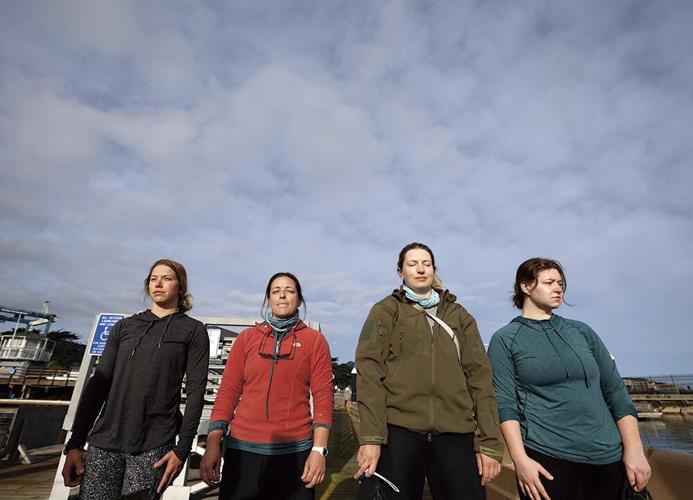
The team held a small ceremony to rename their boat, now called Brizo. From left to right: Kelsey Pfender, Kristen Hofer, Sierra Myers and Jennifer Hofer.
“There was an upcoming informational meeting in Bend, so I sent it to Kris and Sierra, wondering if I was crazy for wanting to do this,” Jennifer Hofer says. Instead of dismissing the idea, both friends enthusiastically joined in. Myers shared her excitement about forming a team: “My immediate reaction was, ‘This is amazing! Why haven’t I heard of it before? Let’s do it!’ I jumped on board and haven’t looked back since.”
After the meeting, the three became even more interested. They formed a team called the Hericanes – named to sound like the weather phenomenon but also capture their all-women team. Through online message boards they posted to recruit a fourth rower, and they found Kelsey Pfender, 29, from Colorado, who had independently come to the decision that she wanted to row. The timing for them aligned perfectly to get ready to race in 2024.
Preparing for a row of this magnitude presents challenges. The Hericanes embarked on a rigorous journey, beginning with the steps of hiring coaches and intensive physical training. Acquiring a suitable boat was also a necessity.

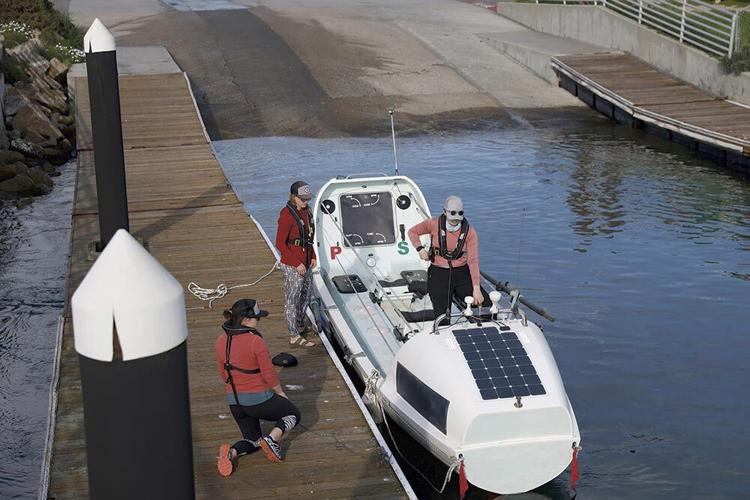
Sierra Myers, Alan Larpthaveesarp and Kristen Hofer attach an oar before heading out for a row. Larpthaveesarp, a local boat mechanic, has been helping the team get the boat ready since it arrived in Monterey in February.
“In the initial months, we focused on training, while immersing ourselves in discussions with fellow rowers and coaches to gain insights. Ocean rowing is entirely new to us, so we sought advice from various teams and experts,” Jennifer Hofer says. “One of our primary objectives was to delineate the comprehensive plan and identify the remaining tasks that needed attention. We adopted a divide-and-conquer approach to manage our responsibilities effectively. During this phase, we were training individually – only recently have we begun training together and meeting in person on a regular basis.”
In January of 2024, six months before their departure date, Myers, the Hofers and Pfendler made Monterey home. (Hofer continued to spend half her time in Oregon working as a park ranger and half in Monterey training.) The Weekly spent the past six months documenting their preparations, recounted in the photo essay that accompanies this story.
Myers recently quit her job as a paralegal, working remotely from Monterey, to focus full time on preparing for the row ahead. Kristen Hofer landed a job at the Monterey Bay Aquarium and developed a fondness for the octopus. Jennifer Hofer had been working for the Forest Service in Oregon but recently quit to focus on the race. Pfender spent a few months in Monterey training and getting the boat ready before leaving for a month to work as a whitewater rafting guide in the Grand Canyon.
They are transitioning away from their regular, working lives on land to their voyage. When they shove off on Saturday, June 8 from Monterey, they are expected to be at sea for about 35 days before arriving in Hawaii.
But before then, they have miles to row as they train, getting ready for the journey.

The team launches for a training row from the Coast Guard Pier in Monterey, a regular weekend activity since February.
ON A MISTY SATURDAY MORNING AT THE COAST GUARD PIER IN MONTEREY, as the sun begins to rise over the hills, the team prepares to launch their 2014 Rannoch r45 boat, named Brizo, for the first time since acquiring it from a team in the Netherlands. This sleek vessel, crafted from fiberglass and measuring 8.64 meters (about 26 feet) in length, features three rowing positions and two compact cabins.
Training – both physically and mentally – entails working closely with ultra sports coach Scott Jones for the mental aspect, team dynamics and how to work with each other. That included three days in Colorado, where the team was put to the test with different mental and physical challenges. The crew also works out at In-Shape in Monterey, using the rowing machines as well a regimen of curated workouts.

(top row) The training regimen includes time on the water and in the gym at In-Shape in Monterey, where members of the Hericanes work out. Top right, Sierra Myers motivates Kristen Hofer, on the rowing machine, as they train together.(lower row) The oars have been sanded and oiled to get ready to go. The team will row bare-handed, because if gloves get wet with saltwater, they can cause chafing and irritation.
The team has also been training on the water in the Monterey Bay, completing 24-hour rows and a 72-hour row. Preparation includes eating dehydrated food, snacks and drinking water from a desalination filter, rowing for two hours on, and resting for two hours – like it will be at sea.
The training schedule hasn’t stopped the team from community outreach efforts and fundraising. They are about halfway to their goal of raising $150,000 which they expect to more than cover the costs of the race including entry fees, the vessel and food.
“The financial campaigning aspect has been the most challenging long-term piece that we’ve been working toward,” Jennifer Hofer says. “It’s a huge financial commitment. You need the boat in order to get sponsors, but you can’t really get the boat until you have quite a bit of financial backing. And so all of this campaigning, getting the boat, race deposits, paying those fees – all of these additional expenses, and just owning a boat is a money pit.”
Beyond donations, the community has helped out in other ways. Local boat mechanic Alan Larpthaveesarp has contributed his time and expertise to upgrade and repair the Brizo.
Beyond raising funds for their own journey, the Hericanes also plan to donate to a nonprofit. With unspent funds and proceeds from the sale of the boat, they expect to give at least $40,000 to Planned Parenthood after the race. “Planned Parenthood felt right almost immediately for us,” Jennifer Hofer says. “We just kept going back to them, and we wanted to make a statement.”
Over the past six months, the Hericanes have appeared at events like Whalefest, hosted trivia nights at Sovino Wine Bar and Other Brother Brewing Co., and shared their story (and fundraising goal) in various venues with meet-and-greets.
“It’s been incredible. Since moving here in January, I’ve been immersed in the vibrant community,” Kristen Hofer says. “I’ve had the privilege of meeting extraordinary individuals and forming deep connections.”

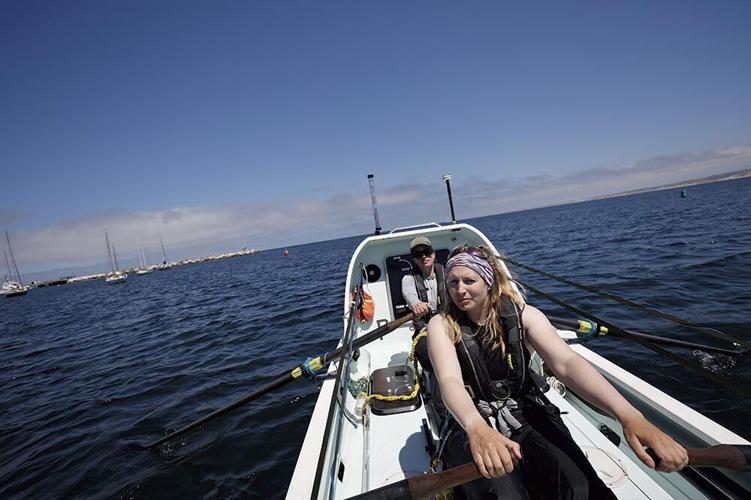
Sierra Myers (front) and Kristen Hofer on a practice row. Their training includes a 24-hour row in preparation for the race, during which they’ll trade off two hours at a time to rest, then paddle.
THEY’VE BECOME INGRAINED IN THE COMMUNITY, but their roughly 35 days at sea will be much less social. Although they are joining 82 people on 33 teams all hoping to complete the row from Monterey to Hawaii, the time at sea is solitary.
Pfender will be the skipper as the team rows two hours on, two hours off. They’ll be rowing 24 hours a day, with just short two-hour breaks for rest in between – so part of their training has emphasized how to row through exhaustion. In their alternating off hours, two rowers will retreat to small cabins to rest or sleep for brief stretches, although the cabins are loud – the sound of the water comes through.
This will all repeat for the roughly 35 days the row should take, and the team hopes to best the other female teams in the World’s Toughest Row, establishing a world record.
“We’re hoping for a world record,” Myers says, “but it’s all about the experience. It’s all about us coming closer as a team and being able to say that we did this crazy thing when we were young and tell my future kids, ‘Yeah, your mom was a badass.’
“I kind of just want to have this personal and team achievement under the belt. I think it would be really, really cool just to say you did it.”
THE HERICANES join 33 other teams in the World’s Toughest Row starting on Saturday, June 8. You can watch them shove off from the Monterey Harbor Monterey at 10:30am (subject to change depending on weather). Follow the progress of the race online at worldstoughestrow.com

The Hericanes hope to set a world record for becoming the first (and fastest) four-woman team to row from Monterey to Hawaii when they participate in the World’s Toughest Row, starting on June 8.
(1) comment
MCN: Kon Tiki...the sequel...don't forget the life preservers.
Welcome to the discussion.
Log In
Keep it Clean. Please avoid obscene, vulgar, lewd, racist or sexually-oriented language.
PLEASE TURN OFF YOUR CAPS LOCK.
Don't Threaten. Threats of harming another person will not be tolerated.
Be Truthful. Don't knowingly lie about anyone or anything.
Be Nice. No racism, sexism or any sort of -ism that is degrading to another person.
Be Proactive. Use the 'Report' link on each comment to let us know of abusive posts.
Share with Us. We'd love to hear eyewitness accounts, the history behind an article.