
M
ikey, a 12-week-old black bear cub about the size of large pug, pulls his leash taut. He appears happy for a diversion.
He eagerly trails Charlie Sammut, owner-operator of the Monterey Zoo, away from the indoor cages adjacent to Sammut’s office at the zoo’s grounds on River Road in Salinas.
As Sammut steps outside the building’s doors – Mikey in tow – about a dozen first-graders from the Crossroads Christian School in Morgan Hill queue up, waiting for a tour of the zoo. They perk up at the sight of Mikey coming out the door, and start tapping each other on their shoulders as Sammut posts up in front of a nearby bench, and asks one of his employees, Lanier Fairchild, for a milk bottle.
Once the bottle is in hand, Sammut holds it, nipple down, and Mikey stands on his hind legs to drink it down.
“Awwwww!” the first-graders crow, as some toggle through their phone screens to take pictures of Mikey lapping up the milk.
“He’s named after Mike Ditka,” Sammut says, referring to the Hall of Fame former player and coach for the Chicago Bears. “I’m a bit of Bears fan.”
Mikey seems friendly, and though Sammut is also at ease, he’s nonetheless careful.
“All baby bears are bitey little bastards,” he says.
From 6am to 11pm, Mikey has to be fed about every four hours, and this is his second feeding of the day. Feeding him is often the first thing – at 6am – and the last thing – at 11pm – that Sammut does at the zoo every day.
An enclosure for Mikey and a fellow bear has been built, but he hasn’t yet moved in. He’s still too young, Sammut says, and for the time being will continue living in a cage in a room adjacent to Sammut’s office. Mikey’s future home – just up the hill, and still empty – is also meant for two bears, but due to a snafu Sammut doesn’t fully understand, there have been setbacks.
“We ordered two baby black bears from a [sanctuary] in Oklahoma, but unfortunately, only one got shipped,” Sammut says, adding that he and his staff have identified potential candidates from a zoo in Illinois, and hope to bring in a companion soon so that Mikey’s not alone.
Pairing animals has become a driving concern for Sammut of late, as he tries to modernize his zoo and give all its animals – many of which were formerly exotic pets, or in captivity – their best possible lives. That means taking them out of their current cages and building more spacious enclosures, and when possible, giving them a companion.
The zoo is a nonprofit, and sustains itself from daily tours, at $14-$16 per person, that serve approximately 3,000-5,000 visitors annually, as well as from revenue from the bed-and-breakfast Sammut operates on the property.
But Sammut dreams of something bigger, a proper zoo where you can just show up anytime – not just for a scheduled visit – as a regional attraction. He wants it to be a resource for the community, something Salinas Valley youth can turn to for diversion and fascination.
And as much as possible, he wants to give his animals more space, and get them out of the confines of their cages.
The dream is expensive – Sammut has recently completed the first of the three phases to modernize the zoo. It cost just under $2 million and took two-and-a-half years.
But when Mikey’s on his hind legs lapping milk from a bottle in Sammut’s hand, and the first-graders are oohing and aahing in the background, those concerns seem to disappear.
It’s a sunny day in early May, and after Mikey is back in his cage, Sammut leads the way up to his new exhibit – the recently completed first phase – which features lions, tigers and bears.
It’s called Oz.
<> <> <>
T
he story of the Monterey Zoo, it could be argued, began in a Seaside garage.
It happened in the mid-1980s, when Sammut, a recent graduate of Palma High School in Salinas, was working as a Seaside police officer.
“I couldn’t stand being near people after work, so I started a collection of pets that got out of hand,” he says.
The first was a cougar named Samson that – as he discovered while on the job – was being illegally kept in a Seaside garage by residents who had grown eager to get rid of it.
Sammut’s parents had a kennel business at that point, and Sammut got permission to take care of the cougar, and kept it in a cage out back. As the kennel business picked up, Sammut quit the Seaside PD, and set his sights on big cats.
“I ordered a tiger through an animal broker I had met along the way (it was legal to do such stupid things back then),” he writes on the zoo’s website, “but when the cub arrived, it was a lion. Opting to keep the lion, the tiger arrived six months later…
“As lion led to tiger, tiger led to bears, bears to monkeys, monkeys to elephants,” Sammut writes. “Eventually, the lion, Josef, became my best friend, my star, and the single most important influence on my life that would change the course of my life forever.”
Josef – who for a time was the MGM lion, and was the live model for Disney animators in The Lion King – was how Sammut got into Hollywood, launching a career where Sammut’s many animals have worked on the TV show Born Wild and several movies that, aside The Lion King, included George of the Jungle and The Postman (when apocalypse strikes, there are lion attacks).
In 1994, as his career in Hollywood was thriving, Sammut bought this 51-acre property on River Road, and it has been home ever since. It has also become the home, at last count, to more than 180 animals.
For many years, the zoo was known as Wild Things, and was a rare wild animal compound open to the public.
“I’ve never wanted anyone to think we were [behind] closed doors,” Sammut says.
Some who visited previously may have been dismayed in seeing large animals confined to 300-square-foot metal cages built on pads of concrete.
But project by project, Sammut is changing that, and the property is starting to look like a first-rate zoo – one that not only confines animals, but gives them a better home than the circumstances they came from.
<> <> <>
S
tuart, a 3-year-old cinnamon black bear (a subspecies of American black bear), is sniffing the grass for hidden food.
He is strolling through one of two newly built bear enclosures, which were finished last year and are the final piece of the first phase of his zoo modernization plan. With Mikey still months away from being ready for living in an enclosure, only one of the two is occupied; Stuart shares it with a 2-year-old cinnamon black bear named Martha.
The two have just been let out of their cages in the back, where they spend the night.
Every morning, a few of Sammut’s 19 employees put out food – various fruits, vegetables, meats and Purina bear biscuits – in various places in the enclosure so that the bears spend their first few hours of the day sniffing it out. The two bears have only been living together for a few months, and are still getting accustomed to each other.
“I wasn’t sure if the two were going to get along, so I built two exhibits in the event that they didn’t,” Sammut says.
In the beginning, it did not look promising. “So we slowed down the introduction tremendously, and gave them a lot more time to do it. Then one day we went up there and found the two of them just all over each playing, out of the clear blue sky,” Sammut says. “They had to do it on their own time.”
Sammut leads the way to the cages behind the empty enclosure, where he’s got two cubs – one a lion, the other a Bengal tiger – that he’s taking care of for a friend at a Southern California film company who’s away for a few weeks on a film shoot in Africa.
They don’t have names yet, Sammut says, but he’s already got a sense of their character.
“The tiger is actually really, really good,” Sammut says, as he walks into the cage holding a baton-like stick as a potential defense in case things turn south. “But the lion is a bit of a scaredy cat, so I’m trying to increase his confidence.”
The young tiger sidles up alongside Sammut making a purring sound that – in tiger-lingo – is referred to as “chuffing.” The tiger repeatedly tries to jump on Sammut – “No, no, no,” Sammut keeps saying – until it finally relents.
“That’s just teaching him manners,” Sammut says.
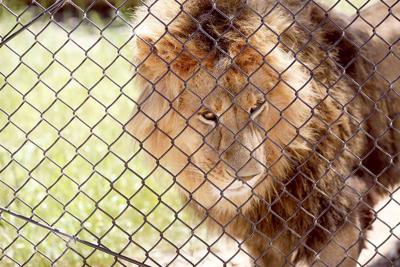
Then it’s off to the other lions, where Sammut has a newly introduced pair, Jake and Leah, that he’s eager to introduce.
The match was made possible by a Bay Area donor, Cheryl Marquez, who came to the zoo where she learned about Jake: He was alone in his enclosure, and spent his days sitting on a platform, staring at the zoo’s other lion enclosure, which houses Zeus and Athena.
“It was very depressing,” Sammut says. He estimated it would cost about $10,000 to get a female lion companion and add another cage outside the enclosure, and the donor pulled out her checkbook. “She told us that day, ‘OK, go to work.’ And that’s exactly what we did. I put the word out, and five days later, we found [Leah] in Colorado in a sanctuary.”
The two lions, which have only been together for about three months, are still getting to know each other, and they had been introduced in separate cages behind the enclosure and let into the area one at a time, so that neither one would get too possessive of it. Then they were formally introduced.
“One day we put everything together – we had safety equipment, people, veterinarians, drones, you name it – we had everything standing by,” Sammut says of their introduction. “It was a touchy day, she bit him once. It wasn’t a serious bite, but it definitely hurt his feelings.”
Sammut had three drones in the air in order to see the lions from above in order to better assess the introduction – when you’re standing outside the enclosure, Sammut says, “it’s hard to see all the angles.”
The footage showed him that the bite was “almost accidental,” so he and his staff decided to keep the two lions together, and since then, he says, “they’re getting along great.”
Sammut then walks behind the safety railing and up to the cage, and Leah sidles up. Jake, meanwhile, makes passes from a safe distance, and Sammut is cheered that he’s not “barking.”
“Even though they don’t get along like buddy-buddy, it’s still better than being alone,” he says. “It’s all about mental stimulation, and there is no better mental stimulation than another one of its kind.”
Oz, which is home to lion, tiger and bear enclosures, has the full feel of a modern, spacious zoo. Ultimately, it’s what Sammut wants the whole place to look like.
To that end, he hopes to bring in agricultural sponsors to help fund the remaining two phases of the upgrade, as most visitors are children of ag workers.
“They are kids that can’t afford to drive to Santa Barbara or San Francisco to see a zoo,” Sammut says. “Salinas could have – Monterey County could have – a world-class formidable zoo, like they do an Aquarium. It just takes funding.”
<> <> <>
A
s Sammut walks through the yet-to-be-modernized part of the zoo, it’s no place like Oz.
Cages are everywhere – some sleek and black, some old-school silver – but the animals still perk up as Sammut walks by.
He points out the empty concrete pads the lions used to be on, and beams when talking about his plans for a Swiss Family Robinson-style enclosure he has planned for a leopard. The black cages are part of his vision for much of the area, which will give the animals both more space and a sense of community.
He brightens with every encounter he has with the animals – his affection for them shines – and he connects with them readily, often walking into their cage or enclosure.
All of them have stories.
There’s Doc, a bearcat – a small bear-like mammal native to South America – whose first instinct upon meeting somebody is to climb on them. He can also be prone to bite, if not on purpose.
“He doesn’t always know where his teeth are,” Sammut says. “I have to constantly go home and super glue myself back together.”
Sammut got Doc when he was a baby, from a friend in South Carolina. Afraid to fly him home because he was so young and fragile, Sammut rented a car and drove back to California with Doc on his dashboard.
There’s a capuchin monkey named after Forrest Gump.
“I think there’s something wrong with him,” Sammut says, explaining why Forrest is less prone to biting than normal capuchin monkeys. “From the time we got him when he was a little baby, he kept looking at me and trying to turn his head 360 degrees.”
Moksha, a white tiger, is so friendly that Sammut can play with her, and he soometimes takes her on walks with a leash. “She’s a real sweetheart, but we poured a lot of time into her,” he says, referring to the staff time it’s taken to keep her so social.
Ed, a hyena, is no longer an animal Sammut handles freely like that. As a youngster, Ed spent his days with Sammut in his office and riding around in a golf cart on the property, but that all changed when Ed attacked him, ripping through his jeans and scratching his skin.
“He went for my knees, which is what hyenas typically do,” he says. “It can happen, it’s the downside. Everybody who’s ever had a hyena knows it, it’s just an unfortunate possibility.”
There are alligators named Handbag and Stiletto, and a buff red kangaroo named Rufus that was formerly owned by a film company that needed to find him a new home. Despite kangaroos’ reputation, Sammut says Rufus has never tried to punch him.
“I’ve been attacked by just about everything else, but not a kangaroo,” he says.
That said, Sammut doesn’t like to sensationalize the potential danger in his line of work, and emphasizes that attacks are rare, because he and his employees work tirelessly to keep the animals socialized.
“If you get bit, you go get it stitched up and you get back to work. It’s what we do,” he says. “If it’s worse than that, you feel foolish, because you missed something.”
And he’s got elephants, four of them – Butch, Buffy, Paula and Kristi – all retired from either the carnival or circus circuit. (Had he not taken them, he says, they would have been sold off to another circus, or put in a sanctuary.)
As he walks into his 5-acre pen where the elephants spend their days with water buffalo, a zebra and an ostrich, he calls over Buffy, whom he calls his “problem child.”
The elephants all respond to his voice – he doesn’t command them so much as ask nicely – and Sammut says that while scientists say elephants have the intelligence of a 7-year-old, they can be smarter, depending on the situation.
They are also voracious. Sammut doesn’t have any trees in the enclosure – “An elephant will eat a tree in a day,” he says – and it’s all he can do to keep them fed with grains, fruits, vegetables, vitamins and about two hay bales each daily.
It costs, Sammut says, about $100,000 to feed his four elephants every year.
<> <> <>
I
nside his grassy enclosure, a warthog named Harley approaches Sammut from the edges.
“Come here buddy!” Sammut says.
Harley is in the zoo’s newest enclosure, which Sammut finished about four months ago.
“A zoo is a constant evolution and process,” he says. “It’s just the way zoos work.”
As Harley and Sammut reach each other, Sammut bends down to pet him.
“[Harley] is very young, he is going on year-and-a-half,” Sammut says, adding he’ll eventually be twice as big. “We’ll see how friendly he is then.”
The connection Sammut has to so many wild animals is clear.
“It’s like a big family,” says Lisa Johnson-Sammut, Sammut’s wife. “You can imagine how connected you are to your dog or cat.
“His motto is, if you’ve never seen an elephant in your life, do you feel connected to that animal? Probably not,” she continues. “He just wants to share that with the community, that animals are so important in so many ways.”
To that end, she says, he’s seeking community support, and the nonprofit Monterey Zoo holds its annual fundraiser May 20.
Proceeds from the gala, with a Kentucky Derby theme, will go first to feed the elephants for the next year, and whatever is left will help fund the next phase of the zoo’s modernization.
In the the area where his lions and tigers once were, Sammut wants to build a series of small cages of different heights and pitches, like a cityscape, where all his smaller animals can co-exist happily.
Almost all the work on the zoo Sammut does himself. It helps that, because he’s building structures for animals and not people, he doesn’t need building permits.
He estimates the second of his three phases will cost about the same as his first, close to $2 million.
He radiates pride as he walks through Oz, and says, referring to how far he’s been able to stretch a dollar, “We’ve had other zoo directors here, and they’re astonished that we built what we built.”
Sammut has never seen the 2011 film We Bought a Zoo. Or at least not the whole thing – he walked out of the theater.
“I had a very good male tiger that I worked with all my life, and I had just lost it,” he says. “I love Matt Damon, but when the tiger started dying, I had to go.”
In that film, Damon’s character had much the same plight as Sammut: trying to engage the community in a local zoo.
There is still much progress to be made on that front, and Sammut’s zoo is not yet a community resource that is open 9-5.
But that is the vision – to experience wild animals in a way that is sustainable, and even-life changing.
“So many people think it’s exciting to go home to exotic pets, and the truth is, I go home to my three dogs, because there is no way to relax with [an exotic] pet,” he says.
That exotic animal fix people sometimes have, Sammut says, is better satisfied by visiting a zoo.
“I want to go home to something that’s not going to try to eat me.”
Among the most remarkable of Sammut’s stories comes from work he does with veterans – in particular, an Iraq War veteran who Sammut says had gone mute and hadn’t spoken to his wife and kids since coming home from deployment.
The family stayed at Sammut’s bed and breakfast, and Sammut put him on the back of an elephant.
“The following morning, his wife was in our office, in tears,” Sammut says.
The night before, after he had ridden on the elephant, he jumped on the bed and played with his kids.
(0) comments
Welcome to the discussion.
Log In
Keep it Clean. Please avoid obscene, vulgar, lewd, racist or sexually-oriented language.
PLEASE TURN OFF YOUR CAPS LOCK.
Don't Threaten. Threats of harming another person will not be tolerated.
Be Truthful. Don't knowingly lie about anyone or anything.
Be Nice. No racism, sexism or any sort of -ism that is degrading to another person.
Be Proactive. Use the 'Report' link on each comment to let us know of abusive posts.
Share with Us. We'd love to hear eyewitness accounts, the history behind an article.