
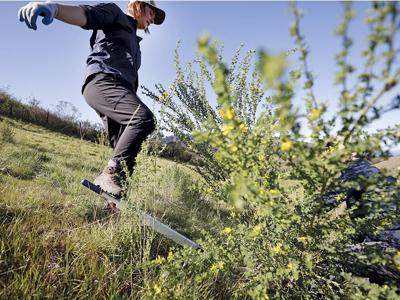
ACROSS MANY OF THE LANDSCAPES ONE FINDS IN MONTEREY COUNTY, A QUIET WAR IS UNFOLDING. As with many wars throughout history, this one is over real estate, with natives fighting to hold their ground against resource-hungry foreign invaders. On many battlegrounds, from urban backyards to expansive wild settings, the foreign interests are finding success in their conquest, to the detriment of the ecosystem’s health and those who have called this county home for thousands of years.
This battle, between native and invasive plant species, takes place on an environmental scale, which means the stakes are high and the impact wide ranging, but it happens across decades and centuries, timelines too slow to grab the attention of human populations at-large. That is, until something substantial happens, such as hotter and more uncontrollable wildfires that burn eucalyptus tree oils and torch through French broom gauntlets, deeply damaging the earth below.
Then there are the more drawn-out effects: dwindling native populations of red-legged frogs and tiger salamanders, the transformation of resilient, native hillsides into dry, golden vistas more vulnerable to drought and wildfire, and the slow rewiring of the soil to make it uninhabitable for the native plants that evolved here.
The most prominent invasive species in Monterey County, such as eucalyptus, French broom, ice plant, bamboo-like arundo and “pampas” grass (which is actually jubata grass, not pampas grass) appear as staples of the local flora. But they were brought to California by way of human hands, either intentionally or accidentally. No one today can say exactly what the landscapes of California, or Monterey County, looked like before European settlers arrived, but the consensus among experts is that it looked much different; more diverse, resilient and healthier. It was a more habitable place for animals and plants alike. The proliferation of invasive plants, which are plants that did not evolve here, has played an important role in some of the degradation of our ecosystem.
Yet, there is another consensus: Many of these invasives are now too well-established for full eradication – it’s likely we will always live with them. Local land managers do not see that as an excuse to do nothing. Humans were the vehicle by which most of these plants arrived and humans will likely be the last line of defense before the landscape transforms into something even less sustainable and further from the way it looked for thousands of years.
“We’re definitely at a point in California where we’re never going to remove all of the invasive species, plant or animal,” says Dave Feliz, manager of the Elkhorn Slough National Estuarine Research Reserve in Moss Landing, where eucalyptus and foreign grasses run rampant. “When it comes to restoration work, we’re not trying to recreate the past because we know that is impossible. Instead, we’re trying to create something new that is sustainable into the future.”
TWISTING ALONG A NARROW BACK ROAD IN THE CARMEL HIGHLANDS, Brian LeNeve rolls down the window of his truck and points out a steep hillside facing the ocean. To the untrained eye it is a beautiful sight: long locks of thick, glimmering green ivy shining in the sun, sprayed with sea mist.
To LeNeve, it is a massacre. He sees a handful of darker green pockmarks struggling for space in the ivy colony: ferns, dudleyas, hedge nettle, buckwheat. All natives. Each being slowly swallowed into oblivion.
“This is what an invasive plant does, it just takes over and smothers everything,” says LeNeve, the local chapter president of the California Native Plant Society. “I’ve been watching this happen here for the last 10 or 15 years. If I ever have grandkids, there won’t be any native habitat left over here.”
“Wings, wind or water,” is a common refrain in ecology and land management. Most of the time, if a plant arrived in a region by a different means of transportation, it is considered nonnative. Sometimes, these nonnatives have the advantage of no natural predator and the genes to reproduce with haste and abundance: a common formula for an invasive species.
Humans have moved plant species away from their native environments for thousands of years, using them for food, medicine, shelter and aesthetics. However, researchers contend that the struggle between native and invasive species accelerated with the advent of the Columbian Exchange – the era marked by the arrival of Christopher Columbus to the Americas and the connection between the Old World and the New World, 500 years ago.
No photos of pre-European California exist, but we know it looked much different. Aside from the absence of grizzly bears, elks and antelope, the depletion of fish populations and strained water resources, today’s grasslands stand in stark contrast to centuries ago. Jenna Allred, climate change adaptation manager at the Santa Lucia Conservancy, says it’s rare to find an area in California where even 10 percent of the grass is native. The meadows and hillsides are dominated by annual grasses, much of it European wild oat brought here as cattle feed, which reproduces rapidly but only stays alive for part of the year.
In her 2015 opus, A State of Change: Forgotten Landscapes of California, paleontologist Laura Cunningham spent 20 years buried in ecological research trying to figure out what California might have looked like before the arrival of European settlement and development. In one image she paints of Inspiration Point in Carmel, the hills are bursting with a spectrum of wildflower types and colors. Allred says the invasive grasses of today leave no room for that kind of wildflower growth.
Most of the marquee invasive species making a home in Monterey County originate from similarly Mediterranean climates, such as South Africa, Chile and Australia, but have become staples of the local viewshed.
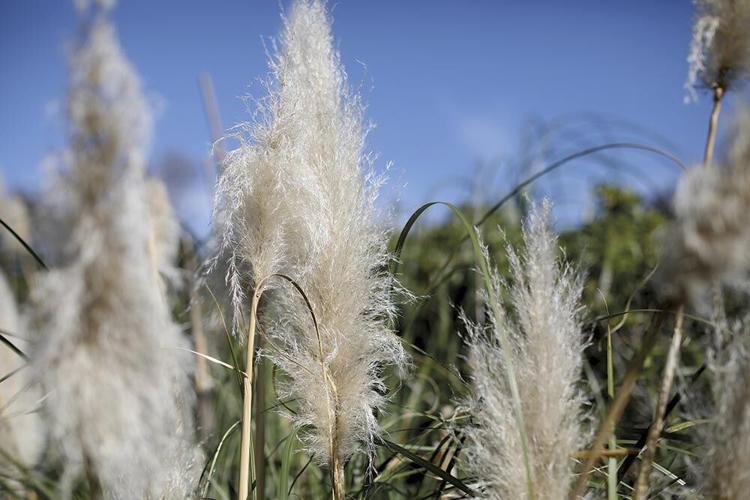
Jubata grass and French broom evolved in the Andes mountain range and the Canary Islands, respectively, and were likely brought for purely aesthetic reasons. The spread of jubata grass is tied to a man named Joseph Sexton, who in the mid-1800s launched a flourishing pampas grass (and likely jubata grass) business in which he sold the South American flora as decorative ornaments, according to the California Invasive Plants Council. The feathery crown atop the grass’s fibrous branches were seen adorning everything from hats to parade floats. Human ideas of beauty offered an extra mode of transportation for jubata grass, which carries roughly 10,000 seeds per flower. Today, jubata grass stands prominently along the Big Sur coast, growing up and out in precarious positions along rocky hill faces.
LeNeve’s favorite folk tale is about the origin of mustard plants along the California coast, which are rumored to have spread during the Spanish expeditions.
“Juan Bautista de Anza, on his expedition from Mexico to San Francisco [between 1775-76] threw out mustard seeds on his way up,” LeNeve says. “On his way back, he just followed the mustard plants. That’s a good story, and we’re sticking to it.”
A competing and well-known narrative stays in the 18th century but traces the origin story to Father Junipero Serra, who is said to have planted mustard to mark his routes between the Spanish missions he founded.

Invasive species such as jubata grass (right, colloquially known as pampas grass) have become well established in Monterey County over the last nearly two centuries, to the detriment of the local flora and fauna.
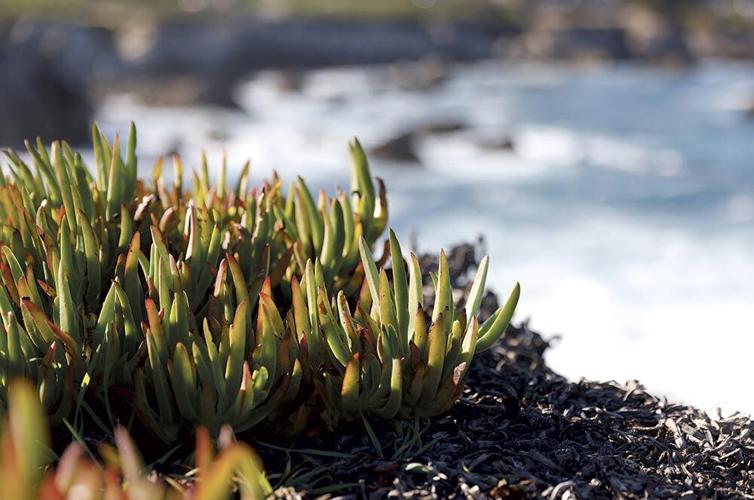
SOME INVASIVES ARRIVED WITH PRACTICAL INTENTIONS. Able to rapidly take root and spread, ice plants caught the attention of early landscape engineers who thought the South African succulent could reinforce California’s coastal dunes, and were planted to prevent erosion near the start of the 1900s. Even Caltrans took up the cause and installed them along 1,000 acres of dunes between Santa Barbara and Santa Cruz.
However, ice plants in California turned into a horticulturist’s take on Pandora’s Box. As with most prominent invasive species in the Central Coast, they thrived in the region’s Mediterranean climate and capitalized on a critical advantage over natives: no natural predator in the local ecosystem. Left unchecked, ice plant roots stitched the sandy soil, turning the once biodiverse dunes into sprawling green carpets, leaving native plants no light, no resources, and little chance for survival.
When Europeans invaded North America, they brought foreign disease that contributed to the crippling of indigenous people. As ice plants took over the dunes, their shallow roots stole resources and, according to the National Oceanographic and Atmospheric Administration, changed the chemical composition of the habitat, reprogramming the dunes into an ice plant haven and hostile territory for native species, such as sagebrush and lupine, that once called them home.
This ability to take over a habitat’s nervous system and turn it against the native plants that evolved here is a common thread when talking about invasives. French broom, the yellow flowered, sweet-smelling ornamental from the Canary Islands that has run rampant in inland areas such as Carmel Valley, is considered a “nitrogen fixer.” Nitrogen-fixing vegetation pulls nitrogen from the air and injects it into the soil, twisting the life support knobs Mother Nature set for native plant species.
“This affects native plants because California’s native plants have mainly evolved from low nitrogen soil,” Allred says. “French broom basically changes the soil composition to make it more desirable for invasives.”
Eucalyptus trees are thought to be even more menacing to the surrounding soil. Similar to other invasives, eucalyptus were thought to be one thing but became something else.
The mid-19th century Gold Rush’s accompanying press for resources left California nearly bare of hardwoods. Desperate for lumber that could build homes and infrastructure, the western frontier turned to the Australian eucalyptus tree, marketed as a sturdy timber that could grow quickly and subsitute for the waning hardwoods.
“The single tree upon which the hope of the nation is fastened, the only tree which could possibly avert… the inevitable ravages of the hastening timber famine, is the miracle tree – the eucalyptus,” reads one promotional article from a 1909 edition of Out West magazine.
Millions of eucalyptus trees were planted, only for frontiersmen to discover that the eucalyptus tree that grew in Australian soil contrasted sharply to the tree taking root in Californian soil. The wood was brittle and splintered easily. It was unusable even for a fence. Not even the tree’s citrusy oil, thought to carry medicinal qualities, was the same quality.
Eucalyptus still found a home as farming windbreaks and private garden pieces, but the tree eventually became a net negative for the local ecosystem. The trees are highly flammable and cause fires to burn hotter – they were a catalyst in the 1991 Oakland Firestorm that killed 25 people in the East Bay. The roots monopolize groundwater and spirals of bark the tree sheds smother the understory and push out all other native species. But whether the trees carry allelopathic qualities – poisoning the soil and killing any chance for biodiversity – is disputed. Although some lab research has backed this allelopathic hypothesis, other researchers claim the lack of any understory is due the eucalyptus roots’ ability to bully other plants out of resources.
The roots are so effective at drying out the soil that in 2015, PG&E planted 32 acres of eucalyptus around a landfill in Lake County so the root systems could be a barrier between the landfill’s geothermal waste and the local groundwater resource.
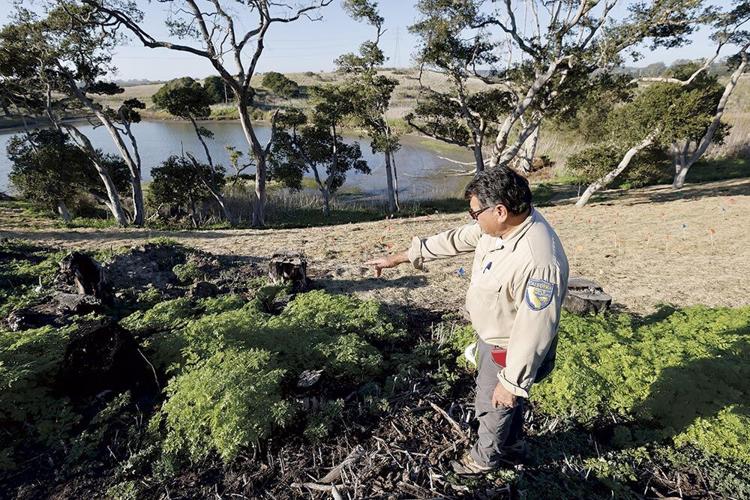
The tree’s negative impacts have inspired eradication campaigns. At Elkhorn Slough Reserve, crews have chopped down 800 eucalyptus trees since 2016 in their attempt to restore the native wetland habitat. Feliz says they cannot even give away the wood of this once heralded “miracle tree” – they now pay someone to haul it to a landfill.

Dave Feliz, manager at Elkhorn Slough Reserve, has led the removal of 800 eucalyptus trees on the reserve since 2016. Although some wildlife has taken to the Australian tree, he says the ecosystem’s long-term sustainability will depend on it returning to its natural oak woodland state.
UNDER OVERCAST SKIES ON A LATE JANUARY AFTERNOON, a cacophony of bird sounds ring from atop the eucalyptus grove straddling Monterey’s Rec Trail. A pair of dueling hummingbirds zip out from behind a trunk and scrub jays dance along the lower branches while cyclists pass by.
Much of the natural white noise emanates from the grove’s canopy, more than 100 feet away. To actually catch a glimpse of the penthouse residents requires binoculars and Amanda Preece, an experienced birder, came prepared and cranes her neck toward the sky.
“All that chittering is from the yellow-rumped warblers. Oh, wow, there’s a turkey vulture up there too,” Preece says, pointing out a slightly larger, shadowy mass perched at the top, surrounded by a flutter of smaller shadowy masses. “The thing about exotic plant species is that they flower on a weird schedule, allowing birds to drink nectar and expand their ranges or find food outside of the normal time of year.”
Preece, the environmental advocate for the local chapter of the Audubon Society, understands that, in theory, eucalyptus trees are unwelcome. She points out the understory, noting the absence of any native plant or animal populations, and says mature Monterey pines would be ideal.
However, Preece pushes back against the notion that a grove like this should receive the axe just because it’s invasive.
“This eucalyptus grove provides a lot of structure. Owls probably roost in there at night, there are many birds that use the nectar. Even if you chop this down and plant native trees, that habitat is lost for probably 40 years,” Preece says. Yes, she wants to see natives, but she and the Audubon Society support a phased transition rather than a blanket eradication.
In 2004, 100 people ranging from scientists, city and county planners, land managers and environmentalists convened at the Elkhorn Slough National Estuarine Research Reserve to debate the value of eucalyptus. Some sought support for eradication programs, others hoped the research would support their status as an important habitat. As Grey Hayes, a reserve researcher, wrote in a dispatch from the event, “there were no easy answers.” Presenters shared data showing native live oaks and eucalyptus contributed similarly to the ecosystem, with different birds and insects preferring one or the other type of tree.
One of the presentations showed that although monarch butterflies nested in eucalyptus over the winter, they also used pines and cypresses. Today, Feliz says eucalyptus trees remain a home for wintering monarchs, and his team at Elkhorn Slough is choosing to retain a grove where monarchs have been found. However, the ultimate goal is for monarchs to move back to native plants.
“We have to keep in mind that all these animals used oak trees and other species for probably a million years before eucalyptus trees arrived here,” Feliz says. “Conservation needs to have a broader lens. It’s not what’s happening this year or last year. We look at the whole long picture.”
Feliz and other local land managers maintain that invasive plants are a net negative, narrowing animal habitats and damaging biodiversity. A 2021 paper published in Nature Communications backs this up. Lead author, Texas A&M professor Barnabas Daru, wrote that the homogenization of ecosystems is “overwhelmingly” explained by invasive plants.
“Habitat conversion, biotic invasions, anthropogenic climate change and pollution have contributed initially to [reduced] diversity and eventually to global species losses,” Daru wrote, placing the introduction and proliferation of invasive plants alongside human-caused climate change and pollution as causes of plant and animal extinction.
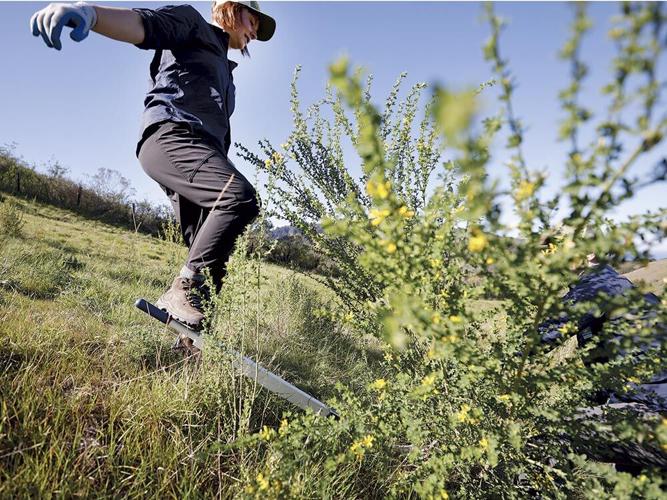
ON THE SANTA LUCIA PRESERVE, restoration manager Jackson Brooke stands atop a hill where a team has returned every year for the last three to remove French broom, the invasive that receives the most attention on this sprawling 20,000-acre chaparral property in Carmel Valley. Any chance for eradication in the area will require a few decades of similar, consistent effort as the plant’s seeds remain viable in the soil for up to 30 years.
“If we didn’t do anything in this area, it would eventually become 95 – to 100-percent French broom,” Brooke says. “Monocultures and invasives also impact resistance to external factors like drought or wildfire.”
Preece says the contrast in scale between Earth time and human time is what makes invasive management and habitat recovery a challenge of focus and consistency.
“If we wanted to get rid of these eucalyptus trees and put in Monterey pines instead, it could be 40 years before we get a nice tall pine. It takes longer than a career to recover a habitat,” Preece says as she brushes against a native coffeeberry tree smothered under eucalyptus debris. “If you could be here for 50 years, you would have such an intimate knowledge of the landscape. That’s something we lost when we kicked all of the Native Americans off the land.”
Yet, invasive plants continue to hold the admiration of locals. Pacific Grove’s Perkins Park, a coastal trail between Lovers Point and Asilomar Beach, is lined with South African ice plants and is named after Hayes Perkins, the man who introduced the invasives to the area in the 1930s.
When blooming with purple flowers, the stretch of ice plants has become an iconic image of Pacific Grove and the city spends $150,000 per year to maintain the park with a team of volunteers.
“By no means are we looking to get rid of this plant species,” says Dan Gho, Pacific Grove’s deputy city manager. “We want it to thrive. It’s a key aspect of Pacific Grove, from residents to tourism.”
Allred says complete eradication is no longer a realistic goal. However, she emphasizes the land has been stewarded by humans for over 10,000 years, and the future of the ecosystem will depend on which direction land managers want to push it in, just as it always has. Feliz says that means focusing on the future.
“I want people to understand and appreciate our natural landscape, and they only do that when they get to experience it,” Feliz says. “But I also want people to take a longer view and think well into the future and well into the past and try to understand that this is an ever-changing habitat.”

The South African ice plant has made a home along coastal scrub throughout California. However, the plant dominates the dune habitat, bullying other species out of resources and homogenizing – and weakening – a once diverse ecosystem.
~ Weed Wrap ~
Plant name: Ice Plant
Native habitat: South Africa
Found locally: Coastal scrub, coastal sand dunes
How they arrived: Introduced in the early 1900s as a way to stabilize coastal dunes. Caltrans planted ice plants across 1,000 acres of dunes between Santa Barbara and Santa Cruz.
• • •
Plant name: Eucalyptus tree
Native habitat: Southeastern Australia
Found locally: Inland chaparral environments, private property across the county.
How they arrived: Introduced in the mid-19th century as a cure to the growing lumber shortage caused by the gold rush. Eucalyptus trees were marketed as a “miracle tree.”
• • •
Plant name: Jubata grass (colloquially called pampas grass)
Native habitat: Andes mountain range, South America
Found locally: Along roadways and the rocky ridges of Big Sur
How they arrived: Brought over as an ornamental, likely by a man named Joseph Sexton, who sold the plants as decorations for everything from hats to parade floats.
• • •
Plant name: French Broom
Native habitat: Mediterranean Europe, Canary Islands, northwest Africa
Found locally: Coastal scrub, grasslands, chaparral
How they arrived: Introduced as an ornamental for private gardens in the 1800s.
(0) comments
Welcome to the discussion.
Log In
Keep it Clean. Please avoid obscene, vulgar, lewd, racist or sexually-oriented language.
PLEASE TURN OFF YOUR CAPS LOCK.
Don't Threaten. Threats of harming another person will not be tolerated.
Be Truthful. Don't knowingly lie about anyone or anything.
Be Nice. No racism, sexism or any sort of -ism that is degrading to another person.
Be Proactive. Use the 'Report' link on each comment to let us know of abusive posts.
Share with Us. We'd love to hear eyewitness accounts, the history behind an article.