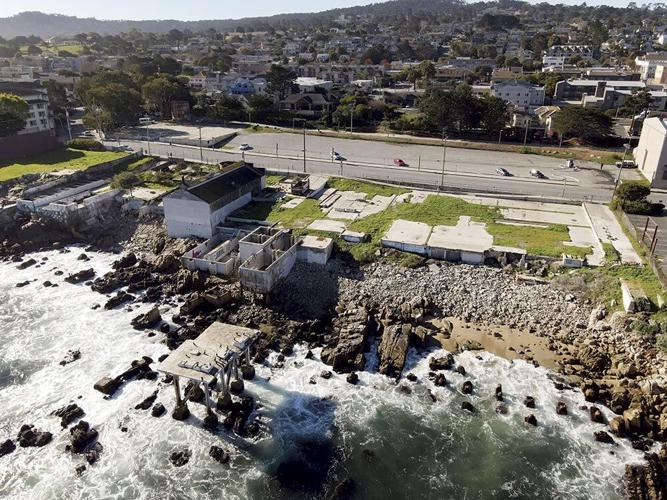
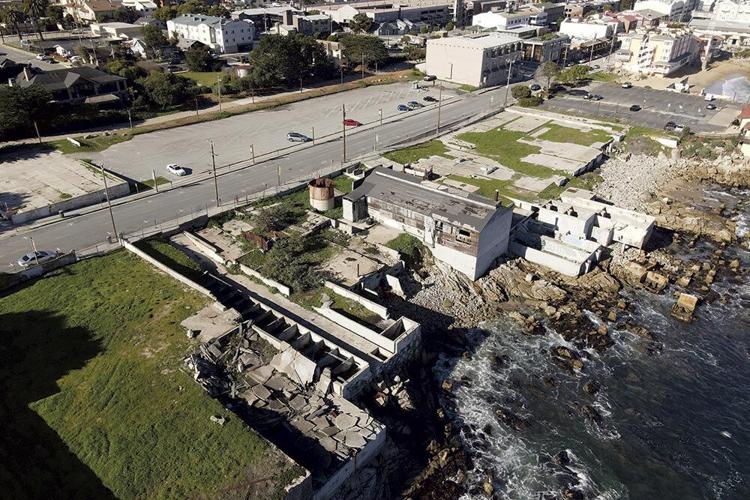


With the exception of a remnant building that was for a time used to process kelp and later became an art gallery, the property at 484 Cannery Row has sat derelict since the San Xavier Cannery burned down in 1967. The parking lot across the street at 501 Cannery Row is also part of the proposed project site; the city of Monterey demolished an old San Xavier warehouse on that property in the mid-1990s for safety reasons.
It may be an apocryphal tale, but it’s said that when former president Barack Obama visited the Monterey Peninsula in 2018 and stayed at the Monterey Plaza Hotel, he saw the blighted coastline property at 484 Cannery Row – a ruinous patch of grass surrounded by a chain link fence – and said something to the effect of, “What the hell is that?”
Whether or not it’s true, it is believable: It not only sounds like something Obama might say, but countless people have said it before that time, and countless people since.
For about 25 years, there’s been an active development proposal on the site, and for almost as long, it’s been the subject of various lawsuits that have generated thousands of pages of litigation, resulting in many more thousands of dollars being paid out to attorneys and others.
The twists and turns over time have been dizzying and often inscrutable for those trying to understand what is seemingly a simple question: How does a prime piece of coastal real estate, located in an iconic tourist hotspot, sit vacant and fallow for decades, with no signs of life in the offing?
The answer to that question lies somewhere within a wild, and wildly complicated story that has not been tied to any crimes, but in which two criminals play key roles – it gets dark. It is a tale of real estate intrigue, and one where it appears there might be some chess being played, but perhaps a lot more checkers.
County Assessor Steve Vagnini, when answering questions about the property in November, said, “There are some projects that just have bad juju on them, and they never happen.”
He could not have known how right he was.
A PIECE OF HISTORY
Setting the project aside, the property, at least, does not appear to be cursed.
Local historian Tim Thomas considers it among the most historic on Cannery Row: the first post-indigenous development on the site occurred in the late 1800s, when Japanese fisherman Otosaburo Noda established a Japanese fishing and abalone diving camp there.
Noda, Thomas says, was responsible for all the Japanese fishermen immigrating into Monterey during that time, and in 1902, Noda partnered with an American, Harry Malpas, and started the first cannery on the street – Monterey Fishing and Canning Company – which focused on abalone. It represented the start of an industry – canning and fish oil reduction – that would define Monterey for generations.
The only existing historic structure on the site is a remnant building of the San Xavier Cannery which, like a handful of other canneries that year, burned down in 1967 in what Thomas refers to as “insurance fires.” (Ironically, it occurred at the start of the Peninsula’s “Fire Prevention Week,” where, among other things, local firefighters engaged in a tug-of-war festivity on Cannery Row.)
But as other Cannery Row properties were redeveloped in the subsequent decades into hotels and restaurants, and most importantly, the Monterey Bay Aquarium, the property showed no real signs of life until Cannery Row Marketplace LLC bought it in 1996 with plans for a massive retail, restaurant and condo development.
The first iteration of the project, called Cannery Row Marketplace, was unanimously rejected by the Monterey City Council in 1999, which felt, along with many members of the public, that the project was too big in scope.
So the developers downsized the project – it would now be 87,000 square feet of retail and restaurants, 38 market-rate condos, 13 workforce housing units and 377 parking spaces – and rebranded it as Ocean View Plaza. The City Council approved it in 2004, with a slew of conditions that included preserving and restoring the last remnant building and making it part of a “history plaza” focused on the history of Cannery Row.
That plaza would open up to the sea, bracketed with retail and restaurants and two floors of condos on top. There would also be apartments across the street where about one-third of the project site is, and a bridge across Cannery Row – like the San Xavier Cannery once had to load product onto trains – to create the aesthetic of history.
But two other details matter more. The first is that, as approved, 93 bayside parking spaces would be on the basement level – coastward of a street that is right along the water, as icebergs cook in the Arctic.
The PROJECT, as previously proposed and approved, is likely DEAD IN THE WATER.
Another is that, unlike all of the other major developments on Cannery Row, which had been approved before the state’s 1995 cease-and-desist order against Cal Am regarding its illegal overpumping of the Carmel River, the project had no water. In this case, the developers proposed solving that problem with an on-site desalination plant that would produce about 25 acre-feet of water annually.
The desal aspect of the proposal was a key reason the staff of the California Coastal Commission later recommended denying a coastal development permit for the project because, among other things, it could negatively impact marine life in a federal marine sanctuary, and the operation could fail, forcing Cal Am to increase its overpumping.
But despite its own staff’s recommendation, the Coastal Commission approved the project in November 2008, and the timing is important: That approval came at the height of the Great Recession, and financing any development at that time was virtually impossible.
So while the iron was in some ways hot, it was also ice-cold.
Cannery Row Marketplace LLC defaulted on its loan in 2009, about the same time other unfortunate realities started to become known, or at least suspected: There wasn’t just a problem of timing, there were problems – very serious ones – with people.

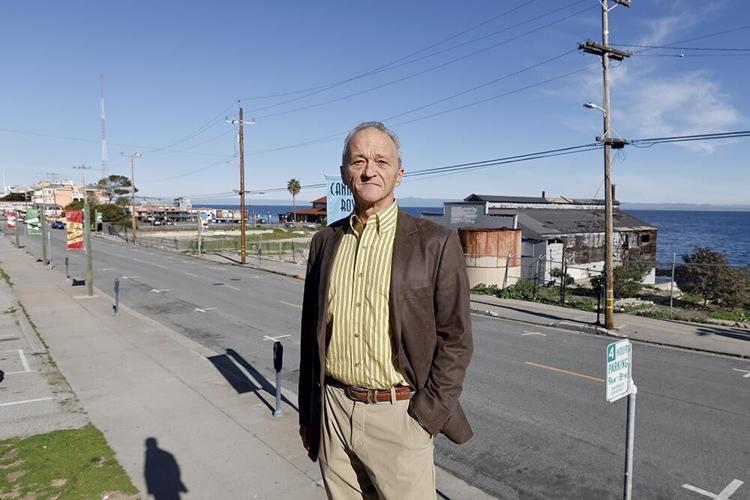
“We’ve got this little hole in the center [of the waterfront] and we’ve got to fill in Da Vinci’s work,” says Bob Faulis, one of the principals of Ruby Falls Fund LLC, which claims to own the property. “I feel terrible no one uses it. I want to share it with people – it’s not right for it to be fenced up.”
CRYPTIC CURRENCY
After 25 years, numerous LLCs, lawsuits (some of which are still ongoing) and money from more than 50 investors, we are essentially back where things started. But it does not appear that outcome was inevitable. To understand how the project got here, one must go back to how it was financed.
In 1999, Cannery Row Marketplace LLC took out a $4.6 million loan on the property with Geneva Real Estate Investments, which was secured by a deed of trust against the property. The loan was soon increased to almost $6 million.
According to Frank Tomasello, one of the original investors in that loan, many physicians in the San Leandro area, like himself, invested in Geneva, and for years, it paid off handsomely. But Tomasello, who is now 87, doesn’t expect he will live to see the loan get paid off.
That’s at least in part because over time, it would become clear that the handling of that loan by its original servicing officer – Geneva’s Carl Miller, who was selling investors a piece of the pie – was problematic.
Knowing this or not, Cannery Row Marketplace LLC defaulted on the Geneva loan in 2009 as the global economy tanked. That same year, according to court documents, Miller passed off the loan to James Kroetch and Robert Feole of Medallion Servicing LLC, which took over servicing it. According to court documents, the two quickly became suspicious of Miller’s business practices, and contended Miller had left behind “incomplete” and partial business records, and that he took all of the lender files.
But nonetheless, court documents reflect, “operational failures” in bookkeeping practices continued under Medallion, and “were consistent throughout the history” of the loan.
In 2012, court documents say, Medallion “caused” a new company to form, this one called 2012 Canrow Owner LLC, to take over the interest on the loan. The new LLC included over 50 investors, and their interest was to be the equivalent share of whatever Miller had sold them.
In May 2013, Medallion tried to put up the property for sale, and recorded a document purporting to have acquired all the fractionalized interests of the original loan. But the sale could not happen because, as Cannery Row Marketplace LLC informed them, Medallion screwed up the paperwork: “Seemingly… the documentation regarding the trustee was in error,” court documents read.
In July 2013, a holder of a second deed of trust on the property held a foreclosure sale, and the successful bidder was Aqualegacy Development LLC.
Medallion, meanwhile, was forced to record a substitution of trustee the following August, acknowledging it had not received the interests of all of Miller’s original investors.
But while Aqualegacy technically held title to the property, its deed of trust was subordinate to the first loan, which remained in default, meaning that by acquiring the property, Aqualegacy had essentially taken on another mortgage – it needed to pay off the original loan too.
But in order to get a loan to push the project forward, Aqualegacy claimed – and court documents reflect – it needed clean chain-of-title documentation in order to secure title insurance to get that loan.
Despite alleged assurances from Medallion, those documents – which may not even exist – were never provided to Aqualegacy, which maintained it was unable to get a loan for that reason, and Medallion foreclosed on the property in January 2014. Aqualegacy then filed for bankruptcy and the matter went to the courts, where it remains – although Aqualegacy has prevailed until now.
And while no crimes have been brought regarding the finances of the property – it’s only been the subject of civil litigation – two main actors associated with the loan, Carl Miller and James Kroetch, are indeed criminals.

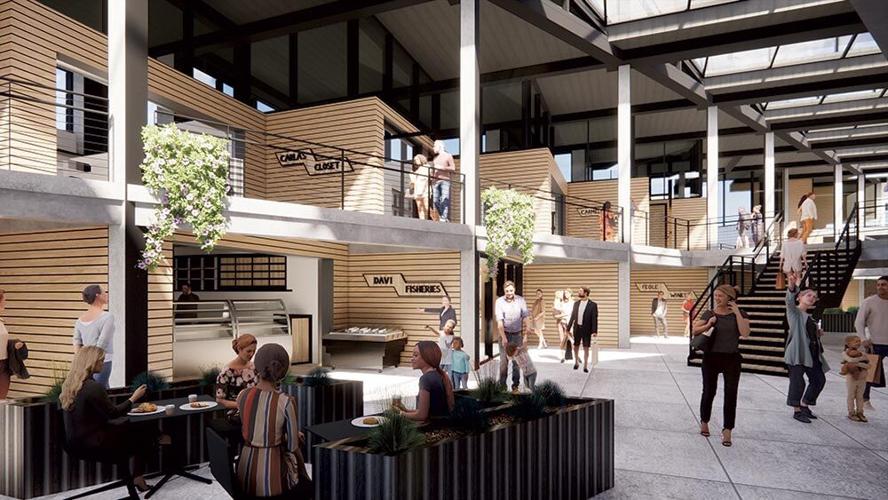
This is not a rendering from the previously approved project, Ocean View Plaza, which lost its coastal development in 2019 – it’s a vision from local architect and Monterey native Cristo Staedler; he created it as part of a thesis project in which he designed a potential development on the property that would include a concert hall, culinary arts school and a marketplace with local artisan goods. It’s not a real proposal – but at this point, it’s probably as real as anything else.
THE DARK SIDE
On Nov. 15, 2013, Carl Miller, who serviced the original loan on the property, was sentenced to 12 years and eight months in state prison after being found guilty – in a completely unrelated matter – of eight embezzlement and forgery-related charges involving hundreds of thousands of dollars from investors.
Miller appealed that sentence, but it was upheld by the state’s First District Court of Appeal in 2016 which, while citing the earlier court record, determined: “The court referred specifically to the likely effect imprisonment would have on Miller’s children, but it found that not sending Miller to prison would send them the message that ‘their father can go out and steal nearly $2 million of money and nothing happens to him.’”
It also stated “the court commented extensively on Miller’s lack of remorse, noting Miller had attempted to shift the blame for his crimes onto two of his employees and had displayed a smirking, entitled demeanor throughout the trial.”
The decision also noted that “the court considered Miller’s minimal efforts to find employment so that he could make restitution to the victims, remarking that he had only submitted online applications to Starbucks and Best Buy rather than actively looking for work.”
Miller was ultimately incarcerated for four years and three months, and was released in March 2018.
James Kroetch, an attorney who took over servicing the loan for Medallion Servicing, and who foreclosed on Aqualegacy, is of a different cloth.
In March 2013 – before Aqualegacy had even entered into the picture – the Pleasant Hill Police Department arrested Kroetch on charges of possession and distribution of child pornography.
That came after a search warrant was served on his residence, in which police reportedly found more than 9,000 images of child pornography and more than 3,000 videos of child pornography, including an animated video used to groom children.
According to court documents, “The [police] laboratory also determined that [Kroetch] had modified several images wherein [he] inserted himself into photos depicting sexual acts with children. Most of the images involved children very young in age ranging in ages from 1 to 12.”
Also, the lab determined Kroetch “was using peer-to-peer networks to share and disseminate child pornography with other users.”
Kroetch ultimately pleaded no contest to a misdemeanor in 2016 and was sentenced to three years of probation and required to register as a sex offender.
In subsequent proceedings before the state bar, Kroech was disbarred in March 2018, and the decision notes that Kroetch said his plea agreement “was a result of a bargain with the district attorney for his assistance in another criminal matter.”
It is not clear what that matter was, but Kroetch remained a free man.
The state bar decision finalizing his disbarment was mailed to both Medallion’s office and Kroetch’s post office box, both located in Orinda, as well as the house where Kroetch was apparently living in Martinez.
From the small street where the house is located, one could almost throw a football and hit John Swett Elementary School, which is only about 500 feet away.
OWNING IT
Aqualegacy sued 2012 Canrow Owners LLC in 2016, alleging it was improperly foreclosed upon.
Key to its claims is it was never given proper documentation by Canrow regarding chain of title, and because the foreclosure sale wasn’t properly noticed. In doing that, Aqualegacy put what in legal terms is referred to as a “lis pendens” on the property – a notice signaling it was the subject of active litigation.
Despite that, Canrow sold the property to Ruby Falls Fund LLC in 2017. (But as far as Monterey County Recorder’s Office’s records reflect, while Ruby Falls took over title to the property, no money changed hands.)
Ruby Falls then became involved in the litigation with Aqualegacy, and one of the principals of Ruby Falls, Bob Faulis, soon began showing up at Monterey City Council meetings and evangelizing his vision for the project.
The website Ruby Falls put together to market the proposed development, canneryrowplaza.net, is surprisingly slick given its assertion that the company acquired the property after “close to three years of due diligence,” while making no mention of the fact the property was the subject of active litigation during the time of the acquisition, not to mention the chain-of-title questions.
Another wrinkle: While Aqualegacy is owned by Michael Brown, a letter an attorney for Aqualegacy sent to Kroetch in 2017 stated that Brown had authorized Phil Taylor, a developer who was a principal with Cannery Row Marketplace LLC – the original owner – “to act on Aqualegacy’s behalf (without compensation and without any rights to participation) to further the entitlements for the project and seek investors.” He claimed that Taylor had found “sophisticated and well-capitalized investors” ready to proceed.
Taylor was back in the game.
That same letter made clear that Aqualegacy was ready to pay $9 million – with $1 million in cash – to settle the outstanding debt on the Geneva loan, but Kroetch rejected the offer, and a month later sold it to Ruby Falls.
Aqualegacy’s case against Canrow and Ruby Falls was ultimately decided in January 2021 by Monterey County Superior Court by Judge Lydia Villarreal. In her decision, Villarreal vacated the foreclosure on Aqualegacy because clear chain-of-title documents were never provided, and because the foreclosure sale wasn’t properly noticed. Villarreal also noted other irregularities, like that when the deed of trust was purportedly granted to Canrow in November 2014, it was recorded that Medallion Silver – not Medallion Servicing – executed the deed, despite the fact Medallion Silver was not the trustee on the deed – Medallion Servicing was.
“Their father can go out and STEAL NEARLY $2 MILLION of money and nothing happens to him.”
On Aug. 30 of last year, Villarreal issued another order granting Aqualegacy possession of the property, and while Ruby Falls has appealed that ruling, right now it appears that Taylor, on behalf of Aqualegacy, is back in the driver’s seat.
(NOT) BUILDING IT
To what extent there’s still a proposed project on the site remains unclear. Ocean View Plaza, as approved by the Monterey City Council in 2004, still has development entitlements with the city, which has continued to renew them as the litigation sorts itself out.
But in November 2019, the California Coastal Commission went with the recommendation of its staff and denied extending the project’s coastal development permit because circumstances had changed since its 2008 approval.
First among those was that the state water board’s 2015 Ocean Plan instituted strict rules regarding desalination projects – particularly when located within a marine sanctuary – which sought to minimize mortality to all forms of marine life, no matter how small. The Coastal Commission staff argued, in its report to the commissioners, that Ocean View Plaza’s proposed desal project – which had been grandfathered in up to that point – was no longer consistent with state policy.
Another key was related to climate change: In 2008, the Coastal Commission estimated there would be approximately 3 feet of sea level rise impacting the project by the year 2100. By 2018, that estimate more than doubled to 6.8 feet, and the agency estimated that parts of the site would be impacted by sea level rise “potentially as early as 2030.”
Ruby Falls sued the Coastal Commission in response to being denied an extended permit, and unless it prevails, the project, as previously proposed and approved, is essentially dead in the water. Even if water becomes available for a development on the site with the planned expansion of Pure Water Monterey, it will still have to come back before the city of Monterey’s various boards for approval, and then ultimately, back to the Coastal Commission.
And given that adding new lights to a high school football stadium is enough to spark a lawsuit in Monterey, the last vacant waterfront property on Cannery Row is likely to remain that way for quite some time.
CALIFORNIA DREAMING
Faulis, one of the principals behind Ruby Falls, which is battling Aqualegacy in court over who owns the property, seems to possess a genuine desire to make the previously proposed project a reality. And he seems to hold out hope that it somehow might become one.
It’s not impossible: Ruby Falls could win its appeal of the 2021 decision that vacated Canrow’s foreclosure sale on Aqualegacy, and that gave Aqualegacy possession of the property.
Then, Ruby Falls could prevail in its lawsuit against the Coastal Commission, which it filed in January 2020 due to the agency not extending the project’s coastal development permit the previous year. (In November 2021, Monterey County Superior Court Judge Thomas Wills allowed Aqualegacy to enter that case, which he also stayed – effectively, put on ice – until the ownership dispute is worked out in the appeal. And now that Aqualegacy has entered that case, it presumably could prevail too – getting its permit back – if it can hold onto the property.)
“If I lose [on appeal], and the project gets developed, I’m happy,” Faulis contends. “I’m not driven by money.”
For Faulis, in his telling, his desire to see the project built is deeply personal: He says his father, who was an engineer in Silicon Valley, was distant as a parent, but the one time “he seemed to let go” and act warmly toward him was on a trip to Cannery Row.
But also in Faulis’ telling, he still stands to make a nice dime: While the county has no record that any money changed hands when Ruby Falls acquired the property from Canrow, Faulis says that Ruby Falls bought out the loan, though he won’t say for how much – he calls that information “proprietary” – though presumably it’s for more than the $9 million Aqualegacy offered Canrow in 2017.
And even if Aqualegacy prevails, Faulis says, it will still owe Ruby Falls about $15 million to pay off the loan.
(Faulis also generated income from the property until he recently lost possession of it: According to Coastal Commission documents, Faulis operated a paid parking lot operation on part of the property – 501 Cannery Row – without a coastal development permit.)
If it all seems confusing, perhaps it’s by design.
Tomasello, one of the original investors in the Geneva loan, has been following the process for years and has amassed files of documents, but he can’t seem to tie all the threads together to figure out how things got here.
“I’m pretty sure 95 percent of the people invested don’t understand it,” Tomasello says. “I think it was purposely set up to be confusing, going in and out of different entities, and no one really knew what was happening.”
So what’s next? Maybe Taylor has an idea, but he declined to comment for this story.
It is intriguing to ponder: Now that there’s no longer an approved project – unless Ruby Falls (or perhaps Aqualegacy) were to prevail in court against the Coastal Commission – any dream for the property is possible, so long as it can be defended in court and make some people some money.
In an op-ed John Steinbeck penned for the Monterey Peninsula Herald in 1957 about the future development of Cannery Row, Steinbeck made a suggestion that, he surmised, would get him “exiled from the Peninsula.”
Steinbeck wrote that “young and fearless and creative architects” in America were “some of our very best artists,” and he suggested they “be allowed to look at the lovely coastline” and design “something that will add to the exciting beauty rather than cancel it out.”
This was at a time when Cannery Row was still full of canneries, and when the road was still called Ocean View Avenue, even though the canneries blocked the view of the ocean.
“We never had a Notre Dame or a Chartres,” Steinbeck continues, “but who knows what future beauty we may create? The foundation is there; sea rocks and beach, deep blue water, and on some days the magic hills of Santa Cruz.”
Steinbeck closes with, “I don’t think any such thing will be done, but so far dreams are not illegal – or are they?”
For whatever dream comes next for this property, it’s a safe bet the courts will be asked to answer.

Above: One of the main reasons the California Coastal Commission denied extending a permit in 2019 for the proposed project was that the agency’s sea level rise prediction for the year 2100 more than doubled since the agency first approved it 11 years earlier.
CAST OF CHARACTERS:
THE PEOPLE
Carl Miller: A loan servicing officer who originally handled the finances of the primary loan on the property, from 1999 to 2009. Miller was later convicted of eight felony embezzlement and forgery charges in an unrelated matter, and sentenced in 2013 to almost 13 years in state prison.
James Kroetch: An attorney who took over servicing the loan from Carl Miller in 2009. He was arrested on child pornography charges in 2013 and later pleaded no contest to misdemeanors – after cooperating with another investigation – and received three years of probation, but no prison time. For those offenses, Kroetch was disbarred in 2018.
Michael Brown: The owner of Aqualegacy Development LLC, which acquired the property in a foreclosure sale in 2013 but was foreclosed upon the next year. Aqualegacy has been locked in litigation over whether it still owns the property – it claimed its foreclosure was not legal – and so far, has prevailed.
Phil Taylor: A developer who was previously a principal with Cannery Row Marketplace LLC, which bought the property in 1996 and had a project – Ocean View Plaza – approved by the Coastal Commission in 2008. Michael Brown, the ostensible owner of Aqualegacy, has authorized Taylor to act as its agent in seeking investors and maintaining entitlements.
Bob Faulis: A principal with Ruby Falls Fund LLC, which bought the property in 2017 and has since been locked up in litigation regarding, among other things, whether it actually owns the property.
THE COMPANIES
Cannery Row Marketplace LLC: Acquired the properties 484 and 501 Cannery Row – about 3.5 acres in total – in 1996. Its proposed development, Ocean View Plaza, was approved by the city of Monterey in 2004 and the California Coastal Commission in 2008. Defaulted on the loan on the property in 2009 amid the Great Recession.
Geneva Real Estate Investments: The company that originally serviced the loan taken out against the property in 1999, and which serviced it until 2009. Geneva’s Carl Miller was convicted in 2013 on felony embezzlement and forgery charges in an unrelated matter.
Medallion Servicing LLC: The company, led by James Kroetch, that took over servicing the loan from Geneva in 2009. (Kroetch later pleaded no contest to misdemeanor child pornography charges.)
Aqualegacy Development LLC: A company ostensibly owned by Michael Brown that bought the property in a foreclosure sale in 2013; Brown has authorized Phil Taylor, a former principal for Cannery Row Marketplace LLC, to pursue investors and secure the entitlements for the property.
2012 Canrow Owners LLC: A company Kroetch compelled the formation of in 2012 to consolidate the fractionalized interests of the original loan. The courts have so far decided Canrow acted illegally when it foreclosed on Aqualegacy in 2014 for lack of proper notice and chain of title documentation.
Ruby Falls Funds LLC: Purchased the property in 2017 for an unknown amount – the county has no record any money changed hands – but principal Bob Faulis says the company acquired title to the property by taking on the orginal loan against the property, which at that time had an outstanding balance of about $10 million.
(0) comments
Welcome to the discussion.
Log In
Keep it Clean. Please avoid obscene, vulgar, lewd, racist or sexually-oriented language.
PLEASE TURN OFF YOUR CAPS LOCK.
Don't Threaten. Threats of harming another person will not be tolerated.
Be Truthful. Don't knowingly lie about anyone or anything.
Be Nice. No racism, sexism or any sort of -ism that is degrading to another person.
Be Proactive. Use the 'Report' link on each comment to let us know of abusive posts.
Share with Us. We'd love to hear eyewitness accounts, the history behind an article.