

Carmel’s fabled artist colony of the early 1900s grew out of destruction. The 1906 Great Earthquake of San Francisco shook that city’s foundation, ignited fires, and sent many of its artists out of town. By invitation of poet and playwright George Sterling, many of them migrated down here, where they wrote, painted, played, frolicked, drank, loved, tramped and fought. Some, like young aspiring poet Nora May French, died. Most eventually moved on.
But they left a bohemian aura in Carmel that lures artists still. Carmel Bach Festival picks up on that with this year’s theme, Bach, Bohemia & Beyond.
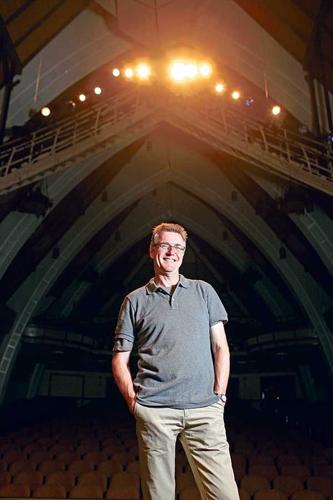
“I’m paying tribute to the history of Carmel and the whole bohemian flavor of this town,” says Paul Goodwin, the festival’s principal conductor and artistic director. “The Carmel Bach Festival came out of the artists colony.”

Conductor Paul Goodwin opens the fest with Handel’s Fireworks Music to “Get people smiling from the very start.”
The festival references the lifestyle predicated on artistic amenities, alternative conventions and the tendency to travel. That definition hails from the region where the Roma people, or gypsies, were thought to come from, that region of the Czech Republic once known as Bohemia, centered on Prague and extending further into Eastern Europe. Many of the composers added into this year’s festival hail from right around there.
That said, a music festival of 38 concerts and 34 free events across 22 days translates to a lot of range and a lot of music. Looking at one of those 38 concerts up close helps reveal an understanding of the artistry, history and depth of the music, why it’s survived, why it compels great numbers of people to devote their lives to play it, and even greater numbers of people to come listen. Looking microscopically close at one of the music programs shows the molecular properties that, zooming out far enough, reflect the bigger festival.
That music program can be Concertmaster Peter Hanson Presents, playing Sunset Center on the Mondays of July 20 and 27.
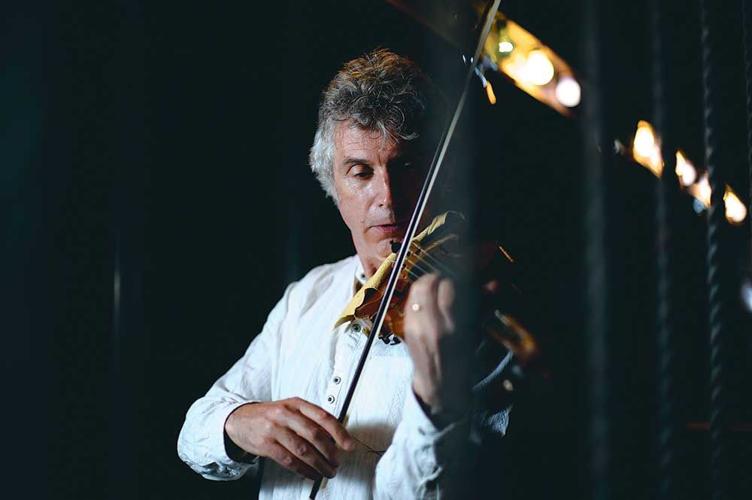
It’s a full string orchestra – just strings. No woodwinds, no percussion, no brass. Hanson, a violinist, got the string players on loan from Andrew Megill, the festival’s associate conductor and director of chorale and chorus, who is directing an entirely a cappella vocal program.
And Hanson is totally going for it.
His Monday night starts with Béla Bartók (1881-1945), an important Hungarian composer who traveled Eastern Europe recording, preserving and absorbing folk music with a methodology that later became ethnomusicology. He was influenced by Liszt, Strauss, Debussy and Stravinsky, but his collected folk music most exemplified his melodies, textures and harmonies.
According to Allen Whear’s program notes for the Bach Festival, in 1939 Paul Sacher, founder of the Basel Chamber Orchestra, put Bartók up in his Swiss chalet to write something light and fanciful. Which Bartók obliged. He composed Divertimento, meaning diversion.
“However,” Hanson says, “Bartók being Bartók and 1939 being 1939, with the Nazis threatening, he did write some heavy stuff.”
There are three movements, totaling about 26 minutes.
“The first has a bluesy feel straightaway,” Hanson continues. That was par with the zeitgeist of that time.
Hanson describes the second movement as “shimmering with nighttime effects, very evocative and atmospheric.” The finale: “Very dancey, pizzicato [plucking] strings, a whirlwind ending.”
The whole piece, he adds, “is like a fantastic celebration of folk tunes and lore and music making.”
Two weeks after Bartók wrote Divertimento, Adolf Hitler’s German army invaded Poland, and Bartók fled his Nazi-friendly homeland of Hungary for America.
“THIS MUSIC IS SO GOOD, NO MATTER WHAT YOU DO TO IT YOU CAN’T HURT IT.”
Next up: Johann Sebastian Bach’s (1685-1750) virtuosic “Ricercar a 6” extracted from the epic Musical Offering. Ricercar (“REEcher-car”) is an Italian derived word for an elaborate instrumental composition in fugal or canonic style. The backstory of the piece, as well as its compositional structure, illuminates Bach’s genius.
In 1747, writes Whear, J.S. Bach visited the court of Frederick the Great in Potsdam, Germany, where his son C.P.E. Bach was employed as a harpsichordist. The elder Bach was famed for his improvisation, so the king sprung on him an eight-bar melody to improvise in three parts on a newly invented instrument called a pianoforte. Bach responded with a spontaneous performance so deft that, Whear writes, “all those present were seized with astonishment.”
But the king, feeling mischievous or malicious, doubled the stakes. Play us a six-part fugue, he challenged Bach. (That’s six separate lines of music improvised on the spot.) This time Bach deferred, saying that it would require him to go home to Leipzig to compose it, but that he would return and play it for the king when finished.
In two months, he created A Musical Offering, comprised of 10 canons, two fugues and a four-movement sonata, bejeweled with hidden riddles and religious allegories, all employing the king’s original melody.
“[Bach] did just about everything you can think of with that melody,” Hanson says. “Two, three, four instruments, trios, sonatas, canons. He turns the melody upside down and backward. There’s one piece where one person plays it forward, the other plays it backward, and it still works. One person can play it upright and the other upside down, and it still works.”
The fional piece in the Musical Offering is the “Ricercar a 6,” arguably the most important piano composition ever.
“This music is so good,” Hanson continues, “no matter what you do to it you can’t hurt it. The intellectual power of this six-part fugue overwhelms whatever way you play it. The brain work that goes behind it is just phenomenal.”
And that’s the number, clocking in at 8 minutes, that Hanson has put into the middle of his Monday Night concert. He’s set the army of string musicians at his disposal on a 1930s arrangement by Anton Webern for greatest effect.
“I wanted to give audiences a broader, more triumphant, full-blooded performance rather than the more delicate period instruments,” Hanson says.

Concertmaster Peter Hanson says Thursday’s Authentic Brandenburg Concertos is “an amazing thing.”
After an intermission, the next piece will be Czech composer Antonin Dvorak (1841-1904) – a predecessor of Bartók who also collected and integrated Bohemian folk music – and the complete five movements of his 30-minute Serenade for Strings in E Major. It was written during his rapid ascent up the music world, in the early part of his new marriage, after his first son had just been born. Like that Pharrell song goes, the man was happy like a room without a roof. And this work sounds like it.
There are five movements, five different characters.
Whear writes, “Throughout, Dvorak’s writing for string is confident in technique and endlessly varied in texture.”
It seems as uplifting an end to a Monday that Mondays are ever likely to see.
“[The piece] is absolutely classic,” Hanson says. “And very, very famous.”
But it may not end there. If all goes well, Hanson is prepared to pop an unlisted bonus track onto the finale of the program. “Bohemian Rhapsody.”
You know: Queen, Freddie Mercury, 1975, rock opera, Wayne’s World, the guitar solo, the headbanger downshift, the tricky dynamics and oblique lyrics that everyone, somehow, can still follow and sing along to (maybe because of the 149 million views on YouTube).
Other concerts and lectures take place in Carmel, Pebble Beach, Monterey and Seaside. But this Monday program seems one of the more easily accessible and instantly appealing. The festival is banking on it by pairing the concert with a garden party-like promotion called Triple Play Monday: an appetizer and home-brewed beer reception to kick things off, then the concert, wrapped up with a wine and cheese after-party in the courtyard, all for $25.
They have faith that once you get a taste, you’ll come back for more.
The 78th Carmel Bach Festival runs July 15-Aug. 1 at various venues in Carmel, Pebble Beach, Monterey, Seaside. Free-$275; concert discounts linclude $20/active military and students with valid ID, and $15/up to 6 tickets for families. 624-1521, www.BachFestival.org

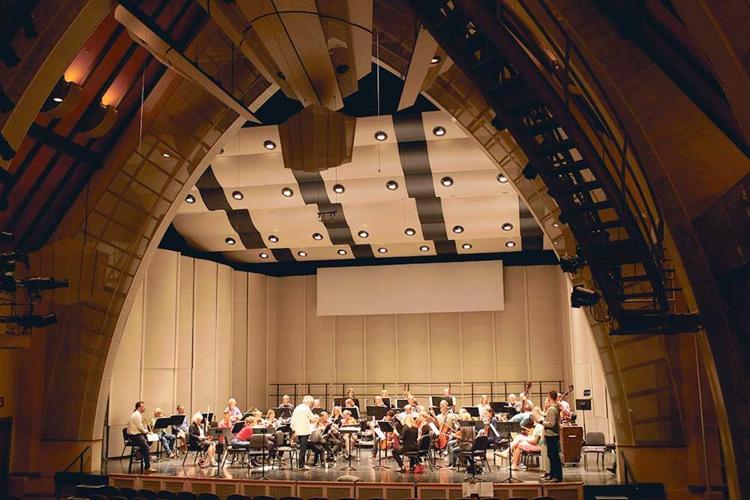
The sound from the Sunset Center’s acoustically sophisticaed stage can be augmented with a state-of-the-art (and discreet) amplification system.
~ INTO THE DEPTHS ~
The layers of Bach Fest charm the passing fan and the die-hard alike.
Debbie Chinn, Carmel Bach Festival’s energetic executive director, says that inclusiveness and expansiveness are the twin engines under the hood of the festival.
“Breaking down barriers in price and perception,” she says. “The centerpiece is our family concert. It was a great success. It brought in a lot of local people who hadn’t found their way into the festival before.”
That family concert returns 11am July 25 at Sunset Center as The Underwater Adventure of Leonard and Rasmus, with Rossini, Handel, Piazzolla and Jelly Roll Morton, for as little as $11.
Here are some more of the festival’s keys to the kingdom of Bach.
Open Rehearsal: Concertmaster Peter Hanson Presents - 10am July 16
The last of the free open rehearsals in which the public can show up and get a sneak peek at the director and players fine tuning the program. For more about this one, read the main story.
Inside the Music: The Magic Flute - 8pm July 21 and 28
The full mobilization of orchestra, chorale, chorus and soloists on Mozart’s beloved opera, done in concert form with narration by David Gordon.
Community Concert - 7pm July 23
This is the 30th year that the Bach Festival has been putting on this free and varied concert at Seaside’s Oldemeyer Center. It’s like a variety show of singers, musicians, youth and that spirit of inclusiveness Debbie Chinn was talking about.
From Bach to Beethoven - 8pm July 24 and 31
Lines up Bach’s Brandenburg Concerto No. 1 in F Major, a commission by young composer Benjamin Wallfisch called “Margrave Interludes,” Gyorgy Ligeti’s Concerto Romanesc, and Beethoven’s mighty and joyous Symphony No. 7 in A Major. Goodwin, who conducts that program, says the Ligeti is “The most wacky piece you can imagine” and “truly knees up music.”
Virginia Best Adams Masterclass Showcase - 1:30pm August 1
This vocalist showcase, directed by David Gordon and accompanied by a small band of musicians, puts forth a lot of beauty and variety for a lovely afternoon at the end of the festival. Virginia, by the way, was the wife and partner of Ansel.
(1) comment
Carmel Bach Festival is also "breaking down barriers in price and perception" by giving discounts to people who bike to Bach!
Carey Beebe, the world-renowned technician whose expertise tending instruments is essential to Carmel Bach performers, is an Australian who loves to bike. And Carey says that his bicycle is an “indispensable tool without which early keyboard instrument logistics at Carmel Bach would fall in a heap.” Why?
As of 2015, Carey has biked to Carmel Bach festival venues for 17 years. Yes, not just occasionally for fun, but on a typical basis, as his way of getting around more efficiently in summer traffic. Carey has biked to Bach Festival venues in Carmel, Carmel Valley, Monterey, Pebble Beach, Salinas, and Seaside.
Since 2014, Carmel Bach Festival will give males or females who bike a 20% HER Helmet Thursdays discount on any Thursday performance. To get your discount, bike (or bike-and-ride) to buy your ticket to a Thursday show, then show your helmet as evidence.
Details and FAQs about these bike-to-Bach discounts, plus more about Carey Beebe: http://bicyclingmonterey.com/bike-needs-a-tune-up-tune-up-needs-a-biker.html
HER Helmet Thursdays, created and launched in Monterey County in 2009 as a public service, is a long-term project. It includes hundreds of Hotels, Educational and Entertainment spots, Restaurants, and related places that give 10-50% discounts on Thursdays to males and females who bike, thereby benefiting HER / Mother Earth too. Details at http://bicyclingmonterey.com/her-helmet-thursdays
Welcome to the discussion.
Log In
Keep it Clean. Please avoid obscene, vulgar, lewd, racist or sexually-oriented language.
PLEASE TURN OFF YOUR CAPS LOCK.
Don't Threaten. Threats of harming another person will not be tolerated.
Be Truthful. Don't knowingly lie about anyone or anything.
Be Nice. No racism, sexism or any sort of -ism that is degrading to another person.
Be Proactive. Use the 'Report' link on each comment to let us know of abusive posts.
Share with Us. We'd love to hear eyewitness accounts, the history behind an article.