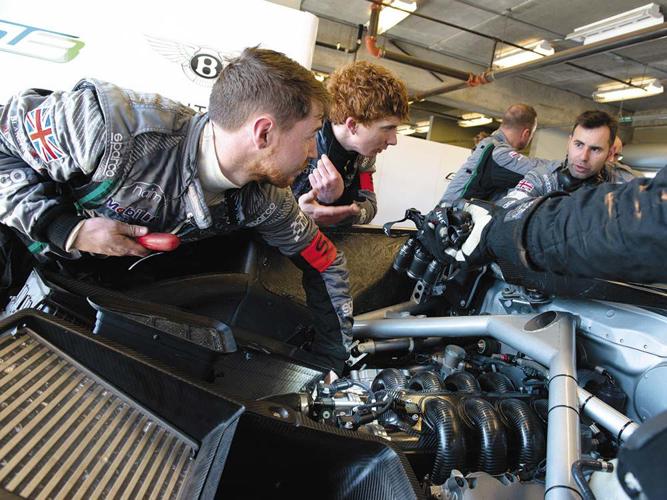

A hastily assembled conference gathers around a large tool case in the Bentley Team M-Sport garage, using it as an impromptu boardroom table. Behind this group, a stricken race car sits on jacks.
It’s just about noon, three-and-a-half hours into the California 8 Hours at WeatherTech Raceway Laguna Seca on March 30, and the second of two Bentley Continental GT3s the team brought to the endurance race is losing a lot of time.
There are about a dozen engineers and mechanics huddled. Their faces show concern or uncertainty, but no panic. Still, heads shake as they pore over data on four different laptop screens. As various solutions are offered, one mechanic says, in a troubled tone, “But that’s engine out.”
The process might be easier if they could only locate the problem.
“We don’t know, to be honest,” says Callum Lees, one of the crewmembers assigned to the car. “We think it’s a sensor, something electronic.”
But they need to find the glitch, and quickly. Both cars are equipped with the same components, so if a part fails on one it may also spell doom for the other.

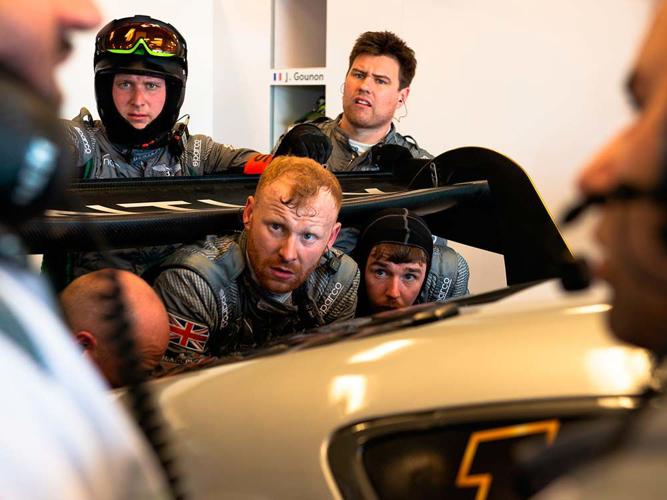
Mechanics discuss options while trying to locate an electronic problem that troubled one of the two Bentley Intercontinental GT3s throughout the California 8 Hours. The work requires ftocus and precision, with an eye on the clock. When it’s over, Jamie Crellin (center), says there’s a feeling of “relief and calmness – a bit of both.”
WHILE THE DRAMA OF ANY AUTO RACE PLAYS OUT ON THE TRACK, hundreds of less visible moments take place in the garage and along the pit wall. This is the domain of tire technicians, mechanics, managers and engineers – a group as responsible for the outcome of a race as the driver.
One day with Bentley’s factory team reveals what they endure over a long stretch. Seven or so stops to change tires, refuel the car and clean the windshield may seem like a lot of work for crewmembers allowed over the wall to service cars during the race. But that amounts to maybe 12 minutes in total – a fraction of an eight-hour day.
It’s a span summed up by extremes.
Forty-five minutes into the event, leaning on a stack of tires in anticipation of the first pit stop of the day, Lees describes one end of the spectrum. “It’s massive adrenaline when things happen,” he says. “Then – two or three minutes – it’s back to normal.”
Several hours later, during a lull in the garage as a hornet’s nest of race cars continues to buzz around outside, Jon Shervinton speaks of the down time with cell phone in hand. “You just watch the race, talk to the wife back home.”
For the most part, they’re a young group – 25 to 30 years old, with unweathered faces that belie the experience in their heads and hands. These are guys who grew up tinkering on cars and took up repair work as a profession before signing on with Team M-Sport. Josh Bades demonstrated their skill level late in the day, removing a car’s transmission without assistance, other than someone sliding him an occasional tool.
Many of them helped to construct the cars. Shervinton, for instance, normally spends his time fabricating aerodynamic carbon fiber surfaces, shaped to improve downforce and reduce drag. At the California 8 Hours, he serves as part of a two-person fuel squad.
Although fans focus on the individual, racing is a team sport. Dozens of mechanics and engineers travel with Team M-Sport from their home in Cumbria in England. “A lot of people underestimate what it takes,” crewmember Rebecca Patterson says. “Everyone has an individual role – with the same goal.”
BY THE TIME THEY LEFT THE HOTEL AT 5:30AM FOR THE SATURDAY RACE, the crew had already put in plenty of work. The two Bentleys competed at the Bathurst 12 Hours in Australia a month earlier. The team prepped and shipped the 107 and 108 – the 7 and 8 is how they identify the cars – to Laguna Seca, where an advance team applied the set up. The rest of the team arrived on Monday.
The 7 gave them trouble throughout the week. During qualifying rounds the day before, finding the right tire set up proved difficult on both cars. The 7 spewed fluid over the track, as well as the windshield of the 8, which happened to be following in its wake. A brake rotor briefly caught fire after driver Jordan Pepper coasted it to the pit stall.
“It was a bit frustrating, but we haven’t lost too much,” says Matthew Wilson, one of the race directors. “We struggled to get the front tires in, but we’re confident we have a good car.”
He then hedges a bit, adding: “But let’s wait and see.”
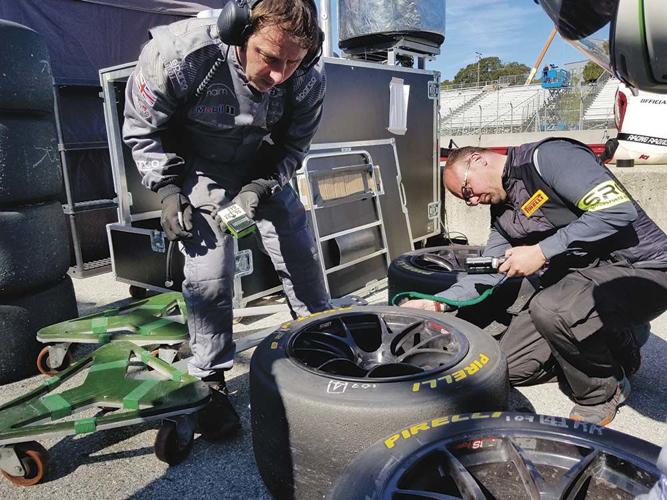
Wilson says this in the semi-quiet of Saturday morning, a little more than an hour before the green flag. Work is going on in the background – sporadic metallic outbursts from the powered lug wrenches and a steady hum of conversation. Jamie Lawson busies himself preparing sets of tires for the early stints. He checks and adjusts the air pressure of each, marks them according to vehicle number, set number and wheel position (LF for Left Front, RR for Right Rear) then moves them into the sun so they gather a little natural heat. There are no tire warmers in the Intercontinental GT Challenge, and cold rubber lacks grip.
“Without the tires, we’re not going anywhere,” Lawson says.

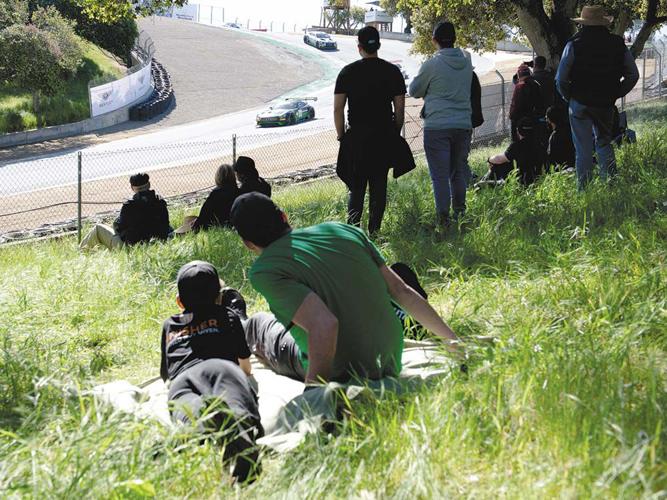
Fans watch race cars dive through the Corkscrew, the track’s most famous corner.
FOR THOUSANDS OF FANS SCATTERED AROUND LAGUNA SECA, the drop of the green flag is a moment of excitement. It’s a different scene in the pit area – more relaxed, with just a hush of apprehension. The cars grumble on pit line and then slowly began to growl as they head out behind the pace car. “Good luck, lads,” a member of the Strakka Racing team says as he passes the Bentley stall, hustling back to his own area.
Moments later, the pace car pulls off the track and a screaming, roaring, popping din that will continue until late in the afternoon swells.
“This is it,” Garreth Winter says.
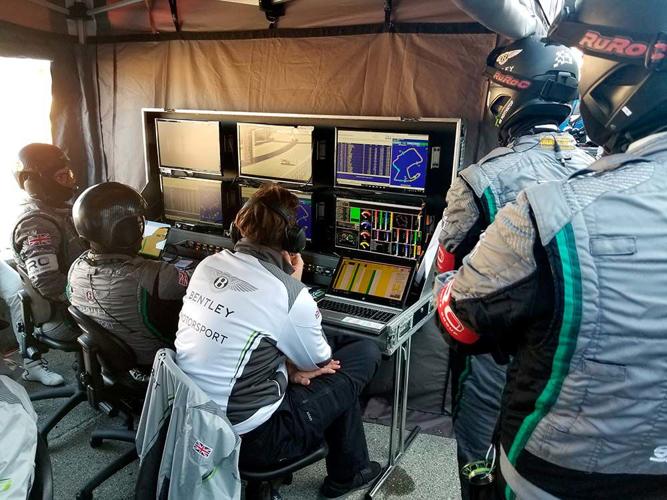
Otherwise, the start is anti-climatic. Some mechanics gather near a television monitor installed in the garage wall. Others hover around the race director’s station at the pit wall, where a series of screens give them options – television coverage, a live track map showing every car’s position in real time or information streaming from the vehicle.
Andy Macdonald, who manages both the 7 and 8 crews, is enjoying the respite. “We can’t really do anything to the cars now,” he says.
Of course, that will change. And the demands on a crew can be unpredictable. Lees speaks of the 24-hour race at Spa-Francourchamps in Belgium, where rest comes at a premium. Crewmembers often sleep in place, finding spots on the garage floor to stretch out with headsets on, knowing they could be called to the wall.
“In the morning, you’re just shattered, but you keep going,” he says.
Around 10am – half an hour after the Bentley crew performed their first round of pit stops without a hitch – there is a sudden rush to the wall.
“The Lambo stopped,” someone yells. On the screen, televisions cameras are focused on a Lamborghini, stalled in the gravel just off the track. Tires are readied on the wall, the crew jumps into position and waits. And waits some more. Then everybody stands down. The bright yellow race car manages to refire and head back onto the asphalt.
“We believed there was going to be a safety car,” Patterson says, explaining the moment of urgency.
A race is managed. The race directors perched along pit wall read telemetry from the car that tells them the condition of each tire, how the engine, gearbox and cooling system are functioning and so on. On one screen, they can see when a driver shifts or brakes. There’s a monitor showing lap times. Another gives them the location of each car. Inside the garage is a room full of engineers, specialists on the engine, tires and other components of the car, all glued to a set of monitors. They even employ a meteorologist. And back at the shop in England, another set of eyes watches the same data. Air and track temperature, humidity, tire wear, traffic, braking points – a lot of numbers and information determines race strategy.
“GT3 is at a level that the cars can go flat out the entire race,” race director Sam Rowcliffe says. “It’s about being in the best position in the last hour.”
Yet the sport itself is shaped by the people involved with the car, from drivers to the men and women torquing wrenches. They are driven and competitive, but the hours of practice and grunt work, the travel and time in hotels has made them into a family. As a crewmember is fitted with a small helmet camera in advance of a scheduled pit stop, Rowcliffe tears himself away from the bank of computers and the stream of instructions he feeds drivers to watch this sideshow.
“You look like Dipsey,” he says, a reference to one of the Teletubbies.
“You sound like him,” the crewmember responds. His face is framed by balaclava and helmet, so there’s no way to identify him.

“It’s not the gearbox,” Josh Bades (center) tells engineers as the team continues to diagnose – without success – the problem plaguing the second Bentley. A noise in the clutch caused them to suspect the transmission. “Normally it’s silent,” Bades explains.
JUST OVER TWO HOURS INTO THE RACE, both cars pit again. The 8’s stop is routine, but a last second adjustment to tire pressures on the 7 creates a scramble to get them up to the wall. And the crew fumbles the tire exchange on the left front when lug wrench man Alex Heywood pulls the gun from the wheel too soon. The powerful tool is still spinning and it sends the nut – the thing that secures the wheel to the car – flying down the pit lane.
“I was in a bit of a panic,” Heywood admits after the stop. “I’ve never lost one. I didn’t quite know what to do. It was all my fault.”
Josh Bades, responsible for the hasty dance of pulling the worn tires off and placing the new ones, snapped one of the spare nuts clipped to his belt from its plastic tie. They are ready for small mistakes.
“I wasn’t panicking – you know exactly what you’re doing,” Bades says. “For him it was like, ‘Oh shit.’”
The incident only cost the 7 a few seconds. As for the lost nut: “When a wheel nut comes out, you’ll never catch it.”
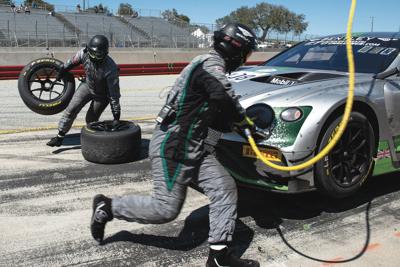
A pit stop is choreography with a purpose. As a car slides to a jarring stop, the driver shuts down the engine. Almost simultaneously, one crewmember inserts a hose into a valve in the fender that triggers pneumatic jacks, lifting the vehicle, while another clips a grounding wire to the rear wing – a safety measure to prevent any static sparks while the fuel man clamps the nozzle to the car’s intake and another (known as the Deadman because he stands above a barrel full of high octane petrol) pulls a lever allowing gas to flow.
All of this takes about a second, during which the two responsible for the jack and ground wire have repositioned themselves on the wall, one with the lug wrench gun, the other ready to grab the tires. Both keep their eyes on the fuel nozzle. The instant they see the fuel guy’s hands twitch, indicating he is pulling the hose, they leap into action, going post to post.
“You’ve gotta be rough with it, but you’ve gotta be precise,” Heywood explains.
It’s like watching Cirque du Soleil, but on pavement. The rhythm is hardly fluid, but the timing is exquisite, each crewmember moving in unison that would be considered sublime if staged. But it is also rugged and athletic.
“It’s just an adrenaline rush,” says Nicky Ross. “You know what you gotta do. Get it done.”
The a-word – that combination of excitement, anticipation, anxiety and whatever else goes into that pang in one’s stomach – is tossed around a lot when crewmembers describe the feeling of a pit stop.
“When the adrenaline picks up, you physically shake,” Lees says. “It’s relief as much as anything when it goes right.”
Yet there is a steady pattern to the day, routine duties that lend all this activity a sense of normalcy. The fuel guys record the amount of time fuel flowed into each car and how many liters they delivered. Then they go through the process of replenishing the trackside rig. Tire engineers from Pirelli appear and, along with Lawson, examine the rubber just pulled from the cars. They measure residual heat levels at different points along the tread and the air pressure – information Lawson keeps at his station for reference, but which is also passed on to the race directors.
Tires degrade as lap after lap scrubs away rubber. If a driver maneuvers off the racing line, hot tires also pick up some of this discarded stuff. And the result of all of this shows in lap times.
With 2:40 remaining, driver Lucas Ordoñez hops out of the 8, clearly unhappy. After debriefing with the managers, he begins checking each tire closely, looking for a perceived flaw. He then begins barking at a Pirelli engineer. “I could feel nothing!” he exclaims, gripping an imaginary steering wheel and moving his arms wildly to demonstrate how much the car was skating in the corners.
To a driver, feel is everything. While team managers transmit lap times and other useful tidbits over the radio, drivers gather information from the car itself. If the rear tires break loose in the corners – a condition called oversteer, describing the wild wrestling match with the steering wheel that follows – they feel it first in their backsides. If the car resists nosing into a turn (understeer), they catch it in their hands and feet.

Sam Rowcliffe (in white) feeds information to drivers from a series of monitors that give him telemetry from the cars, lap times, where all cars are running on the track and other data.
THERE IS A RACE GOING ON OUTSIDE. You know it from the snarling sound of the cars as they tear down the front stretch and the moments of commotion in the pits. But the M-Sport crewmembers only catch glimpses of it.
The 8 – shared by drivers Ordoñez, Markus Palttala and veteran Maxime Soulet – has been flirting with the top ten all day and is running well. The 7, on the other hand, limps into the pits at 11am in serious trouble. One of the pit crew yanks open the driver’s door and begins checking settings. Another buries himself deep into the trunk. Managers confer and the word “gearbox” is heard above the din.
Finally they roll the wounded vehicle into the garage, where mechanics swarm the car. Driver Jules Gounon refires the 7, but it’s just to help the crew track down the problem. Bades pulls himself from the trunk and shouts “It’s not the gearbox.”
By the time Gounon heads back out into the fray, the 7 is 74 laps behind the leader. And it will get worse, because the glitch still lurks somewhere in all the high-tech components.
“That’s all we were doing – trying to diagnose,” Bades says. “When you can’t find it, it’s frustrating.”
The 7 rolls slowly onto pit lane once again and back into the garage. The tool case becomes a boardroom table for mechanics and engineers (a bit later it will serve as a lunch table). The decision is made to put in an experimental set-up to test for future races. That means the car back on jacks and the crew adjusting the suspension, gears and other aspects. They will hunt down the electronic gremlin back at the shop in England.
SET-UP IS THE RACING WORLD’S CATCHPHRASE for the settings that determine a car’s handling characteristics. Like everything else in racing, set-up involves both data and muscle. They work off a checklist detailing spring load (how weight transfers when cornering or braking) camber (the angle of wheels from vertical) and caster (a suspension setting to assist camber), gear ratio, ride height, rear wing angle. There are hundreds of changes possible, and the car will perform differently with each.
Watching the operation, Lawson shakes his head. “It’s a hard race to sum up,” he says.
When the 7 clears the garage, Shervinton steps into the paddock where strolling fans had paused to watch the crew at work. A few of the guys stretch out on the floor, heads propped against improbable pillows – a jack stand, a tire, a tool box. Shervinton takes a moment to take in the scene.
“People talk about Laguna Seca. And when they talk about Laguna Seca, they talk about The Corkscrew. But I haven’t seen it. I suppose it’s up there somewhere,” he says, gesturing toward the steep hill where letters spell out C-O-R-K-S-C-R-E-W. “I’m going to get home and people will ask what it was like, but I don’t know.”
They operate in a world limited by cement walls, asphalt and commands issued over the headset. After the race, they break things down for travel and are taken back to the hotel. They are more familiar with the guts of the car and the narrow passage between garage and pit than the iconic corners. But they do have a race to run – their own.
In the Intercontinental GT Challenge, race stewards apply minimum and maximum pit stop times. For fuel, four tires and a driver change, 100 seconds must tick off the clock. Any other stop cannot exceed 50 seconds. “We’ve left the pits on time, every time,” Macdonald says. “We’ve done our jobs.”
It’s a sentiment echoed by other crewmembers. Engineers form the equations that translate into set up and changes to the car during the race. Managers provide instruction. Drivers pedal the car. For mechanics, an unyielding work ethic, a steady hand and smooth pit stops are their contribution to the outcome. “You just get the job done and get on with it,” Winter explains. “That’s the easiest way.”
It’s a refrain you hear a lot when you ask the guys about life in the pits.
“For a young team, we did pretty well,” Ross observers.

Jamie Lawson goes through a post-pit stop routine, checking tire temperature and air pressure with a Pirelli engineer.
WHEN THE U.S. LEG OF THE INTERCONTINENTAL GT CHALLENGE ends after eight full hours, an eerie quiet descends on the track. The 7 guys are wrapping up – the car had been retired from the race with a couple hours remaining. Some are out of their fire suits. Engineers emerge from their stations. Drivers emerge from the engineering room. There is a lot of standing around.
Some components on the cars must be removed. They are new updates and will be shipped to Bentleys waiting to run at Monza in Italy. Some of the crew will head there after returning to the shop, as well.
Between stops, there is very little conversation about the last, more about the next. They’ll go over events in detail when they get back to the shop.
Soon the 8 will arrive back at the garage and another round of breakdown work will start.
They work from 5:30 in the morning to 6 or 7, maybe 8 in the evening. It has been a long, not very glamorous but dutiful day. The 8 crossed the finish line in 11th position, two laps down from the winning HubAuto Corsa Ferrari and 34.9 seconds out of 10th. It completed 325 laps.
The 7 was not classified.
“It’s disappointing, but it’s racing,” Ross says.
And he doesn’t even plan to crash on the bed when they get to the hotel after they finish work on the 8. Instead, the guys will probably go out for a beer. “We’re still young guys, touring the world and racing cars,” he says, smiling.
THE TRANS-AM SPEEDFEST is the next event at WeatherTech Raceway Laguna Seca. It takes place Friday-Sunday, May 3-5. weathertechraceway.com
(0) comments
Welcome to the discussion.
Log In
Keep it Clean. Please avoid obscene, vulgar, lewd, racist or sexually-oriented language.
PLEASE TURN OFF YOUR CAPS LOCK.
Don't Threaten. Threats of harming another person will not be tolerated.
Be Truthful. Don't knowingly lie about anyone or anything.
Be Nice. No racism, sexism or any sort of -ism that is degrading to another person.
Be Proactive. Use the 'Report' link on each comment to let us know of abusive posts.
Share with Us. We'd love to hear eyewitness accounts, the history behind an article.