

im Thomas loves abalone, and not just because it tastes so good. He loves it with personal and professional passion: He’s a fourth-generation local, popular tour guide and insatiable Monterey historian who knows the once-lowly-and-abundant abalone – now going for $75 a steak at Sardine Factory – cements itself to every bit of Monterey history: Its discovery first brought the Japanese, which led to the discovery of the salmon haul to be had, which brought other waves of influential immigrants, which led to the discovery of sardines, which led to the rise of Cannery Row.
“It just came to me,” Thomas says. “All the the connections come back to abalone. It all starts with abalone. Five thousands years ago, the Rumsien people gathered it. It was a huge part of their life.”
Nonetheless, we probably wouldn’t know much about Monterey’s definitive gastropod without a simple recipe from a single individual. So Thomas did some history homework.

Before “Pop” Ernest Doelter set up shop on Alvarado and, later, Fisherman’s Wharf, the way Americans used to cook abalone seemed a little like marinating a nice porterhouse in paint. They’d boil it into tastelessness or, worse, tenderize it with lye. Yes, lye.
Not Pop. Circa 1908 – a time when almost all of the local abalone was shipped to Japan – he started taking the ample abalone pulled in by the area’s Japanese fishermen, pounding it, washing it with egg, rolling it in cracker crumbs and quick-frying it in olive oil.
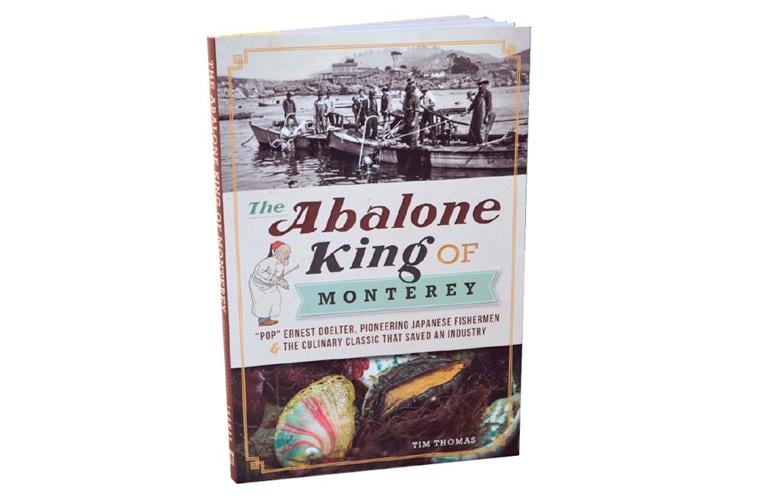
Freshly published at 144 pages from The History Press, The Abalone King of Monterey: “Pop” Ernest Doelter, pioneering Japanese fishermen and the culinary classic that saved an industry, explains how and why that had so many consequences.

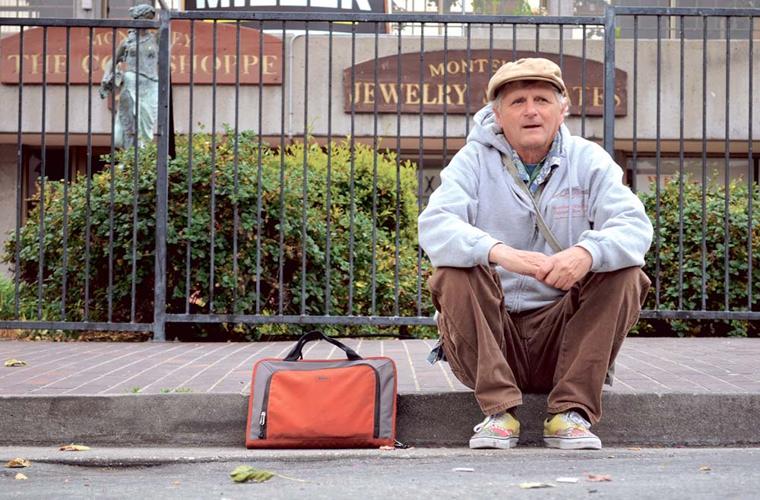
Tim Thomas, pictured on Alvarado where Pop’s original Monterey location did business, can see all local history reflected in the mother-of-pearl abalone shell. “Even the very word abalone comes from Monterey,” he says. “That’s a cool thing.”
Excerpts from the book appear below, along with notes on the chefs who obsess over abalone, and the farm that has made its cultivation sustainable in an award-winning – and flat-out fascinating – way.
Find THE ABALONE KING OF MONTEREY ($19.99) at www.historypress.net or wherever books are sold. Tim Thomas presents a free slide-illustrated book talk followed by a sale and signing 2pm Saturday, June 28, at Monterey Library, 625 Pacific St. in Monterey. 646-3949 or www.monterey.org/library for more.
The Abalone King of Monterey
By Tim Thomas; excerpts used with permission and selected by Ellie Newman
From the Preface:
Sometime in the summer or fall of 1908, Chef “Pop” Ernest Doelter introduced his newest recipe, the abalone steak, in his small, picturesque Monterey restaurant. Unfortunately, we don’t know who the first person was, or even what he or she felt, when that first bite was taken. What we do know is that soon after that first bite, the Cafe Ernest on Alvarado Street became known up and down the California coast, and people came from all over to eat his delicious new food sensation, “abalone.” The demand was so big, and the restaurant so crowded, that all five of Chef Doelter’s children were put to work serving abalone to patrons.
So, just what is an abalone? An abalone is a big marine snail or gastropod from the genus Haliotis. Abalone may be found in most oceans of the world, usually in cold waters, off the Southern Hemisphere coasts of New Zealand, South Africa and Australia, as well as the Pacific coasts of western North America and Japan in the Northern Hemisphere.
Abalone goes by many names – sea ears, ear shells, Venus’s ears and muttonfish. In Mexico, it’s called orejas de mar, and in Japan, it’s known as awabi. But the name abalone comes from Monterey, and it originated with the Rumsiens, the native people of Monterey, who had a word for the red abalone, the largest of the abalone and the predominate abalone in the Monterey Bay. That word isaulun. Early Spanish settlers called it abulon, based on the Rumsien word, and linguists today trace the word abalone all the way back to that word, aulun, that started in Monterey several thousand years ago.
From Chapter 3, “Diving Abalone”
Initially, the boats were equipped with a hand pump, and two to four men would hand-pump the air to the diver. The diver would descend to about 30 feet. The deeper he went, the harder it was to pump. He would be down all day collecting abalone. These pumps had to be taken apart and lubricated with oil every day. The only high-quality oil that could be found around Monterey was olive oil, which was perfect for lubricating the pumps. The problem was that the divers would complain that all they could smell for the first hour was olive oil. Ishimatsu Kurihara, Sennosuke Hayakawa and Jirmatsu Yamaguchi, the first helmet divers, arrived in Monterey from the Boso Peninsula sometime in October 1898. They were taken out to Point Lobos, and once again, they were helmet diving for abalone the very next day.
Even though helmet diving was more efficient – and warmer – there were still companies in Monterey that dove in the traditional ama style. Working in pairs, one diver would go down, following the anchor line from the boat. He would collect as much abalone as he could in two minutes, putting the abalone in his basket. When it was time for the ama to return to the surface, his partner on the boat would throw a large rock over the side that was tied to a rope and threaded through a pulley system. The other end of that rope was tied around the diver’s waist, pulling the ama to the surface quickly. As soon as the ama hit the surface, his partner dove in. The first diver made his way onto the boat, where he would warm up next a fire burning in a barrel on the boat.
From Chapter 7, “The Bohemians”:
He was going to make an abalone steak, something no one else was doing or had even thought of at that time. Doelter believed that he could make it palatable and appetizing without boiling or using lye. Many of the chefs in Monterey thought that he was foolhardy and told him that it couldn’t be done. He brought the abalone into his restaurant one day and began to experiment.
Being German he was, of course, very familiar with weinerschnitzel, a lightly pounded veal cutlet that’s coated in flour and cracker crumbs, run through an egg wash and then cooked in oil or lard. This seemed to work very well with the abalone. Ernest would slice off the foot to make a steak and pound it four or five times with a wooden mallet or a rolling pin (the pounding breaks up the connective tissues, making the abalone tender). He seasoned it with salt and pepper and then added his secret ingredient, “abalone nectar” (the juice that came out of the shell). He ran the abalone steak through an egg wash, added cracker crumbs and cooked it up quickly in olive oil or butter. In another version of this recipe, he would, after seasoning it with salt and pepper and abalone nectar, cook the abalone without the egg wash and cracker crumbs. He also made an abalone soup using nectar as the base, as well as abalone chowder and stew.
Word got out very quickly about this new seafood sensation, and the Café Ernest became the hot spot in Northern California. People came from all over to eat Pop’s fresh abalone steaks. Business became so good that he had to hire extra help, including a young man named Walter Stokes, a Monterey native whose family first came to the peninsula in the early 1830s…
Everyone wanted to know his secret for tenderizing the abalone, but Doelter was tight-lipped. One chef was convinced that the tenderizing happened because of the method Doelter used to kill the abalone. The chef was so convinced that the approached Doelter’s younger daughter Mimi, hoping to get the secret out of her. After making the chef swear to an oath of secrecy, she told him, “Pop strangles them.”

From Chapter 7, “The Bohemians” (and George Sterling’s “Abalone Song”):
Oh! Some folks boast of quail and toast,
Because they think it’s tony;
But I’m content to owe my rent
And live on abalone.
Oh! Mission Point’s a friendly joint,
Where every crab’s a crony;
And true and kind you’ll ever find
The clinging abalone.
He wanders free beside the sea
Where’er the coast is stony;
He flaps his wings and madly sings –
The plaintive abalone.
By Carmel Bay, the people say
We feed the lazzaroni
On Boston beans and fresh sardines
And toothsome abalone.
Some live on hope, some live on dope,
And some on alimony;
But my tom-cat, he lives on fat
And tender abalone.
Oh! Some drink rain, and some champagne,
Or brandy by the pony;
But i will try a little rye
With a dash of abalone.
Oh! some like jam, and some like ham,
And some like macaroni;
But bring to me pail of gin
And a tub of abalone.
He hides in caves beneath the waves,
His ancient patrimony;
And so ‘tis shown that faith alone
Reveals the abalone.
The more we take, the more they make
In deep sea matrimony;
Race suicide cannot betide
The fertile abalone.
I telegraph my better half
By Morse or by Marconi;
But if the need arise for speed,
I send an Abalone.
Oh, some folks think the Lord is fat,
Some think that He is bony;
But as for me, I think that He
Is like an abalone.
From Chapter 8, “The Panama Pacific International Exposition”:
Notably, this is the first time, at least publicly, that he was crowned the “Abalone King.” It’s unknown whether this title came from the newspaper writer or Pop himself, but it’s a crown he wore for the rest of his life.
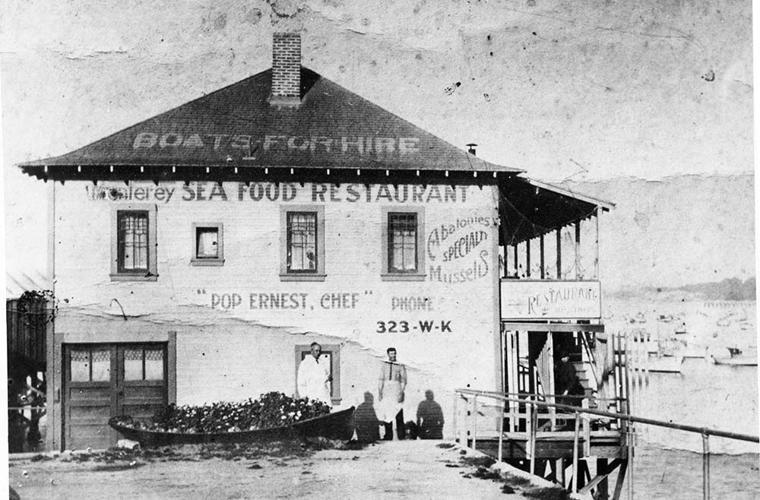
He initially named it The Club because it was in the old Monterey Yacht Club, and most people still referred to the building as the Club. Also, the name “Club” was already painted in large letters on the roof where everyone could see it.
That name didn’t last long, though, and in just a few short months, he changed the name to Pop Ernest’s Sea Food Restaurant. The new place could seat up to two hundred people and was built on stilts over a large rock formation in the Monterey Harbor. It had a large open porch where people could eat and look out onto the Monterey Bay. It was always very festive, with strings of Japanese lanterns hanging throughout. The interior of the restaurant had a nautical theme, with whalebone ribs draping the fireplace, abalone shells, fishnets and light sconces made of seashells. The restaurant actually had two rooms for serving – one on the lower level that catered to the working class and one on the upper level that catered to the Hotel Del Monte clientele. T.A. Work was his very first customer.
Just a few days after he opened The Club, The States Restaurant, formerly the Hof Brau of San Francisco, ran a series of ads in the Monterey Daily Cypress promoting its abalone dinners, one of which stated: Abalone a sea food fresh from the rocks of Carmel Bay tender and satisfying.
The States Restaurant was where Pop made abalone famous, and it was making a statement. Not only was it still serving abalone, but it was also buying it from the Point Lobos Abalone Company. At that time, it was not unusual for people from Monterey to travel via the Del Monte Express to spend a day or two in San Francisco. In part, the States was riding Pop’s coattails.
(0) comments
Welcome to the discussion.
Log In
Keep it Clean. Please avoid obscene, vulgar, lewd, racist or sexually-oriented language.
PLEASE TURN OFF YOUR CAPS LOCK.
Don't Threaten. Threats of harming another person will not be tolerated.
Be Truthful. Don't knowingly lie about anyone or anything.
Be Nice. No racism, sexism or any sort of -ism that is degrading to another person.
Be Proactive. Use the 'Report' link on each comment to let us know of abusive posts.
Share with Us. We'd love to hear eyewitness accounts, the history behind an article.