



THINK ABOUT WHERE BIG SCIENTIFIC BREAKTHROUGHS HAPPEN, and visions of large laboratories on university campuses or inside government facilities or corporations might come to mind. Dr. David Craig Wright bucks the stereotype. His small laboratory in a former yoga studio in downtown Pacific Grove is where the infectious disease specialist is making cutting-edge discoveries, and it suits him just fine.
That jab in the arm that leads to dreaded pain and swelling? It could be a thing of the past, if Wright and his team’s latest discovery, a new delivery system for vaccines, catches on. He and his team already have the patent for it, #11,911,461, awarded on Feb. 27, a process that took just seven months. It’s the 20th patent Wright has earned in a 40-year medical research career.

Wright in his lab, a former yoga studio, where he and Hoadley spend days conducting experiments and running tests.
The new patent covers a modification of the SARS-CoV-2, or Covid-19, virus the team designed and a vaccine against Covid-19 itself, along with the system to deliver the vaccine into the body. The patent also covers the fact that the vaccine can be delivered subcutaneously, or under the skin, which can be painless compared to most vaccines that must be injected into muscle.
These inventions are just the beginning. The team of the locally owned company, D4 Labs, LLC, initially focused on a better Covid-19 vaccine, but now that they’ve conquered that task, Wright, D4’s chief science officer, is on a mission to prove that the technology can be used with other vaccines for flu and other diseases – including taking needles out of the equation completely.
Wright, 74, is able to make these discoveries thanks to a mind that never stops asking questions, a willingness to collaborate with others and an inherent quality of playfulness.
“He was a lot of fun [growing up] – he still is,” says Emily Wright, the doctor’s daughter, a teacher and scientific writer who serves on the D4 team and is named on the patent. She jokingly introduces herself as “the Dr. Wright translator,” serving to break down his complex scientific ideas into layperson’s terms.
“He was always up to play whatever game I wanted to play,” Emily Wright says. Her dad would play with her and her friends on the street in front of their home. One day, one of Emily’s friends came to the door when she wasn’t there. Well then, the child asked, could her dad come out to play?
That spirit of playfulness and inquisitiveness are what has led Wright and his team to their latest discovery, and it could be a game-changer for vaccines.
ON AN OVERCAST EARLY SPRING MORNING IN DOWNTOWN P.G., Wright is outside of his offices, a combination lab and treatment clinic on Grand Avenue, waiting for a visitor and looking very much the part of a scientist in a long white lab coat and an N95 mask.

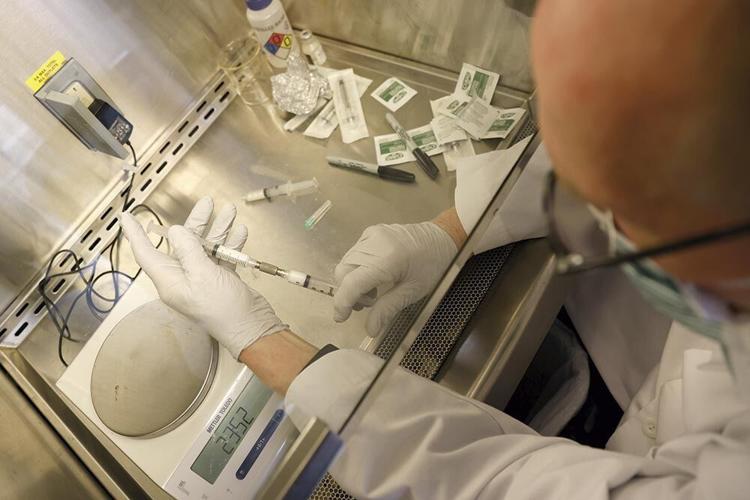
Wright creates his structures – microscopic spheres that can carry vaccines – in a simple procedure using syringes.
“Call me Craig,” Wright says introducing himself, holding the door. Just inside to the right is a small table with more masks for visitors and the patients that come to him for treatment of infectious diseases a couple of days a week. The noticeable whir of an air purification system exchanging the air inside the building hums constantly in the background.
On the wall of the lobby are Wright’s diplomas and achievements, including printouts of his 20 patents inserted into plastic sleeves and pinned to a wall. There are also framed art prints, and as Wright leads a tour, there is art in every room. The pinned-up patents underscore his technical skill as a scientist, while the art demonstrates his convictions about healing.
“There are only four things that heal people,” Wright says as he points out the artwork. “Humor, art, music and compassionate health care.” Later, he describes his offices as “an odd combination of a doctor’s office and a lab, with art and music thrown in.”
Pre-pandemic, Wright had two grand pianos in his clinic for pianists who came in to play live. The pianists passed away and the pianos are now gone – he plays recorded music instead now. Wright prefers stride piano playing, a type of jazz.
What takes up a good share of the building’s square footage is Wright’s lab that includes high-tech testing equipment, as well as equipment for treating multiple people at once, including treatment chairs for up to seven people and supplemental oxygen equipment for up to three people. Wright acquired the equipment in the early days of the pandemic – just in case.
(Wright is quick to state they do not work with live viruses, bacteria or anything else that could harm anyone. “We don’t do anything dangerous here,” he notes.)
Wright set up in Pacific Grove in 2019, first just a few blocks away from his current location in a smaller space off of Lighthouse Avenue. The new, larger location he moved into just last year has allowed him to continue treating patients, while also conducting D4 research.
“This is the perfect place in the world to set up a biotechnology business,” he says of P.G. There is space available for rent and the climate is perfect, “no snow,” a big point for the doctor who has spent most of his life on the East Coast.
“Steinbeck called Pacific Grove Eden, and it is the garden of Eden. I love this place,” he says. He doesn’t understand why other companies like his don’t follow suit.
The company Wright founded with Cheryl Assemi of Carmel, D4 Labs, is privately held by the two. Their funding comes from three private sources, Wright says, with himself personally and another family-owned company providing funding when needed.
Wright built his new business on his education and background in the area of infectious disease. His educational background includes studying biology at the University of Virginia, followed by UVA Medical School. He did an internship at Harlem Hospital in New York City, and a residency in internal medicine at the Walter Reed Army Medical Center, along with a three-year infectious disease fellowship at the Walter Reed Army Institute of Research.
Since 1985, Wright has been an infectious disease practitioner who helped launch three biopharmaceutical companies, including the most recent, D4 Labs. One of those companies where he worked in the 1990s is Novavax, a small company that went on to gain notice in the early days of the pandemic for its own Covid-19 vaccine.
Not long after he launched D4 Labs, the world was facing an enormous global pandemic. Wright was ready to jump in and help.
AS THE COVID VIRUS SWEPT AROUND THE WORLD and the death toll was rising – over 3 million people died in the world due to Covid in 2020, according to the World Health Organization (the toll is now estimated at over 7 million) – pharmaceutical companies were racing to develop vaccines that would offer protection from infection and death.
Researchers didn’t have to start from scratch. There had already been vaccine studies of coronavirus, SARS-CoV, as well as other viruses since the 1980s. Those studies laid the foundation for quickly creating new vaccines against Covid-19 at a record pace.
The pandemic was declared by WHO on March 11, 2020. Just six days later, March 17, the first human trials of a vaccine developed by Moderna Therapeutics began in Seattle. (It was the same day shelter-in-place shutdowns were declared in Monterey County.) Pfizer-BioNTech and Johnson & Johnson followed, and by early December, the U.S. Food and Drug Administration had issued emergency use authorizations. The first vaccination in the U.S. outside of a clinical trial was given on Dec. 14, 2020.
There were challenges to the vaccines, however. Both the Moderna and Pfizer vaccines require extreme cold storage and dry ice for transportation. Simple refrigeration won’t do. Like many vaccines, they work through injections into muscle, which can lead to pain and swelling around the injection site. In addition, immunity is not long lasting, requiring multiple doses.
“Wait a minute, I’m a vaccinologist,” Wright remembers saying to himself. What if, he asked, he could design something new that didn’t have to be injected into muscle, that wouldn’t require such cold storage and would only need a couple of doses?
Wright, says his daughter, Emily Wright, is always looking for what’s been overlooked, and “delivering a superior product, but also [asking], ‘what’s the patient experience like?’” That duel approach comes thanks to his roles of both researcher and physician.
Wright and his team got to work trying a few different methods of creating a better vaccine. They found the answer in one building block of the virus itself.
IF THERE’S A UNIVERSAL SYMBOL OF THE COVID-19 EMERGENCY, it is the SARS-CoV-2 virus itself, pictured as a grayish or light-colored orb dotted by protruding red spike proteins, shaped something akin to a Medieval weapon. Those microscopic spikes allow the virus to latch on and attack human immune systems.

Jacob Hoadley inspects newly created structures for carrying vaccines under a microscope inside the lab. The D4 team was awarded a U.S. Patent in February for a new vaccine delivery system. The designing of the system was done in Pacific Grove but companies in other states were used to manufacture certain components.
Wright focused on those spikes, based on his extensive experience in constructing and deconstructing proteins. (Proteins are macromolecules involved in almost every cellular process of the body. They replicate and transcribe DNA. They also control cell division and the transfer of materials and information into and out of the cell.)
The D4 team used a specific spike protein, called S1, of the C.1.2 variant of Covid discovered in Africa in 2021, because it contained many of the mutations that had been causing numerous cases worldwide (The highly infectious Omicron variant, which caused a significant number of cases in 2021, includes the S1 spike.)
Noticing that other companies were using the entire sequence of a spike protein, Wright questioned if that was really necessary, Emily Wright says. The team found that certain sequences within S1 cross-reacted with human proteins and they “chopped out” those parts, explains Wright’s assistant, Jacob Hoadley. That left a modified spike protein to work with.
Next, they encapsulated the modified spike protein in microscopic spheres, or structures – an area Wright has been researching since 1993 – using a solution containing Vitamin E. Like cells, which have membranes, the D4 team created “the smallest artificial membrane you’ve ever seen. Smaller than cells,” Wright says. Hoadley says the spheres have a “cargo space” in the middle. Into that space, Wright adds, “we can put a lot of stuff inside.”
Those structures are what is known as an adjuvant, or something added to a vaccine to increase its effectiveness. The adjuvant the team created was also part of the patent.
In the lab is a piece of equipment that magnifies the structure 400 times onto a screen, enabling a viewer to see thousands of small spheres that look like mini bubbles, floating across a monitor. It’s not unlike watching a mesmerizing video of jellyfish at the Monterey Bay Aquarium (but without the bright colors), or a holiday yule log on the TV.
The video of the spheres is a favorite of Wright’s: “If I watch this I’ll keep watching it for hours. I think it could replace the fireplace for scientists,” he jokes.
With these structures carrying a vaccine, Wright theorized they could skip injecting into muscle – the way many vaccines have to be administered due to their design – and instead inject subcutaneously, or under the skin. He used as his inspiration the polio vaccine developed by Jonas Salk, which can be administered either subcutaneously or into the muscle. The dose of the D4 vaccine is small, about one-third of a teaspoon.
Their vaccine was used to subcutaneously immunize Syrian hamsters at the Maryland-based BIOQUAL Inc., an accredited company to perform animal research in compliance with the Animal Welfare Act. Test results showed the vaccine successfully generated antibody responses after a single dose, with those responses increasing after a second dose.
Further testing showed the vaccine provided prolonged antibody responses to several Covid variants, and a reduction in disease severity. The results also suggested a potential for long-term protection. In addition, the refrigerated vaccine has been found to remain stable for up to two years.
More importantly for the people receiving vaccines, it means needing only a very thin needle under the skin. “Therefore it doesn’t hurt,” Wright says. “Most people don’t like vaccines because it hurts, they’re afraid of needles.”
Yet people are giving themselves subcutaneous injections at home, like insulin, Wright points out. He envisions a day vaccines could be shipped to people’s homes so they can vaccinate themselves.
For those who fear needles, Wright and Hoadley have tested use of a device that “injects” vaccines into the skin via a forceful spray using CO2 – think Star Trek’s hypospray come to life. The technology could be used to vaccinate thousands of people a day if needed.
More research is required, Wright says. The animal study only included five hamsters, and no human trials have yet been conducted. And for the D4 technology to become widespread, “it will take a larger company to take my ideas and run with them,” he says.
In all, it took Wright, his team, and partner companies four years to work on the invention, but a relatively quick seven months to receive the patent.
“One of my patents took nine years,” Wright says. “So it is so unique what we did – we showed that you could make a small portion of protein and put it in a structure and immunize animals just twice, not four or five times.”
WRIGHT TRIED TO RETIRE after he left Novavax in 2006, but it didn’t stick, says Emily Wright. He opened up a treatment clinic in Carmel and was known to work seven days a week, before closing that clinic and co-founding D4 Labs with Assemi and others. He has scaled back a little.

Wright plays pickleball in Pacific Grove a few times a week. One of his side projects with a friend is designing a racket with the goal of reducing noise, as well as providing a more comfortable handle. They hope to patent the racket.
Now Wright says he has no plans to retire. Retirement, he believes, is deadly to doctors. Physician friends of his have retired and then died within a couple of years.
“I’m just like Charlie [Higuera] down here at the [Grove] Market, he’s 90 and he’s right, work keeps you going,” Wright says of his downtown neighbor.
Wright likes his work and there is so much more of it to do. He’s in the best health of his life, he says. Outside of work in the lab the only time he spends outdoors is playing pickleball a few days a week on the P.G. courts. (Wright, with a friend, is working on another invention to patent: a quieter pickleball racket with a more comfortable paddle. Most of his patented inventions deal with drug delivery systems, adjuvants for vaccines and structures, the very things that make up his latest patent. The pickleball racket is one of other side projects he enjoys, Emily Wright says.)
Not long after announcing that they had been awarded a patent, Wright and Hoadley were already using the technology they developed to test it on flu vaccines. They took the vaccine and encapsulated it in the now-patented adjuvant to create a product that can also be injected under the skin. They’ve continued with DTap (diphtheria, tetanus and acellular pertussis) and polio vaccines.
They’re eagerly working on getting accepted to present a paper about the inventions within the patent at the fourth edition of the International Vaccines Congress, set to take place Oct. 24-26 in Baltimore. It’s Wright’s chance to introduce his small-town discovery on a global stage.
(0) comments
Welcome to the discussion.
Log In
Keep it Clean. Please avoid obscene, vulgar, lewd, racist or sexually-oriented language.
PLEASE TURN OFF YOUR CAPS LOCK.
Don't Threaten. Threats of harming another person will not be tolerated.
Be Truthful. Don't knowingly lie about anyone or anything.
Be Nice. No racism, sexism or any sort of -ism that is degrading to another person.
Be Proactive. Use the 'Report' link on each comment to let us know of abusive posts.
Share with Us. We'd love to hear eyewitness accounts, the history behind an article.