
WHEN IT COMES TO CONSTRUCTING NEW HOUSING IN MONTEREY COUNTY, the answer for decades has been “no” – not always directly but for reasons like not enough money, not enough water, too many state regulations, high developer fees and onerous permitting processes. The result is that not enough units have been built over the years to meet demand and prices have risen ever higher, leaving too many people struggling under the weight of expensive housing.
Born out of what has become an increasingly frustrating situation is a growing group of people who no longer want to take no for an answer. Instead of focusing on what can’t be done, they’re asking what can be done to build market-rate affordable housing, for those renters and potential buyers in what’s called the “missing middle,” people who make too much for government-subsidized housing but not enough for market-rate.

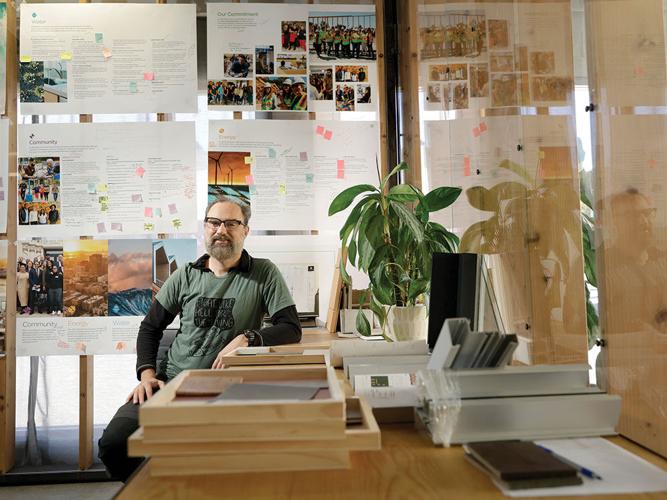
Sibley Simon in his office at Workbench in Santa Cruz, a housing development firm. He leads New Way Homes, a nonprofit that operates an impact investment loan fund to build mission-based and below-market-rate rental housing in the Monterey Bay region.
That missing middle became the focus of separate housing forums held in November in Salinas and on the Monterey Peninsula, where hopeful stakeholders – including developers, business leaders, elected officials, planners and representatives from nonprofit agencies – focused on how to move forward on building infill, workforce and affordable-by-design housing.
Advocates say the conditions to build such housing have improved in recent years, thanks to new state laws allowing for more subdivisions of lots, lessening of parking requirements, streamlining approvals, supporting construction of more accessory dwelling units and more. They believe they can leverage those laws into action.
In one example of efforts to bring more housing to the county, nonprofit Regenerative California is betting on tapping into an estimated $159 billion in local private wealth that organizers say could be unlocked to build 3,000 homes in Monterey County within five years, including employer-sponsored and infill housing. (That number is still far less than the state’s estimate of more than 20,000 units needed at all income levels.)
Whether they can reach that goal is yet to be seen, but they’re going to try. Starting this month dozens of volunteers are launching a 90-day sprint to gather the information and resources needed for the effort – the pilot project is backed in part by a $100,000 grant from Monterey County Supervisor Kate Daniels’ discretionary fund, approved 5-0 by the Board of Supervisors last June.
As Regenerative California’s efforts get underway, other organizations and coalitions are pursuing plans to add more infill housing to the region.
“If we’ve got the political capital and the social capital to do it, we know the financial capital is there,” says Gabe Sanders, executive director of Opportunity Housing Trust, vice president of ReVision West, and a Regenerative California volunteer. “It’s just a matter of connecting the right people at the right time, and this is the right time.”
THERE ARE TWO MAIN CATEGORIES TO AFFORDABLE HOUSING. There’s what some refer to as affordable with a capital “A,” government-subsidized, low-income housing built by nonprofit developers. Prime examples include Moon Gate Plaza in Salinas’ Chinatown by MidPen Housing, Alfred Diaz-Infante Apartments in East Garrison by CHISPA and Lightfighter Village in Marina by EAH Housing and the Veterans Transition Center.
Then there’s affordable housing spelled with a lower-case “a,” housing that’s affordable by design, typically infill apartments, smaller houses, or starter homes and condos. The word Regenerative California leaders are using is “attainable.”
Nonprofit developers use a complex mix of federal and state government funds, foundation grants, tax credits, federal housing vouchers and land donations or greatly reduced ground leases. To meet federal Department of Housing and Urban Affairs requirements, people eligible to live in subsidized units must make a percentage of the area median income (AMI) or less, usually no more than 80 percent. In Monterey County, 80 percent of AMI for a family of four is $115,700.
At the other end of the economic spectrum, those wanting to purchase a market-rate home need an income of 200 to 300 percent of AMI, which for Monterey County is between $215,000 and $320,000 annually to afford a home priced between $830,000 and $1.2 million, according to estimates by Regenerative California.
Between that 80-percent AMI and 200 percent is what’s been dubbed “the missing middle,” which encompasses a lot of middle-income workers including teachers, managers, first responders, nurses and others. They’ve been locked out of the market as buyers, while remaining saddled with high rents.
It’s this missing middle that some advocates are turning their attention to, while still advocating for capital “A” affordable housing.
“We have to take a both/and approach,” says Matt Huerta, vice president of community development with the Monterey Bay Economic Partnership, known as MBEP. “While I’m optimistic and happy we’re building more teams around the missing middle, we can’t take our eyes off [the need for affordable housing]. That continues to be the biggest need to address.”
He points out something else, that those in the missing middle are occupying less expensive housing, crowding out lower-income households. “So the missing middle is applying pressure on the lower tier,” he says. “We need to free that up.”
SIBLEY SIMON HAS HIS EYES ON HOUSING THE MISSING MIDDLE, as well as those at lower incomes, by investing private capital, or a mixture of private and public capital, to construct infill housing. He’s proven the formula can work.
The former tech entrepreneur and CEO who once created software and content for virtual worlds is now immersed in the very real and complex world of creating affordable housing. Simon’s background in mathematics and physics lends itself to attacking the problem logically.
After 15 years in the tech world, Simon says he was feeling burned out and wanting to do something more meaningful. He began volunteering with the Homeless Services Center in Santa Cruz, now known as Housing Matters, as its treasurer and helped launch two successful campaigns to house hundreds of the most vulnerable and chronically homeless.
“It was very successful in getting a lot more people out of long-term homelessness, but it’s not solving the problem fully, because more people are becoming homeless,” he says he realized at Thanksgiving in 2014. “I decided I want to become a more mission-driven housing developer with the first priority on permanent supportive housing.”
The realization led him to found nonprofit New Way Homes in 2015, which operates an impact investment loan fund used to build mission-based and below-market-rate rental housing in the Monterey Bay region. He also became managing director of Envision Housing, a developer that specializes in building apartment buildings with more affordable rents.
In 2022 he became a principal and impact development executive for Workbench, an architecture, development and general contracting firm based in Santa Cruz that focuses on denser infill housing that includes environmentally sustainable, below-market rate units, helping to solve the missing middle problem. Simon says they’ve built 275 accessory dwelling units and infill apartments over the past few years, with another 2,000 units in the development pipeline.
“We’re really interested in workforce housing and affordable housing that takes less or no public money,” he says.
That’s where New Way Homes and its impact investment loan fund comes in, helping to pay the early expenses of projects, launching those projects and making them more affordable in the long run, without depending on government subsidies.
“The reason we built it is because the early stage cost of a project is the hardest to fund, and in the market rate world, it’s where the highest return is expected,” Simon says.
About 200 investors have provided the money in the New Way fund, approximately $12 million. They include local foundations, a health care network, local banks and private individuals. They invest their money into the fund and receive a return of 4.25-percent interest over 10 years.
So far, these efforts have resulted in the completion of a 12-unit transitional housing project in Oakland and seven units of permanent supportive housing in a historic Santa Cruz Victorian home. The 121-unit permanent supportive Harvey West Studios in Santa Cruz is under construction, after New Way Homes owned and funded the pre-development of the project, then transferring it over to owner-operator Housing Matters.
There are more units planned in Oakland and Santa Cruz, some of which have been approved and have development applications submitted. Another project Simon is involved in through Workbench, in collaboration with real estate firm CRP Affordable, is a 100-unit, 100-percent affordable apartment building currently under construction in Scotts Valley, slated for completion in 2027.
Simon and his team are also working on a project in Salinas that might have already been built by now, had fate and market conditions not intervened.
WHEN SIMON BEGAN THE QUEST to build a 100-percent affordable apartment building at 467 and 459 East Market St. in Salinas, the plan was to build it using only private capital, no government subsidies. He had to pivot after the cost of construction materials soared to an estimated 60-percent higher than pre-pandemic levels and a leaking underground gas tank that didn’t exist on any land records was uncovered.
“The fundamental problem now is that it’s too expensive to build. The state legislature solved the problem that most of the housing we needed wasn’t legal to build. Now it’s legal – it’s too expensive,” he says. “It breaks my heart… Fundamentally, you just can’t build most types of housing in Salinas and not lose money right now.”
The project is relying on government support – so far it used a $2 million state grant to clean up the underground leaking gas tank. Simon reported to the Salinas City Council in September that they’re drawing up new plans – the first set of plans became too expensive to build, exceeding $40 million, not including other costs like financing. The forthcoming plans will include more than 75 affordable units, from studios to three-bedroom apartments, plus commercial space featuring a kitchen incubator with El Pájaro Community Development Corporation.
Through Envision Housing and Workbench, Simon relied on provisions in two State Senate bills, SB 423 and SB 330, that streamline the approval process, where city planners approve the final plans, instead of going through public hearings.
Despite having to abandon using private investment only for the Salinas project, Simon is still committed to building housing that is less expensive without using government subsidies, which can be difficult and time-consuming to obtain.
“There’s 40,000 units of [affordable] homes approved in California, waiting for tax credits and competing year after year. The bottleneck is not the development side of getting projects going,” he says. “The bottleneck is the amount of money and public funding, and it’s very expensive.”
FUNDING IS ONE PIECE OF THE EQUATION. Another piece is in the hands of local governments. Salinas architect and founder of the Salinas Planning and Research Corporation (SPARC), Peter Kasavan, believes the city has the capacity to build more infill projects, but it will take changes when it comes to land use policy and the costs of development permits and fees.
“The important thing is the government, or the city in charge, has great influence on all three of those areas. There’s an opportunity to ameliorate some of the headwinds to the housing crisis,” Kasavan says.
Through SPARC, Kasavan, with the Salinas Valley Chamber of Commerce, organized the Salinas Community Housing Action Plan forum on Thursday, Nov. 20, focused on individuals creating infill projects in their own neighborhoods by taking underutilized and vacant properties and creating multi-unit projects of smaller, lower-priced homes and rentals.
Kasavan opened the forum by pointing out that Salinas has some of the highest-priced housing in the country. “How do we allow that?” he asked. “The [Salinas City Council] can’t solve this by themselves. The [city] staff can’t solve it by themselves, and the community can’t solve it by themselves, but together we can solve it.”
Kasavan is now turning his attention to pressing the city for zoning and land use changes, which could allow for smaller units and higher density in some neighborhoods, making it easier to build infill projects and homes on smaller lot sizes.
“For instance, the zoning code calls for single-family residences to be on minimum lot sizes. Plus, you would have to have a garage for two cars,” he says. “So we can’t afford to house our people, but the old zoning code wants us to house cars.”
The city’s permitting process also needs revamping, he says. “Permitting is particularly onerous in the City of Salinas, and it doesn’t need to be. We need to reduce barriers.”
He hopes that changes at the city, combined with the entrepreneurial spirit of Salinas residents who embark on infill projects, will bring about more units. It doesn’t replace larger-scale developments, Kasavan says, like what is already proposed for the city’s northern growth area, or what nonprofits are building, but another way to build more homes.
“This is how you deal with housing costs. You have to produce more houses,” Kasavan says. “We need the leadership and the will to implement these strategies into the zoning ordinance and support it, advocate for it, enable it and educate the community.”
The city’s zoning code is set to undergo a three-phase update that will take approximately two years. On Dec. 2 the Salinas City Council heard an overview of the plan for community engagement. The stated goal of the process: prepare new zoning code that is streamlined and user-friendly, with objective standards consistent with “development needs and community vision.”
FACILITATING THE CONSTRUCTION of 3,000 well-built homes within five years was a bold goal but also a calculated one on the part of Regenerative California’s organizers.
“We think of that number as more of a catalyst,” said Ashley Muse, Regenerative California’s attainable housing project lead, during a streaming event on Dec. 3, a follow-up to the Monterey Attainable Housing Forum one month before. The state-required number of planning for nearly 20,300 houses is an overwhelming number, she said – a goal of 3,000 is ambitious but attainable.

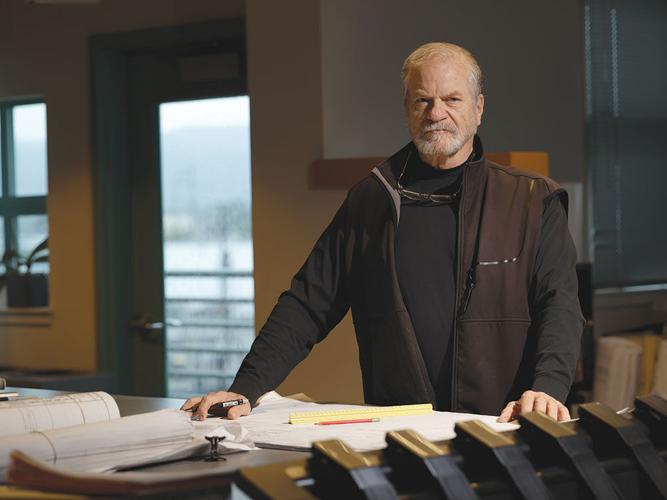
Below left: Peter Kasavan inside his Salinas architecture office.
“How can we get that catalytic first 3,000 homes out there and in doing so pave the way for other projects to follow so we can have a shot at actually meeting those regional needs?” she asked.
During the Attainable Housing Forum, held Nov. 6-7 at Asilomar Conference Grounds, 60-plus people gathered to strategize how to make the goal a reality. They looked at building coalitions of employers to create workforce housing, as well as other ways to promote infill developments and other housing.
Muse says there are “land stewards” in the community who are eager to provide more housing, like healthcare facilities, faith-based communities, school districts and other employers who are looking to solve their workforce housing needs. They aren’t seeking to make money on development and they don’t have a background in it. There is an opportunity, however, for employers to band together and be a common voice calling for local jurisdictions to further streamline zoning, permitting and approvals.
Building the 3,000 units would take capital, and for that Muse provides an estimate that at an average cost of $750,000 per unit – taking into account all types of units from apartments to single-family homes – it would take $2.25 billion to build them. A typical project requires 20 percent of the cost in order to get construction loans, meaning $450 million of “catalytic capital” to secure those loans.
Working with the nonprofit Impact Finance Center based in Colorado, Regenerative California leaders estimate the private wealth available in Monterey County is conservatively $159 billion. While not proposing to use only private wealth, they believe the community has what it needs and more to meet the goal of 3,000 units.
The question, Muse asked on Dec. 3, was if the money exists, and they can show the benefit to the community, “Why can’t we unlock this?”
Forum participants divided into three groups. One group is focused on finding and cataloging available land. Another is tackling ways to remove barriers to planning, permitting and accessing utilities.
The third group, the Capital Fund for Attainable Housing, has the task of figuring out where to get the money.
SANDERS IS SITTING OUTSIDE ALTA BAKERY in downtown Monterey with a cappuccino on a sunny fall day explaining the intricacies of community land trusts and raising capital to build housing. He’s been talking to local employers who understand what’s at stake if their employees can’t afford to live locally.
“What it really comes down to is if this place doesn’t have a reliable workforce, the folks who made our coffees today won’t be able to keep doing that,” he says. A new face every couple of months doesn’t build relationships. “Ask any retail business. It’s just hard to keep people around,” he says.
As executive director of the Opportunity Housing Trust, a nonprofit community land trust founded in 2024, Sanders is working on creative ways to acquire land for creating permanently affordable housing. Community land trusts own the land, in turn offering ground leases to owners of the affordable homes on that land, ensuring stability for low-income families.
Sanders helped organize and took part in the two-day forum and is co-leading the Capital Fund for Attainable Housing with Jake Ifshin, an impact investment adviser and member of the Regenerative California advisory board. Their group is charged with uncovering the blended capital – that is capital from a variety of sources – that will be needed to achieve the goal of 3,000 homes.
“We already know we have the potential for anchor investors for the capital fund locally,” Sanders says. “If people start putting skin in the game, people that are respected in the community, I think that will get even more of the same investment for those low-interest loans, combined with grants to get really beneficial projects off the ground.”
With examples from other parts of the country where impact investing has led to the construction of attainable housing – projects have been built in Michigan, North Carolina, Wisconsin and Oregon – the question became, why not Monterey County?
“Yes, the cost of land is higher. Yes, the cost of labor is higher,” Sanders says, “but so is the wealth.”
THERE IS SKEPTICISM that such efforts to find new capital, build small infill projects and enact change within recalcitrant bureaucracies will succeed, or even be able to produce enough new homes to make a difference.

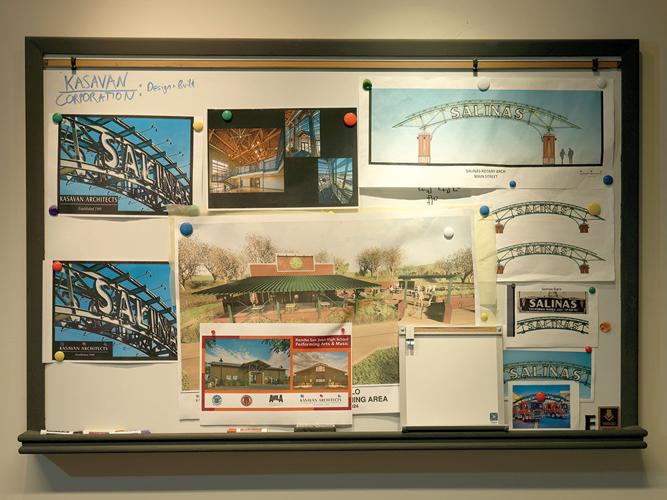
Kasavan has designed a number of civic-minded projects, including the downtown Salinas arch and the Ted Taylor Ag Vocational Center at Rancho Cielo.
MBEP’s Huerta, who helped plan the Regenerative California forum, admits he was skeptical about the group’s goal of facilitating the creation of 3,000 homes, but by the end of the two days his attitude changed to “cautious optimism.”
Huerta believes there are lessons to be learned from the world of affordable housing, capital “A,” when it comes to streamlining and investing. He advocates for taking the best tools from the marketplace and the best tools from the affordable housing space and applying it to building more units for the missing middle.
Overall change will not come quickly, but Huerta believes it’s coming.
“It’s not going to be as fast as everybody wants and needs, but I think this is a pivot point,” he says.
(0) comments
Welcome to the discussion.
Log In
Keep it Clean. Please avoid obscene, vulgar, lewd, racist or sexually-oriented language.
PLEASE TURN OFF YOUR CAPS LOCK.
Don't Threaten. Threats of harming another person will not be tolerated.
Be Truthful. Don't knowingly lie about anyone or anything.
Be Nice. No racism, sexism or any sort of -ism that is degrading to another person.
Be Proactive. Use the 'Report' link on each comment to let us know of abusive posts.
Share with Us. We'd love to hear eyewitness accounts, the history behind an article.