
IN UKRAINE, THE SCHOOL YEAR STARTS ON SEPT. 1, AFTER TWO MONTHS OF SUMMER VACATION. In 2022, however, only those schools and kindergartens that are equipped with bunkers reopened, the Ukrainian Ministry of Education Serhiy Shkarlet announced. Some 59 percent of all schools and universities are not ready to resume classes, he told the media on Aug. 22.
The Russian slow burn war on Ukraine traces back to 2014, when Vladimir Putin’s regime annexed the strategically important Crimean Peninsula and started to seriously fuel the fires of the Donetsk and Luhansk separatism. But the conflict escalated to a full-scale, direct attack on Feb. 24, 2022, horrifying the Western world. Since then, according to UNICEF, of the country’s 7.5 million children, 2 million have crossed into neighboring countries, and another 2.5 million are internally displaced. Over 10 million Ukrainians of all ages crossed over to Poland, many of them moving further west.
However, since then, thousands and thousands returned to their homeland after the conflict quieted down and withdrew outside of Kyiv, the capital, back to Donetsk and Luhansk, where it has simmered for eight years. Some who returned saw their apartments frozen in time, with a Christmas tree still up, as Ukrainian journalist Alya Shandra told the British outlet Monocle 24, but that’s a lucky scenario. Others returned to no apartments at all.
“I met a Ukrainian teacher who just bought the apartment and was ready to retire,” says Patricia Matulas Mason, a Salinas resident and teacher, who went to the border to teach Ukrainian and Polish students this summer. “The apartment was destroyed in an attack, and insurance didn’t cover it.”
Summertime at war is not fun for anyone, but what a bore the war is for children, as Lucy, Peter, Edmund and Susan, the original crew of The Chronicles of Narnia can attest. When your city is being bombed and your dad is with the army, there is no real summer vacation. Adults are busy and anxious. Sitting in the bunker is not swimming in the lake. Under the circumstances, even some school instruction doesn’t sound bad. A magical wardrobe would do, as Lucy found out, but what about a summer camp in a foreign land, in a foreign language and, more importantly, without war as a constant theme? To a group of children from the Ukrainian town of Yavoriv, at that very moment, in July 2022, it sounded as magical as Narnia.
THE INITIATIVE CAME FROM AMERICAN EDUCATORS, most precisely from the American Federation of Teachers President Randi Weingarten, who visited the Polish-Ukrainian border town of Medyka in April 2022. AFT immediately got in touch with the Polish teachers union ZNP and with the Ukrainian teachers union VPONU, providing them $100,000 of raised funds.
“Our visit will shine a light, not only on the impact of Putin’s war,” Weingarten said in a press release, “but on the persistence, compassion and bravery of the teachers dedicated to protecting and helping their kids learn amid Russia’s heinous attack, wherever they might be in the region.”
Since February, there’s been an outcry of help for Ukraine, starting with organizations such as the Norwegian Refugee Council that provides critical humanitarian assistance to people trapped in eastern Ukraine, those displaced in western and southern Ukraine, and those arriving in Poland, Romania and the tiny Republic of Moldova. In those countries, some transit centers offer educational psychosocial support for children, but much more children-directed help was – and is – needed.
In this context, AFT joined forces with the Kosciuszko Foundation, a Polish-American cultural nonprofit headquartered in New York City, as well as NATAN Worldwide Disaster Relief, an Israeli nonprofit. The idea was to send a group of American educators to the Polish-Ukrainian border and give young Ukrainians a chance to relax, learn a bit of English, but mostly to connect, and forget about the war.
“We have been bringing native [English] speakers to Poland for summer camps for over 30 years,” says Marek Skulimowski, president of the Kosciuszko Foundation. “And with what happened in Ukraine, we started txo wonder if we shouldn’t invite Ukrainian children.”
Skulimowski’s only concern was that he didn’t have enough native speakers ready and processed, and here AFT stepped in: “They just asked us how many we want.”
When the local union leaders passed the message at the meetings all over the United States, they were shocked by the response. Hundreds of American teachers from all over the nation wanted to go.
“It happened so fast,” says Kati Bassler, president of Salinas Valley Federation of Teachers, whose national affiliate is AFT.
A recruitment process was announced, and from hundreds of applications, a lucky, adventurous team of 15 was selected. Among them were Mason, who teaches English as a second language, Spanish and French at Alisal High School in Salinas, and Gabrielle DeVilla, a science teacher at Washington Middle School in Salinas. Both are SVFT members and employees of the Salinas Union High School District.
“Patricia and Gabby acted right away,” Bassler says. “Their willingness to help was 100 percent.”
Bassler is proud that she was able to send two teachers. She adds, “They gained as much as the kids did in terms of a cross-cultural experience.”
While not everybody had a chance to go, many local educators added their brick to the effort. Within days, Bassler gathered $2,500 to support the trip – mostly $50 and $100 donations from fellow teachers of Monterey County.

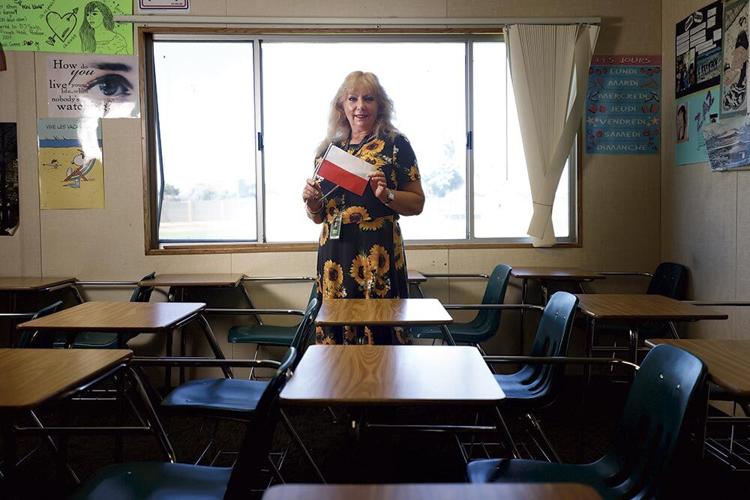
Patricia Matulas Mason of Salinas holds a Polish flag in her Salinas classroom. She is part Polish, part Lithuanian.
MASON IS A WORLD TRAVELER who taught English in Italy and worked as an interpreter in Dubai. When she heard the union president mention the opportunity, she jumped on it.
“I had been watching the news and wondering if there is something you can do besides giving a donation,” Mason says.
Her feelings of rage mixed with compassion are so intense that she considered throwing away the memorabilia from her past visit to Russia, as if wooden matryoshkas are to be blamed for Putin.
Perhaps part of this intensity comes from the fact that many Mason family members came from the region of current Poland and Ukraine. That is often the case with American immigrants who arrived in the U.S. before 1918 from what was then “Austria.”
“It’s time to give back,” Mason says. “My grandmother was Polish and my grandfather was Lithuanian. My great-grandmother was a Jewish midwife in Suwalki, Poland.”
For DeVilla it was less personal, but not less important. She was so excited about the news that she started to study basic phrases in Ukrainian and Polish. Born and raised in Salinas, she has been teaching science since 2015, and has always been interested in international volunteerism. “I’ve always wanted to see how other people live,” she says.
DeVilla’s father worked at Meals On Wheels of the Monterey Peninsula for over 25 years. “I grew up around service,” she says. “It was ingrained in my upbringing and adulthood. I wanted to help in some way.”
First they said yes, and only after they did, they looked up the destination on the map. It sounded obscure and unpronounceable.
Cieszanów, where the summer relief camp took place from July 18-29, is located at the southeastern tip of Poland, at the foothills of the Carpathian Mountains and the border with Ukraine. A town of less than 2,000 residents surrounded by ancient natural preserves, it offers both severe, long winters as well as sweltering summers, as the one of 2022.
It’s fair to say that history-wise, small but resilient Cieszanów has seen it all. It was sacked by the Cossacks in 1968, by the Swedes in 1656 and by Crimean Tatars in 1672, and that was only the beginning. A site of Polish-Ukrainian fights after both nations came to independence after World War I, it was bombed by the Luftwaffe during World War II. Since the Russo-Ukrainian conflict blew up in February 2022, this community of a bit over 1,000 inhabitants witnessed a deluge of people, mostly women and children, all fleeing west.
Thanks to the flexibility of this border – the same border through which U.S. and NATO military support arrive in Ukraine – it was possible to invite to Cieszanów a group of children from Yavoriv, another fierce little town with a dramatic past, located almost the exact distance from the border that Cieszanów is, 25 kilometers (15 miles), but on the other side, outside of the E.U. and NATO.
While in recent months things have been relatively quiet in Western Ukraine, on March 13, the Russians bombed the military base in Yavoriv. A Russian military spokesperson claimed the attack killed up to 180 foreign mercenaries. Ukraine reported there were at least 35 Ukrainian soldiers dead and 134 injured, as reported by various media outlets. The attack was heard in Poland.

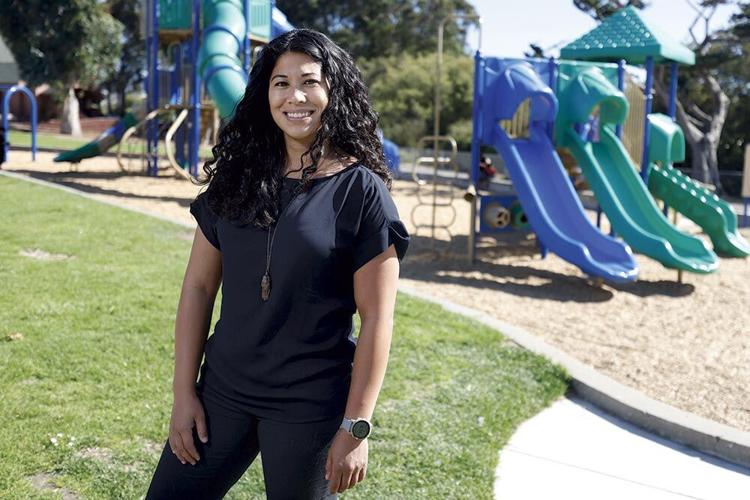
Gabrielle DeVilla, one of the two Salinas teachers who became part of a group of 29, upon returning home in August.
IN MID-JULY 2022, POLAND’S BORDER GUARD PASSED A BUS WITH 29 UKRAINIAN STUDENTS FROM YAVORIV, ages 10-16; their adult caregivers; and one guitar on their 50-kilometer (30 miles) trip west. They came for two weeks, sleeping in the building of the local public school that was also involved in the project. From the beginning it was clear that after the program, all children and teachers were to return to Ukraine.
“We came from the Yavoriv region,” wrote one of the Ukrainian teachers, Tamara Tieriekhova, in a statement to the Polish media. “We are three teachers and 29 children. We are so happy to be invited and thankful for the material and psychological help.”
“We all flew in from different directions and settled in the cabin,” DeVilla says about the arrival of the AFT crew at the Polish-Ukrainian border. Volunteers’ flights were sponsored by South African airline Airlink, another puzzle of this last-minute effort to put a relief summer camp together.
Ukrainian kids and teachers slept in the school building on foam pads. Polish parents, meanwhile, picked up their Polish children every night.
The other part of the school was used for morning instruction, mostly conversational English with basic grammar. Most of the kids were at a level of basic or newcomer English proficiency.
“We use English during all camp activities so our youth not only integrates with the Ukrainian participants, but also improves their language skills,” wrote Marzena Wilusz, director of the school in Cieszanów.
Just like DeVilla, Mason worked with the youngest group of the cohort, her “usual age group: 11 to 13.” Each group had five Polish and five Ukrainian students.
“It was clear that the Ukrainian kids have been through a lot,” Mason says, adding she was incredibly moved by the stories she heard, of schools and whole villages gone, destroyed during the Russian attacks.
“It took almost a week for them to stop hanging out in separate national groups,” Mason says.
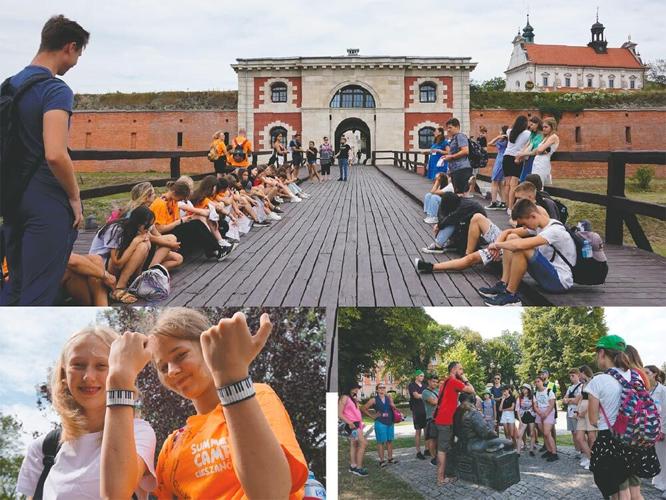
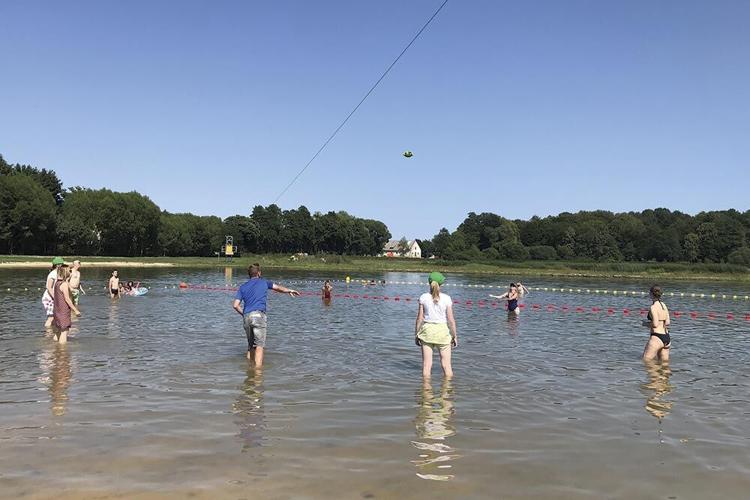
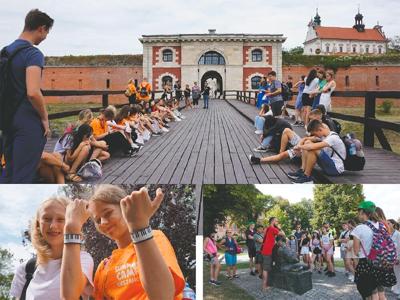
By the end of the camp, everybody was close enough to hang out in mixed groups during lunchtime, field trips and afternoon activities, such as swimming in the river or gathering at a bonfire.
To facilitate the latter, the camp relied on a local cultural center, Folkowisko, “a wartime child” of the local festival celebrating regional cultures and run by The Folkowisko Foundation, which suddenly went from putting together regional cultural programs to operating as a humanitarian aid organization.
“What happened? The war happened,” says Marcin Piotrowski of Folkowisko Foundation. “We were a group that used to organize festivals. We still do, I’m on my way to one right now… ”
That festival experience means they have a skilled logistics crew, which became useful when they started to transport people from the border, locating them deeper in Poland. Piotrowski and his wife run an agriculture tourism house and that was the first place where they housed Ukrainians fleeing war.
“Because our background was always culture,” Piotrowski says, “we immediately started to think about education.”
He contacted the Kosciuszko Foundation, and they were already talking to AFT. Then, NATAN got in, sending young leaders, ages 16-20, from the youth movement Hashomer Hatzair who served as counselors. The Israeli and Brazilian youth-led activities including sports, crafts, music and dance. (Ironically, Hashomer Hatzair, a secular Jewish youth movement with roots in socialist Zionism, was also founded there, in Austria-Hungary.)
The older youth were responsible for leadership training workshops that would take place in the afternoon, that is if the participants would not be touring Polish castles and fortresses, such as the eighth-century city of Przemysl or the Renaissance Zamosc.
The students connected through activities, and also through classes. “The fact that the camp was in English helped,” Piotrowski says, “because that equalized Polish and Ukrainian kids. Especially the older ones, they developed friendships.
“For some of them, it was the most important adventure of their lives.”

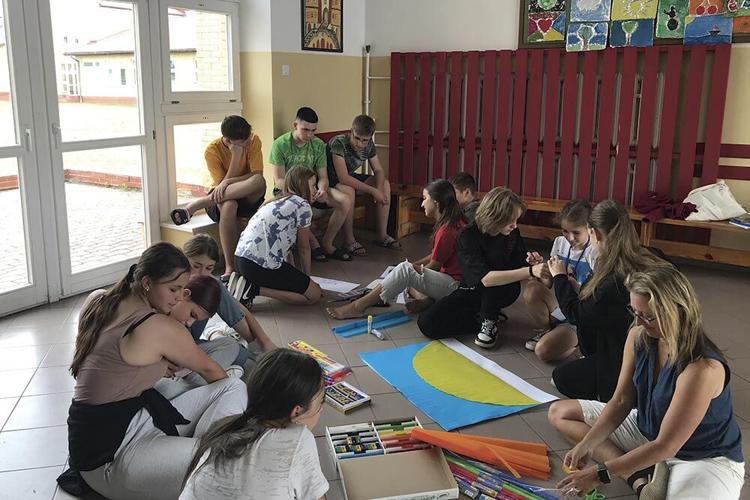
Young Ukrainians working on their flag. One of the main goals of the relief summer camp was to foster neighborly friendship among nations that at times were at war.
WHILE THE TIME WAS PASSING AND FRIENDSHIP BECAME TIGHTER, many came to certain conclusions. “Those teachers had passion,” Piotrowski says. “They showed us how one can teach. It was pretty incredible.”
The difference in the approach to learning and the level of seriousness expected in school was obvious to Eastern European students and teachers. They didn’t expect that much movement or play in summer school.
“Loud, animated, upbeat,” Mason says, describing the American teachers’ style, different in approach than their European students are accustomed to.
She says the students really enjoyed the interactive aspects of activities she proposed. “I was surprised by their lack of exposure to technology,” she adds.
But she had Chromebooks with her, and the students “took to it like fish to water,” giggling and playing against each other. Fortunately, she also brought “tons of American candies,” to celebrate those little contests.
In Eastern European schools, students are rarely praised unless they truly excel. “Some observed that teachers are being positive all the time,” DeVilla says. “Polish teachers are, they said, only negative. They definitely liked more positive praise.”
She also reports the Ukrainian students brought a higher level of English. “They were very eager to learn English, and really pressed for conversational English,” DeVilla says.
In Mason’s observation, the Ukrainian students were more patriotic than their Polish peers. They waved their flag and sang Ukrainian songs. “We asked the Poles to sing their anthem and they didn’t want to.”
Mason was most enchanted with a 12-year-old Ukrainian student named Sergiy, who got to try a typical American birthday celebration this year, with singing and cake. DeVilla will always remember Volodimyr, age 13, and his guitar. In fact, they all will. The guitar proved to be the ultimate icebreaker and made him popular among his peers and adults alike.
“It was beautiful,” DeVilla says. “They would just start singing, sometimes with a guitar, sometimes without it. They would just break into a cappella.”
The favorite song they sang over and over again was “Oh, the Red Viburnum in the Meadow,” a Ukrainian patriotic march of the time of Bohdan Khmelnytsky, a 17th-century leader who, seeking independence from Poland-Lithuania, made a military alliance with Russia and placed central Ukraine under Russian control.
On the meadow a red viburnum has bent down low / Our glorious Ukraine has been troubled so / And we’ll take that red viburnum and we will raise it up / And we, our glorious Ukraine shall, hey – hey, rise up – and rejoice / and we’ll take that red viburnum and we will raise it up / And we, our glorious Ukraine shall, hey – hey, rise up and rejoice
While bonding with Polish and Ukrainian teachers, DeVilla learned a bit about historic animosities between the nations that continue to simmer today. While the right-wing Polish government opened its borders to millions of Ukrainians, it kept them shut on the northeast of Poland, at the border with Belarus, where migrants from Syria and Iraq are left to freeze in the forests.
“I’m happy that we, as Americans, are here to build bridges,” Mason says.
listen well to the past / they are still there / they still violate us
tomorrow, the Russians will come / to remind us about coffins / in which we feel / indispensable for at least two / centuries / we are feeling just in place
tomorrow, the Russians will come / Hryniawska can see them as they again / destroy her garden, in other words Poland / and the tulips, because it’s all the same
Poet Eugeniusz Tkaczyszyn-Dycki, who was born and spent his formative years in Wólka Krowicka, 10 miles from Cieszanów, is considered one of the best living Polish poets. At age 15, he discovered that his mother was Ukrainian and that generations of his ancestors were involved in the partisan fight for an independent Ukraine. From his father’s side, the family was heavily “polonized,” and the Ukrainian past became a well-guarded secret.
While the poem above, titled “LXXXV,” is about old Hryniawska, a local senior citizen who anxiously looks east, forever expecting the end of her world, and the end of tulips, in both western and eastern Ukraine, there are millions of Hryniawskas doing the same. The difference is that Russia already came for their tulips.
Tkaczyszyn-Dycki’s poetry is a fitting postcard from the uncertain Polish-Ukrainian borderland, a place that historian Timothy Snyder called “the Bloodlands,” where 14 million noncombatants were killed within 12 years (1933-1945). Ukraine was one of the main stages of this tragedy; between 1932-1933, as many as 5 million perished in what is today widely recognized as an avoidable famine, despite Ukraine having the most productive agricultural lands in Europe.
The nature of the Russo-Ukrainian war keeps changing every day. The world is looking at the first 50 ships that are carrying 1.2 million tons of Ukrainian grain and other food that left the country’s Black Sea ports; the deal was called off several times before it happened. The situation in Polish-Ukrainian relations will keep changing accordingly.
“The war had changed us,” Piotrowski says. “We knew that we would be on the front lines because of the fact that we live here. I was preparing myself psychologically for weeks, but still – it was a shock.”

Happy campers swimming and playing in the clear water of the Bruisienka River on the boundary of southern Roztocze, a land of low, rolling hills in eastern Poland and western Ukraine.
AT THE END OF THE SUMMER RELIEF CAMP, there was a dilemma about what to do with the toys and games and the sports equipment. Should they go on the bus to Ukraine, or stay in the school in Cieszanów? Eventually, the decision was made that they can spread the joy even further by packing the equipment to send over to an orphanage in Lviv.
“It was heartbreaking to leave [the students],” Mason says in early August, a few days after returning to the U.S. “I feel that the story isn’t over.”
“Everybody was so sad to leave. It was too short, but you could tell the impact because on the last day there was not a single dry eye,” DeVilla adds.
“I think it worked out well,” Skulimowski says about the initiative. He was born in Lubaczów, six miles from Cieszanów. Skulimowski himself traveled to the border in June; the Kosciuszko Foundation organized its own regular summer camps this year too, bringing an additional 100 Ukrainian children. “We were able to take them out of the nightmare they were living, from the sirens and the constant threat of being bombed. But the most important thing is they were immersed in English all the time. And, we are planning to do relief summer camps next year.”
In Cieszanów, they learned that small things matter; one of the American teachers with AFT, a skilled hairdresser, ventured across the border to offer free haircuts in Ukraine. War or not, everybody needs a haircut, maybe especially now when you don’t know where your next one is coming from.
And those types of moments, that were not about the curriculum, were the highlights.
“The best parts,” DeVilla says, “were the moments when it felt just like a regular summer camp.”
(0) comments
Welcome to the discussion.
Log In
Keep it Clean. Please avoid obscene, vulgar, lewd, racist or sexually-oriented language.
PLEASE TURN OFF YOUR CAPS LOCK.
Don't Threaten. Threats of harming another person will not be tolerated.
Be Truthful. Don't knowingly lie about anyone or anything.
Be Nice. No racism, sexism or any sort of -ism that is degrading to another person.
Be Proactive. Use the 'Report' link on each comment to let us know of abusive posts.
Share with Us. We'd love to hear eyewitness accounts, the history behind an article.