
It’s easy to get lost in the sprawling, 5,500-square-foot headquarters of nonprofit Loaves, Fishes, and Computers in Salinas. In the front is a store with sample monitors, keyboards and laptops, available for $100-$220.
Just down the hall is a sleek room with stools and a wood-paneled counter, reminiscent of an Apple Genius Bar. It’s a work space, or “hub,” with Wi-Fi access.
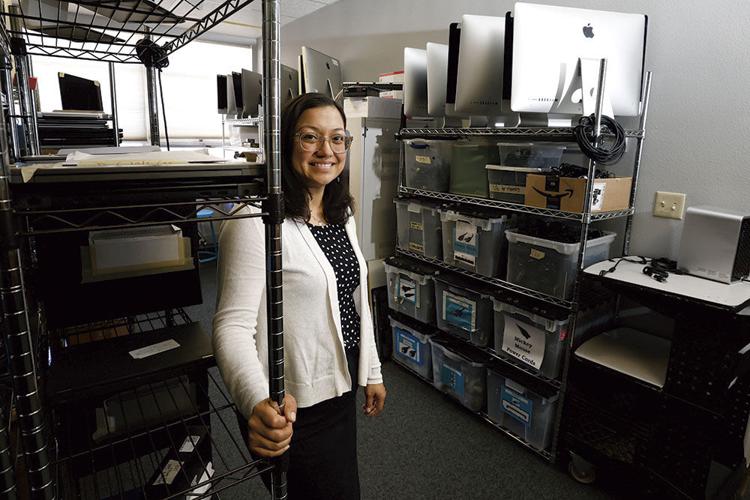
Behind a row of white boards serving as a divider, a volunteer is tending to milk crates stacked with dozens of Chromebooks to be refurbished. Beyond that, an equipment room is home to big shelves of computers and parts.
The LFC team of staff and volunteers accept donated computers, wipe the hard drive, repair them and prepare them for resale. Devices come with six months of tech support.
In the back of the building is a classroom, where a group of about a dozen seniors – here thanks to the Alliance on Aging – have just received tablets. LFC instructors stand in front of the room and start with the simplest of instructions: how to turn it on. The questions begin immediately (“how do you rotate it?”), as the five teachers start walking around to coach the participants one-on-one.
The services of LFC are available to people who are low-income, unemployed, receive CalFresh or other benefits, but the nonprofit services whoever is in need of its technological tools and digital literacy training. “We don’t really turn people away if they need help,” Executive Director Gabriela Lopez Chavez says, “because we understand at this point in our society, digital access is critical.”
The role of LFC, founded in 2009, has always been to help close the digital divide. But increasingly, LFC views its role not just as empowering people – with devices, repairs, or training – but also impacting policy decisions related to digital access.
“The narrative has changed,” Lopez Chavez says. “Our old slogan was ‘the low-cost computer store.’ Now we dedicate time to look at policies, and understand how digital equity plans are being set up in our state and county.”
That nonprofits serve people in need who have been left behind in the economy is not new. For some local community organizations, the idea of engaging upstream – to think about how they might impact economic development decisions and the shape of the local economy to better include their clients – is relatively new.
LFC is one of nine community-based organizations participating in a two-year effort, funded by the James Irvine Foundation, to reshape how the sector engages in regional economic development decisions. The Salinas Inclusive Economic Development Initiative (SIEDI) delivered $100,000 per year to each participating group for two years, along with training and mentorship. And for leaders like Lopez Chavez, it’s contributed to a different way of thinking. “This program has so much potential for sustainability and shifting paradigms within our community,” she says.

Ken Smith was a founding member of the nonprofit COPA and has worked as a political adviser to State Sen. Anna Caballero. He created the curriculum for SIEDI’s first cohort. “The skills that made you a good activist organization may or may not translate to making you a good economic development player,” he says. His focus was on developing those skills for participants.
“The theory of the initiative is that too often, economic development decisions are made for the community as opposed to with the community,” says Ken Smith, the project manager who ran SIEDI for its first two years. “The theory is that if the voices at the decision-making table are different, then everybody will win. The decisions will be smarter, they will be done more in collaboration with the community, and the community will be baked into the planning. To build a healthy and vibrant economy, all voices need to be in the mix.”
JAMES IRVINE LEFT IRELAND AT AGE 19 IN 1846 FOR THE UNITED STATES, and joined the wave of forty-niners seeking gold. When he died in 1886, he left 110,000 acres of ranchland in Orange County to his son, James Irvine, Jr., who became an early pioneer in modern agriculture, converting fields of cactus to citrus, grapes and barley. Irvine Jr. became a wildly successful agribusinessman, and founded the Irvine Foundation in 1937. That foundation made its first grant of $1,000 in 1938.
The foundation – with a vision of “a California where all low-income workers have the power to advance economically” – has continued to grow, with an endowment of over $3 billion in 2022.
Last year, it granted $187.3 million to California nonprofits.
One initiative is to invest in what the Irvine Foundation calls “priority communities,” places that Initiative Director Jessica Kaczmarek says “have been historically overlooked by philanthropy.” For the Irvine Foundation, those places are Salinas, Fresno, Stockton, San Bernardino and Riverside. In each, the foundation has granted funds to local groups to craft a vision for economic advancement.
For SIEDI, that takes the form of a $3 million grant in 2020, administered by the Community Foundation for Monterey County, which manages the initiative. (A disclosure: The author’s husband works at CFMC.)
Of that, $2 million went directly to participating organizations over a two-year period: $100,000 per year to nine participating nonprofits in the initial cohort, and $20,000 to each of five advisory groups. (Another $250,000 went to the groups for technical assistance.)
The nine participating groups are the Agriculture and Land-Based Training Association (ALBA); Building Healthy Communities; Center for Community Advocacy; Centro Binacional Para El Desarrollo Indígena Oaxaqueño; Hijos del Sol; Loaves, Fishes, and Computers; Monterey Bay Central Labor Council; Mujeres en Acción; and Rancho Cielo Youth Campus. The five advisers are Digital Nest, Hartnell College Foundation, nonprofit housing developer CHISPA, First 5 Monterey County and COPA (Communities Organized for Relational Power in Action).
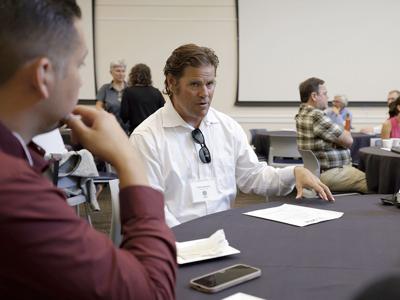
Training has happened largely through quarterly convenings that brought representatives of each group together for presentations on subjects related to economic development, like housing or digital literacy.
“Our job is really about building relationships, and understanding from different leaders: How do you bring people together to rethink your economy, and diversify the voices at the table that can help inform what the economy can look like for the people that live and work in your region?” Kaczmarek says. “It is important that the people who are most impacted by the systemic problems be at the center of the solutions.”
Systemic problems of economic inequality run deep. In Salinas, the median household income is $75,747, according to Census data. But to afford a two-bedroom rental home at market rate, $2,675/month, a household would need to earn $107,000 to avoid spending over 30 percent of income on rent. Meanwhile, according to a 2018 study, the median annual income of farmworkers in the region was just $25,000; 89 percent were renters, compared to 53 percent of the city’s population overall.
Smith was hired by the Community Foundation to manage the first two years of SIEDI. During that time, news broke that Amazon was considering building a 2.9 million-square-foot warehouse with 50 loading docks in Salinas. For Smith, it became an example of a missed opportunity. “I did a quick check-in and nobody knew about it,” he says. “Why aren’t you at the table?”
The Amazon proposal was eventually dropped, but for Smith it was a case study in what happens all too often in decision-making about economic development: the people who might be the ones to actually get the jobs are not included.
But Smith has an example that he sees as a case study in success: Joby Aviation’s facility in Marina.
“Joby jobs are much better than Amazon jobs,” he says. “There is a powerful role to be played connecting the community with good jobs. [In the case of Joby] those connections were made, and they bore fruit.”
MARIA ELENA MANZO CAME FROM MEXICO TO CALIFORNIA AT AGE 16 TO WORK IN THE FIELDS. After moving to Salinas, she decided to get involved in the community. Her starting point was at her church, Madonna del Sasso, one of many houses of worship in the region involved in COPA, which aims to empower people to advocate effectively for themselves. Manzo became a COPA leader in 2001 and has since been involved in successful campaigns to create Esperanza Care, public health insurance for undocumented immigrants in Monterey County, and VIDA, a community health worker program.
Manzo is now the director of Mujeres en Acción, which convenes small groups of women with leadership training aimed at economic self-sufficiency. Most participants are farmworkers, and many are monolingual speakers of Spanish or Mixteco.
In Manzo’s mind, there was not a natural relationship between the Mujeres membership and the tech sector. Since 2018, Joby Aviation has been running its R&D out of the Marina Airport, creating electric vertical take-off and landing machines, also known as flying cars. It felt a world away.

“The narrative has changed,” says Gabriela Lopez Chavez of Loaves, Fishes and Computers. “Twenty years ago we would talk about how we were serving the community. Now, it’s: We are working with the community.”
But through SIEDI, Manzo learned about a manufacturing apprenticeship program at Joby (job opportunity!). She sent out a notification via What’sApp to current and former Mujeres participants, and they shared it with their families and friends. Interest was strong – some 100 of 220-plus applications Joby received came from Mujeres-adjacent people or other SIEDI referrals. Joby ended up hiring three apprentices out of its initial 20 from the Mujeres-related applicant pool in 2022. (They are a son, a brother and a nephew of Mujeres participants – the next step is to encourage more women to apply.)
One was working in the fields; one was working at a grocery store butcher counter; and one was delivering parts for a car sales company. All three completed a six-month, paid apprenticeship, and have since been hired on. Another four apprentices came via other SIEDI groups, and three are still with Joby.
“The one thing they had in common,” Manzo says, “is that they said they would never apply to that position because they didn’t see themselves working in that field.” It turned out that a nudge from a trusted community organization was all they needed. For Manzo, “It really changed my perspective of the technology industry.” Instead of coming in with its own workforce from Silicon Valley, it could be an employer of local people and offer a path into good-paying jobs of the future.
A SIEDI mentor encouraged Manzo to advance the relationship and meet with Joby officials. “I had never really worked with industry leaders. I said, ‘What’s my role here?’” She quickly learned from mentors: “They have the jobs that the community you serve needs.”
And then she quickly learned the value of relationships. “When I met with [Joby], something happened between the two of us,” Manzo says. “They learned that there is talent in the community, and I learned there are a lot of jobs available that the community doesn’t know about. They need the workforce and the community needs the jobs, so it’s in our mutual interest.”
Joby officials say the relationship has helped the local community understand and trust the aerospace industry. And it’s resulting in high-quality candidates who already live in the area.
“Before this, when we posted jobs with titles like ‘hand lamination technician’ or ‘robot operator,’ local people would scroll past them on Indeed because they don’t resonate,” says Cody Cleverly, Joby’s workforce development lead. “This type of outreach allows us to connect on a personal level with folks and tell them, ‘It doesn’t matter your background. You can, if you want a career in manufacturing, apply for an apprenticeship. Look at all these transferable skills from agriculture, hospitality, or auto mechanics.’
“We are committed to creating jobs for people in the region who want to stay here and work here and have a career in aerospace.”
To Manzo, SIEDI is most effective when it comes to getting people talking: “What Joby taught me is the importance of the relationship, the conversations.”
PEOPLE IN THE PRIVATE SECTOR AND IN GOVERNMENT HAVE LONG RECOGNIZED THE POWER OF THE RELATIONSHIP. Many community organizers and nonprofit leaders have too, but formalizing that is the vision for SIEDI. And the story of Joby Aviation is the initiative’s primary case study in how it works.
State Sen. Anna Caballero, D-Merced, attended a SIEDI meeting in 2022, sat at a Mujeres en Acción table, and Manzo told her the story of the three apprentice placements. That got Caballero curious about Joby, and she scheduled a tour of the Marina facility. And that led her to becoming a champion of the advanced air mobility sector. She authored SB 800, signed into law in October, which creates an Advanced Air Mobility, Zero-Emission, and Electrification Aviation Advisory Panel with a three-year charge of mapping out air mobility infrastructure.
A SIEDI conversation made Caballero into a champion of the emerging sector, says her chief of staff, Luis Quinonez, and it also gave Joby a critical tie to the community. He and Cleverly both note that not only does a local workforce already live here – a benefit in a housing-constrained region – but also that if a novel technology will succeed, it requires trust, and the best way to build trust is from neighbors. “We’re talking about the Jetsons in real life. There’s a healthy suspicion,” Quinonez says. “If you have a relative or neighbor vouching for it, you feel like you have a stake in it.”
That’s beneficial for Joby’s long-term prospects. But Quinonez goes a step further.
“Frankly, Joby would not have established its status without the partnership with SIEDI,” he says. “They would not have made it this far.”
Joby announced earlier this year that its big headquarters will be in Dayton, Ohio, but the company still plans to keep a local presence. Within weeks, a vote is expected from the board of the California Competes Grant Program for $9 million to Joby. If awarded, they plan to invest $50 million to expand the Marina facility to over 200,000 square feet and create up to 600 new jobs, on top of 447 today.
“A stronger community is going to benefit everybody,” Manzo says. “People might be open to, ‘It’s in my own interest – if there is a better economy, people are buying more things.’ But if we see it as us and them – well, who is us?”
Growing the pie so that everyone gets a piece – including the poor and the working class – is better for those at the top of the economic ladder as well.
“It might sound radical,” Manzo adds, “but it should be common sense.”
MANY COMMUNITY-BASED ORGANIZATIONS EXIST TO HELP FILL THE GAPS THAT THE ECONOMY LEAVES BEHIND. People who cannot afford food for themselves and their families, a workforce that cannot afford housing, students who cannot afford technology needed to study – many rely upon the services of the nonprofit sector to help them get access to essentials like food, housing, recreation, laptops and more. At its core, SIEDI envisions a different idea for what role those organizations might play: Instead of serving people who find themselves desperate and unable to afford a basic standard of living, what if those people simply had enough? What if they were not marginalized by the economy to begin with?
“The future is going to depend on how economically viable Salinas is,” says Luis xago Juarez, a neighborhood organizer with Building Healthy Communities. “We have students that are graduating and going to universities. Are they able to come back home and find a career that’s going to help them? Is this going to be home for them? Do residents here in Salinas belong here?”
SIEDI’s vision is to create an economic future in which Salinas residents do belong, and can create a realistic plan to thrive and prosper. And that means getting involved from a different perspective.
Loaves, Fishes, and Computers, for example, is advocating to extend a pandemic-era federal benefit called the emergency broadband benefit, $50/month for low-income households. The renamed Affordable Connectivity Program was extended at up to $30/month in the Infrastructure Act, and over 20 million households have enrolled – but only 29 percent of Monterey County residents have applied for the benefit, although 47 percent actually qualify. LFC continues working on outreach to eligible residents and helping them apply, but also thinking about the program itself. The benefit is set to run out after five years, and LFC is advocating to make it permanent.
Then there’s the statewide Community Economic Resilience Fund (CERF), established by Senate Bill 162 in 2022, allocating $600 million from the state’s 2021 Coronavirus Fiscal Recovery Fund to the workforce services branch for the purpose of economic development. Several SIEDI members serve on the steering committee for a six-county regional group that will compete for funds.
Housing is an issue the SIEDI cohort has explored and in October, Salinas City Council initiated a process to consider rent stabilization, something Juarez, along with other cohort members, champions. Juarez talks less about empowering renters than he does about growing the economy for all. If rent isn’t exorbitantly high, he says, “our residents are going to be able to spend their money in this local economy.”

“We have to listen to those who are trying to survive,” says Luis Xago Juarez of Building Healthy Communities. He is also a Chicano theater artist and teaches ethnic studies at Hartnell College, in addition to participating in the SIEDI cohort.
For some local organizers, that is a new way of thinking, and that’s the whole point.
Jackie Cruz, executive director of the Hartnell College Foundation, told the cohort during a July convening: “SIEDI is probably the most important movement right now for the Salinas Valley.”
She adds that the premise might seem simple, but it’s not: “Engaging with institutions and building a future for themselves shouldn’t be radical,” Cruz says. “Doesn’t that seem like a reasonable thing to do, to expect the community to create their own destiny?”
Her unspoken answer is a solid yes.
SIEDI IS WRAPPING ITS INITIAL TWO-YEAR PERIOD, and the Irvine Foundation is considering whether or not to extend it. Conceptually, Smith says, real change won’t happen for a long time, even if it’s extended.
“This is not a two-year project, or a five-year project, or even a 20-year project,” he says. “It’s a generational project. The profound questions about the future of the Salinas Valley economy, they are very long-term questions.”
Still, there are examples of SIEDI’s impact to date: the emerging discussion of rent stabilization in Salinas, the positions at Joby, engagement in the state’s CERF process. “These stories seem small, but they prove a theory,” Smith says. (After getting the initiative started over its first two years, Smith is stepping down.)
Dan Baldwin, president and CEO of the Community Foundation, is hopeful about a two-year extension. That’s where he sees the next critical step as inviting the private sector and business leaders into the room.
He paraphrases the perspective of organizers: “‘We need to be at this table, and if we’re not at this table, we’re going to get left out.’ Historically, these groups felt left out, and I would agree with them.
“What SIEDI 1 did is create this sense of empowerment,” Baldwin says. “My hope is SIEDI 2 actually creates these tables.”
The Community Foundation is in a unique position in that it works with members of the business community, and also nonprofit organizers. Baldwin sees that as a critical bridge between these two groups that historically have too often been viewed, by themselves and by others, as adversaries. “We want to use the Community Foundation’s trusted relationships to create tables where more meaningful conversations can take place,” he says. “This cohort is now more equipped to be at that table.”
It’s a literal table, Baldwin adds – not a golf course, or an exclusive club, or any venue that has historically excluded people of color, working-class people, immigrants and others.
Michael Castro, who runs SIEDI for the Community Foundation, says success will take a long time to see. “It’s not a project where we will be able to say, ‘We created this many jobs.’ In a two-year timeline, that’s impossible.”
Instead, Castro says, a generation from now things will look different. How will we know if SIEDI is working? “The residents have enough. There are family-sustaining jobs. It sounds so simple.”
(0) comments
Welcome to the discussion.
Log In
Keep it Clean. Please avoid obscene, vulgar, lewd, racist or sexually-oriented language.
PLEASE TURN OFF YOUR CAPS LOCK.
Don't Threaten. Threats of harming another person will not be tolerated.
Be Truthful. Don't knowingly lie about anyone or anything.
Be Nice. No racism, sexism or any sort of -ism that is degrading to another person.
Be Proactive. Use the 'Report' link on each comment to let us know of abusive posts.
Share with Us. We'd love to hear eyewitness accounts, the history behind an article.