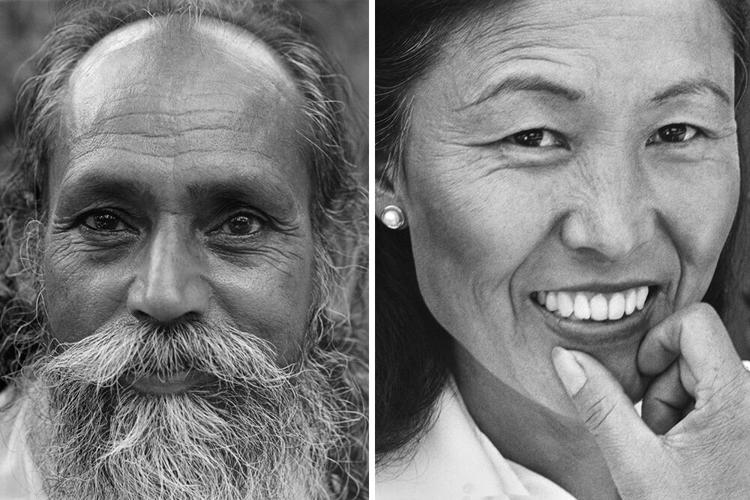
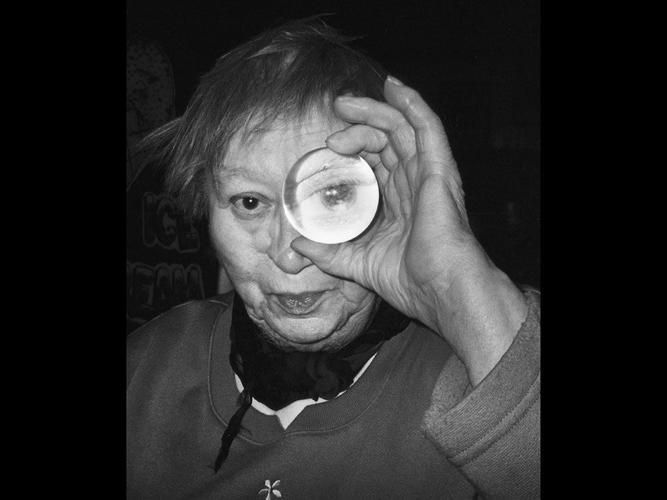


(left) Baba Hari Dass was an Indian yoga master. In 1952 he took a vow of silence, and from then on he communicated with the help of a small chalkboard. He taught yoga to Ram Dass, who would go on to write the influential 1971 book Be Here Now. Baba Hari Dass came to the United States in 1971 and inspired the creation of the Mount Madonna Center in the Santa Cruz Mountains, among other similar retreat centers. He died in 2018. “This is one of my absolute favorite photos,” David Fuess says. (right) Wha Ja Kim was a pioneering acupuncturist with an office on Cass Street in Monterey. Fuess worked as her assistant, and the experience had a huge impact on his life. “If it weren’t for her I wouldn’t be an acupuncturist,” Fuess told the crowd during a 2013 exhibition of his portraits. Kim died in 2019.
THE FIRST TIME DAVID CUSHING FUESS REMEMBERS SEEING A PHOTOGRAPH APPEAR, slowly at first then all at once in a pool of developer, he was 10 years old. The experience captured his boyhood imagination, and laid the groundwork for a lifelong fascination with portrait photography.
“I understood something visceral about photography early on,” Fuess says. “Those people are alive in the photographs for me. I’m there.”
The people Fuess is referring to are mainly artists, spiritual teachers and healers of a range of modalities, both locals and visitors, who were captured by Fuess’ camera in the 1970s and ’80s at a time when the Monterey Peninsula felt like the center of a universe of discovery and creation. To look at these photos now is, in many cases, to peer back in time: to the early years of the Esalen Institute and its exploration of human potential; to what was perhaps a more Bohemian, artistic time in Carmel; to the animated faces of old-timers now gone but not forgotten. At the time, however, the photos were news – not breaking news, perhaps, but the kind of human interest stories that regularly fill pages of any local paper, connecting people to the place they live and the neighbors they live around by highlighting the stories of artists, business people, teachers, activists and others.

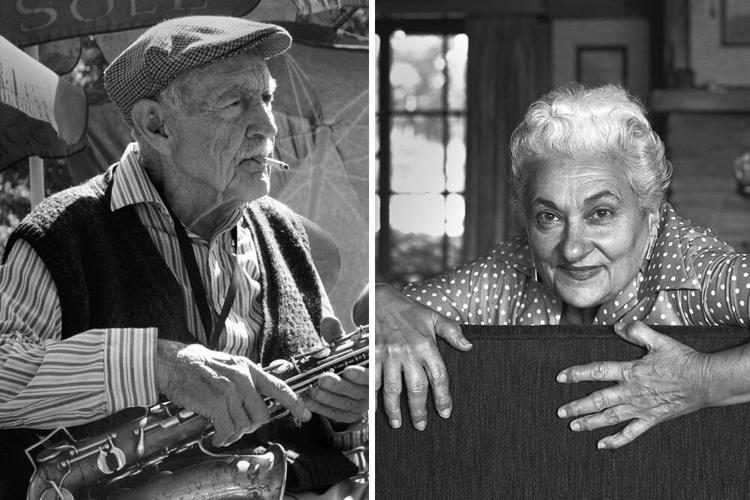
(left) Jake Stock was a member of the Monterey Stock family, and of the family band called the Abalone Stompers. “They always had fun playing,” Fuess says, of the jazz/soul group. Fuess took this photo of Stock at the Big Sur River Inn. (right) Eve Tartar Brown was a Brooklyn-born artist who moved to Carmel Valley in the 1960s. She created sculptures and a collage technique that involved cutting and assembling many tiny pieces of paper. Her work can be found in many collections on the Monterey Peninsula – including that of the Monterey Museum of Art. She died in 2000. “She was a force of nature,” Fuess says.
FUESS ARRIVED IN CARMEL IN 1972, drawn by a desire to be close to the ocean, to nature and to his parents, who had moved here after his father John, a diplomat, retired. In 1975 he got a job at the Carmel Pine Cone – the pay was $2.50 an hour, he recalls – writing feature stories. It was a good deal for the paper, Fuess says now, because the Pine Cone got a writer and a photographer in one. This is how his collection of portraits began.
“I was in bliss,” Fuess says of the job. “Basically I could call up anyone I wanted and say, ‘Let’s do a story.’”
And call he did – artist Barbara Spring and writer/Henry Miller confidant Emil White and Esalen Institute cofounder Dick Price and architect Nathaniel Owings and more. Almost all the photos in Fuess’ collection were taken to accompany a newspaper article, and their compositions show traces of how and when the interview took place. Some photos seem to clearly express the personality of the subject. A portrait of Lutheran minister, councilor and president of the Cypress Institute John Frykman, for example, shows the man with one leg in a metal garbage can, the other foot resting on its rim – an homage, Fuess explains, to Gestalt founder Fritz Perls’ novel In and Out the Garbage Pail. “He was in for the game,” Fuess says. “Full of life.”

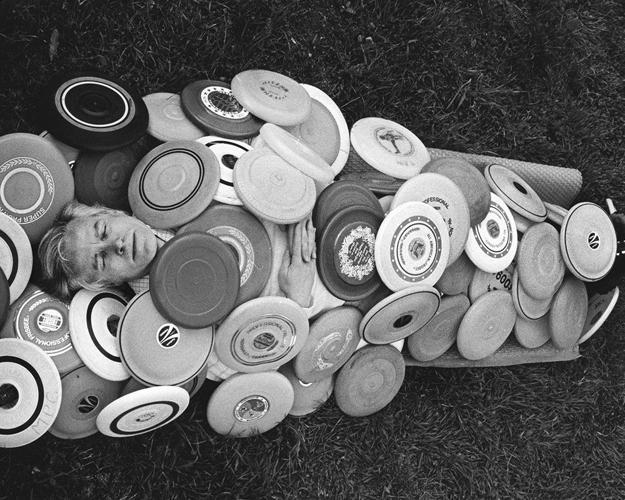
Stancil Johnson was a psychiatrist, a frisbee enthusiast and “historian of all things flying disc.” In 1975 he wrote the book Frisbee: Practitioner’s Manual and Definitive Treatise. He’s a member of the Frisbee Hall of Fame and the Disc Golf Hall of Fame. He died in 2021; he’s pictured here with his entire frisbee collection.
Fuess’ camera of choice was a Nikon 35 mm, or a Pentax 6x7. He developed and printed all his own work.
“I shoot from the hip,” Fuess says, of his technique as a photographer. “I’m a quick photographer.” (His writing technique was similarly spontaneous – after an interview, he recalls, he’d type up all his notes, then end his work day. That night he’d dream, he says, and wake up with the first sentence of the story-to-come in mind.)
After the Pine Cone, Fuess became a staff writer for Health and Consciousness magazine and then, in 1980, an arts editor at Monterey Life Magazine. In 1983, he became co-editor of Community Spirit Magazine. (All of these publications have since ceased to be printed.)
Today, however, Fuess is primarily known not as a local journalist and photographer, but for the direction his life took next. Today Fuess is an acupuncturist and healer – he has taught kundalini yoga, tai chi, and more.
“It just kind of happened,” he says, reflecting on his varied life path. “But the key to it is sincerity.”

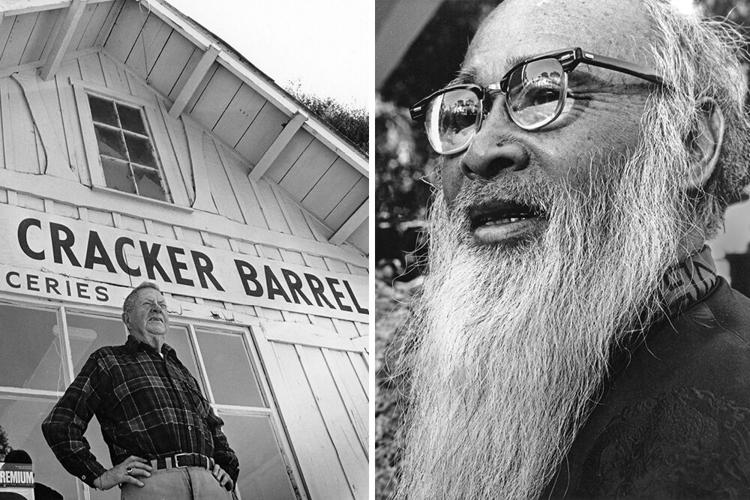
(left) “Rosie” is the namesake of Rosie’s Bridge in Carmel Valley. He owned a bar inside the Cracker Barrel – “He was actually called Rosie because his cheeks were red from drinking,” Fuess recalls. (right) Chang Dai-chien was one of the most famous Chinese artists of the 20th century who spent time living in Carmel and Pebble Beach. Fuess interviewed Dai-chien in Pebble Beach in 1975 and learned that he ritually buried his paint brushes in his backyard because “they were such an extension of his being.”
ON A WARM FALL AFTERNOON AT HIS HOME high on a hill in Carmel, Fuess is bursting with stories to tell and memories to share as he flips through photographs, some now 50 years old. He professes to have never photographed someone he didn’t like, and all the stories are filled with a deep admiration.
“I really liked him,” Fuess says, appraising a photo of the artist Jack Swanson, known for his paintings of Western landscapes, holding a sculpture of a horse. “He knew being a cowboy from the inside out.”
Not all the people in the photos were, or are, well-known; few have a reputation that stretches beyond the specific community they were a part of. Still, their stories, both small and significant, weave the fabric of a certain time and place. Many of the people in Fuess’ photographs have since died, changing the nature of the portrait from an artifact of the present to one of the past.
“The thing about these people is they were the real deal,” he says. “This was a golden age – and I was in a cherry spot.”
It was this conviction that inspired Fuess to gather 100 of his portraits in 2013 for an exhibition he titled You Must Remember This: A Love Letter to the Monterey Peninsula (available to watch via YouTube). The images that make up this photo essay are a smaller selection of that exhibit.
Fuess still takes photos – all with his phone these days. It’s a device Fuess feels ambivalent about (“it takes people out of the moment”), but one that has undoubtedly democratized photography, allowing all of us to photograph the people and places and small moments that make up our lives. In 50 years, what will our camera rolls have to say about life as it was in 2023?
Only time, and our own desire to remember, will tell.

Kalisa Moore, the “Queen of Cannery Row,” was among the last living connections to John Steinbeck. Her La Ida Café was a refuge for bohemians, bellydancers, artists and poets. She died in 2009.
BIRD’S EYE VIEW, a collection of portraits by David Cushing Fuess, will be on display at the Press Club starting Dec 1. 1123 Fremont Blvd., Seaside. 394-5656, montereycountyweekly.com/pressclub
(0) comments
Welcome to the discussion.
Log In
Keep it Clean. Please avoid obscene, vulgar, lewd, racist or sexually-oriented language.
PLEASE TURN OFF YOUR CAPS LOCK.
Don't Threaten. Threats of harming another person will not be tolerated.
Be Truthful. Don't knowingly lie about anyone or anything.
Be Nice. No racism, sexism or any sort of -ism that is degrading to another person.
Be Proactive. Use the 'Report' link on each comment to let us know of abusive posts.
Share with Us. We'd love to hear eyewitness accounts, the history behind an article.