Gary Pisoni has a unique relationship with God.
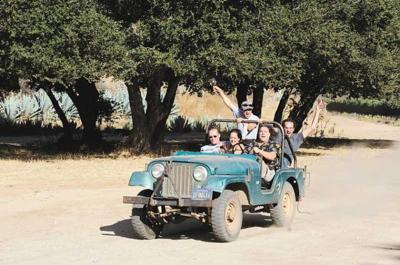
Then again, those who have torn through the rollercoaster dirt roads of his Santa Lucia Vineyard in his windshield-less 1959 Jeep – sloshing red wine on their laps as Pisoni shouts vineyard creation stories, gesticulates like a true Italian, swats curly hair from his face and looks over his shoulder as much as he does at the road in front of him – have seen God after just one run.
Since Pisoni has completed thousands of such loops, it’s a safe bet that he and God are in as close contact as the four passengers squished in the back seat.
“God makes the wine,” he grins. “I’m just the custodian.”
Considering those custodial gifts, God might forgive us for granting Pisoni a certain divinity. He shepherds some of the most sought-after Pinot grapes on the continent on scrabble his family bought for just $350 per acre. He’s helped lift the Santa Lucia name heavenward through shrewd vineyard-designated partnerships with top boutique labels. The dark-fruit force of the Pisoni Estate reserve inspires steady pilgrimages to the few restaurants and stores lucky enough to carry it (where fans happily pony up for bottles that start at $65).
He evangelizes his love for good wine with a preacher’s passion and increasingly immortal stories that can’t always be printed. And while Jesus may have turned water into wine, Pisoni turned no water into wine.
But Pisoni’s relationship with his maker is only a small part of this only-in-Monterey-County story. It’s his other relationships that are more telling: with the land, with his family and with that juicy little thing called the truth.
~::~
One day a child was conceived in a specific section of the Pisoni property. Given the general tenor of Pisoni’s bacchanalian barbecues, that isn’t so shocking. What came later, however, is.
That first child appeared after Pisoni urged Dianna Lee and her winemaker husband Adam of Siduri Wines – one of Pisoni’s many celebrated Pinot buyers – to take a blanket down to the vines he tends for them.
The onsite conception inspired Pisoni to later gift the Lees two extra rows of vines. Then, Dianna developed a type of lupus that in turn damaged her kidneys and required a year of chemo. She survived, but was told she wouldn’t have any more children. So the Lees adopted their second kid, Amber.
Dianna’s doctors didn’t tell her to stop making love, though, so on another celebratory day at Pisoni Vineyards, she and Adam revisited their al fresco romantic rendezvous.
And there, among the hand-tended vines, something immaculate happened. Around nine months later they named their third child Truett.
Events like these root the wild winemaker more deeply to this hilly piece of mountain. “Good things happen in the vineyard,” Pisoni says.
Another incident is rather miraculous in its own right, and had Pisoni acting like one of the property’s native boars.
~::~
The Pisoni dirt used to be as dry as a sun-burnt bum. And that was OK, given its original purpose: keeping cattle and hunting game. But Gary Pisoni loved wines, and knew more than a little about the best ones out there – he started buying old Bordeaux when he was barely out of his teens. He saw the possibilities in the cool nights, the near absence of rain and the gravelly, well-drained soils.
Gary appealed to his father and partner, longtime produce farmer (and fellow Gonzales High alum) Eddie Pisoni, to consider grapes over grazing.
“‘We have 1,000 acres of lettuce and produce. Why do we need to plant more of anything?’” Gary remembers his dad saying. “I asked him if he’d ever been invited to a $250 lettuce tasting.”
It was a persuasive argument. But even with Eddie’s blessing, no water meant no wine. Pisoni drilled a well once, in vain. Then twice. Over the course of nearly a decade he made six successive attempts, each costing tens of thousands of dollars and weeks of labor, but found no flow. In the meantime, he personally drove a tanker from the valley floor to wet the little plot he could sustain.
That’s one reason Vineyard and Winery Management Editor Tina Caputo calls Pisoni “tenacious.”
“Who else would stick that out for nine years?” she says. “You’d eventually give up – you’re not gonna find water here.”
“Dad was pretty upset with me,” Pisoni says, “[but] I figured I’d try one more time.”
When the water finally came in 1991 – warm and sulfur-stinky from an underground hot spring – he went nuts.
“It was running like a river,” he says. “I jumped in like a wild pig – I was shaving, washing my hair.”
If Pisoni had loved the property before, now he was really horny for it. He took to erecting love notes beyond the tokens of affection already in place: swings, patios and a vine-shaded barbecue area with a big brick pizza oven. The new jewels included a three-headed shower on a bluff, semi-secret water fountains and a wood-burning hot tub overlooking the valley. (“When is it warm enough?” he asks. “After two bottles of wine.”) A waterfall and a pond further celebrated the precious presence of H2O.
Pisoni lives to tour people around the place. Nonstop jeep circuits are a staple of any event. He camps out there regularly. His affection also translates to the vines he could now expand to more than 40 acres. His veteran team – including two of his best friends, partner and Gonzales High contemporary Gary Franscioni (see sidebar, p. 22) and long-term, do-everything ace Elias Gandora – treats each vineyard like an only child, even though there are 10 all told, most of them named after friends, relatives or inside jokes.
“The best winemaker,” goes one of Pisoni’s trusty proverbs, “amplifies the voice of the earth without disturbing it.”
~::~
Pisoni also has a unique relationship with the deer that pass through. “I warn ’em,” he says. “‘Eat my grapes and I’ll eat you.’”
His rapport with his wine buyers, with whom he often shares rich and spicy homemade venison sausage, is just as old-school. It might stem from his upbringing in little Gonzales: “Everybody knows everybody,” he says. “You know who you can trust and who’s a liar.” Handshakes happen in place of contracts, quality reigns over quantity, friendship claims priority over profits, and if disagreements aren’t settled by the bottom of a bottle of wine, the partnership enjoys the same life expectancy as a grape-grubbing buck.
“Three rules!” he booms after jamming the jeep’s brakes. “Be my friend, make good wine and pay the bill!”
Once his vines started producing, he would approach his favorite wine guys at tastings and invite them to his land. They’d stop by the ranch house for some of his homemade brew – Pisoni was already claiming blue ribbons at the Monterey County and Salinas Valley fairs – and he’d plant a seed.
“If I’m an amateur and I can make this,” he’d say, “imagine what a pro like you could do.”
Often his hospitality extended to his cellar, where at least one buyer (with the help of a $500ish bottle of 1970 Haut-Brion) agreed to a deal before he set foot in the vineyard.
Not that any were disappointed when they witnessed the mouthwatering medley of environmental variables assembled up the dirt road: long hang times at 1,400 feet high, fog-cooled nights ushered in by the Salinas Valley winds and potent flavor-inducing soils: a perfect prescription for Pinot.
“They’d come see the grapes, see a serious grape grower and have so much fun,” says Pisoni’s son Jeff, who now makes wine himself.
They’d also see some uncommon intensity.
“Gary is an incredibly passionate person,” Siduri’s Adam Lee says. “When he sees passion in other people, he’s in.”
Being in it together, Pisoni-style, meant breaking the prevailing precedent. He’d charge by the acre, not the ton, freeing his vineyard managers to focus on fruit quality over output, and granting buyers very close control over their grapes.
“His was one of first California growers to do that,” says Caputo, who’s also a columnist for Wine Online. “Charging by the acre gives vintners freedom to farm however they want to.”
“Farmers want more tons,” Pisoni says. “We want the best crop. We drop a lot of fruit, and the wines are not thin or watery or without a lot of flavor. It’s intense.”
His attention to his buyers also sets him apart.
“We wanted some input,” Lee says. “We’ve always done that, but growers didn’t get it. It was like pulling teeth. Gary got it: ‘I will call you on cell before I set foot in the vineyard. It’s your vineyard.’ We were in this together.”
If winemakers don’t turn his grapes into greatness, Pisoni asks for his name to disappear from the vineyard designation on the bottle. They get another shot, but if they blow it, they’re dropped like watery grapes on the ground.
Many partners have succeeded, however, netting awards for their labels and the magic word Pisoni. He’s not alone in calling them some of the top Pinot producers on the playing field: Roar, Ojai, Flowers, Patz and Hall, Peter Michael, Siduri, Testarossa.
“I think of it like an all-star team,” Pisoni says. “We compare notes and ideas. They’re the best Pinot Noir makers in the state.”
Pisoni has already seduced powerful wine tastemakers including Robert Parker, Wine Spectator and Wine & Spirits. He’s brought more notoriety to the Santa Lucia Highlands appellation, a wine-growing region that in the last decade has joined a high-brow conversation previously limited to Napa and Oregon.
But he won’t be the Pisoni to take it to the next level.
~::~
Long before his family bought the highlands plot, Gary Pisoni was obsessed with wine. He was drinking his decorated collection so quickly that it only made sense to plant his own grapes.
He’d make deals with Gonzales-area growers to collect leftover fruit by hand, split the yield with them, and then experiment fermenting his own juice at the farmhouse, where he still minds several barrels every year. He even took a couple of classes at UC Davis. And, to further his studies, he says: “I got winemakers drunk and stole their secrets.”
When the Pisonis acquired their Santa Lucia spot in 1982, the amount of water Gary could truck up limited him to a small spread of grapevines – but also forced him to focus more closely on making those work, perfecting his leaf-pulling and vertical-vine practices during the long wait for a successful well.
His sons came to the game much differently: Rather than talking their dad into winemaking, he was indoctrinating them. As kids, they fermented grapes in mason jars. By high school, they were experimenting with whole barrels.
Older brother Mark, 32, studied viticulture at UC Davis and ag business at Cornell. He gets yeasts, pH and sulfur dioxide in ways his 56-year-old dad never will. Jeff, 31, boned up on oenology at CSU-Fresno, then honed his craft at landmark operations like Peter Michael and Bernardus.
“Make no mistake,” says Bernardus Vineyard Manager Matt Shea, “the sons run the show. They are well respected among the purists.”
“They have made it more structured than before, in a good way,” Lee adds. “Gary will give you the shirt off his back – but he’ll give you clothes until he’s naked, and it’s almost too much to be that generous.”
And like the Santa Lucia Highlands appellation itself (see sidebar, this page), which was founded in 1991, the sons Pisoni are just getting started.
“This appellation has learned a lot just recently,” says Mark, whose new composting program has enhanced soil resilience. “Working with family is rocking. We get instant feedback; we can [conduct] experiments out in the vineyard; we’re in the vineyard and cellar. We have that control all the time.”
That rare arrangement also resonates with Jeff, who directs winemaking traffic in Sonoma near major suppliers, collaborators, bottlers and buyers.
“It’s easy to say, and cliché, but the most fun thing is that we really do have a chance to make the best wine,” he says. “It’s so hard to get all the ingredients in place for that: [we own] a good spot, grow our own grapes, work with good winemakers, can afford to drop fruit and invest in new barrels. We can really push ourselves to be great.”
Papa Pisoni’s translation: “Mark and Jeff went to school for wine and know things I don’t. One son grows the grapes, one makes the wine, and I drink for a living.”
~::~
First, he says, there was a little Spumante.
Pisoni’s telling one of his well-traveled stories again. The previously raucous room at this summer’s Bernardus Wine Dinner is silent. You can almost hear the swooping of Gary’s hands as he moves through the space between tables. He speaks in breathless bursts of urgent enthusiasm, as if he might not gather enough oxygen to get out the next sentence:
“My cousins in Italy, they’re saying, ‘Cousin Gary, have a little grappa. OK, have a little wine. Cousin Gary, have a little espresso and grappa.’”
But Pisoni had to get to the airport. “No problem,” he remembers thinking, “I’m in Italy.”
When he finally hit the road, he got pulled over.
As Pisoni tells it, he slyly slipped on his seatbelt and asked sweetly, “What did I do wrong, officer?”
The cop insisted he was driving unbuckled. Pisoni disagreed. They went back and forth. The officer finally appealed to Gary’s wife, Margarette.
Her reply, Pisoni announces, hands thrown high: “I learned a long time ago: Never argue with my husband when he’s drunk.”
Another story from a night brimming with them: Pisoni describes how he snuck a supremely sought-after clone through customs in his pants, by telling a suspicious female agent eyeing his offending crotch, “Hey, I’m Italian. You want to check?”
Pisoni is forthright to a fault about seemingly everything, but that doesn’t stop his legends from gaining luster as the night progresses. When asked where exactly in Burgundy he procured the Old World clone that’s helped make Santa Lucia Highlands a Pinot power source, he surprisingly defers: “I’m not really supposed to talk about that.”
“He’s the only guy who knows,” Mark adds.
So go the stories that make great wine greater, that swirl the wine-dinner circuit, that get better as bottles accumulate on his wine cellar table.
“The more the wine flows,” Shea says, “the bigger the stories get.”
There are, however, some indisputable truths.
For starters, despite Pisoni’s escalating fame and clamors for his Pinot fruit – he estimates there are 100 winemakers on the waiting list for his $15,000-an-acre grapes – the core crew is focused on staying small, sustainable and family-driven. Gary’s mom will go on running the family produce farm office and its 83-person payroll.
“We don’t want to get too big,” says Mark, whose wife manages the vineyard office. “We really pride ourselves on it. People can pick up the phone and call us.”
Another truth: Pisoni wines will get better, and harder to get. Bruno’s Market sommelier Brian Johnson battled to carry Pisoni for years. The shipment he snagged a couple of months ago sold out in a couple of days.
“Now that the Sideways wave is over, other growers seem to be plateauing in Pinot production and popularity,” Shea says, “but I don’t see him slowing down. Whether he’s going to take over the world, I don’t know. But he seems to have harnessed momentum better than anyone.”
Truth three: Pisoni loves wine, and wants people to embrace it like he does. “My favorite glass of wine?” he says. “The one in my glass.”
More truth: Pisoni comes with the same openness to people as he does wines.
“He doesn’t put on airs,” Caputo says. “He’s not putting on any kind of show, no matter what company he’s in, where he goes, or who he’s with.”
More still: None of Pisoni’s natural theatrics or spiraling stories would be relevant if the wine wasn’t really damn good.
And this: There’s good-crazy and bad-crazy.
“He’s a gregarious, wild, crazy guy,” Caputo says. “His hair’s all crazy, he looks a little disheveled, talks really fast, says a lot of things. He’s got tons of energy, you can tell he loves life, and that he’s having a great time. Vitners say he’s crazy, but in the end always they say he’s a great guy, not just entertaining – genuine.”
At that, Pisoni’s face splits into a purple grin. “To be in this business,” he says. “You gotta be Pinot Noir crazy.”
Honest to God.
(0) comments
Welcome to the discussion.
Log In
Keep it Clean. Please avoid obscene, vulgar, lewd, racist or sexually-oriented language.
PLEASE TURN OFF YOUR CAPS LOCK.
Don't Threaten. Threats of harming another person will not be tolerated.
Be Truthful. Don't knowingly lie about anyone or anything.
Be Nice. No racism, sexism or any sort of -ism that is degrading to another person.
Be Proactive. Use the 'Report' link on each comment to let us know of abusive posts.
Share with Us. We'd love to hear eyewitness accounts, the history behind an article.