

It gets cold at night in the Urgoma Mountains in the middle of Ethiopia, dropping to nearly zero degrees. Layers of expedition-style gear and heavy sleeping bags are required. There’s also little civilization above 10,000 feet, high on the roof of Africa, where shepherds graze livestock, and Ethiopian wolves subsist mostly on mole rats.
To get deep into these mountains, Carmel residents Steve and Molly Attell rode on horseback for 10 days. The terrain got so steep they’d have to dismount their horses to keep from slipping.
Their days began at 7am. The pain would start setting in almost immediately: aching groin, knees, ankles, all those under-used leg muscles fatigued from gripping the horse, plus a ubiquitous sore back. By lunchtime, Molly Attell didn’t want to stand; she’d spend the break laying down. By the end of an eight-hour, 20-mile day, she couldn’t walk; she’d stand for a few minutes next to her horse, holding on to stay upright and wait for circulation to get going before she’d make a beeline to her sleeping bag. She’d wake up sore, then start again.
“I just felt completely physically thrashed,” Attell says. “When we left home, I thought, ‘How fun, we get to ride horses eight hours a day.’ After the first day I said, ‘Oh boy, here we go.’”
Her husband reminded her the whole thing was her idea.
Some people daydream about spending retirement savings on travel to storied museums or pristine beaches. The Attells were in high-altitude meadows of the Sanetti Plateau in of pursuit of wolves.
It’s the kind of journey Molly and Steve have been making for two decades, driven by Molly’s accidental obsession with wolves and coyotes. They’ve studied these animals all over the planet.
There was Botswana, where gunmen emerged from the bush at a border crossing from South Africa. The Attells were on their way to find painted dogs, mottled pack animals known for their big, round ears, when the men ordered their driver to hand over his gun. (The men ultimately let them pass.) In Italy, they trekked into the Dolomites in pursuit of rare Italian wolves, and Marsican bears, a brown bear that’s nearly extinct.
Along the way, the retired nurse (Molly) and architect (Steve) have been connecting with biologists who study wild canids, the family of carnivores including coyotes, wolves and foxes.
“I have this great passion for wild canids,” Molly says. “You have to go to the places where they are.”
But none of it would’ve happened if the Attells hadn’t met a Prunedale conman who sold them half-coyotes, claiming they were something else altogether.

Molly and Steve Attell recently scouted for coyotes in Fort Ord, to no avail.
Here’s how two normal, middle-class, educated people accidentally raise a pack of predators in their backyard.
It was 25 years ago, and Steve was an architect at Morrison Knudsen, an international engineering firm that built projects like the Hoover Dam and launch pads at Vandenberg Air Force Base. He was thinking about getting a border collie.
He picked up a copy of Dog Fancy magazine and read an article about a Prunedale man who had a litter of native Plains Indian puppies, heritage breeds he said he was guarding from extinction. (The Attells asked his name not be published, saying he harassed them after they went public with the forthcoming part of the story 20 years ago; he’s since moved to Oregon, where he maintains a business selling alleged American Indian dogs.)
The Attells, who lived in the San Francisco suburb of Burlingame at the time, drove down to Monterey County to meet the dogs, and paid $1,200 for an athletic, husky-like pup they named Sequoya. A year later, they returned to get her a playmate. They named him Captain Jack, and though he was supposed to be the perfect mate for Sequoya, the Attells weren’t looking for puppies. They tried to keep the dogs separate while she was in heat, but their efforts failed, and they ended up with a litter of five.
They were gentle dogs, but there were signs something wasn’t exactly domestic. They were constantly alert, their ears perked up even when they were resting. They could pounce up onto the table from all four paws planted on the ground. They had curly tails and narrow snouts, and had a supremely strong hunting instinct, constantly pursuing rabbits and deer, and often bringing back squirrels.
“I started suspecting his whole story was made up,” Molly says. “They had a lot of wild traits.”
Before the puppies were born, Molly wanted to figure out what the story was with American Indian dogs, partly to assuage her suspicion, and partly to provide them the best-suited care.
She spent three days in the Burlingame Public Library reading about animal behavior and looking up artistic renderings of Native Americans and their dogs.
At the same time, Carmel resident Linda Mullally was experiencing similar distrust. Then a columnist for Dog Fancy, she also had two of the purported Plains Indian dogs, Shiloh and Lobo, from the same dogseller. She had always preferred high-stamina breeds like huskies and Rhodesian ridgebacks, but these dogs seemed far more rugged. Mullally pestered the seller for names of other buyers, and got a number for Steve and Molly in Burlingame. They swapped suspicions, and became increasingly convinced they were the victims of a scam. They rummaged through the paperwork for the name of the original breeder, and eventually found a woman in South Dakota who lived in a trailer with exotic birds, and who had trained dogs for the movie Dances With Wolves.
Mullally and her husband, David, detoured on a road trip in search of the origin story direct from the breeder. Molly flew out on a separate trip, and got the true story: The breeder had rescued an orphaned coyote pup, and eventually bred the coyote with a husky. The Prunedale man bought puppies from that litter, including Seqouya’s mom.
The Attells and Mullallys had half-coyotes. The Attells, in fact, had seven.
“When you realize you’ve got coyotes in your bed, it changes your life forever,” Mullally says.
Small changes – like building indoor and outdoor kennels to protect neighborhood chickens and their furniture, and extending hikes to longer and longer distances – led to a bigger change, a career in travel writing. As Mullally and her husband began exploring more back-country spaces to let their coyote hybrids run free, they co-authored two books about hiking with dogs. (The latest, Best Dog Hikes: Northern California, a Falcon Guide, came out in June.)
The Attells sold four of their five puppies, but two got promptly sent back, one after biting a toddler’s face. One found a home in Colorado, where he was eventually shot and killed. The last of their wild dogs died in 2009.
“WHEN YOU REALIZE YOU’VE GOT TWO COYOTES IN YOUR BED IT CHANGES YOUR LIFE FOREVER.”
The Attells are careful to advise against buying wild hybrids – they loved their coyote-dogs, but many people don’t, and lots of wild-domestic hybrids get put down. Like Mullally says, “They can be socialized, but they can’t be domesticated.”
Still, their pets provide some insight into what coyotes are really like.
“People think of them as being really wild and aggressive, but they’re not,” Steve says. “None of the dogs ever got into any kind of argument or scuffle.”
Molly and Steve hiked and ran with Chitsa and her brothers, Dakota and Zorba, alongside their parents, Sequoya and Captain Jack, for years.
“Dakota was the love of my life,” Molly recalls fondly.
She was still curious about how to best care for the dogs, so she returned to the Burlingame Library, this time reading about coyotes. She soon told Steve she wanted to attend a seminar in Yellowstone, featuring coyote researcher Bob Crabtree.
At the time, Crabtree was a scrappy young scientist who’d just recently finished his postdoc in wildlife ecology at UC Berkeley. He was studying the impact of wolves – reintroduced to Yellowstone starting in 1995 – on coyotes, though he had no real backing.
“I brought in money from everything you could imagine, from a guy at the bar who gave me a hundred bucks to every federal agency grant,” Crabtree says.
Molly was nervous about approaching Crabtree in the parking lot after his talk, thinking she might come on too strong. She didn’t know that he was desperate, and any manpower would help. “Can you come out next winter?” he asked.
It goes down to zero degrees during Yellowstone winters – during the day – but Molly said yes. Their challenging journey to becoming citizen scientists had begun.

About two years ago, when Claude died, the wolves came out. They swarmed a hidden clearing d…
On one visit to Yellowstone, the Attells spotted an alpha pair of coyotes chasing a bear. They chased the bear up a tree; the bear slid down, and the coyotes bit the bear’s butt. The bear climbed back up the tree, then slid down, hit the ground running, and made for another tree – with the coyotes on its heels. This cartoonish pursuit lasted an hour.
Opportunistic coyotes don’t hibernate, searching out food sources even in the snow. On another trip, the Attells watched a river otter provoke a coyote – as if to say, “Just try me,” approaching and running away as the coyote slipped on a frozen pond.
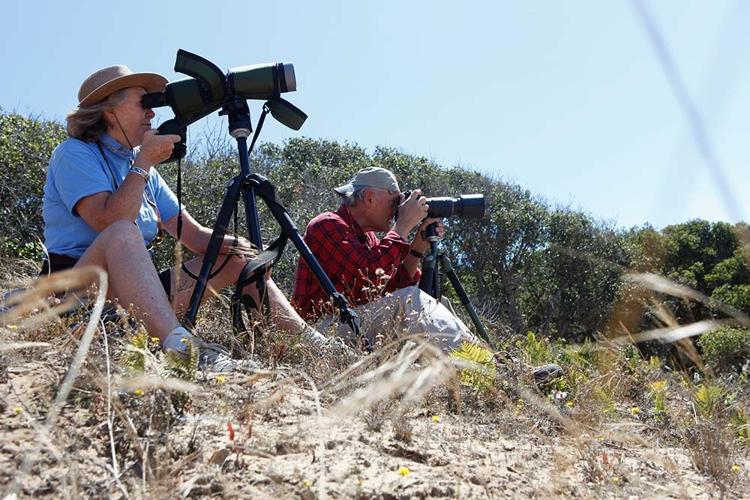
These scenes are memorable, but observing coyotes is mostly an exercise in staying still. The first winter, sitting still for hours on snowy hillsides, was so cold that the Attells decided to join Crabtree only in the summer. For 15 years, they’d set out into Yellowstone before sun-up with backpacks of PB&J and warm jackets, and sit still until nightfall, scanning the landscape with binoculars.
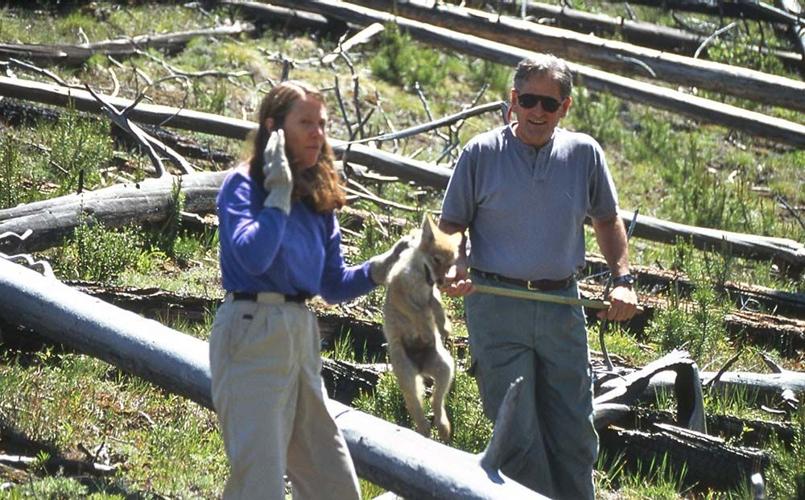
The research team’s protocols applied to pups about six weeks old, when they get curious and strong enough to venture out of their dens while moms are off hunting. That’s when Crabtree’s team of grad students and volunteers could swoop in. Once someone spotted a pup, he or she would radio the team. They’d all rush in carrying brooms, then gently sweep the pups into their arms before they could scamper off.
Then they’d work fast – losing a few degrees of body heat can be enough to kill a fragile baby coyote. While one person would hold a tiny pup, the size of a chihuahua, between two hot water bottles, someone else would draw blood and implant a GPS tracking device in its belly.
That allowed Crabtree to watch their population over the years, starting in 1995 when wolves were reintroduced to Yellowstone.
“There’s no question that the coyote population increased when the wolf population was killed off,” Crabtree says. “Now that wolves are back, the coyote population is going down.”
That’s not necessarily bad news. It’s part of an ecological resetting that happened thanks to wolves coming back.
“Now we’ve got all the original species that were there pre-Columbus, and the park’s a lot healthier. There are fewer coyotes, because that’s the way it was. The system is more balanced,” Crabtree says.
His research effort itself has grown dramatically: His science on a shoestring evolved into the Yellowstone Ecological Research Center, which is today conducting 27 long-term research projects. The nonprofit has raised more than $8 million.
That research and his center might not exist without volunteer work from the likes of Molly and Steve. Molly donated things like a $7,000 pulse oximeter to get a quick reading from a coyote’s tongue or ear, one example of the perspective she’s brought as a citizen scientist.
“She made me more competent because she’s an RN and has been in thousands of surgeries saving lives,” Crabtree says. “What you don’t want to do as a wildlife biologist is kill the animal you’re studying.”
The Attells donated an old TV to Crabtree’s interns, who worked long days and lived in a trailer. “At the right time and the right place, a gift is worth $2,000 instead of $200,” Crabtree says. They also give what they can along the way, most recently leaving behind $1,000 worth of gear in Ethiopia, where crew members had no sleeping bags or tents.
As citizen scientists, they’ve donated time and goods, but also by putting two additional sets of eyes on fragile populations. That helps gather more data, which goes directly to policymakers.
“Molly’s very determined,” Mullally says. “She’s just a dedicated person. I call her my Viking girl, with her red hair.”
Now 64, Attell’s hair has gone gray, but she’s no less devoted to wild canid study. The licence plate of Molly’s hybrid Ford c-max evokes a female fox: “GRAYVXN.”
Molly insists trekking into remote and dangerous places to spend hours tracking predators is totally normal.
“People say they’d never in a million years pay to do something like this, but I’m amazed not everyone would want to,” she says. “It makes you feel alive when you push yourself to go to strange places.”

After 15 consecutive summers volunteering on coyote research in Yellowstone, Molly says, “I always liked to be the one to cuddle the pups between two hot water bottles.”
Just last month, a San Francisco dad posted a YouTube video of a close encounter with a coyote, beginning moments after he said it tried to snatch his 7-year-old daughter off her scooter in the Richmond. The video’s since been taken down, but shows the coyote looking directly at him as he curses – repeatedly – at the animal, which is slow to retreat.
While experts overwhelmingly agree our fear of coyotes is inflated – you’re much more likely to get bitten by a neighborhood dog – it does have some basis in reality. A 2013 paper by a University of California researcher reports that coyote attacks are going up as cities expand and wild-urban interfaces get closer to homes and playgrounds; adaptable animals like coyotes are increasingly likely to end up in neighborhoods.
And as Molly acknowledges, “True carnivores do kill for a living.”
But respect and fear are different things. In this case, the fear of coyotes – and all predators – does nature and reality a disservice, says Mike Sutton, who lives in Carmel Valley, and is president of the California Fish and Game Commission. (He also know the Attells and Crabtree personally.)
“We have a history of basically a war on predators globally,” Sutton says.
Top-of-the-food-chain species help keep some species in balance, and help protect others – even plants – by eating their predators. The whole ecosystem – even the structure of riverbanks, which are often held together by roots – depends on predators.
Fortunately, Sutton continues, “We are moving into a new era of respect for predators.” On Aug. 6 the Fish and Game Commission voted to ban wildlife killing contests in which prizes are awarded to whomever kills the highest number of animals. More than 13,000 members of the public commented in support of the ban. (The commission is set to codify the decision on Oct. 8.)
While that’s progress, coyotes still receive little protection. It’s long been illegal to hunt wolves or mountain lions in California, and there are limits on deer and elk, but canids like coyotes and foxes remain unregulated – literal fair game.
“[Wild canids] keep nature in check and in balance,” Molly says. “They’re valuable. I think what we need to teach people is that all things have value. If we can coexist with them, why not?”
On a recent walk at Fort Ord, the Attells barely even glance toward Monterey Bay for an ocean view. They’re far more interested in scat on the trail.
They set up efficiently in a grassy, open meadow, each unpacking a tripod and gear from a backpack. Molly clips on a professional-quality, $2,500 scope, and Steve affixes his Nikon D2X. Then, they wait. On this day, they see no animals, but Molly can’t help but ruminate on the challenges of living in the wild as a coyote: “I think about it every day, all the perils they face.”
Steve started out photographing buildings for construction and architecture jobs, but has turned to wildlife as his subject matter. The couple is at work on a book of photography and travel writing, aimed at transforming people’s perceptions of predators. First they intend to visit and document every known wild canid habitat on the globe, which they expect to take two or three more years.
Next up: the Slovenian Alps in September, where they’re worried about getting decent wolf photos because the forest is so thick. Then next June they’ll head to the pampas of Brazil, where they’ll look for maned wolves, which resemble long-legged foxes, adapted to see over the high grasses of the region.
Just another typical retirement trip.
“Part of it is just this quest,” Molly says, “but it’s also a quest to interesting places.”
Correction: An earlier version of this story incorrectly stated Linda and David Mullally's purported Plains Indian dogs were named Plains and Lobo; their names were Shiloh and Lobo.
(0) comments
Welcome to the discussion.
Log In
Keep it Clean. Please avoid obscene, vulgar, lewd, racist or sexually-oriented language.
PLEASE TURN OFF YOUR CAPS LOCK.
Don't Threaten. Threats of harming another person will not be tolerated.
Be Truthful. Don't knowingly lie about anyone or anything.
Be Nice. No racism, sexism or any sort of -ism that is degrading to another person.
Be Proactive. Use the 'Report' link on each comment to let us know of abusive posts.
Share with Us. We'd love to hear eyewitness accounts, the history behind an article.