



Hanging on the wall of the lobby inside the Monterey Regional Fire District office is a large canvas photograph of an ominous wildfire glowing in the distance, entitled “A Rumor of War.” It was taken by the department’s board president, Warren “Pete” Poitras, at 10:45am, July 23, 2016, day two of the Soberanes Fire.
Just on the other side of that wall where the dramatic photo hangs is the office of Monterey Regional Fire Chief Michael Urquides. His office is in effect a war room, where he prepares himself for future battles.
Inside Urquides’ war room is a round table, about four feet in diameter, covered with several neat stacks of documents. They aren’t about battling the next wildfire. They are related to one thing: a request for proposals – RFP in government lingo – from the Monterey County Emergency Medical Services Agency for a new private ambulance contract to replace the current contract with American Medical Response-West that expires on Jan. 31, 2020.

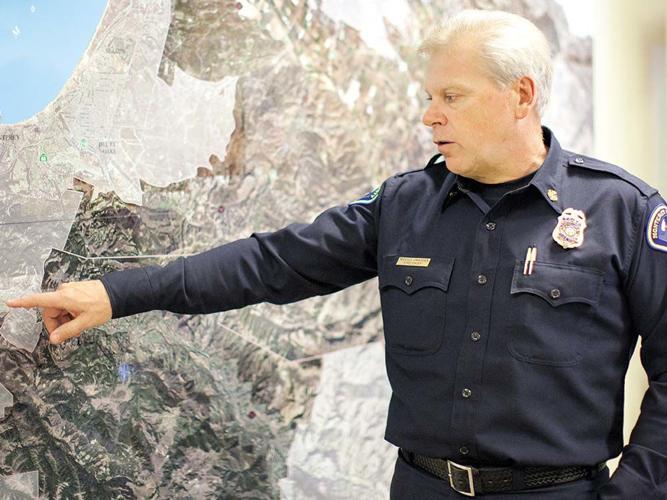
Monterey Regional Fire District Chief Michael Urquides says proposed response zones would have prevented his district’s ambulances from responding to calls in AMR’s neighboring jurisdiction, even in cases where his ambulances were closer.
Urquides has studied these dozens of documents as carefully as any general studies intelligence reports. His battle: to stop the RFP from moving forward. From the moment it was made public in January, Urquides and the Monterey Regional Fire District board, along with the Monterey County Fire Chiefs Association and local firefighter and paramedic union members became alarmed. The RFP didn’t just represent a new ambulance contract, it represented changes to the way emergency medical services are delivered to the county’s residents and visitors.
Six miles from the fire district headquarters is the office of EMS Bureau Chief Michael Petrie, inside the Monterey County Government Center on Schilling Place in Salinas. Petrie, who started as a paramedic, has his own set of intelligence documents containing research on best practices and the future of emergency medical services in the U.S. To him, the research underscores that Monterey County’s emergency medical system is antiquated and needs to be updated.
Petrie is convinced that the tradition of “red lights and siren” responses for most calls needs to end. Not every medical call needs firefighters in a big engine and paramedics in an ambulance to show up, according to some researchers. All that personnel plus wear and tear on vehicles adds to cost, and can lead to accidents en route. In some cases, insurance might not cover an ambulance ride, leaving a patient with expensive bills. Petrie’s vision of the future includes an approach where patients with less pressing needs get a referral to a doctor, or maybe an Uber ride to a nearby clinic.
That sort of talk makes firefighters and paramedics uneasy. Fewer medical calls and a need for less paramedics in favor of emergency medical technicians could mean future layoffs. Ambulance providers, who could experience a loss in revenue, are all nervous.
Urquides and other chiefs flagged a few changes in the RFP that could affect patient services: potential delays in ambulances getting to certain regions, particularly in rural areas; and a staffing transition for ambulances. For example, the RFP allowed some ambulances to be staffed with emergency medical technicians only, instead of one EMT and one paramedic, which requires 1,200 hours of training or more, compared to 120-150 hours for an EMT.
It’s not unusual for ambulance contracts in the state to become political battles over such issues, and Monterey County is no different.
On May 21, the RFP did stop – but not because the chiefs were asking county officials to stop it. After only one bidder came forward on May 10 – Monterey County’s current ambulance provider, AMR – county officials announced the bid was too costly and rejected it.
As of the Weekly’s deadline, the bidding process has not yet resumed, even with an end date for the existing contract just six months away.
In the meantime, the battle over the future of Monterey County’s emergency response system continues, and not just locally. There is a larger battle being fought at the state level for control of who gets to decide the regulations contained within the emergency medical system, as well as who gets to provide ambulance services – and collect the revenue that goes along with those services.
“You have an awful lot of calls that really aren’t emergencies.”
The EMS Agency, in the now-defunct RFP, states that its “first responsibility and primary loyalty is to the people of Monterey County and the next patient of the Monterey County EMS System.”
Exactly what happens when a 911 call is made by or on behalf of that next patient is at stake.
WHEN SOMEONE DIALS 911 ANYWHERE IN MONTEREY County, who picks up the phone and what happens next depends on a few variables.
Most police, fire and medical calls – both landline and mobile – go to the county’s communication center in Salinas. Some calls go directly to the California Highway Patrol.
If it’s a medical call, both an EMS dispatcher and the relevant fire departments are contacted. The EMS dispatcher will ask the caller a series of questions to determine if an ambulance is needed.
The center handles an average of 50,000 emergency and non-emergency calls a month. (Cal Fire, which serves Pebble Beach, Carmel Highlands and other areas, has its own communications center. Some medical calls go through there because its fire trucks are staffed with both firefighters and paramedics.)
Which agency’s ambulance is dispatched (see sidebar, p. 28) depends on the location of the medical emergency.It’s a bit of a patchwork – the county’s 2017 report by Missouri-based consultant Fitch and Associates described the system as fragmented and not using best practices.
The patchwork is partially because of the county’s diverse geographical 3,300-square-mile region, but it’s also a result of how EMS evolved in Monterey County. For decades, the county was served by various small ambulance companies, as well as agencies that had their own ambulances, like Monterey Regional Fire. Most of the county was not covered by paramedic-operated ambulances. In 1988, the Monterey County Board of Supervisors voted to create an exclusive operating area for a single ambulance company. Carmel and Carmel Valley wanted no part of it, preferring to stick with their own ambulance crews. A lawsuit ensued, and a court ruled those areas could be grandfathered in as separate areas.
The Board of Supervisors also asked the voters in 1989 to approve County Service Area 74, a benefit assessment district that collected a $12 yearly fee from property owners to finance a paramedic EMS system. Voters said yes. In 2000, the board went back to the voters to replace the assessment with the Paramedic Emergency Medical Services Special Tax and Supplemental Paramedic Emergency Medical Services Special Tax. Voters again said yes, and to this day, the county collects $12 a year from homeowners.
That money goes to support the county’s EMS system. Currently, every ambulance in Monterey County is staffed by an EMT and a paramedic. In the now-defunct RFP, the county was looking at a different model – one that would require some ambulances staffed by EMTs only.
The fire chiefs looked at that change and claimed it was better for patients to get more highly trained paramedics, and also that the change was illegal: Voters approved the $12-a-year tax on the basis that it would go toward funding paramedics, Urquides said, and if the county moved forward with the RFP as written, Monterey Regional Fire would sue.

Monterey County EMS Bureau Chief Michael Petrie says his agency is “under immense political pressure to do what stakeholders want us to do, which in many instances is not in the best interest of the public.”
WHEN THE COUNTY HIRED FITCH AND ASSOCIATES TO CRAFT THE NEW RFP, it was a chance to reframe how Monterey County handles its emergency response system. Petrie envisioned an opportunity to modernize the system, increase safety and save costs.
“Many ambulance calls are not what you would think they are,” he says. “When I was a paramedic, I had a call one night at 2am for a guy who stubbed his toe and it wouldn’t stop bleeding. So we go out, red lights and sirens, to that.
“You have an awful lot of calls that really aren’t emergencies.”
Ahead of a new ambulance contract, the EMS Agency is adopting new communications protocols on Sept. 1. Petrie foresees the protocols as a way to reduce the number of Code 3, or red-lights-and-sirens calls, and increase alternatives like referrals to nurse advice lines, local clinics or even medically-based rideshares.
The new protocols got considerable pushback from fire chiefs. They’ve complained openly that Petrie is overstepping his authority to make the changes. One argument against reducing Code 3 calls is that sometimes what gets called in as an injured toe turns out to be more serious.
In January, when the RFP was released, it became a lightning rod for a deeper debate about how to best run an emergency response system. Fire chiefs, Monterey Regional and AMR all took issue with a number of proposed changes.
Critics said the RFP would limit how AMR uses “peripheral providers” like Monterey Regional Fire and Carmel Ambulance. In a written response to the RFP, AMR estimated it would have to add one to two more ambulances to provide coverage to Carmel Valley and Carmel at a cost of more than $770,000 a year. (The county responded that the agencies in those areas receive significantly more revenue than that amount.)
Monterey Regional charges AMR $1,000 for every call it takes on the company’s behalf. The district’s 2017-2018 financial audit statement lists $828,423 in ambulance revenue alone, up from $781,181 the year before. That’s about 3.5 percent of its total revenue.
Petrie contends the chiefs’ real worry is that districts like Monterey Regional Fire will lose revenue because their ambulance units sometime cover calls outside of their service area.
Urquides counters, “We do not build our budgets using revenue generated outside of our district.” He says one of the main problems with the RFP is that it eliminates most automatic calls, in which a computer automtically assigns the nearest ambulance regardless of jurisdiction, and would require the county’s ambulance provider to station units all over the county, regardless of call volume – meaning higher costs.
AMR Regional Director Michael Esslinger agrees. “The proposed RFP would have nearly tripled patient fees and done little to improve patient outcomes,” Esslinger writes by email. “If implemented as written, Monterey County would have the most expensive ambulance fees in the nation.”
Critics have sounded the alarm over cost, and also response times. Current required response times are eight minutes for high-priority calls in urban areas, and up to 16 minutes for rural.
Under the RFP, the ambulance provider would have been required to place ambulances in lower-volume call areas – Petrie says to create a more equitable system for all residents, including in remote rural communities – and while some response times would get faster, the chiefs contend others would get slower. That shift would also raise the ambulance provider’s costs, because the lower-volume areas bring in fewer calls and less revenue.
AMR officials also took issue with a change that would require employees to work no more than 12 hours per shift.
“In highly populated areas this makes sense, but in areas that have lower call demand, like much of Monterey County, it only serves to increase costs by requiring more staff, and more vehicles and equipment,” Esslinger says.
Currently, staff can work 12-hour shifts, followed by 12 hours on standby. That’s an arrangement employees prefer, since it means less commuting. It also helps with the chronic shortage of paramedics.
Another complaint by AMR was that proposed fines for not meeting set standards were too high and unsustainable. New response zones in the RFP could have resulted in ambulances not reaching calls within the standard, resulting in fines that would then be passed on to patients. Ben Hitchcock, an AMR paramedic and president of the International Association of Firefighters Local 186, says his union estimated the fines could cost an ambulance provider up to $500,000 a month.
“There is no room to be experimental in this county.”
“I can’t push the fines enough,” he says. “I understand the provider needs to be held to a higher standard, but the increased level of fines and the new fines they’ve proposed make it hard for anyone to bid. I was in contact with a number of providers that were interested in coming in, but they did not want to because the fines were too restrictive.”
Petrie disagrees that the fines proposed were too high: “There has to be some way to sanction poor performance.”
Hitchcock was one of 63 people who the consultants interviewed in 2017 asking about the county’s current EMS system and what should go into the next RFP – plus hearing from 30-40 more members of the public at town hall meetings – but the two things he wanted to see most of all didn’t make it: workforce and pay protections. He calls his interview with Fitch and Associates “very superficial.”
Petrie, on the other hand, is proud of the public input process. “We believe we have given people extensive opportunities to give input,” he says. But when the RFP came out, critics were disappointed.
“When it came to the final product, they didn’t seem to listen to anybody,” Hitchcock says.

Ben Hitchcock, an AMR paramedic and president of IAF Local 186, worried that the now-defunct RFP would have meant coverage gaps due to requirements like increased training that some employees would not have been able to complete in time.
FITCH AND ASSOCIATES WAS DECLARED A “HOSTILE ORGANIZATION” by the 74th Annual Convention of the Florida Professional Firefighters in 2018, after the consultants recommended reducing staffing levels at the Orlando Fire Department in 2016. Other fire unions have made similar pronouncements.
That the EMS Agency hired Fitch added to firefighter’s lack of trust. (Tensions go back further: A 2013 consultant’s report noted relations between the EMS Agency, fire chiefs and AMR were strained even then.)
In some ways, Petrie can’t win. Last year he and former EMS medical director James Stubblefield investigated Salinas firefighters for allegedly falsifying training certificates. Petrie said he’s required to report potential violations. Salinas Firefighters Local 1270 President Josh Hostetter announced the union considered the investigation a “political attack.”
Several months later, Petrie and Stubblefield conducted a similar investigation into county paramedics and reported their findings to the state EMS Authority. The state’s investigation confirmed to Petrie on Feb. 21 that there had been falsified documents and stated that it took disciplinary action against three paramedic supervisors.
With relations already icy, the stage was set in January for a battle over the RFP. Chiefs and others complained that they and the public had been shut out, due to confidentiality rules that govern a competitive bidding process. A public relations battle began, with letters to the editor and op-eds in local papers.
“I recommend the Board of Supervisors reject the EMS Agency’s current recommendation and order a complete redesign process which engages all local stakeholders,” former Monterey County director of health Len Foster wrote in the Monterey Herald on May 8. He called the RFP “seriously flawed.”
The EMS Agency ran ads, including in the Weekly, that contended the new ambulance contract “will deploy ambulances in a more equitable manner throughout the county… provide you with a higher level of emergency medical services… provide the right resources at the right time, for the lowest reasonable cost.”
“There is a logic and a rationale for everything we put in [the RFP],” Petrie says. “This is not for 2019, it’s for 2020-2030. EMS then will look nothing like it does today.”
THE AMBULANCE CONTRACT IS JUST ONE SKIRMISH in a larger power struggle playing out statewide. EMS authorities and firefighter unions are battling over who is in charge – and who should be. Is it the fire chiefs? Private ambulance companies? Or government bureaucrats?
“Part of the context is that statewide, fire is trying to take over EMS,” Petrie says. He points to proposed state legislation backed by firefighter unions that would wrest control from EMS agencies in favor of fire departments.
On March 22, the Monterey County Emergency Medical Care Committee – an advisory group made up of fire chiefs, city officials, healthcare officials and citizens – voted to ask the Board of Supervisors to stop the RFP process, specifically naming concern over response times and the amount of public input.
Petrie struck back with a letter on March 26 to the California Emergency Medical Services Authority, alleging that the committee was attempting to subvert the competitive bidding process. He also suggested they’d broken laws against influencing the process, and reported the possible violations to the California Attorney General’s Office. Petrie reasoned that since the committee is made up of representatives from the stakeholders who will win or lose based on the RFP’s outcome – fire departments, paramedics, AMR and others – they had a conflict of interest.
The California Emergency Medical Services Authority wrote back on April 11, telling Petrie that if the county’s EMS Agency deems the process has been “negatively influenced by political special interests, it may unilaterally cancel the bid process.” The county declined to cancel.
Then on June 7, the local battle went statewide. The California Fire Chiefs Association, known as CalChiefs, filed a lawsuit in Sacramento County Superior Court asking a judge to issue an injunction to stop the California EMS Authority from issuing opinions to local EMS agencies like the one it gave to Petrie in that April 11 letter. A copy of that letter and Petrie’s letter were attached to the lawsuit as evidence of alleged violations.
CalChiefs’ main complaint is that local agencies are overstepping their authority regarding changes to EMS systems and ambulance contracts, contrary to California law and past court decisions.
On April 4, the state EMS Authority told the state’s Office of Administrative Law it would stop enforcing or issuing opinions on the contested regulations. And yet, on April 11, it issued a ruling in the letter to Petrie, so CalChiefs sued. A hearing date has not yet been scheduled.
WHAT HAPPENS ON FEB. 1, 2020, the day the county is supposed to officially enter into a new ambulance contract, is up in the air at this point.
It’s likely that the CalChiefs suit will stop the state EMS Authority from prohibiting ambulance contract extensions beyond 10 years. If the state did enforce its policy of no extensions, that would leave Monterey County open to any companies to rush in and fill the void. Hitchcock says if that happens, it will be “chaos.”
Urquides says fire chiefs are asking the county to extend AMR’s current contract for at least a year while the court case is sorted out. They’ve been assured verbally by county officials that whenever the new RFP process starts, fire officials will be given more input.
AMR’s Esslinger says in order for the next RFP to be successful, the EMS Agency is going to have to be more realistic about what changes to add and how much they will cost.
“There is no room to be experimental in this county, especially given the fact that the county already has an excellent, high-performing EMS system,” he says.
In the meantime, the struggle between Petrie and the rest of the EMS community continues. And the public is left in the middle, waiting for service.
Billing Center
Today, there are four agencies that provide ambulance services within Monterey County: AMR, under contract with county EMS to operate within the exclusive operating area; Monterey Regional Fire, serving portions of Carmel Valley; Carmel-by-the-Sea Ambulance; and Fort Hunter Liggett Fire Department, which serves the South County military base exclusively.
AMR receives a $100,000-a-year subsidy from the county to reimburse it for using other departments for calls, mainly Monterey Regional Fire, and Cambria Hospital District and San Luis Ambulance, both located in San Luis Obispo County. The subsidy also helps pay for the cost of county radio system infrastructure and maintenance of equipment and vehicles.
The ambulance provider makes money through billing insurance companies and patients. The average cost of an AMR ambulance ride in Monterey County is about $3,400.
The company reported a loss of $43,000 last year in Monterey County. In 2014, AMR reported a profit of $2.1 million.
The contract includes the Monterey County Fee Forgiveness Program, where patients can apply to AMR for either a “compassionate care” write-off or other discounts.
(0) comments
Welcome to the discussion.
Log In
Keep it Clean. Please avoid obscene, vulgar, lewd, racist or sexually-oriented language.
PLEASE TURN OFF YOUR CAPS LOCK.
Don't Threaten. Threats of harming another person will not be tolerated.
Be Truthful. Don't knowingly lie about anyone or anything.
Be Nice. No racism, sexism or any sort of -ism that is degrading to another person.
Be Proactive. Use the 'Report' link on each comment to let us know of abusive posts.
Share with Us. We'd love to hear eyewitness accounts, the history behind an article.