
It has been 30 years since The Vagina Monologues first asked audiences to say the word out loud.
Eve Ensler, who now goes by V, wrote the play and premiered it off-Broadway in 1996. It won an Obie the following year, and in 2001 a star-studded benefit performance sold out New York’s Madison Square Garden. Since then the play has become part of the global canon, performed everywhere from celebrity-packed charity galas to countless modest college productions. CSU Monterey Bay staged its most recent version in 2018.
“This spawned over a dinner, a meeting of the minds of a few fabulous, brilliant women of the arts in this area,” says producer Justine Stock, who is leading the project on behalf of New Canon Theatre, event co-host and beneficiary. “We were like, ‘Where’s The Vagina Monologues?’ It hasn’t been done here in quite some time. And it’s such an empowering piece.”
The idea came from Kathryn Smith, a Carmel resident and longtime supporter of local arts and culture. She will direct the one-night-only community reading on Thursday, Nov. 12, which is already sold out.
“I told Justine she should get women from Monterey County of different backgrounds – not actresses – and do The Vagina Monologues,” Smith says. “She just ran with it.”
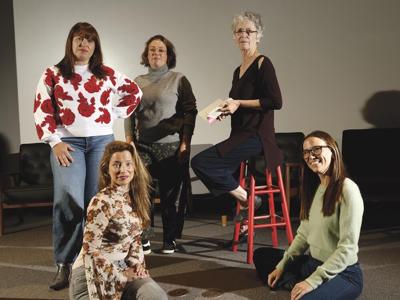
The resulting cast is a cross-section of local life. It includes Grammy Award-winning pianist and Monterey County resident Tammy Hall, Jacquie Atchison of the Arts Council for Monterey County and local trans actress Rachael Artemis Holder (V expanded the play in 2004 with a monologue drawn from interviews with transgender women). Alexa Dieterle and Kelsey Woods round out the ensemble, and Mireya Pamatz is stage manager.
For Stock, assembling that group has been the highlight.
“The most fun part is getting to work with these goddesses, just these incredible movers and shakers,” she says. “I wanted women of the arts, women of the community. I called them and they answered the call. People that are really busy – Tammy Hall, pianist, composer, activist – said yes immediately. It is unreal.”
Stock has a personal history with the play. She was in the audience off-Broadway when V first performed it.
“It was a revelation,” Stock says. “We walked out of there like it was a battle cry. There wasn’t a dry eye in the house. These pieces are intergenerational and international.”
Nicola Shangrow Reilly, who will read the narrator parts, first encountered the play on her college campus at age 19. “I remember walking away, feeling proud and contemplative,” she says. “I was happy the show existed.”
That mix of pride and recognition is a large part of why the play has endured. V built it from interviews with real women. By her own account, she was curious about her own body and about women’s experiences more broadly, so she started asking questions. The answers became a series of monologues recording stories many women recognize as their own: girls getting their first period with no idea what is happening to them, abuse both large and small that goes unnamed, and above all the shame attached to whatever role their bodies played in a given story.
Not all of it is heavy. Much of the play is funny, and its swings between laughter and grief are part of its power.
Stock will read the part of an older Jewish woman who recalls a humiliating encounter with a man that shut her off from her own body for good. “It’s a very sad story because after that she got cancer, her reproductive parts were removed, and she never had a chance to explore herself this way – but it has great humor,” Stock says. “It will make you laugh and cry.”
Because the performance is a reading, there are no characters in the traditional sense. Still, Smith says the performers will wear minimal costumes built around bright, colorful women’s clothing. She also plans to project artwork by the late Carmel artist Robin Sawyer and to play music by Rhiannon Giddens.
Smith is struck by how current the material still feels.
“It’s hard to believe that 30 years later it’s still so relevant,” she says. “It seems that we took a step forward and then two steps back. We still need to fight for control over our bodies.”
She stresses the importance of women continuing to take control of their own narrative and paying close attention to how they are portrayed.
Stock sees another reason the revival matters.
“So many people still haven’t seen this,” she says. “You’re talking about my daughter’s generation. So that’s the 16-, 17-, 18-year-olds who have not seen this.”
The play has always been tied to activism. Its success gave rise to V-Day, a global movement to end violence against women and girls that has long encouraged community productions raising money for local causes. The Monterey reading follows in that spirit.
Alongside New Canon Theatre, the project’s partners include Set Free Monterey Bay, a nonprofit working to combat human trafficking in the region, a problem Stock says she recently learned is much larger locally than she had realized.
For the women taking the stage on Nov. 12, the evening is less about revisiting a 30-year-old play than about continuing a conversation that is far from finished.
THE VAGINA MONOLOGUES is performed at 7pm Thursday, Nov. 12. The Stanton Center, 5 Custom House Plaza, Monterey. $45; sold out. newcanontheatre.org.
(0) comments
Welcome to the discussion.
Log In
Keep it Clean. Please avoid obscene, vulgar, lewd, racist or sexually-oriented language.
PLEASE TURN OFF YOUR CAPS LOCK.
Don't Threaten. Threats of harming another person will not be tolerated.
Be Truthful. Don't knowingly lie about anyone or anything.
Be Nice. No racism, sexism or any sort of -ism that is degrading to another person.
Be Proactive. Use the 'Report' link on each comment to let us know of abusive posts.
Share with Us. We'd love to hear eyewitness accounts, the history behind an article.