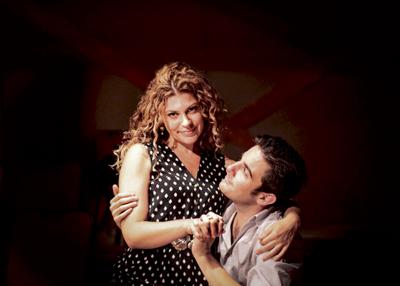
Centuries before Robin Thicke and Miley Cyrus were doing things on stage that even sexually liberated MTV fans struggled to find the words to describe, Don Juan had mastered the art of seduction – or sexual assault, depending on how you look at it.
The legendary seducer first appeared around 1630 in Spain as The Trickster of Seville, then as Don Juan in Moliere’s take about 50 years later, and perhaps most famously in Mozart’s 1787 opera.
Since then, the cultural norms that might’ve made Don Juan (or Giovanni in Mozart’s Italian version) charming in one era have given way to those that make him sleazy in another. That evolution is exactly what Hidden Valley’s production of Don Giovanni aims to capture, director and designer Robert Darling says.
“Our attitudes toward men who abuse women have changed somewhat since this opera was written, and we’re trying to acknowledge that,” Darling says. “I don’t think we could do the play as if we are in the 18th century.”
If, like me, you’ve snoozed through musicals in the past, the decision to make this opera feel, well, less like opera, sounds like a remarkably good idea.
Darling directs a contemporary take on Mozart’s famous opera, mostly in English, using the translation by poet W.H. Auden. The text is unchanged, but there’s still room for the actors (with the help of modern costumes) to make the text into something that feels like the present. It’s through the acting – the subtle art of their posture, expressions and stage presence, that creates a contemporary vibe.
Giovanni, in this version, could be a 1-Percenter from Pebble Beach, whose conquests include Zerlina, whose peasant role is interpreted here as that of a migrant farm worker.
Much of what sets the opera in 2013, rather than another century, is more subtle and artful. It’s a meticulous set of musical calculations by Darling and Conductor Stewart Robinson, transforming opera from archaic to contemporary.
To execute that, Robertson is picking up the tempo of certain passages, to make some conversations feel more like speech and less like song. “When you sing text, you essentially slow it down, and you lose the immediacy and literal context,” he says.
For Robertson, this dusting off actually means a return to the musical past, making Don Giovanni sound more like he thinks it did in Mozart’s day. With a pared-down score for just eight musicians (this is the first American production using this orchestration), there’s a speedy, brighter sound than a full orchestra could give.
“The trend is to try and return to that quicksilver, lighter approach,” Robertson says. “In returning to the way things were done in the late 1800s, we get something much more vital and natural.”
“OUR ATTITUDES TOWARD MEN WHO ABUSE WOMEN HAVE CHANGED SOMEWHAT SINCE THIS OPERA WAS WRITTEN.”
While Mozart wrote the original score for 40 to 50 players – “We can’t fit that into Hidden Valley Theater,” Robertson says – his own premiere included only seven violins. That’s an ensemble many critics today would raise an eyebrow at, but Robertson is nodding here to Mozart himself, deviating from Mozart’s script just as the composer himself did.
There’s also the English lyrics, which make it easier for audiences to follow, and also for actors to communicate. “It’s nice to be able to sing to each other in our native tongue,” says Nora Graham-Smith, who plays Zerlina. “There is something very real and organic in this production, that translates much easier to today’s society.” Both Graham-Smith and Gregory Gerbrandt, who plays Giovanni, have a formidable vibrato, but there’s a sultry, smoky quality to Graham-Smith’s that makes it sound like she could retool into a jazz singer.
Like Shakespeare plays, which can feel dry today but were funny and accessible to audiences in the bard’s day, Don Giovanni and other operas were entertainment for mixed company in their time, not just a sophisticated night out that might offer little of substance to relate to.
Opera productions for the past half-century or so have been dominated by what Darling calls “braindead opera.”
“Arms were waved, scenery was changed, things were done,” he says. “It was how beautifully you produced the tone and did the violins play in tune.
“What I am hoping with this production,” he adds, “is that we also engage the mind.”
And engage it does. Darling’s asking no smaller questions that those about morality, gender relations, sexual violence and interpersonal accountability. He’s not sure whether Don Giovanni has any code of ethics at all, but it’s up to the audience – not God, as would’ve been expected in early productions of the play – to decide. As Darling puts it, “Does he pay by being a social outcast, with his soul, or does he pay at all?”
DON GIOVANNI runs 7:30pm Sept. 12, 14, 19 and 20, and 2:30pm Sept. 15 and 22. Dinners follow with the cast on Sept. 12, 15 and 22. Hidden Valley, 88 Carmel Valley Road, Carmel Valley. $50/general admission; $35/17 and under; $30/dinner. 659-3115, www.hiddenvalleymusic.org
(0) comments
Welcome to the discussion.
Log In
Keep it Clean. Please avoid obscene, vulgar, lewd, racist or sexually-oriented language.
PLEASE TURN OFF YOUR CAPS LOCK.
Don't Threaten. Threats of harming another person will not be tolerated.
Be Truthful. Don't knowingly lie about anyone or anything.
Be Nice. No racism, sexism or any sort of -ism that is degrading to another person.
Be Proactive. Use the 'Report' link on each comment to let us know of abusive posts.
Share with Us. We'd love to hear eyewitness accounts, the history behind an article.