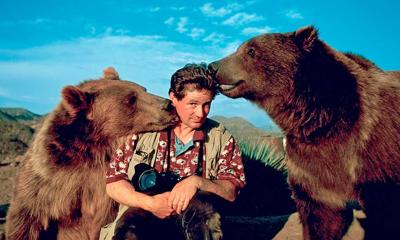

As a 20-year stringer for National Geographic, photographer Joel Sartore has set foot on all seven continents, capturing images of places and animals that most people only see from the seat of an armchair.
Sounds like a dream job, but it does occasionally require having to run for one’s life.
“I’ve been charged by muskox, polar bears, grizzly bears and wolves. It’s nerve-wracking, because if you don’t get back into your car in time, you get eaten,” Sartore says. “It’s a very primal experience. It’s makes you realize we’re not the top dog everywhere we go.”
Megafauna aren’t the only occupational hazards: While at work in the Amazon, Sartore was bitten by a sandfly and infected with leishmeniasis, a severe parasitic disease that put a 50-cent-sized hole in his leg and laid him up for months.
On another assignment in the North Slope of Alaska, Sartore struck upon the idea to remove his shoes and socks for 20 minutes to capture the teeming essence of the region’s mosquito population, and aside from the stunning images he produced – in which the better parts of both feet were blanketed with blood-suckers – it did not go well.
“Some of them filled up and then came back and brought their friends,” he says. “My feet itched bad, so bad, for days.”
The Midwestern native and National Geographic fellow comes to Golden State Theatre this May 28 as the first “explorer” in this year’s National Geographic Live speaker series, and while his presentation will include humorous retellings of his many near-death experiences and years of working for Nat Geo, much of the talk will center around his greatest passion: trying to save the world’s many endangered species by taking beautiful pictures of them.
That passion is woven into a project Sartore calls Photo Ark, and it’s wildly ambitious: photograph every captive species on Earth, as well as any endangered ones he comes across in the wild. Already, he says he’s photographed 3,700 in the last nine years, and estimates he’s got about 8,000 left, a number that will take him 15 more years to complete.
“The world zoos have a great cross section of what the world looks like,” Sartore says, adding that they also help with efficiency. “It’s a lot easier. You can get a lot more done if you go to a zoo [and shoot] 100 species.”
Sartore’s efforts already seem to be paying off. In 2012, while hiking with a biologist in a central Florida prairie, Sartore had the chance to photograph an endangered Florida grasshopper sparrow.
A year later, Audobon Magazine ran Sartore’s picture of the bird on its cover, prompting the U.S. Fish and Wildlife Service to pledge $1.3 million to fight its extinction. “They were really motivated by the coverage in Photo Ark,” Sartore says. “I was very excited to hear that.”
At its most successful, Photo Ark gets people to think beyond the iconic species that typically sell magazines. Often times, that means thinking smaller.
“There’s far more of the little species than anything else,” he says. “They drive ecosystems and keep the planet healthy.”
It’s a planet that’s becoming increasingly less healthy, where new extinctions are occurring at a rapid pace, a reality that gives Sartore an added sense of urgency.
“As endangered species fall, so do we,” Sartore says, adding that he was alarmed by what he saw on a recent trip to Vietnam.
“They have 90 million people in a very small country, and they’ve consumed most of their wildlife,” Sartore says. “They’re eating everything up.”
By Sartore’s estimation, extinctions are less the result of people not caring, and more about them not knowing.
“Most people care about the megafauna,” he says, “but I think if people even knew about [smaller] endangered species, they’d care a lot more.”
And making us care more is the heart of Sartore’s mission.
“I just want to do something with my time on earth, in the hopes that it will slow the extinction.”
NATIONAL GEOGRAPHIC LIVE happens 7pm Wednesday, May 28, at the Golden State Theatre, 417 Alvarado St., Monterey. $47. 649-1070, www.goldenstatetheatre.com
(0) comments
Welcome to the discussion.
Log In
Keep it Clean. Please avoid obscene, vulgar, lewd, racist or sexually-oriented language.
PLEASE TURN OFF YOUR CAPS LOCK.
Don't Threaten. Threats of harming another person will not be tolerated.
Be Truthful. Don't knowingly lie about anyone or anything.
Be Nice. No racism, sexism or any sort of -ism that is degrading to another person.
Be Proactive. Use the 'Report' link on each comment to let us know of abusive posts.
Share with Us. We'd love to hear eyewitness accounts, the history behind an article.