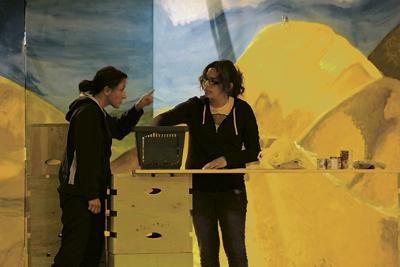

Last Saturday evening, as the traffic and energy of weekend nightlife swelled in the East Salinas neighborhood of the Alisal, about 30 people were ensconced in the anonymous Breadbox building, home of the Alisal Center for the Fine Arts. The space was dark. Overhead theater lights on rigging illuminated a stage, and people sat on bleacher-style seats, watching the stage or looking at laptops. Others were practicing lines.
The occasion for this gathering was a tech rehearsal for a play from L.A.’s Cornerstone Theater Company called Plumas Negras (Black Feathers), about the neighborhood outside the Breadbox doors – the Alisal. The play runs this Thursday-Saturday only.
Cornerstone was founded 27 years ago by Harvard graduates Bill Rauch and Alison Carey as a blend of theater, activism and community. Its ethic, then and now, has been to live in and work with different communities to explore the issues and stories found in them.
Their first performance was an adaptation of Shakespeare, Marmarth Hamlet, in Marmarth, N.D., population 190. In 1992 they moved to Los Angeles, and the original, commissioned and adapted plays got more ambitious while staying local and collaborative.
There was the Watts Residency series of five plays. Their Faith Cycle dealt with religion over the course of four years, the plays conducted in places of worship. Their Justice Cycle, five world premiere works, looked at how laws affect communities. In 2008 they created an adjunct company, Teatro Jornalero Sin Fronteras (Day Labor Theater Without Borders), seemingly taking up the torch lit by Luis Valdez’s Teatro Campesino.
“We build stories through interviews,” says Juliette Carrillo, usually a Cornerstone director but in Salinas now as the writer of Plumas Negras.
The work began more than one year ago, when the company decided its next project should be East Salinas. (Artistic Director Michael John Garces, now 37, had worked there when he was 17.) Garces, Carrillo and others began visiting the Alisal to find the stories that would become Plumas Negras.
In addition to interviews, the company conducted “story circles” in which people from the Alisal told Carrillo stories. She wrote drafts, took them to L.A. to workshop with the company and brought rewrites back to Alisal community members to read. She took feedback from those readings back to L.A. for more polishing. “Then,” she says, “we came back here and set up camp.”
“We” are 40 members of the company (actors, tech, creative and admin people, as well as students in their Institute Summer Residency) who’ve been living in Salinas for 30 days. “Camp” is the Salinas Valley Community Church where they slept, the Vineyard Church where they ate, and the Breadbox, where they set up for their three performances.
The structure of the Spanish – and English-language play revolves around three generations – a grandmother, a mother and a daughter – who live in the Alisal. Through them and many others, different histories flow out, from the braceros’ stories in the ’60s to immigration and identity issues of today.
The local community members and organizations they’ve connected with is impressive. Salinas City Councilman Jose Castañeda is championing their work. Juan Martinez, one of the founders of Lowrider magazine, contributed the story, about the braceros, and is one of the 30 or so locals in the play.
Other contributors include ALBA (Agricultural & Land-Based Training Association), Rancho Cielo, Western Stage, Hijos del Sol, Salinas United Business Association, the Steinbeck Center, Building Healthy Communities and Baktun 12, whose members have done their own Alisal interview play project, called ReAlisal.
“[For] a lot of them,” says Cesar Ortega, Cornerstone’s community engagement and communications person, “this is their first time on the stage.”
At the Saturday tech rehearsal, two Cornerstone cast members, Page Leong and Marcenus “M.C.” Earl, rehearsed their parts in black clothes approximating crows – an allusion to the play’s name – while director Michael John Garces gave instruction. Six men dressed as fieldworkers entered from a door in the painted backdrop and sat on crates on stage. They read their lines, machismo talk in Spanish, some with scripts in their hands.
Lupita Garcia, 45, sat in the bleacher seats awaiting her cue. She was swept into the production when 30 Cornerstone members came in to her workplace, the Alisal Family Resource Center.
“They started talking to me about it,” she says. “They insisted I [audition].” She did, and got the role of Adelina, a fieldworker in 1960s Spreckels who lives in a work camp. “I’ve worked [in the Alisal] for 20 years with fieldworkers,” she says. “This play is related to my life.”
The year-long process of putting on these three performances is coming to a conclusion and is as fascinating as the play itself: the local immersion, the community involvement, the grassroots connections, the activism. As for the scope of the drama to come, director Garces says, “We’re not trying to tell the story of Alisal, but a story of Alisal.”
PLUMAS NEGRAS is performed 8pm Thursday, Friday and Saturday, at Alisal Center for the Fine Arts (The Breadbox), 745 N. Sanborn Road, Salinas. Admission is pay-what-you-can. 272-2409. Parking at Sanchez Elementary School next door.
(0) comments
Welcome to the discussion.
Log In
Keep it Clean. Please avoid obscene, vulgar, lewd, racist or sexually-oriented language.
PLEASE TURN OFF YOUR CAPS LOCK.
Don't Threaten. Threats of harming another person will not be tolerated.
Be Truthful. Don't knowingly lie about anyone or anything.
Be Nice. No racism, sexism or any sort of -ism that is degrading to another person.
Be Proactive. Use the 'Report' link on each comment to let us know of abusive posts.
Share with Us. We'd love to hear eyewitness accounts, the history behind an article.