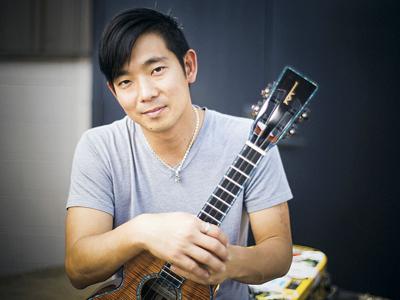

Ukulele virtuoso Jake Shimabukuro’s YouTube channel can keep you engaged for hours, easy. Whether it’s the Hawaiian native’s spot-on uke interpretation of Queen’s “Bohemian Rhapsody,” a flawless take on Bach’s Two Part Invention No. 4 In D Minor or a soul-satisfying rendition of The Beatles’ “While My Guitar Gently Weeps,” his delivery extends beyond hitting all the correct notes – it’s his ability to draw such powerful phrasing out of the minimal, four-string instrument that continues to bring him international acclaim and love from the likes of Bela Fleck, Yo-Yo Ma and Ziggy Marley.
Shimabukuro continues to challenge himself. Last January, he invited longtime touring bassist Nolan Verner and session drummer Evan Hutchings to join him in a Tennessee studio. Six days later, they resurfaced with the Nashville Sessions, the 40-year-old ukulele maestro’s debut of all-original material and the manifestation of a fresh musical perspective. Approached like a jazz album, the improvised jams, recorded live without preparation or rehearsal, are explorations into unanticipated, but welcoming, musical territory.
The result: One of the best records of 2016 and a key Shimabukuro didn’t know was already in his pocket, to a door he hadn’t unlocked. Now he’s more fired up than ever.
“I’ve already been writing because I was so inspired by this last project,” he says. “I feel like a whole new side of me is coming out. Nashville Sessions was a springboard for new ideas and I’m planning on getting back into the studio in February to go for round two.” The Weekly found him a week ahead of his Golden State Theatre appearance to explore his thoughts more deeply.
Did recording an album in Nashville have an effect on you?
There’s always been comfort in covering other people’s songs, which is why I wanted to come to Nashville. I had a desire to write and compose my own new stuff. Nashville is the home of songwriters, so I thought it would be a great place to go and write some new music.
I got to sit in with Vince Gill and The Time Jumpers. I also got to hang with Jerry Douglas, who’s one of my favorite musicians. Those kind of encounters inspired me to go into the studio. I had confidence to write and come up with new things. I just wanted to go for it and jam. I didn’t want to think about the length of the song, or needing a verse or a bridge – just doing whatever felt right.
“6/8” turned into this seven-minute song, but at the end we were just jamming and looking at each other like, “How are we going to end this?” I think I eventually stopped playing, then the bass stopped, then the drummer jumped up. We thought about fading it out, but we said, “Nah, it’s real, it’s live, it’s what happened.” That’s how we wanted the album to be: Leave everything exactly the way it was in the studio, which is why the titles are what they are. We were writing the songs so quickly that we were just coming up with temporary titles and never changed them. They’re like studio notes that we used to identify the files. One tune has a Celtic melody so we called it “Celtic Tune” and another is played in F minor so we called it “F Minor.”
Was everything recorded live?
Drums, bass and ukulele were all recorded live in the studio and we didn’t do any editing. That’s what I love about [the record]: It has that energy, like the vibe of a live performance.
I was surprised that Nashville Sessions was your first album of all originals. Why’d it take so long to release an album of all-original material?
I never really had confidence. If you cover “Hallelujah” all you have to do is play the melody and everyone knows what it is – there’s comfort in that. When it’s your own music and it’s new, it’s scary. You never know whether it’s going to work. I’ve been doing covers for a long time – which I enjoy doing – but sometimes, since I have so much respect for the composer, I want to stay true to the song even if I want to venture off into other new areas.
When I do original music, I can take stuff that I learned from other songs and bring out some of my other influences, but at the same time, you don’t have a box that you have to stay in. You’re free to go in any direction. That’s why on the new record, songs take drastic turns. That was the fun of creating original pieces on the spot. The sense of freedom was great.
What’s it been like to translate these songs to be performed live?
It was scary in the beginning. There’s a song called “Kilauea,” which is a one-take completely improvised piece. We literally just chose a key and tempo and started jamming, so when we had to perform it live, I had to learn what I played. I’d listen back and think, “How am I voicing that?” It took me a long time to figure out what I had played on certain parts. I’m so used to figuring out someone else’s song and in this case, I’m covering myself.
The beginning [of the tour] was a little rough, but now we have the songs together and we’re very comfortable.
Are there still untapped musical places you want to explore?
I’ve always played the tenor ukulele, but on this album I incorporate the baritone, soprano and standard ukulele. There’s also more electric ukulele – I didn’t shy away from using the overdrives and distortion. It gives the ukulele a different voice and more sustain on the notes.
This album opened new possibilities and I’d like to explore more of that.
(0) comments
Welcome to the discussion.
Log In
Keep it Clean. Please avoid obscene, vulgar, lewd, racist or sexually-oriented language.
PLEASE TURN OFF YOUR CAPS LOCK.
Don't Threaten. Threats of harming another person will not be tolerated.
Be Truthful. Don't knowingly lie about anyone or anything.
Be Nice. No racism, sexism or any sort of -ism that is degrading to another person.
Be Proactive. Use the 'Report' link on each comment to let us know of abusive posts.
Share with Us. We'd love to hear eyewitness accounts, the history behind an article.