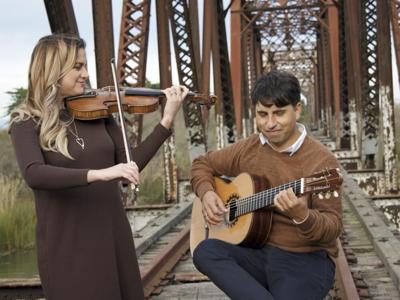

This music-for-social-change revolution started in Venezuela in 1975 and over the last 20 years, it has been adopted by various activist groups across North America. The formula is to provide willing local children with hours of after-school musical training each week – all publicly funded. By 2015, El Sistema, as the original nonprofit was called, included more than 400 music centers and 700,000 young musicians in Venezuela. In the U.S. there are over 80 El Sistema-inspired initiatives that aim to serve youth in low-income families, forgotten communities and school dropouts. That includes the local Youth Orchestra Salinas (YOSAL) where Camilo Ortiz and Amalia Diaz met.
Both are from Colombia – a country that hosted the El Sistema craze before it came north. Before he relocated to California, Ortiz obtained his master’s in classical guitar in Arizona. Diaz studied violin performance in Mississippi; she was sent to YOSAL as an experienced program adviser because she has done parallel work in Colombia. (Now, she teaches at El Sistema in Watsonville.) They started to play together for fun – he on a classical guitar, she on violin – and never stopped.
Diaz and Ortiz are relaxed about the repertoire; they sound great playing South American music, such as tango, and European classics like Erik Satie’s Gymnopedie No. 1. (Contrary to the automatic assumption that people make, they are not a couple – both are happily married and living with their respective spouses in Monterey.)
In 2019, Diaz suggested they try out for a Carnegie Hall competition called Progressive Musicians. They went through two rounds of auditions and on Feb. 22, the duo Camilo y Amalia will perform at one of the most important stages on the planet.
“To be a teacher, you have to be really good at whatever you teach,” Diaz says. “Someone was surprised that I was good enough to play in the Carnegie Hall and I chose to work as a teacher, and I was surprised that they were surprised.”
Both Ortiz and Diaz believe that local youth deserve excellence and hope their big trip to New York will validate the children they teach. “Many of them are first-generation Americans,” Ortiz says. “They need opportunities in life. Focusing on music can be life-changing.”
(0) comments
Welcome to the discussion.
Log In
Keep it Clean. Please avoid obscene, vulgar, lewd, racist or sexually-oriented language.
PLEASE TURN OFF YOUR CAPS LOCK.
Don't Threaten. Threats of harming another person will not be tolerated.
Be Truthful. Don't knowingly lie about anyone or anything.
Be Nice. No racism, sexism or any sort of -ism that is degrading to another person.
Be Proactive. Use the 'Report' link on each comment to let us know of abusive posts.
Share with Us. We'd love to hear eyewitness accounts, the history behind an article.