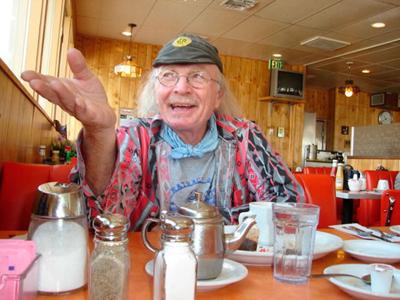
Michael Hurley hasn’t done a damn thing for the past 45-plus years other than craft stomped-on packages of bluesy folk – with slightly out-of-key vocals – that are primitive, unpolished and usually involve sometimes-funny tales of freight trains, defeat, loneliness and wine guzzling.
“I like my wine, yes I like my wine/ But the wine ate my stomach out,” Hurley sings on his 1964 “I Like My Wine,” one of his earliest recordings.
Music journalist Byron Coley, who’s known Hurley since the 1970s, offered some insight as to Hurley’s lyrical process in an interview with NPR.
“To go to a Michael Hurley concert or listen to one of his records really is to enter another kind of universe where time moves a little more slowly, and narratives develop at their own pace,” he says. “But they develop very fully.”
Some 45 years later, hipsters have been repping Hurley like an ironic moustache and, as a result, the eccentric musician’s career has been experiencing a revival. Hurley recently opened for the much younger folk musician Cass McCombs at the Great American Music Hall.
“We would say that Hurley outshone McCombs, but opening bands and headlining bands aren’t competing for a better performance – are they?,” wrote SF Weekly’s Erin Browner.
Hurley won’t have to worry about upstaging a headlining act on Saturday at the Henry Miller Memorial Library because he is the main attraction. But achieving Bob Dylan-level stardom or being a headliner never seemed important to Hurley, who refers to himself as “Snock.” He’s been quietly churning out records since the mid-’60s – he’s released 20 – but only spent about a minute signed to a major label in the ’70s. Those recordings went out of print faster than you could say “Columbia Records.”
He did gain some notoriety for his collaborative work with the Holy Modal Rounders and Jeffrey Frederick & the Clamtones on the highly quotable and humorous 1976 LP Have Moicy. (“They’re bringing thunderbird wine and a pound of hash/ Come on along if you’re one of the people/ Cause we’re going to get the spirit down at the hoodoo bash.”)
The now-trendy genre dubbed “freak folk” is directly influenced by the stuff he’s been doing since he was 22 years old. Now 72, Hurley finds himself playing to rooms full of 20 – and 30-somethings. And popular indie acts have been lovingly latching onto Hurley like deer ticks: In 2007, Devander Bernhardt’s Gnomonsong label released Hurley’s Ancestral Swamp and several of his tunes have been finding new life through covers by the likes of The Violent Femmes, Vetiver, Yo La Tengo and Cat Power, who delivers a heartfelt rendition of “Werewolf,” an homage to what Hurley considers the most sympathetic monster of all: “Cryin’ nobody knows, nobody knows my pain/ When I see that it’s risen, that full moon again.”
Opener Meg Baird’s 2011 Seasons on Earth rides a wave of greatness carried by the momentum of lyrics that read like impressionistic poetry – complete with meter, alliteration and iambic pentameter – worthy of a poet laureate.
“The land turned over and bore her jewels to you/ Steal this night from my sleep/ And I’ll lie in this stream that flows/ For 10 more drops of stillness I’d tell you anything,” she sings on “The Land Turned Over.”
A cloud of melancholy hovers over most of the record, amplifying its emotive effect. Baird wrote the songs during a fragile time of her life, laden with uncertainty, constant change and loss.
“There’s these two – or three-year pockets where you keep getting hit with stuff and everything seems transitional,” she says. “The years you just have to persevere to get through them.”
Baird does however close the album on a sunny note with the brightly nostalgic “Song For Next Summer.”
Aside from a few shows here and there, Baird has been focusing mostly on getting used to her new surroundings – she recently moved from Philadelphia to San Francisco. One of the things she’ll miss most is her place within Philly’s ever-expanding, tight-knit music community. Over the years, Baird has been involved with numerous Philly musicians including psych-folk rockers Espers, which she cofounded, and Kurt Vile. Outside of Philly, Baird has contributed on albums by Bonnie “Prince” Billy and Sharon Van Etten.
“[Philly] has gotten large enough that you’re finding different groups that don’t overlap with each other,” Baird says. “It always felt pretty organic. It’s all about people who love music and help each other out.”
Thankfully, San Francisco’s music scene is similar to the one Baird left behind so the coastal transition won’t be terribly difficult, especially since she’s already widely known from all the touring Espers has done.
“S.F. has that same openness and crossover where people are working on a lot of different projects not for any reason other than it’s interesting,” she says. “There are a lot of good musicians out here so hopefully I’ll be able to have some fun collaborations some time soon.”
MICHAEL HURLEY and MEG BAIRD perform at 8pm (gates at 7pm) Friday, Jan. 18, at the Henry Miller Library (indoors), a quarter mile south of Nepenthe Restaurant on Highway 1, Big Sur. $25. 667-2574.
(0) comments
Welcome to the discussion.
Log In
Keep it Clean. Please avoid obscene, vulgar, lewd, racist or sexually-oriented language.
PLEASE TURN OFF YOUR CAPS LOCK.
Don't Threaten. Threats of harming another person will not be tolerated.
Be Truthful. Don't knowingly lie about anyone or anything.
Be Nice. No racism, sexism or any sort of -ism that is degrading to another person.
Be Proactive. Use the 'Report' link on each comment to let us know of abusive posts.
Share with Us. We'd love to hear eyewitness accounts, the history behind an article.