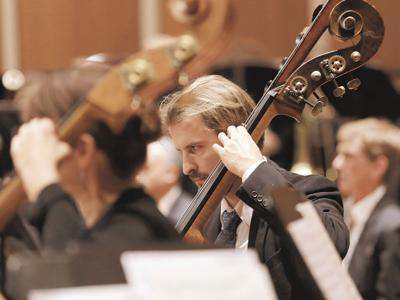
Fall concert season bursts into bloom this weekend when opening night of the Monterey Symphony’s 71st annual season offers a diverse program including a world premiere of an unusual work from Grammy-decorated John Wineglass.
Wineglass’ path to composing took a far less-traveled road. After being classically trained on viola from age 5, he was already touring the Far East by age 11. But he broke convention by abandoning that to become a self-taught pianist.
“I learned how to play piano in church by playing a lot of gospel hymns,” he says, “so I grew up on gospel and jazz in addition to classical.”
He has now been playing what he calls “keys and strings” for a while now. Wineglass was at a crossroads when he moved to the Monterey Peninsula after considering both Los Angeles and Santa Barbara.
“Look, I’m an East Coast guy,” Wineglass says. “I grew up in the city – first D.C. and then New York, OK? So when I first got here, this whole thing about nature and trees and ‘energy’ and everything was pretty foreign to me.”
At least until one of his first visits to the Mitteldorf Preserve, a stunning acreage of huge coastal forest protected by the Big Sur Land Trust for a low-key wine and cheese event.
“Someone told me to bring my violin because we’d be out back in the redwoods,” he recalls. “So I’m thinking, ‘Take my violin out into the forest? Oh really?’”
He played along. “I’m thinking OK, so these are a bunch of crazy Californians,’” Wineglass recalls. “But those trees! It was like I was in a music chamber. From then on, I got it – nature and music are one.”
He calls his song Big Sur: The Night Sun the culmination of that revelation. Eclectically instrumented, the work injects indigenous drums, hand-made percussion instruments, native songs and tribal wooden flutes into the symphony orchestra environment.
Following that, the Shakespearian theme is well-represented with Sergei Prokofief’s profound Romeo and Juliet Suite 2, a smaller work edited down from his much longer four-act ballet. The evening concludes with Beethoven’s Triple Concerto, the only work the maestro did for more than one solo instrument, featuring three visiting soloists: Anna Petrova, piano; Rebecca Anderson, violin; and cellist JeongHyoun Christine Lee.
A copy of Wineglass’ score together with a full-concert CD will be placed in a time capsule honoring the Carmel Centennial.
(0) comments
Welcome to the discussion.
Log In
Keep it Clean. Please avoid obscene, vulgar, lewd, racist or sexually-oriented language.
PLEASE TURN OFF YOUR CAPS LOCK.
Don't Threaten. Threats of harming another person will not be tolerated.
Be Truthful. Don't knowingly lie about anyone or anything.
Be Nice. No racism, sexism or any sort of -ism that is degrading to another person.
Be Proactive. Use the 'Report' link on each comment to let us know of abusive posts.
Share with Us. We'd love to hear eyewitness accounts, the history behind an article.