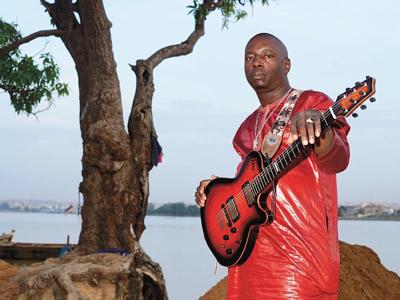
Often called the “Hendrix of the Sahara,” Malian guitarist Vieux Farka Touré doesn’t revel too deeply in the moniker.
“People say what they want,” Touré says. “People listen and everybody has their own opinions.”
Touré was raised in a village in Mali’s capital city, Bamako. His father, Ali Farka Touré, was an internationally known guitarist in his own right, and the younger Touré liked what he heard at home. “My father was very cool – a great guitar player – and he exposed me to great music,” he says. “As a young boy, I listened to John Lee Hooker, B.B., Clapton. My father would put all of them on the big radio before school.”
Touré began as a drummer, but he was soon secretly playing guitar – secretly, he says, because his father was trying to shield him from the inherent dangers of the music world.
“I didn’t want to alarm him,” Touré says. “It was because when he started out, he got taken advantage of a lot. It was a hard life and he didn’t want me to have that. He wanted to protect me.”
Faced with his son’s burgeoning talent, the two eventually began to collaborate.
“When I first started to play with him I struggled to keep up,” Touré recalls, laughing. “It’s funny, sometimes the music chooses you. Learning guitar was surprisingly easy. It was almost like it was in my blood or something. Early in my career people asked why I wasn’t just following my father, but it was important for me to establish my own identity. Now that people know what I can do, I can return to those roots with pride – and, I hope, a certain authority.”
The music echoes blues artists, yes, and even a bit of Hendrix. But its structure is deeply rooted in West African folk music, with traditional chants for its lyrics, bursting with life and unbridled energy.
“In Mali, many people are illiterate and music is the main way of transmitting information and knowledge,” Touré says. “It’s important to me and to the Malian people that we stay connected to our roots and our history. We are nothing if we abandon respect for the past, but we can also marry modernity with the strength of our traditions.”
Ultimately, however, Touré’s musical path is straightforward. “I just want to make people happy. Making people happy makes me happy,” he says.
(0) comments
Welcome to the discussion.
Log In
Keep it Clean. Please avoid obscene, vulgar, lewd, racist or sexually-oriented language.
PLEASE TURN OFF YOUR CAPS LOCK.
Don't Threaten. Threats of harming another person will not be tolerated.
Be Truthful. Don't knowingly lie about anyone or anything.
Be Nice. No racism, sexism or any sort of -ism that is degrading to another person.
Be Proactive. Use the 'Report' link on each comment to let us know of abusive posts.
Share with Us. We'd love to hear eyewitness accounts, the history behind an article.