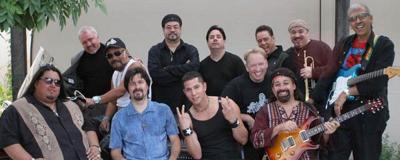
Arcelio Garcia, lead singer of the pioneering Latin rock outfit Malo, is not bashful about broadcasting his band’s influence on the current Latin music explosion.
“There’s a difference between the creator and the imitator,” he says. “All of these groups were raised on me.”
According to Garcia, one act that owes a significant debt to Malo’s music is Ozomatli, a popular Latin rock, funk and hip-hop hybrid. “Ozomatli is good,” he says. “I listen to them, and it’s like a copy of me.”
While all sorts of Latin artists, including Los Lonely Boys and, to some extent, Ozomatli, have migrated into the mainstream over the past few years, Garcia recalls a more difficult time for Latino rockers, the early ‘70s. “We had to fight for every inch,” he says of Malo.
According to Garcia, he got into actual physical altercations with members of rock bands that Malo toured with during that time, including Quicksilver Messenger Service and Ten Years After. “Most of the rock groups didn’t like the fact that we got up there and blew them away,” he says.
Though there may have been hard times for Latin rockers as the genre developed, it was also a heyday for the music style. In 1970, Santana released his legendary 1970 album Abraxas, which yielded the massive hits “Black Magic Woman” and “Oye Como Va.” The Los Angeles Latin rock act El Chicano scored on the pop charts with their 1970 hit “Viva Tirado.” The eclectic, multi-ethnic group War dipped into Latin sounds on songs like “Low Rider” and “The Cisco Kid.”
Malo also hit it pretty big during those days with their 1970 self-titled debut featuring the hit “Suavecito.” The track, a pop number with high R&B vocals and horns, climbed all the way to 18 on the pop charts.
Even though Malo has Carlos Santana’s brother, Jorge, on guitar, Garcia is quick to differentiate his group from Santana and the other Latin rockers of the early ‘70s. “Malo was the first band to incorporate the horns and cha cha together,” he says. “Carlos was Latin rock, and we were a Latin rock orchestra.”
After the success of their first record, Malo toured with some of the biggest rock acts of the day, including Queen. But in 1974, Garcia contracted yellow jaundice and was forced to take a year off from performing. During this period, he moved to New York City, where he studied salsa music and took a day job as an assembly-line fixer. Malo weathered on, enlisting Little Willie G from Thee Midnighters as a vocalist for one record.
Once he regained his strength, Garcia reassembled Malo. The band has continued touring and releasing albums throughout the ‘80s and ‘90s. Though Jorge Santana left Malo in the mid-‘70s, a couple years ago he returned to the fold.
The band’s latest release, a live CD called Malo En Vivo, captures the group in their element: onstage. It kicks off with the exuberant, almost-five-minutes-long instrumental “Monotombo,” a mix of dense percussion and horn blows that evokes images of an orgiastic crowd on a sweaty dance floor. Another track, “Café,” finds Santana’s clean guitar lines cutting through the music sharply.
Garcia says his immense 12-person band truly gives it their all during live performances. “We call it an hour and a half of aerobics,” he says of Malo’s stage show. “We move for a whole hour and a half.”
MALO, TIERRA AND LA VENTANA play 8pm Saturday, Dec. 8, at the Fox Theater, 241 Main St., Oldtown Salinas. $15-$40. 1-888-825-5484.
(0) comments
Welcome to the discussion.
Log In
Keep it Clean. Please avoid obscene, vulgar, lewd, racist or sexually-oriented language.
PLEASE TURN OFF YOUR CAPS LOCK.
Don't Threaten. Threats of harming another person will not be tolerated.
Be Truthful. Don't knowingly lie about anyone or anything.
Be Nice. No racism, sexism or any sort of -ism that is degrading to another person.
Be Proactive. Use the 'Report' link on each comment to let us know of abusive posts.
Share with Us. We'd love to hear eyewitness accounts, the history behind an article.