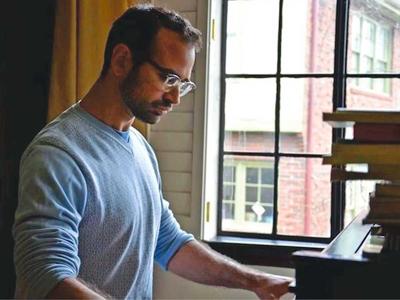
John Cage (1912-1992) looms as a towering figure from the avant garde schools of early 20th-century Paris and New York. One of his most influential works, Sonatas and Interludes for Prepared Piano (1946-1948), gets a reading this weekend by CSU Monterey Bay Assistant Music Professor Jeff Treviño. It’s a monumental work for solo piano and in spite of the composition’s title, the instrument is not just “prepared,” it is completely altered.
Treviño, who was a piano performance major as an undergrad student and now focuses on recording and music technology, explains.
“Cage was obsessed with the concept of measurements,” Treviño says. “He gives a set of detailed measurements for how certain objects should be placed on the strings and hammers to change the instrument’s sound. He doesn’t describe the sounds, he just lists which objects to place in very specific locations.”
The composition calls for bolts and screws; Cage also left instructions “to use anything made of plastic and anything made of rubber.” Treviño is using zip ties for the plastic and automotive hoses for the rubber.
It took Treviño two hours to alter the venue’s piano and he’s been returning on a daily basis, both to rehearse the score and to tweak his installations.
“Believe it or not, the piano music itself looks more or less like any other score of piano music,” Treviño says. “And like any score, you can practice it over and over, but this one comes out differently every time.”
To call this work ambitious is an understatement. It runs over 70 minutes across 16 movements.
“It amounts to preparing for a concert that consists of playing 16 very different pieces back to back with no intermission,” Treviño says.
Cage is perhaps best known for his 1952 ultra-minimalist composition 4’33”, which many call four minutes and 33 seconds of silence, but to Cage it’s the sounds of the natural environment heard by the audience while the musicians remain silent for that time.
“The thing that I love most about Cage’s music is the way he invites us to consider any sound as potentially a musical one,” Treviño says. “He’s not predictable. The only way to realize this piece is to listen carefully and be present in the moment.”

As an assistant professor of music and technology at CSUMB, Jeff Treviño’s research includes “human–computer interaction and sonic creativity.”
SONATAS AND INTERLUDES FOR PREPARED PIANO 7pm Friday, Jan. 26. The Lab 3728 The Barnyard, Suite G-23, Carmel. $25; $15/students. 667-2574, thelabarts.com.
(0) comments
Welcome to the discussion.
Log In
Keep it Clean. Please avoid obscene, vulgar, lewd, racist or sexually-oriented language.
PLEASE TURN OFF YOUR CAPS LOCK.
Don't Threaten. Threats of harming another person will not be tolerated.
Be Truthful. Don't knowingly lie about anyone or anything.
Be Nice. No racism, sexism or any sort of -ism that is degrading to another person.
Be Proactive. Use the 'Report' link on each comment to let us know of abusive posts.
Share with Us. We'd love to hear eyewitness accounts, the history behind an article.