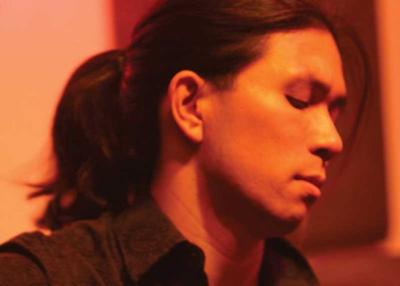
Guitar virtuoso Goh Kurosawa’s repertoire can taste like a chef’s salad, tossed with everything from traditional Japanese folk tunes to the flamenco of Paco de Lucia to Elvis’ “Can’t Help Falling in Love” to his own gripping originals. No matter the genre of the song, though, watching and listening Kurosawa play the axe—though he didn’t pick it up until he was 18—whets an appetite for more.
“The reason I was attracted to the guitar is because it’s a very versatile instrument,” says the Japanese transplant, who now lives in Los Angeles. “It’s an instrument you can play by yourself and it can sound like a full orchestra.”
As a child, Kurosawa’s primary music source came from the traditional Japanese folk songs sung to him by his grandmother before going to bed.
“Those songs are essential to my music,” he says. “I always go back to my own Japanese culture.”
When Kurosawa came to the United States in 1996—to study at Washington University in St. Louis and at the California Institute of the Arts—he was given the opportunity to study under the legendary jazz double bassist, Charlie Haden.
The most important piece of advice he received from the musical great was: “Play only when you mean it.”
“It means, don’t play a note if you don’t mean it,” Kurosawa says. “If you’re playing and nothing’s happening, a lot of people [are] of the tendency to play more and more; but the truth is, if you relax and look for that one note that works, it speaks much more.”
Kurosawa started as a classical guitarist but has since explored every dimension of the instrument, constantly pushing the boundaries of its simple wood body and six strings.
“There are so many new things to learn about the guitar all the time,” he says.
The way Kurosawa continues to expand upon his knowledge is by exploring the music of other countries and learning about the culture, the people, and even the cuisine. For Kurosawa, a recent trip to Brazil was more than a vacation. It was an epiphany.
“I’ve always been fond of performing bossa nova and Brazilian music,” he says. “I felt like I learned something that I was missing; the way [Brazilians] listen to music is very genuine and they don’t mind showing what they feel when listening to music.”
Kurosawa’s original tunes delve deep into musical theory. “Nothingness,” from the LP Sharp Three, is an intricate journey into the land of variable time signatures; it doesn’t follow the commonly used 4/4 signature.
“At the time when I wrote it I was studying Balkan music and a lot of Balkan music is in odd time signatures,” he says.
The nine-minute-plus instrumental is a multifaceted adventure into mountainous panoramas featuring Al Di Meola-inspired jazz arpeggios, a mixture of loud and soft, and far-out screeches achieved with a steel slide grinding the guitar strings.
But the song is much more than the experiment of a musical genius; it’s a philosophical ode to Kurosawa’s younger brother and frequent contributor Kai, who will accompany Goh on Friday night in Carmel Valley on his self-designed 24-string guitar, bass, sitar combo called the “Big Mamma Bear.”
It’s apparent that Kurosawa continues to abide by Haden’s advice: There isn’t one unnecessary note played in the entire song.
(0) comments
Welcome to the discussion.
Log In
Keep it Clean. Please avoid obscene, vulgar, lewd, racist or sexually-oriented language.
PLEASE TURN OFF YOUR CAPS LOCK.
Don't Threaten. Threats of harming another person will not be tolerated.
Be Truthful. Don't knowingly lie about anyone or anything.
Be Nice. No racism, sexism or any sort of -ism that is degrading to another person.
Be Proactive. Use the 'Report' link on each comment to let us know of abusive posts.
Share with Us. We'd love to hear eyewitness accounts, the history behind an article.