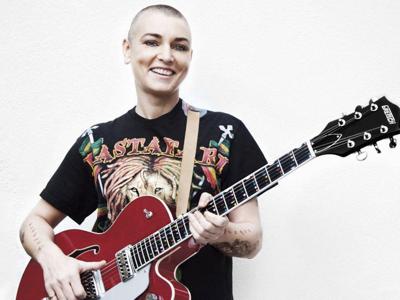
In 2011, Sinéad O’Connor’s tour was canceled due to “mental health issues.” So, it wasn’t too shocking when her 2013 show at Sunset Center in Carmel was canceled due to “personal circumstances.”
Before the cancellation, I had spoken to the dynamic singer-songwriter in preparation for a story. After O’Connor was found dead, at 56, on Wednesday, July 26, I am grateful that I was gifted the opportunity to speak with such an effervescent soul.
As a music writer, I’ve interviewed hundreds of musicians throughout the years, and many, especially the big-time rockers, phone it in with stock answers that sound like a robot on autopilot engineered them. Usually, every media outlet publishes what might as well be a press release from a record label.
Then there are the rarities: Those artists who aren’t simply puppets on the other end of the phone or computer screen waiting for their management to chime in with a “two-minute warning.” O’Connor was one of the gems who made me feel like I was speaking to a human being.
She responded thoughtfully and was also hilarious. O’Connor’s humor was somewhat sarcastic but not mean-spirited; it was subtle.
When I asked her why the tour was called “The American Kindness Tour,” she responded quickly: “I was asked to think of a name for [the tour], and that was the name I thought of because, in my experience, American people are very kind,” O’Connor explained in a tone that said, “You know I’m kidding, right?”
Our conversation seamlessly moved to the subject of album titles. O’Connor said she wanted to make an album called Fuck Off.
“Fuck Off would be the greatest album title ever,” she said with a chuckle. “I just haven’t had the guts yet to do it.”
She realized she might have already done it with her 2012 record How About I Be Me (And You Be You)?
“I guess that’s a very polite way of saying, ‘fuck off.’”
I asked how she could be so cautious about naming an album, but fearlessly ripped a photograph of Pope John Paul II during her 1992 appearance on Saturday Night Live, in protest of the pattern of silence around sexual abuse within the Roman Catholic Church.
“That’s a whole other interview,” O’Connor replied. “I’ll write it down for you one day.”
O’Connor had nothing against religion. However, she despised monstrous people who used religion to shield abuse. The Grammy Award winner performed a solo-acoustic, press-only concert in 2012 at London’s St. Pancras Old Church.
“I’ve played a lot of church gigs, and I love playing the churches, especially because I did an album called Theology, which is all based on songs that I love and even Old Testament scripture,” she told me. “I also like performing in churches because it spiritually focuses you, singing-wise. I’m a person who prays inside myself the whole time I sing, and it’s easier in a church.
“I’ve always liked religious music, too,” she added. “I like all kinds of music, and I want to sing as many different types of music as possible.”
O’Connor was much more than the genius who brought Prince’s “Nothing Compares 2 U” out of obscurity and into the limelight in 1990. (Check out her stellar debut, The Lion and the Cobra, if you need further convincing.) She was also known for putting everything she had into her live shows.
“We all have extra-special performances,” she said. “But I think I’m pretty damn good every night.”
At the time of the interview a decade ago, O’Connor was in the infant stages of making what would become I’m Not Bossy, I’m the Boss, released in 2014. It was the last full-length record she made.
The singer-songwriter added a side note during our discussion about her children. They always came first.
“That’s why I don’t tour very much, or at least I haven’t traditionally,” O’Connor told me. “I [tour] to make what I need every year to pay bills. I’m not a huge, multi-million-dollar artist, and I don’t make the kind of money that I can tour and drag my children around on. I have to find a balance. It’s a tricky job. There’s always going to be an issue one way or another.”
O’Connor’s 2021 memoir, Rememberings, dives deep; in the book, she admits that she never seemed to find that “balance” she strived for. Her struggles with mental health and the backlash from her candid public statements led to a bevy of perpetual controversies that overshadowed the brilliance of her music and its lasting influence. She embodied the power of artistry, activism and resilience. And there was always time for a bit of cheekiness.
“I’d like to be remembered as a nice, loving mother,” O’Connor said before our conversation ended. “And somewhat of a mischievous female.”
(0) comments
Welcome to the discussion.
Log In
Keep it Clean. Please avoid obscene, vulgar, lewd, racist or sexually-oriented language.
PLEASE TURN OFF YOUR CAPS LOCK.
Don't Threaten. Threats of harming another person will not be tolerated.
Be Truthful. Don't knowingly lie about anyone or anything.
Be Nice. No racism, sexism or any sort of -ism that is degrading to another person.
Be Proactive. Use the 'Report' link on each comment to let us know of abusive posts.
Share with Us. We'd love to hear eyewitness accounts, the history behind an article.