
In many ways, the success of the annual International Documentary Film Festival, presented for the 18th year by the Monterey Bay Chapter of the United Nations Association, is remarkable.
Democratizing technological advances, internet platforms, citizen journalism and new interpretations of fair use have increased the volume of documentaries flooding the marketplace. (The surge is also likely inspired by success stories like Fahrenheit 9/11 and An Inconvenient Truth.) Their sheer proliferation can obscure the individual successes of good docs.
In a year in which Americans are dealing with government-led moral regression and nuclear aggression, exposés of sexual predation, the deadliest mass shooting in modern U.S. history, long-term warfare and supra-natural disasters, it’s a wonder that anyone wants to pay to see more dread and suffering. The success of La La Land seemed to indicate that maybe documentary fatigue was setting in.
But there’s something about documentaries. They assure us that the real world is worth paying attention to (and worth paying to do so), that ignorance is not bliss and that events have consequences. They remind us information is power and, given enough power, we can make meaningful changes to our world. They tell us that we humans, fellow creatures, our environment, that life itself matters.
But savvy documentary filmmakers will have already taken all this into account by alleviating tough stories with rays of hope, animating dark matter with engaging subjects.
John Antonelli of Mill Valley Film Group in Sausalito has a film in this year’s festival. He argues that filmmakers need to battle documentary fatigue “by honing our craft, selecting our subjects, and spending as much time as is needed to tell the story in a way that will find an engaged audience.”
According to Ronald Nelson, who is on the 2017 UNA film Festival selection and planning committee, they have curated out the mediocre fare.
He says that the dozen committee members researched and sought out about 60 promising films, cut those that didn’t fulfill their criteria, watched the rest, voted on those, then culled by content and quality. That way, he assures, “The cream rose to the top.”
There’s something about documentaries. They assure us that the real world is worth paying attention to.
Those include films like Chasing Coral (91 minutes, playing Saturday) from the makers of Chasing Ice, and the formally constructed and odd scenes of Italian film Irregulars (9 minutes, playing Saturday).
They include Laura Pacheco and Jackie Mow’s locally produced East of Salinas (53 minutes, playing Saturday), about a precocious and bright third-grader named Jose Ansaldo who lives in the Salinas Valley, is undocumented, has parents who work long hours in the fields, and, thanks to President Donald Trump’s repeal of DACA (the film pre-dates the 2016 election), is facing a more precarious future than even the filmmakers imagined.
Antonelli’s film is The New Environmentalists: From Guatemala to the Congo (28 minutes, playing Friday), narrated by Robert Redford, the latest installment in a series of films that profile international winners of the Goldman Environmental Prize, the ceremony for which happens at the San Francisco Opera House every April. Antonelli is coming to the festival for a Q&A, and is speaking at CSU Monterey Bay.
“In the case of The New Environmentalists we are blessed with stories that, although they can be exploring dire environmental conditions, they always focus on a protagonist who has made a positive difference,” he writes by email. “Audiences always comment on how inspiring it is to watch an environmental story that has a positive outcome.”
For some stories, the outcome hasn’t arrived yet.
The Greek film 4.1 Miles (21 minutes, playing Friday) opens on a boat on the Aegean Sea captained by Kyriakos Papadopoulos of the Greek coast guard. He and his small crew are called to save refugees trying to make their way to Europe. In years past, he tells the camera, when they rescued 20 Ethiopian refugees at once, it made for exciting news for his seaside community. But now there are thousands coming, and it’s taking a toll.
“The world needs to know what’s happening!” one Greek man yells as a drowned refugee is carried off the boat. “We can’t be going through this alone!”
Those plaintive words sounds like the essence of these types of documentary films. And the reason we continue to watch them.

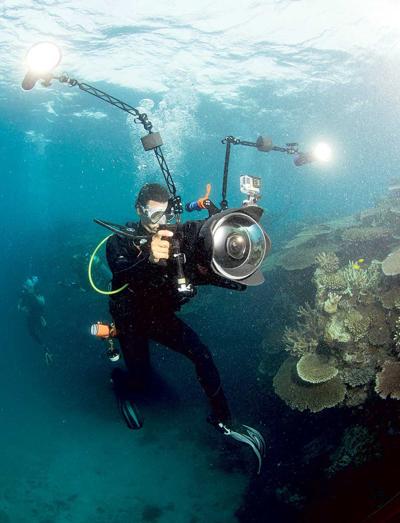
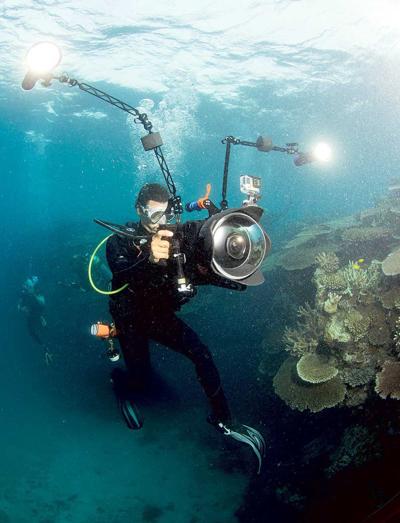
As coral reefs are vanishing at unprecedented rates around the world, *Chasing Coral* reveals how and why with vivid imagery.
18TH ANNUAL INTERNATIONAL DOCUMENTARY FILM FESTIVAL runs 7pm Friday and Saturday, Nov. 3-4, at CSU Monterey Bay’s World Theater, 5260 6th Ave., Seaside. $10/day; free/students with ID; $4/all-day parking. 582-4580, unamontereybay.org/film-festival
(0) comments
Welcome to the discussion.
Log In
Keep it Clean. Please avoid obscene, vulgar, lewd, racist or sexually-oriented language.
PLEASE TURN OFF YOUR CAPS LOCK.
Don't Threaten. Threats of harming another person will not be tolerated.
Be Truthful. Don't knowingly lie about anyone or anything.
Be Nice. No racism, sexism or any sort of -ism that is degrading to another person.
Be Proactive. Use the 'Report' link on each comment to let us know of abusive posts.
Share with Us. We'd love to hear eyewitness accounts, the history behind an article.