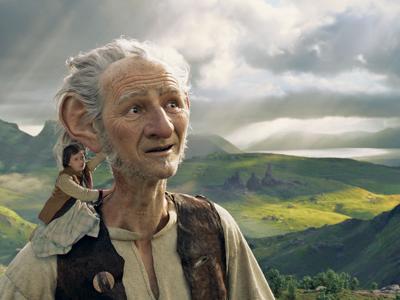
Movie fans should be forgiven for supposing that an adaptation of Roald Dahl’s beloved book The BFG by screenwriter Melissa Mathison and director Steven Spielberg – their first collaboration since 1982’s E.T. – would be cause for celebration. Here is another story about a lonely child who befriends a mysterious creature and has an adventure that changes her life for the better, and yet my only sense of wonder came from wondering where master cinematic fantasist Spielberg has disappeared to.
For a movie about giants and the expansive power of dreams, The BFG feels rather small. Oh, there are most certainly giants, and they most certainly roam a sweeping landscape. And there are certainly dreams, and they certainly inspire some very important people to some very impressive action.
But for far too long up on that screen, not much actually happens. And there’s never much that hits you in the gut or the heart like E.T. did.
Much of the failure of BFG to connect emotionally comes down to its protagonist, the 10-year-old orphan Sophie, who spots the 24-foot-tall Big Friendly Giant from her London orphanage, where he scoops her up and carries her away to the distant land of giants. Young star Ruby Barnhill is bursting with personality, but her Sophie doesn’t do much of anything for the first solid hour or so of the movie. She is literally dragged, kicking and screaming, into the plot, and eventually befriends the giant, a uniquely vegetarian creature among more threatening flesh-eating giants, with names like Bloodbottler and Fleshlumpeater.
Among these creatures, it turns out, the BFG is himself a social misfit who refuses to eat children. Dahl’s imaginative book shines through here, telling a story about inclusion and friendship without getting moralistic. The 1982 book is dedicated to Dahl’s late daughter, Olivia, who died of measles at age 7 in 1962.
Throughout the movie, Sophie remains a mystery as a character. More importantly, it’s never fully established why she’s worthy of having an entire story constructed around her.
We know that Sophie is a prematurely grown-up insomniac who wanders her orphanage at night, tidying up after her irresponsible adult caretakers. But we have no idea what she might prefer her life to be beyond the unspoken obvious (such as, perhaps, not living in an orphanage with people who don’t love her). Sophie doesn’t actively join the giant on his adventures; rather, she’s been kidnapped. Making her an active participant in her own story would have gone a long way advancing her role from being just a hanger-on.
Not much happens in the first half of The BFG. Sophie gets a tour around the gigantic home of the BFG himself (Mark Rylance, motion-captured and enhanced with CGI), learns about his work – he gathers dreams from children, which is why he skulks around city orphanages – and discovers that he is bullied by the other giants.
Some of this is momentarily lovely, such as when the BFG explains to Sophie how he hears the “secret whisperings” of stars, trees and bugs, and some of it is wonderfully silly-gross, as with the disgusting vegetable called a snozzcumber that the BFG munches on.
Rylance brings his usual marvelously understated elegance to the BFG, but the green-screen seams between the CGI and the live action are often obvious, a shocking problem for the likes of Spielberg, who has long been a pioneer of beautifully realistic fantasy FX. Worse, though, is the fact that this is a long, directionless tour of a fantasy world: It’s spectacle, not story. Dahl’s wordplay is certainly witty, and the BFG’s world is cleverly imagined, but that’s icing, not cake.
When the cake arrives at last, finally, it involves a turn into what feels like a different sort of movie altogether: a twist from contemplative fantasy meandering into something more action-oriented. (I won’t spoil it for those who have not read the book, but it’s in this second half of the film that Spielberg deploys some imagery that is far more like something reused from his Jurassic Park than it is akin to E.T.) There is momentary amusement in this twist, but it feels at odds with the earlier, more reflective tone. It also means losing the charming sense of timelessness that characterizes the beginning of the movie; early on, it could be taking place almost anytime in the first half of the 20th century, but then gets firmly rooted in the early 1980s, when Dahl wrote the book.
Most disconcerting of all, by the end of the film, the Wizard of Oz-esque feeling that it was all just a dream gets dismissed – even though Spielberg never successfully convinces viewers that the fantastical world we’ve seen could be perceived as real.
THE BFG (2) • Directed by Steven Spielberg • Starring Ruby Barnhill, Mark Rylance, Rebecca Hall, Bill Hader • Rated PG • 117 min. • At Century Cinemas Del Monte, Maya Cinemas, Northridge Cinemas, Lighthouse Cinemas.
(0) comments
Welcome to the discussion.
Log In
Keep it Clean. Please avoid obscene, vulgar, lewd, racist or sexually-oriented language.
PLEASE TURN OFF YOUR CAPS LOCK.
Don't Threaten. Threats of harming another person will not be tolerated.
Be Truthful. Don't knowingly lie about anyone or anything.
Be Nice. No racism, sexism or any sort of -ism that is degrading to another person.
Be Proactive. Use the 'Report' link on each comment to let us know of abusive posts.
Share with Us. We'd love to hear eyewitness accounts, the history behind an article.