Peter Jackson sure has nerve.
The Hobbit: An Unexpected Journey, a prequel to Jackson’s Lord of the Rings trilogy, begins with dwarves sitting around a dinner table saying, “Hey, we need to get to Erebor to reclaim our home.” Fine. But after 170 minutes, the film ends with the dwarves barely close enough to see a far-off view of Erebor. Why does Jackson have to draw this out so much?
With the Rings trilogy, which was based on three J.R.R. Tolkien books, it made sense for Jackson to do this. But The Hobbit is only one (albeit dense) Tolkien book that doesn’t lend itself well to three movies, as is Jackson’s intention. (Roughly 125 pages of appendices will also help pad things out.)
Indeed, The Hobbit: An Unexpected Journey feels unnecessarily long. Perhaps because all the Rings movies were nearly three hours, Jackson felt compelled to repeat the length, but there are far too many scenes that you genuinely fear will never end. Dwarves eating dinner and singing two(!) songs, trolls chatting by a campfire, a kooky wizard (Sylvester McCoy) with racing rabbits, and an old Bilbo (Ian Holm) hanging out with his nephew Frodo (Elijah Wood) are but a few examples of moments that should’ve been edited thoroughly. This is a three-hour movie that feels like the extended edition.
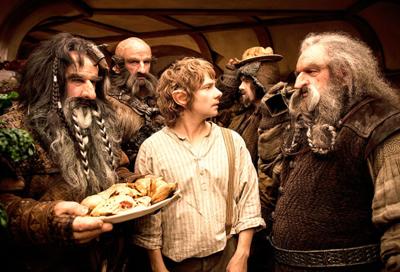
The Bilbo/Frodo scenes do serve one purpose: They set up the flashback to 60 years earlier, in which Gandalf (Ian McKellen) tricks a younger Bilbo (Martin Freeman) into hosting a dinner party for 13 dwarves. The dwarves need someone to help sneak them into Erebor so they can slay the mighty dragon that’s taken their land. Bilbo agrees to go for reasons that are never explained. Thorin (Richard Armitage), the dwarf leader, doubts Bilbo at every turn, and even Bilbo agrees with him.
The premise is notably similar to Fellowship of the Ring, and the connections to the Rings trilogy do not end there. Elves Galadriel (Cate Blanchett) and Elrond (Hugo Weaving) appear, as does Saruman (Christopher Lee) and, after two hours, Gollum (Andy Serkis). Along with the aforementioned Gandalf, older Bilbo and Frodo, they all bring a familiarity to The Hobbit that makes it enjoyable to return to Middle Earth.
Aside from this inherent curiosity, the only other reason to see The Hobbit is if you can find a theater showing it in 48 frames per second. Here, briefly, is what that means and why you should care: The standard for normal, “realistic” motion on screen is 24 frames per second. Seeing it in 48 fps means the picture will have twice as much visual detail and clarity. Images are clearer, crisper, bolder and more dynamic. Best of all, fast-moving action scenes never blur, allowing for a vivid, clean image throughout. There may be moments in which it seems like characters are moving a bit fast and the hyper-realistic nature of calmer moments takes some getting used to, but once your eyes adjust, you’ll realize you’ve never seen anything that looks quite this good.
Sadly, though, The Hobbit: An Unexpected Journey is more visually impressive than it is a storytelling triumph. It’s a movie to see, however, if you’re eager to embrace the future of filmmaking, as this no doubt is the first step in getting us there.
THE HOBBIT: AN UNEXPECTED JOURNEY (2½) • Directed by Peter Jackson • Starring Martin Freeman, Ian McKellan, Richard Armitage, Ken Stott, Graham MacTavish • Rated PG-13 • 169 min. • At Century Cinemas Del Monte, Maya Cinemas, Northridge Cinemas, Cannery Row XD, Lighthouse Cinemas.
(0) comments
Welcome to the discussion.
Log In
Keep it Clean. Please avoid obscene, vulgar, lewd, racist or sexually-oriented language.
PLEASE TURN OFF YOUR CAPS LOCK.
Don't Threaten. Threats of harming another person will not be tolerated.
Be Truthful. Don't knowingly lie about anyone or anything.
Be Nice. No racism, sexism or any sort of -ism that is degrading to another person.
Be Proactive. Use the 'Report' link on each comment to let us know of abusive posts.
Share with Us. We'd love to hear eyewitness accounts, the history behind an article.