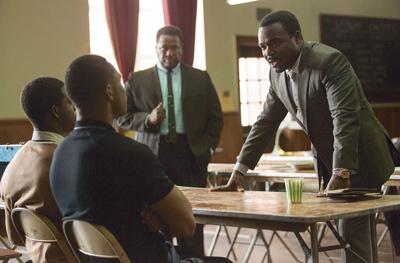
When we first see Martin Luther King, Jr. (David Oyelowo) in director Ava DuVernay’s riveting drama Selma, it’s in a context where we’re already used to seeing him: He’s delivering a speech. It’s October 1964, and King is about to receive the Nobel Peace Prize, but he’s not yet on a stage in that first scene; he’s rehearsing that speech in a mirror. One of the greatest orators in American history is doing the thing that we don’t always think about when we think about the greatest at anything in history: He’s practicing, doing the unseen work that’s essential before the amazing can happen.
Selma could have been just an inspirational drama about a pivotal historical moment. But DuVernay has chosen a single crucial philosophical battle, and shown us all the struggle, negotiation, strategizing, self-doubt, mistakes and intelligence that went into winning it.
The narrative focuses on the efforts in 1965 by King, his colleagues in the Southern Christian Leadership Conference and other allies to secure voting rights for Southern blacks, whose in-name-only legal franchise was regularly thwarted by state and local regulations. As they plot their strategy – focusing on Alabama, under the control of proudly racist Gov. George Wallace (Tim Roth), and planning peaceful protest marches from Selma to Montgomery – King also begins meeting with President Lyndon Johnson (Tom Wilkinson), hoping to find an ally but instead encountering a president with other legislative priorities.
Those conversations between King and Johnson form a vital center of Selma, but they’re not the only places where the film wrestles with the best methods for achieving social change. Turbulent events do play a significant role in Selma, yet the film is ultimately more concerned with the decisions that led to those events, and their ripple effect.
Given recent racially-charged incidents and protests, it was perhaps inevitable that Selma would be freighted with contemporary significance – which seems both unfair and appropriate. DuVernay’s film is too effective on its own terms for it to be reduced simply to an allegory for Where We Are Today, yet it’s also tremendously encouraging for anyone who wonders if there’s any hope. The film’s tag line proclaims that “one dream can change the world,” but that may actually do Selma a disservice. With every moment that shows King fine-tuning his speeches and sermons, it reminds us that having a dream is only a start.
SELMA (4) Directed by Ava DuVernay • Starring David Oyelowo, Tom Wilkinson, Carmen Ejogo • Rated PG-13 • 127 mins. • At Maya Cinemas, Century Cinemas Del Monte, Northridge Cinemas, Lighthouse Cinemas.
(0) comments
Welcome to the discussion.
Log In
Keep it Clean. Please avoid obscene, vulgar, lewd, racist or sexually-oriented language.
PLEASE TURN OFF YOUR CAPS LOCK.
Don't Threaten. Threats of harming another person will not be tolerated.
Be Truthful. Don't knowingly lie about anyone or anything.
Be Nice. No racism, sexism or any sort of -ism that is degrading to another person.
Be Proactive. Use the 'Report' link on each comment to let us know of abusive posts.
Share with Us. We'd love to hear eyewitness accounts, the history behind an article.