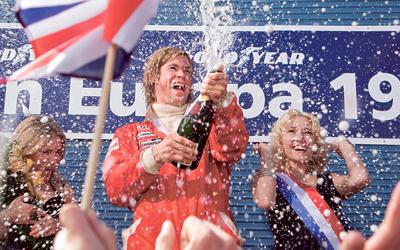
Rivalries – the kind that go down in history, like the one Ron Howard’s Rush is based on – are almost always grounded in contrast. Machine-like Björn Borg vs. combustible John McEnroe; dancing, brash Ali vs. lumbering, stolid Foreman – they captivated audiences because they were as much about style as talent. Winning wasn’t the only thing; people argued over how you looked while you were doing it.
Rush, however, takes its cues less from the great sports rivalries than from one based in the arts: the Mozart vs. Salieri dynamic of Amadeus. And in so doing, the film inadvertently manages to say as much about the reputation of its director as it does about the story at hand.
Because if Howard is likely to be compared with either of the key players in this fact-based tale of the mid-’70s Formula 1 racing rivalry between cocky, daring James Hunt (Chris Hemsworth) and diligent, risk-averse Niki Lauda (Daniel Brühl), it’s the latter. Despite being an Oscar winner for A Beautiful Mind, Howard’s reputation among cinephiles ranges from “competent” to “workmanlike.” He’s the guy who’s going to take whatever story you give him and deliver something perfectly watchable, but you’re never going to go to one of his movies for the privilege of seeing a master direct the hell out of a motion picture.
This story is exactly the kind at which Howard has proven most adept, using the framework of real-life characters as he did so effectively with A Beautiful Mind, and Frost/Nixon. The action begins with a crucial race in 1976, before flashing back to the early years of the rivalry between Hunt and Lauda on the minor-leagues circuits of European racing. Howard and screenwriter Peter Morgan effectively set up the parallel between the two men as children of privilege who rebel against the expectations of their families, before focusing on the clash of styles that differentiated them.
THERE’S GREAT MATERIAL ABOUT THE CONNECTION BETWEEN PEOPLE WHOSE GREATEST PLEASURE IS BEATING ONE ANOTHER.
Mostly though, there’s racing – and Howard shows some flash in those scenes that hasn’t been typical of him in the past. Working with cinematographer Anthony Dod Mantle, Howard finds the kinetic appeal of racing without resorting to two-second edits, although it’s hard for him to get past the fact that one shot of a car moving very fast around a track looks a lot like the previous shot.
There’s also some great material in Rush about the connection that develops between people whose greatest pleasure is beating one another. After a crash appears to sideline Lauda for the remainder of a season, he endures grueling rehabilitation. And when a reporter insults Lauda during a press conference, Hunt comes to his defense with surprising brutality. While Brühl’s performance is considerably more compelling than Hemsworth’s – Brühl’s reaction takes perfectly capture the pique of a guy who can’t understand people who don’t see the world as rationally as he does – both actors capture the competitive respect that drives great sports legends.
Rush offers plenty to like in its study of the drive to win; it just doesn’t offer much to love. Like so many of Howard’s films over the years, it’s content to hit its marks without ever finding a way to elevate the material. So we get the scenes of the two men interacting with their wives that feel merely perfunctory.
Rush works, and maybe that’s rare enough that it’s not worth nit-picking. But as Salieri learned in Amadeus, there’s a great divide between art that works, and art that wows.
(0) comments
Welcome to the discussion.
Log In
Keep it Clean. Please avoid obscene, vulgar, lewd, racist or sexually-oriented language.
PLEASE TURN OFF YOUR CAPS LOCK.
Don't Threaten. Threats of harming another person will not be tolerated.
Be Truthful. Don't knowingly lie about anyone or anything.
Be Nice. No racism, sexism or any sort of -ism that is degrading to another person.
Be Proactive. Use the 'Report' link on each comment to let us know of abusive posts.
Share with Us. We'd love to hear eyewitness accounts, the history behind an article.