As a young girl growing up in Iran in the 1970s, Marjane Satrapi had two obsessions: shaving her legs one day, and being the last prophet of the galaxy. That amusing split between the Iranian girl’s earthly and heavenly interests found a grim parallel in the fate of her homeland.
In her graphic novels Persepolis: The Story of a Childhood and Persepolis: The Story of a Return, Satrapi depicted growing up in a privileged, progressive household in Tehran, where her family protested the Shah’s secular tyranny. Their joy at the revolution became dismay when a fundamentalist religious regime seized power and entered a decade-long war with Iraq.
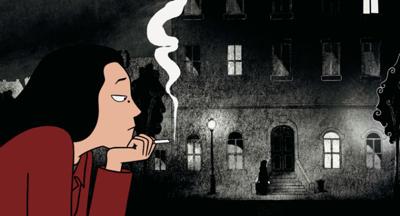
Satrapi drew the Persepolis books in a simple, childlike style that perfectly captures her younger self’s naïve point of view. We see her early belief in God, her adolescent love of rock music, her ill-fated romances and especially the history of her country, all through the magnifying glass of her age.
Having lived in France since the 1990s, Satrapi teamed with Vincent Paronnaud to co-write and co-direct an animated version of Persepolis for the big screen. The moving, lyrical film won the Grand Jury Prize at the 2007 Cannes Film Festival and is France’s official entry for contention in the Academy Award for Best Foreign Language film. Persepolis’ portrayal of clashing cultures finds fresh angles on coming-of-age clichés while celebrating the power of at least two art forms.
Persepolis takes its title from the ancient capital of the Persian Empire. At a time when the U.S. and Iranian governments are rattling sabers at each other, Persepolis provides some much-needed context. The film’s ingenious first half even injects some welcome humor into a recap of recent Iranian history.
Marjane (voiced by Gabrielle Lopes) comes across like a stepsister to one of those funny-bratty anti-heroines of children’s books like Eloise, only with a political bent. Marching around the living room, she bombastically calls for the Shah’s ouster while proclaiming her revolutionary credentials. Among her friends in similar progressive families, she even finds a status symbol in the fact that her beloved Uncle Anoosh was a political prisoner for nine years: “Better than Laly’s father!”
When Anoosh describes his arrest and flight to the Soviet Union, we see the events as a fairy tale in the prism of Marjane’s imagination. Her youthful romanticization runs aground against harsh realities when Anoosh gets arrested again, and chooses Marjane as his sole allowed visitor. Their heartbreaking reunion scene in his cell demonstrates how the animated film builds upon the graphic novel. Instead of black-and-white panels separated by white borders, the film’s deep, black backgrounds seem to blend in with the darkness of the movie theater. You feel immersed in the action rather than reading it at arm’s length.
Reminiscent of the clean, economical animation of Charlie Brown, Persepolis’ emblematic style particularly suits the fundamentalist takeover. Animating the Islamic authority figures as having identical beards provides a perfect symbol of oppressive conformity, while the robed bodies of crone-like teachers have the shapelessness of comic-book ghosts.
As a tween, Marjane rebels quietly, wearing a punk-rock T-shirt in public and buying disco and heavy metal tapes from black marketeers. She experiences the West firsthand in the film’s second half as she attends school in Vienna and hangs out with posing bourgeois anarchists.
Persepolis proves less compelling in its second half, despite its frank portrait of a young woman’s depression, exacerbated by guilt, homesickness and alienation. Moving from a theater of war and revolution, scenes that dramatize self-pity and bad boyfriends can’t have the same weight. The family scenes remain warm and touching throughout the film, however, with Catherine Deneuve and Danielle Darrieux providing the voices of Marjane’s mother and grandmother.
American filmmakers have made some terrific movies of graphic novels, including American Splendor and Ghost World, but they’ve all been live-action films. With our pioneering and cutting-edge comic book and animation artists, America should own this genre (even compared with Japanese anime). Instead, Satrapi and Paronnaud wed the graphic novel to animation in Persepolis, and it’s the kind of blessed marriage through which both partners grow up.
PERSEPOLIS ( 3 ½ ) Directed by Vincent Paronnaud and Marjane Satrapi • Starring the voices of Chiara Mastroianni and Danielle Darrieux • PG-13, 95 min • At the Osio Cinemas.
(0) comments
Welcome to the discussion.
Log In
Keep it Clean. Please avoid obscene, vulgar, lewd, racist or sexually-oriented language.
PLEASE TURN OFF YOUR CAPS LOCK.
Don't Threaten. Threats of harming another person will not be tolerated.
Be Truthful. Don't knowingly lie about anyone or anything.
Be Nice. No racism, sexism or any sort of -ism that is degrading to another person.
Be Proactive. Use the 'Report' link on each comment to let us know of abusive posts.
Share with Us. We'd love to hear eyewitness accounts, the history behind an article.