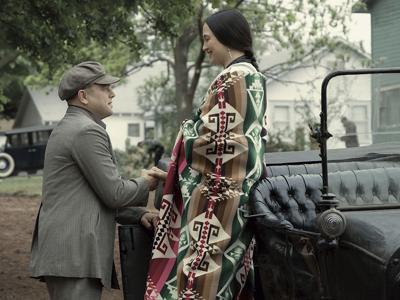

Before the establishment of the United States, the Osage Nation stretched across the Great Plains from the Rockies to Missouri. In the early 19th century, stuck in the vise of American expansionism, the Osage ceded their vast tribal lands to the U.S. and settled on a reservation in Kansas. But by mid-century, American settlers began coveting that land, too, so in 1870 the Osage sold it and used the money to buy land to the south in what is now northern Oklahoma. The hope was that there – where the land was rocky and infertile – white settlers would finally leave them be.
In purchasing that land for their new reservation – about the size of Delaware – the Osage made a shrewd business decision: Even if parts of their land were eventually sold off to whites, the Osage would retain rights to all the minerals that may lie beneath it.
And as it turns out, that land was sitting atop one of the richest oil reserves in America, and by the 1920s, the Osage were, per capita, the wealthiest people on Earth. So once again white men wanted a piece of it – and no small number of them participated or were complicit in a vast, murderous conspiracy to gain control, piece by piece, of the Osage’s mineral rights.
It is within this world that filmmaker Martin Scorsese sets his latest epic, Killers of the Flower Moon, based on the 2017 book of the same name by David Grann who, like Scorsese, is a master of his craft. The true story they both tell, despite being known for a century, was largely relegated to obscurity before Grann came along, which serves as its own kind of indictment.
Scorsese’s film, like the book, wrestles with deeply uncomfortable truths about both the history of America and the banality of evil – like many other horrific episodes of human history, the events portrayed in Killers suggest that evil is a latent gene within much of humanity, and can assert itself when conditions are ripe.
Killers centers around the family of Mollie Burkhart (brilliantly portrayed by Lily Gladstone), a full-blooded Osage who, like her sisters, is married to a white man. Mollie’s husband, Ernest Burkhart (Leonardo DiCaprio), is a World War I veteran who comes to Osage country after the war to find work with his uncle William Hale (Robert DeNiro), a successful businessman who, it quickly becomes clear, is a devil in disguise.
As members of Mollie’s family begin to die under suspicious circumstances, the Osage come to realize something foul is afoot, and the tribe makes pleas to the federal government to investigate the deaths.
Enter Tom White (Jesse Plemons), who arrives to the area with a team from the Bureau of Investigation, a precursor to the FBI. From there, the question driving the narrative becomes a matter of how much White and his men can prove, and to what extent the perpetrators will be held accountable.
It also captures the internal struggle of Ernest, who seemingly loves Mollie, yet is also a part of the murderous conspiracy – a conflict deftly played by DiCaprio.
The screenplay was co-written by Scorsese and Eric Roth (who won an Oscar for his adaptation of Forrest Gump), but underwent a major rewrite after the film was initially cast: The original screenplay had White as a more central character – a role DiCaprio was initially meant to play – but Scorsese came to decide the story should be told from the perspective of the Osage, not a white outsider looking in.
The film was shot entirely on Osage land and features several Osage actors, and Scorsese and his team worked with the tribe throughout the production to ensure it adhered to authenticity. In that, the film succeeds.
But where it falters is in its length – three hours and 26 minutes, no intermission. This is in part because of the slow pace of the film, which tracks Mollie’s dawning realization of the conspiracy. It is also filled with moments of silence, and there is often more said on the characters’ faces than in their words.
While the movie has many scenes that, taken in isolation, are artistically stunning, in the end it feels like less than the sum of its parts. That Scorsese is requiring theatergoers to remain glued to their seats for 200-plus minutes is asking too much.
(0) comments
Welcome to the discussion.
Log In
Keep it Clean. Please avoid obscene, vulgar, lewd, racist or sexually-oriented language.
PLEASE TURN OFF YOUR CAPS LOCK.
Don't Threaten. Threats of harming another person will not be tolerated.
Be Truthful. Don't knowingly lie about anyone or anything.
Be Nice. No racism, sexism or any sort of -ism that is degrading to another person.
Be Proactive. Use the 'Report' link on each comment to let us know of abusive posts.
Share with Us. We'd love to hear eyewitness accounts, the history behind an article.