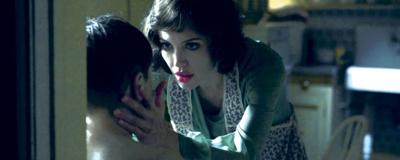
Behold the power of Spike Lee to get under people’s skin! By some unaccountable phenomena, Clint Eastwood’s Changeling resembles a Spike Lee movie. It starts with a simple premise: Single mother Christine Collins (Angelina Jolie) asks police to find her pre-teen son gone missing in 1928 Los Angeles. Then, like Lee, Eastwood piles on extraneous, subplots: a corrupt police force (“The Gun Squad”) manipulating Christine’s misfortune; her exploitation by both the rabid media and opportunistic radio evangelist Rev. Gustav Briegleb (John Malkovich); bogus psychiatry practiced by a shrink (Dennis O’Hare) who terrorizes her in a mental institution. Plus, Eastwood’s usual film-noir extravagances: His favorite hues are green and darkness. The only red in the film is Jolie’s 3-D lipstick.
For these reasons, Changeling isn’t suspenseful: It’s creepy. Lacking the historical veracity of De Palma’s Black Dahlia, its style is a bizarre form of old-school storytelling, mixing masochistic dread with ugly reportage. The opening credit, “A True Story,” is a bad omen. Fact and fiction are tools that Eastwood uses, like Lee, for a shrewd form of demography. Critic Gregory Solman once suggested that Eastwood works both sides of the aisle: Jolie plays a pre-feminist martyr surrounded by men who represent both conservative repression (the cops) and sentimentality (the Rev.). Eastwood also throws in serial killer episodes that lapse into gruesome pedophilia– including a set of child performances that are the least convincing since Jake Lloyd in The Phantom Menace.
Also like Lee, Eastwood has a knack for appealing to spurious cultural fears. Changeling (with its sub-Chinatown score) teases the contemporary appetite for dark cynicism. Instead of celebrating mother love, the movie indulges nihilism (“Our protectors have become our brutalizers,” Malkovich warns). Changeling doesn’t explore post-WWI culture, yet J. Michael Straczynski’s contrived script distorts pre-Depression-era gloom into timely horror. The psycho ward alibi– Extraordinary steps were necessary”– is Eastwood’s nod toward Gitmo.
You’d have to be a tabloid addict to fall for Jolie’s lousy lead performance. She initially evokes the emotional purity of silent-movie icon like Lillian Gish: Employed as a phone company supervisor, Christine dutifully tends circumscribed female phone operators or hovers over her child with maternal dedication. Then Eastwood puts on the screws and Jolie goes limp: She slouches, looks forlorn courtesy of eye shadow and droopy hats and speaks in a weak, anguished voice. Refusing to challenge society like Meryl Streep’s intransigent bereaved mother in A Cry in the Dark, Jolie goes for pity.
She makes Christine another sentimentalized woman with no family or friends for consul (like Frozen River, Ballast). During the tacked-on serial killer trial, Christine becomes St. Angelina and Lady Vengeance– Jolie also plays both sides of the aisle. Eastwood-Jolie fans are suckers if they mistake Changeling’s B-movie triteness for richly revived Hollywood classicism. Changeling isn’t just a mess of manipulative attitudes like a Spike Lee film; above all, it’s an extremely unpleasant experience.
CHANGELING (2) Directed by Clint Eastwood. • Starring Angelina Jolie, John Malkovich and Dennis O’Hare. • R, 140 min. • At Century Cinemas Del Monte Center, Lighthouse Cinemas, Maya Cinemas, Northridge Cinemas.
(0) comments
Welcome to the discussion.
Log In
Keep it Clean. Please avoid obscene, vulgar, lewd, racist or sexually-oriented language.
PLEASE TURN OFF YOUR CAPS LOCK.
Don't Threaten. Threats of harming another person will not be tolerated.
Be Truthful. Don't knowingly lie about anyone or anything.
Be Nice. No racism, sexism or any sort of -ism that is degrading to another person.
Be Proactive. Use the 'Report' link on each comment to let us know of abusive posts.
Share with Us. We'd love to hear eyewitness accounts, the history behind an article.