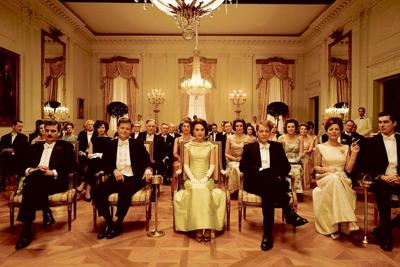
Jackie takes place in the days after Jacqueline Bouvier Kennedy’s husband, President John F. Kennedy, was assassinated in 1963. The time was inscrutably painful, dealing with loss, but also funeral arrangements and the establishment of her husband’s legacy.
The movie’s content pivots on an interview Jackie (Natalie Portman) gives to a journalist (Billy Crudup) at her Hyannis Port, Massachusetts, home, loosely inspired by a real interview she gave to Life magazine’s Theodore H. White. Flashbacks show her giving a tour of the White House in 1961, and are intercut with her actions immediately following the assassination – at the hospital, on Air Force One coming home, telling her children their father is dead. Jackie reveals enough trauma to get White to trust her (“I tried to hold his head together,” she says), and then skillfully frames her husband’s “Camelot” legacy. A cynic might say coercing the journalist was a brilliant piece of manipulation, whereas an optimist (or sentimentalist?) will believe this was born out of the grief of a heartbroken widow.
As seen in Jackie, the most difficult task Jackie Kennedy took on prior to this was renovating the White House. Now her world is upside down, and in spite of her searing heartbreak she’s still exposed to the public eye and political maneuvering. One of the best things about director Pablo Larraín’s (No) film is its curiosity: Larraín wants to show us who Jackie was. It answers many of the questions we’ve naturally had for the past 50-plus years, and is endlessly intriguing because of it.
That said, it’s tough to say how much of Jackie is true. Noah Oppenheim (Allegiant) wrote an original screenplay for what we see here, meaning it’s not adapted from previously published material. Oppenheim extensively researched archival materials and footage, which means at least the broad strokes are true, if not entirely accurate. For example, it’s known that Jackie asked for books about Abraham Lincoln’s funeral from the Library of Congress. But there are scenes in which Jackie speaks with a priest (John Hurt), and there are no records that indicate this conversation occurred, nor is there a way to know what Jackie may have said to Bobby Kennedy (Peter Sarsgaard) in private as they both grieved.
Portman is superb in capturing Jackie’s walk, talk and essence. It’s a difficult performance. If only Portman’s performance came in a better overall movie. Like its title character, Jackie is a bit scattered. For many, as it was for me, Portman’s performance will be enough.
Jackie (3) • Directed by Pablo Larraín • Starring Natalie Portman, Peter Sarsgaard, Greta Gerwig • Rated R • 100 min. • At Osio Theater
(0) comments
Welcome to the discussion.
Log In
Keep it Clean. Please avoid obscene, vulgar, lewd, racist or sexually-oriented language.
PLEASE TURN OFF YOUR CAPS LOCK.
Don't Threaten. Threats of harming another person will not be tolerated.
Be Truthful. Don't knowingly lie about anyone or anything.
Be Nice. No racism, sexism or any sort of -ism that is degrading to another person.
Be Proactive. Use the 'Report' link on each comment to let us know of abusive posts.
Share with Us. We'd love to hear eyewitness accounts, the history behind an article.