It is a reassuring thing to see a director so synonymous with big budgets and technical effects paring back and making a film with the strong writing and layered themes of the best independent cinema.
William Friedkin, whose name is synonymous with knife-edge tension in The French Connection (1971) and The Exorcist (1973), has taken a different but welcome path in his adaptation of Tracy Letts’ off-Broadway play, Bug. With some superficial resemblance to the it-came-from-within possession theme of The Exorcist and a similarly creepy ambiance, Bug suggests a tweaker’s version of a long tradition of American conspiracy cinema from The Manchurian Candidate (1962) and The Conversation (1974) and Richard Linklater’s more recent A Scanner Darkly (2006).
There are mysterious, nefarious institutional forces evoked in the end-of-the-line claustrophobia of Bug. In an arresting opening helicopter shot of a small Oklahoma motel glowing like a beacon in a great expanse of nowhere, Friedkin suggests the theme of surveillance, both real and imagined, that infests his new film.
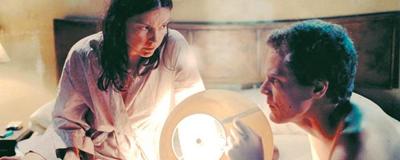
Agnes (Ashley Judd) is a grief-plagued resident of that grotty Rustic Motel, beside herself with anxiety over the imminent release of her abusive ex-con husband, Jerry (Harry Connick Jr.), from a two-year prison stint. A waitress who spends her off hours either lapping up or shopping for alcohol, Agnes is a woman who might welcome the peace that obliteration brings. Her salvation and doom—rolled up into one sinewy package—arrives in the form of a vulnerable, quiet man named Peter (Michael Shannon), introduced by her gay friend R.C. (Lynn Collins) as a possible salve to her loneliness.
In a film as much about real need as imagined threat, Peter could be the cure for Agnes’ long-buried grief over losing her six year-old son years before. Though Peter proclaims that women are not his thing, Agnes’ pain appears to have an aphrodisiacal effect. In a Cronenberg-creepy sex scene complete with close-ups of microscopic activity and a bug erupting from a cocoon, the pair trades saliva, sweat and other fluids. In the afterglow, Peter shares a little more of himself, delivering the news that he is the victim of a nefarious plot. As a soldier in the Middle East, Peter tells Agnes, he was infested with a bug as part of a government-conducted medical experiment. That infestation, whether genuine or imagined, becomes the foundation of their relationship, among the fly strips, cans of bug spray and the bug zappers that begin to dominate their grim domicile.
Onstage, Letts’ play skitters and burrows with a number of metaphorical possibilities for his bugs: the consuming potential of grief and loneliness, as well as drug addiction, mental illness, government conspiracy, domestic violence, environmental pollution, obsessive love.
Onscreen, in Friedkin’s hands, some of the clammy claustrophobia of a set-bound production is missing. Part of the play’s skin-crawling effects came from a sense of being trapped in the airless drug- and drink-fueled paranoia of its protagonists. But a refusal to dwell too long on drug use or the wall-to-wall nudity that gave Peter his victimized vulnerability and the play its visceral impact are indicative of Friedkin’s larger timidity of tone.
On one hand a welcome scaling back of Friedkin’s creative self-indulgence, Bug is also in some ways a reminder that film’s arsenal of effects—bigger actors, bigger budgets and better effects—do not always trump the theater’s power of suggestion. Friedkin’s handling of the material feels tentative and lukewarm.
One of the film’s biggest weaknesses may be a cast of actors who often work well in individual moments but never summon up the co-dependent mixture of grief and paranoia required. Having her Monster moment with a face stripped of makeup and a wardrobe of unflattering jeans and tank tops, Ashley Judd gives a noble stab at overcoming a film career seemingly reduced to middling thriller dreck not long after her breakout performance in 1993’s Ruby in Paradise. But with her emotional energy fading in and out as often as her Southern accent (curious, considering her Kentucky roots), she never convincingly occupies either Agnes’ party-girl toughness or her bone-deep grief.
Reprising his highly praised run in Letts’ theatrical production, Michael Shannon is an appealingly iconoclastic lead with a walleyed expression that suits the subject matter and a lonesome quality that explains Agnes’ investment in even his wildest delusions.
As the bruiser ex whose nasty reputation precedes him, Harry Connick’s one-note turn as Jerry doesn’t live up to the hype. Even with pumped-up deltoids and nipples straining from a skintight Stanley Kowalski T-shirt, Connick fails to convey the menace that would make a sensitive paranoid like Peter look like a knight in shining armor by comparison.
Admirable in its low-fi ambitions but disappointing in its final effect, Bug may nevertheless signal the renewed vigor of Friedkin to material worthy of his talent.
BUG ( * * ½ )
Directed by William Friedkin. • Starring Ashley Judd, Michael Shannon and Harry Connick Jr. • R, 105 min. • At the Maya Cinemas, Osio Cinemas.
(0) comments
Welcome to the discussion.
Log In
Keep it Clean. Please avoid obscene, vulgar, lewd, racist or sexually-oriented language.
PLEASE TURN OFF YOUR CAPS LOCK.
Don't Threaten. Threats of harming another person will not be tolerated.
Be Truthful. Don't knowingly lie about anyone or anything.
Be Nice. No racism, sexism or any sort of -ism that is degrading to another person.
Be Proactive. Use the 'Report' link on each comment to let us know of abusive posts.
Share with Us. We'd love to hear eyewitness accounts, the history behind an article.